


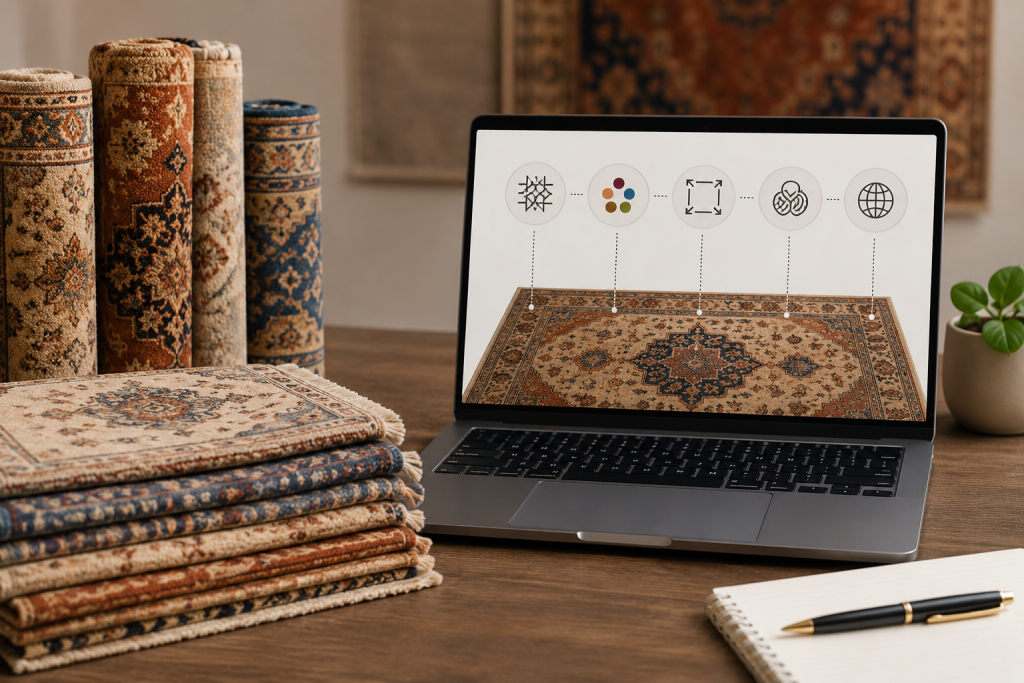
A rug may look simple to a shopper at first. They see a color, a pattern, a size, and maybe a price. But behind every successful rug e-commerce website, showroom inventory system, and product feed, there is a much deeper structure. That structure is called a product taxonomy.
For rug businesses, product taxonomy is not just a technical website detail. It affects how customers browse, how Google understands your website, how product filters work, how internal links pass value, how ads are organized, and how easily a buyer can move from interest to purchase.
If a rug website has poor categories, visitors may feel lost. They may not know whether to browse by style, material, size, room, origin, or construction. Search engines may also struggle to understand the relationship between product pages, collection pages, and educational content. But when rugs are categorized correctly, the entire website becomes easier to use, easier to rank, and easier to scale.
This is especially important for rug stores, galleries, wholesalers, and online rug retailers that manage hundreds or thousands of products. A strong taxonomy can turn a confusing inventory into a clear buying journey.
For rug businesses that want long-term organic growth, taxonomy should be connected with website design, SEO, content, and conversion strategy. That is why a structured digital marketing strategy for rug businesses should always look at how product categories are built, named, linked, and optimized.
What Is a Product Taxonomy?
A product taxonomy is the system used to organize products into categories, subcategories, attributes, and filters. In simple terms, it is the way a website groups products so customers and search engines can understand them.
For a rug business, taxonomy may include broad categories such as area rugs, Persian rugs, Oriental rugs, modern rugs, wool rugs, hand-knotted rugs, runner rugs, and outdoor rugs. It may also include more specific attributes such as size, color, material, origin, weave type, room use, pile height, shape, age, condition, and price range.
A good taxonomy answers important customer questions before they even ask them. What type of rug is this? Where can it be used? What is it made from? What style does it match? What size is available? Is it handmade or machine-made? Is it new, vintage, antique, or custom?
For rug e-commerce, taxonomy is the foundation of product discovery. If a customer cannot quickly narrow down a large catalog, they may leave the site. If Google cannot understand the category structure, important collection pages may struggle to rank.
This is why taxonomy should not be treated as a random menu structure. It should be planned around buyer intent, search demand, product inventory, and business goals.
Why Rug Taxonomy Matters for SEO
Rug taxonomy plays a major role in SEO because category pages often target high-value keywords. A single rug product page may rank for a very specific product name, but a category page can rank for broader commercial searches such as “Persian rugs,” “wool area rugs,” “8×10 rugs,” “hand-knotted rugs,” or “modern rugs for living room.”
When category pages are organized well, Google can better understand the topical structure of the website. For example, a main category page for “Persian Rugs” may link to subcategories for “Vintage Persian Rugs,” “Hand-Knotted Persian Rugs,” “Persian Runner Rugs,” and “Persian Rugs by Size.” This creates a clear hierarchy.
Internal linking also becomes stronger when taxonomy is clear. Blog articles can naturally link to relevant category pages, service pages, and educational guides. Product pages can link back to parent categories. Related categories can support each other. This helps users and search engines move through the site more easily.
Danabak has already explained the value of this approach in its guide on how internal linking helps rug website rankings. Product taxonomy and internal linking work together because categories provide the structure, while links help search engines understand importance and relationships.
A weak taxonomy can create duplicate pages, thin category pages, confusing URLs, and poor crawl efficiency. A strong taxonomy can help build topical authority and improve rankings across product, collection, and blog pages.
Why Rug Taxonomy Matters for User Experience
SEO is important, but taxonomy should first serve the visitor. Rug buyers often have different levels of knowledge. Some shoppers know exactly what they want. Others only know they need something for a room.
One buyer may search for “8×10 wool rug.” Another may search for “rug for living room.” Another may look for “Persian rug with blue pattern.” Another may simply browse by style until something feels right.
A good taxonomy supports all of these buying paths.
If the website only organizes rugs by origin, a customer who wants a bedroom rug may struggle. If the website only organizes rugs by room, a collector looking for antique Persian pieces may feel underserved. If the website only organizes by style, a practical shopper looking for a washable runner may leave.
The best rug taxonomies combine category hierarchy with flexible filtering. This allows different users to shop in different ways. A knowledgeable rug buyer can browse by construction, origin, or age. A home decor shopper can browse by room, color, size, or style. A designer can browse by material, pattern, size, and availability.
This is where website design becomes critical. Rug taxonomy should not only exist in the backend. It should be visible in navigation, collection pages, filters, breadcrumbs, product cards, and internal links. A strong rug e-commerce website makes the taxonomy feel natural instead of overwhelming.
Main Ways Rugs Are Categorized
Rugs can be categorized in many ways. The right structure depends on the business model, product range, and customer behavior. A luxury rug gallery may categorize differently than a mass-market online rug store. A wholesale supplier may need trade-focused categories. A local showroom may need location and service-based browsing.
Still, most rug taxonomies are built around several core classification systems. These include product type, construction, material, origin, style, size, shape, color, pattern, room, age, condition, price, and availability.
Each category type helps answer a different buyer question.
| Taxonomy Type | Customer Question It Answers |
|---|---|
| Product Type | What kind of rug is it? |
| Construction | How was it made? |
| Material | What is it made from? |
| Origin | Where does it come from? |
| Style | What design look does it have? |
| Size | Will it fit my room? |
| Shape | What layout does it suit? |
| Color | Does it match my decor? |
| Pattern | What visual design does it feature? |
| Room | Where can I use it? |
| Age | Is it new, vintage, or antique? |
| Condition | What is its quality status? |
| Price | Does it fit my budget? |
| Availability | Can I buy it now? |
A complete taxonomy does not always need all of these as main categories. Some should be top-level categories, while others should work better as filters or product attributes. The key is knowing which ones deserve their own landing pages and which ones should remain as filtering options.
Categorizing Rugs by Product Type
Product type is one of the most common ways to organize rugs. This is often the first level of taxonomy because it helps shoppers quickly understand what kind of rug they are browsing.
Common rug product types include area rugs, runner rugs, round rugs, hallway rugs, stair runners, outdoor rugs, accent rugs, custom rugs, wall rugs, and rug pads. For some businesses, product type may also include rug-related services such as rug cleaning, rug repair, rug appraisal, and rug restoration.
Product type categories are useful because they match common search behavior. Many shoppers do not start with technical rug terms. They search for practical product types such as “runner rugs,” “large area rugs,” or “outdoor rugs.”
For e-commerce websites, product type categories are often strong SEO landing pages. A page for “Area Rugs” can introduce all area rugs, then link to subcategories such as wool area rugs, modern area rugs, Persian area rugs, and 8×10 area rugs.
A local showroom may use product type differently. Instead of building a huge e-commerce catalog, it may create pages around product categories that bring local visitors, such as “Persian rugs in Charlotte,” “custom rugs in Charlotte,” or “runner rugs near me.”
Danabak’s guide on rug store near me local SEO explains why local intent matters when creating pages for rug buyers who are looking nearby.
Categorizing Rugs by Construction
Construction is one of the most important rug taxonomy layers because it explains how a rug is made. It also affects quality, price, durability, texture, and buyer expectations.
Common construction categories include hand-knotted rugs, hand-tufted rugs, handwoven rugs, flatweave rugs, machine-made rugs, braided rugs, hooked rugs, and loomed rugs.
For higher-end rug businesses, construction should be a major taxonomy element. A buyer looking for a hand-knotted rug usually has different expectations than someone looking for a machine-made area rug. The price range, value, durability, and buying journey can be very different.
Hand-knotted rugs often deserve their own category page because they carry strong commercial and educational value. Customers may want to understand why they cost more, how they are made, and how to identify quality. Machine-made rugs may also deserve a category page for shoppers looking for affordability, consistency, or modern styles.
Flatweave rugs, such as kilims and dhurries, may be categorized under construction, style, or origin depending on the website. This is where taxonomy can become complex. A kilim can be a flatweave rug, a tribal rug, a vintage rug, and a decorative room rug at the same time.
This is why the main category should be chosen carefully, while secondary attributes should support filtering and internal linking.
Categorizing Rugs by Material
Material is another major taxonomy layer because it affects feel, durability, care, price, and buyer preference. Rug materials can include wool, silk, cotton, jute, sisal, polypropylene, polyester, viscose, bamboo silk, nylon, leather, and blends.
Wool rugs are often one of the most valuable material-based categories because many buyers search for them directly. Wool is associated with durability, natural texture, and long-term use. Silk rugs, on the other hand, often belong to a more luxury-focused taxonomy because they are associated with fine detail, sheen, and high-end craftsmanship.
Natural fiber rugs such as jute and sisal may appeal to shoppers looking for casual, organic, or coastal interiors. Synthetic rugs may appeal to buyers looking for affordability, easy maintenance, or outdoor use.
Material categories can be very helpful for both SEO and filtering. However, a website should avoid creating too many thin material pages unless there is enough product inventory and content to support them.
For example, “Wool Rugs” may deserve a full SEO landing page. But “Cotton Blend Beige Transitional Runner Rugs” may be better as a filtered view rather than a separate indexable category page.
The goal is to create pages that are useful enough to rank and convert.
Categorizing Rugs by Origin
Origin is especially important for traditional, handmade, antique, and collectible rugs. Many buyers search for rugs based on where they were made or the weaving tradition they represent.
Common origin categories may include Persian rugs, Turkish rugs, Moroccan rugs, Afghan rugs, Indian rugs, Pakistani rugs, Chinese rugs, Caucasian rugs, Tibetan rugs, Nepalese rugs, and European rugs.
Origin-based categories can be powerful for SEO because many rug search terms include place names. “Persian rugs,” “Moroccan rugs,” “Turkish rugs,” and “Afghan rugs” are not just descriptive labels. They represent strong search intent and cultural design recognition.
However, origin categories need careful handling. Not every rug with a Persian-inspired design is an authentic Persian rug. Not every Moroccan-style rug is actually made in Morocco. A clear taxonomy should separate true origin from design inspiration.
For example, a website may use “Persian Rugs” for authentic Persian-origin rugs and “Persian-Style Rugs” for rugs inspired by Persian patterns. This helps avoid confusing customers and improves trust.
Trust is important in rug marketing because rug buyers often care about authenticity, value, and craftsmanship. A clear taxonomy can help communicate this honestly.
Categorizing Rugs by Style
Style is one of the most shopper-friendly ways to categorize rugs because many customers shop based on interior design preferences. Style categories help buyers find rugs that match their home, office, showroom, or design project.
Common rug style categories include traditional rugs, modern rugs, contemporary rugs, transitional rugs, vintage rugs, bohemian rugs, tribal rugs, farmhouse rugs, coastal rugs, minimalist rugs, Scandinavian rugs, rustic rugs, abstract rugs, and luxury rugs.
Style categories are powerful because they connect rug inventory with how people imagine their space. A customer may not know whether they want a hand-knotted wool rug from a specific region, but they may know they want a modern rug for a neutral living room.
For SEO, style-based categories can attract high-intent searches. Terms like “modern rugs,” “vintage rugs,” “boho rugs,” and “traditional rugs” are common ways buyers search online.
Style also works well with content marketing. A blog can explain how to choose a rug style for a room and then link naturally to product categories. Danabak’s article on storytelling with rugs and content marketing ideas for retailers is a good example of how rug businesses can use stories and style education to support product discovery.
Categorizing Rugs by Size
Size is one of the most practical rug taxonomy elements. Many rug buyers begin with size because they need the rug to fit a room, hallway, dining table, bedroom, entryway, or seating area.
Common size categories include 2×3 rugs, 3×5 rugs, 4×6 rugs, 5×8 rugs, 6×9 rugs, 8×10 rugs, 9×12 rugs, 10×14 rugs, oversized rugs, runner rugs, and custom-size rugs.
Size-based taxonomy is especially important for e-commerce because shoppers often filter by size before they look at style or material. A buyer who needs an 8×10 rug may not want to browse hundreds of products that are too small or too large.
However, size pages should be planned carefully. Some size categories have strong search demand and deserve indexable pages. Others may be better as filters. For example, “8×10 rugs” or “9×12 rugs” may deserve category pages if inventory is large enough. But highly specific combinations may create too many low-value pages.
A strong rug taxonomy often uses size as a filter, while creating SEO landing pages only for the most commercially important size groups.
Categorizing Rugs by Shape
Shape is closely related to size, but it serves a different purpose. Shape helps buyers imagine how a rug will fit the layout of a room.
Common rug shapes include rectangular rugs, round rugs, square rugs, oval rugs, runner rugs, octagon rugs, animal hide rugs, and custom-shaped rugs.
Rectangular rugs are usually the default and may not always need their own main category. Round rugs, runner rugs, and custom-shaped rugs often deserve stronger visibility because they match specific layout needs.
For example, a round rug may be used under a round dining table, in an entryway, or in a small seating area. A runner rug may be used in a hallway, kitchen, staircase, or narrow room. These use cases can support SEO content and product filtering.
Shape can also be combined with room-based taxonomy. A page about hallway runners can link to runner rugs, while a guide about dining room rug sizing can link to round and rectangular dining room rugs.
This creates a more helpful user experience than simply listing shapes with no context.
Categorizing Rugs by Color
Color is one of the most important visual decision factors in rug shopping. Buyers often search by color because they are trying to match furniture, walls, flooring, curtains, or a room theme.
Common color categories include blue rugs, red rugs, beige rugs, ivory rugs, black rugs, grey rugs, green rugs, brown rugs, gold rugs, navy rugs, pink rugs, white rugs, and multicolor rugs.
Color-based categories are especially useful for e-commerce and visual browsing. They also work well with image search and social media promotion because rugs are highly visual.
However, color taxonomy can become messy if it is not standardized. One product may be described as ivory, cream, beige, off-white, or natural. Another may be blue, navy, indigo, or teal. If color terms are inconsistent, filters become less useful.
A rug website should use a controlled color vocabulary. This means choosing standard color labels and applying them consistently across products. Additional color details can be added in product descriptions, but the main filter values should stay clean.
Color categories can also be combined with style and material. For example, “blue Persian rugs,” “neutral wool rugs,” and “red traditional rugs” may be valuable pages if there is enough inventory and search demand.
Categorizing Rugs by Pattern
Pattern is an important taxonomy layer because it describes the visual design of a rug. Some buyers search for specific patterns, while others use pattern as a way to narrow down style.
Common pattern categories include floral rugs, geometric rugs, medallion rugs, striped rugs, abstract rugs, animal print rugs, border rugs, tribal rugs, lattice rugs, all-over pattern rugs, solid rugs, distressed rugs, and pictorial rugs.
Pattern can overlap with style. For example, a geometric rug may be modern, tribal, Moroccan, or flatweave. A floral rug may be traditional, Persian, vintage, or transitional. This overlap is normal, but the taxonomy must handle it clearly.
Pattern is often best used as a filter rather than a main navigation category, unless the website has strong inventory and search demand around specific patterns. For rug galleries and luxury sellers, pattern education can also be part of content marketing.
A blog explaining rug patterns can link to related collections and product pages. This can help customers understand the meaning, history, and design value of different rugs before they buy.
Categorizing Rugs by Room
Room-based taxonomy is one of the most customer-friendly ways to organize rugs because many shoppers think in terms of where the rug will go.
Common room categories include living room rugs, bedroom rugs, dining room rugs, kitchen rugs, hallway rugs, entryway rugs, office rugs, nursery rugs, outdoor patio rugs, and bathroom rugs.
This approach works well for buyers who are not rug experts. They may not know construction, origin, or pattern names, but they know they need a rug for a living room.
Room-based taxonomy also supports helpful content. A rug store can create guides such as “How to Choose a Living Room Rug,” “Best Rugs for Dining Rooms,” or “What Size Rug Works Under a King Bed?” These articles can naturally link to room-based categories.
For local rug showrooms, room-based categories can also support showroom consultations. A customer may browse living room rug ideas online, then book an appointment to see options in person.
The key is to make room-based pages genuinely helpful. They should not simply show products. They should explain size guidance, material considerations, cleaning needs, layout tips, and style suggestions.
Categorizing Rugs by Age
Age is especially important for antique, vintage, and collectible rug businesses. Buyers in this market often care about age because it affects value, rarity, condition, and design character.
Common age categories include new rugs, vintage rugs, antique rugs, semi-antique rugs, old rugs, and reproduction rugs.
Age categories require clear definitions. Different sellers may use terms differently, so transparency matters. A customer should understand what the business means by vintage or antique. This builds trust and reduces confusion.
Vintage rugs often appeal to buyers looking for character, softened colors, and one-of-a-kind style. Antique rugs may appeal to collectors, designers, and buyers who value history and craftsmanship. New rugs may appeal to shoppers looking for current sizes, easier availability, or custom options.
Age-based taxonomy works especially well when combined with origin, style, and construction. For example, “vintage Persian rugs,” “antique Turkish rugs,” or “new hand-knotted wool rugs” may be meaningful categories for the right business.
Categorizing Rugs by Condition
Condition matters most for vintage, antique, handmade, and one-of-a-kind rugs. It may not be a top-level category for every rug website, but it should be part of the product data.
Condition labels may include new, excellent, very good, good, fair, worn, distressed, restored, repaired, overdyed, washed, and damaged.
For SEO, condition may not always be a major category. But for conversion, it is very important. Customers need honest details before buying higher-value rugs online. If a rug has wear, repairs, fading, or restoration, the product page should clearly explain it.
Condition also helps internal operations. It affects pricing, photography, sales descriptions, shipping expectations, and customer service.
For a rug business, honesty about condition can improve trust. It is better to explain wear clearly than to create disappointed buyers. This is especially important for businesses selling antique or vintage rugs online.
Categorizing Rugs by Price
Price-based taxonomy helps buyers browse within budget. It is usually used as a filter rather than a main category, but some websites create landing pages for budget ranges.
Examples may include rugs under $500, rugs under $1,000, luxury rugs, designer rugs, investment rugs, and sale rugs.
Price filters are practical because rug prices can vary widely. A machine-made area rug may cost far less than a hand-knotted antique Persian rug. Without price filtering, customers may waste time browsing products outside their budget.
However, price-based pages should be used carefully for SEO. “Rugs under $500” may be useful for some retailers, but luxury rug businesses may not want to position themselves around budget terms. A high-end gallery may prefer categories such as “Luxury Rugs,” “Collector Rugs,” or “Designer Rugs.”
The taxonomy should match the brand. A discount-focused taxonomy may hurt a premium rug brand if used incorrectly.
Categorizing Rugs by Availability
Availability is a practical taxonomy element that affects conversion and customer satisfaction. It includes whether a rug is in stock, made to order, custom, backordered, sold, available for showroom viewing, or available online only.
For one-of-a-kind rug businesses, availability is especially important. If a rug is sold, the page may still have SEO or portfolio value, but the site should clearly communicate that it is no longer available. The page may also recommend similar rugs.
Availability can also support local showroom experiences. A rug may be available in a specific showroom, warehouse, or city. If the business has multiple locations, inventory taxonomy should help customers understand where a product can be seen.
For online stores, availability filters should be simple. Buyers should be able to show only in-stock rugs if they want to purchase quickly.
Categorizing Rugs by Brand or Collection
Some rug businesses categorize products by brand, designer, collection, or manufacturer. This is common for retailers that carry multiple rug brands or designer collections.
Collection-based taxonomy works well when buyers recognize the brand or collection name. It also helps organize marketing campaigns, seasonal launches, and email promotions.
For handmade or one-of-a-kind rug businesses, collection categories may be created around themes instead of brands. Examples include tribal collection, neutral collection, vintage collection, designer picks, new arrivals, showroom favorites, or artisan collection.
Collection pages can be strong merchandising tools. They can tell a story and guide customers toward a curated buying experience. This is useful because rug buyers often appreciate context and design inspiration.
A collection page should include more than a product grid. It should explain what makes the collection unique, who it is best for, and how customers can use the rugs in real spaces.
Categorizing Rugs by Use Case
Use-case taxonomy organizes rugs around practical customer needs. This can be very effective because it matches how many buyers think.
Examples include pet-friendly rugs, high-traffic rugs, washable rugs, outdoor rugs, kid-friendly rugs, luxury living room rugs, office rugs, entryway rugs, and rugs for hardwood floors.
Use-case categories can help buyers make decisions faster. Instead of forcing them to understand technical rug features, the website helps them solve a problem.
For SEO, use-case pages can target long-tail keywords with strong buyer intent. A customer searching for “best rug for high traffic hallway” or “pet friendly area rugs” has a clear need.
Use-case categories also work well with educational content. A blog post can explain what makes a rug good for high-traffic areas and then link to relevant collections.
This approach is especially helpful for rug businesses that serve homeowners, designers, families, and commercial spaces.
Categorizing Rugs by Design Era
For vintage, antique, and high-end rug businesses, design era can be another useful taxonomy layer. This may include antique, vintage, mid-century, modern, contemporary, traditional, classic, Art Deco, or revival styles.
Design era helps customers who are shopping with a specific interior design period in mind. It also helps designers who source rugs for curated spaces.
However, era-based taxonomy requires expertise. A website should avoid using terms casually if they are not accurate. Mislabeling a rug as Art Deco, antique, or mid-century can create trust issues.
For rug businesses with expert knowledge, era-based content can support authority. It can help the website rank for educational searches and build confidence among serious buyers.
Categorizing Rugs by Cultural or Weaving Tradition
Many rugs are connected to specific weaving traditions. This can include Persian, Turkish, Caucasian, Moroccan, Navajo-inspired, Tibetan, Afghan, Indian, Pakistani, and other traditions.
This taxonomy layer should be used carefully and respectfully. It should reflect accurate product knowledge and avoid treating cultural labels as simple decoration.
For authentic rugs, cultural taxonomy can help customers understand origin, technique, symbolism, and value. For inspired designs, the website should use clear terms such as “Moroccan-style” or “Persian-inspired” if the rug is not actually from that origin.
This distinction protects trust and helps buyers make informed decisions.
Top-Level Categories vs Filters
One of the biggest taxonomy decisions is deciding what should be a top-level category and what should be a filter.
Top-level categories are usually important enough to appear in the main navigation or collection structure. Filters help customers narrow down products within categories.
For example, a rug website may use these top-level categories:
| Top-Level Category | Possible Filters |
|---|---|
| Persian Rugs | Size, color, material, age, condition |
| Modern Rugs | Size, color, pattern, material, room |
| Wool Rugs | Size, style, color, construction |
| Runner Rugs | Length, color, material, room |
| Vintage Rugs | Origin, size, color, condition |
| Outdoor Rugs | Size, color, material, shape |
If every attribute becomes a top-level category, the website becomes confusing. If everything is only a filter, the website may miss important SEO opportunities.
The best approach is to make top-level categories based on search demand, inventory size, business priorities, and buyer behavior. Filters should support browsing without creating unnecessary thin pages.
How Taxonomy Affects URL Structure
Product taxonomy often affects URL structure. URLs should be clean, readable, and logical.
A simple URL structure may look like this:
/rugs/persian-rugs//rugs/wool-rugs//rugs/runner-rugs//rugs/vintage-rugs/
For product pages, the structure may include the category or may use a shorter product URL depending on the platform and SEO strategy.
A clean URL helps users and search engines understand the page topic. However, rug businesses should avoid creating overly deep URLs with too many layers.
For example, a URL like /rugs/persian/hand-knotted/wool/blue/8x10/living-room/ may be too complex. It can create duplicate versions of similar pages and make the site harder to manage.
Instead, the website can use a main category URL and allow filters to refine the results without indexing every possible combination.
This is especially important for large rug catalogs. Poor filter handling can create thousands of low-quality crawlable URLs.
How Taxonomy Affects Navigation
Navigation is where taxonomy becomes visible to users. A good rug website should make it easy for visitors to choose their preferred browsing path.
A customer may want to shop by style, size, room, material, or origin. The navigation should reflect the most common and valuable paths.
For example, the main menu may include:
- Shop by Style
- Shop by Size
- Shop by Material
- Shop by Room
- Shop by Origin
- New Arrivals
- Sale
- Custom Rugs
This type of navigation helps different buyers find their way quickly.
However, too many menu items can overwhelm visitors. The best navigation is clear, not crowded. It should guide shoppers without forcing them to think too much.
For local rug showrooms, navigation should also include location-based pages, appointment booking, services, and contact information. A buyer who wants to visit a showroom should not have to search for the address or phone number.
How Taxonomy Affects Product Filters
Filters are one of the most important parts of rug e-commerce. Because rugs vary by size, color, shape, style, material, and price, customers need filters to narrow the catalog.
Good filters should be easy to understand and relevant to the product category. For example, a “Runner Rugs” category should include filters for length, width, color, material, style, and price. A “Persian Rugs” category may include filters for size, color, age, city or region, material, construction, and condition.
Filters should not include values that are irrelevant or empty. Empty filters create frustration. Too many filter options can also overwhelm users.
A good filter system should help customers move from broad interest to confident choice. It should feel like a guided shopping experience.
How Taxonomy Affects Product Titles
Product titles should reflect taxonomy in a natural way. They should include important product attributes without becoming keyword-stuffed.
A weak product title might be:
- “Beautiful Rug 1234”
- A stronger title might be:
- “Hand-Knotted Wool Persian Rug 8×10”
This title communicates construction, material, origin/style, and size. It helps the user and search engine understand the product quickly.
For luxury or one-of-a-kind rugs, product titles may also include design style, age, or region when accurate.
For example:
- “Vintage Turkish Oushak Wool Rug 6×9”
- “Hand-Knotted Antique Persian Heriz Rug 9×12”
- “Modern Abstract Wool Area Rug 8×10”
Product titles should be consistent across the website. If some titles use size first and others use style first, the catalog may feel messy. A standard title formula can improve clarity and SEO.
How Taxonomy Affects Product Descriptions
Product descriptions should expand on taxonomy details. If a rug is categorized as wool, hand-knotted, Persian, vintage, and blue, the description should explain what those attributes mean for the buyer.
A strong product description may discuss material feel, craftsmanship, design style, room placement, condition, and care. It should not simply repeat category labels.
For example, instead of saying “This is a blue wool rug,” the description can explain how the blue tones work in a living room, how wool supports durability, and why the construction matters.
This helps customers understand value. It also helps search engines understand the product more deeply.
Product descriptions should be unique whenever possible, especially for high-value rugs. Duplicate descriptions across many products can weaken SEO and reduce buyer confidence.
How Taxonomy Affects Image SEO
Rug websites depend heavily on images. Product taxonomy can improve image SEO when file names, alt text, captions, and surrounding content are aligned.
For example, an image of a hand-knotted Persian rug should not have a file name like IMG_3847.jpg. A better file name may include product attributes, such as hand-knotted-persian-wool-rug-blue-8x10.jpg.
Alt text should describe the image clearly. It should not be stuffed with keywords.
A helpful alt text might be:
- “Blue hand-knotted Persian wool rug displayed in a living room.”
- This tells both users and search engines what the image shows.
Danabak’s guide on alt text for rug images explains how better image descriptions can support on-page SEO for rug websites.
How Taxonomy Supports Internal Linking
A strong taxonomy creates natural internal linking opportunities. Category pages can link to subcategories. Blog posts can link to relevant product categories. Product pages can link back to parent categories. Related collections can link to each other.
For example, a blog about living room rug sizes can link to 8×10 rugs, 9×12 rugs, and living room rugs. A blog about handmade rugs can link to hand-knotted rugs, wool rugs, and Persian rugs.
This helps users discover more relevant pages. It also helps search engines understand which pages are important.
Internal linking is especially useful for rug businesses because many product pages may be deep in the site. Category and blog links can help search engines find and evaluate those pages.
A planned internal linking strategy can also support commercial pages. For example, educational content about rug marketing can naturally support Danabak’s SEO services and rug-specific service pages when the topic is relevant.
How Taxonomy Supports Google Ads
Product taxonomy is not only for SEO. It also affects Google Ads campaign structure.
A rug business with clean categories can create better ad groups, product feeds, landing pages, and campaign segments. For example, Google Ads campaigns may be organized around Persian rugs, modern rugs, runner rugs, wool rugs, or rug cleaning services.
If the taxonomy is messy, ads may send users to the wrong pages. This can hurt conversion rates and waste budget.
A strong taxonomy helps match ads to landing pages. If someone searches for “wool runner rugs,” the ad should send them to a page that clearly features wool runner rugs or a closely related category.
Danabak’s guide on Google Ads for rug stores explains why ad performance depends on more than budget. The landing page, product structure, and user journey matter too.
How Taxonomy Supports Meta Ads
Meta Ads depend heavily on visual browsing, product feeds, and audience targeting. A clean rug taxonomy helps create better product sets, retargeting campaigns, and creative themes.
For example, a rug business can create Meta campaigns around modern rugs, luxury rugs, new arrivals, vintage rugs, or living room rugs. Each campaign can use visuals that match the category.
Taxonomy also helps with retargeting. If someone browses Persian rugs, they can be shown related Persian rug products. If someone views outdoor rugs, they can receive outdoor rug ads instead of unrelated products.
This improves relevance and makes the customer journey smoother.
How Taxonomy Supports Email Marketing
Email marketing becomes more effective when products are categorized well. A rug store can send targeted emails based on customer interests, browsing behavior, purchase history, and product categories.
For example, a customer who browses vintage rugs may receive emails about new vintage arrivals. A designer who looks at oversized rugs may receive curated large-format rug collections. A customer who buys a runner may receive care tips or related hallway design ideas.
A strong taxonomy helps segment email lists and personalize campaigns. This can increase engagement and repeat purchases.
Danabak’s article on rug store email campaigns explains how email can keep rug buyers engaged after they visit the website.
How Taxonomy Supports Content Marketing
Content marketing and taxonomy should work together. Blog content can educate buyers, answer questions, and guide visitors toward relevant product categories.
For example, a blog about “How to Choose a Rug for a Living Room” can support the living room rugs category. A blog about “Wool vs Synthetic Rugs” can support wool rugs and synthetic rug collections. A guide about “Persian Rug Patterns” can support Persian rugs, traditional rugs, and antique rug categories.
This creates topical depth. Search engines can see that the website does not only sell products but also provides helpful information around those products.
Danabak’s guide on how rug businesses can use SEO to rank higher on Google explains why helpful content and product pages should work together.
Common Rug Taxonomy Mistakes
Many rug websites make taxonomy mistakes that hurt SEO and user experience. One common mistake is using too many categories without a clear hierarchy. This makes the site feel cluttered and confusing.
Another mistake is mixing different taxonomy types at the same level. For example, a menu that lists Persian rugs, blue rugs, wool rugs, living room rugs, sale rugs, and 8×10 rugs all as equal top-level categories may confuse users. These labels represent origin, color, material, room, promotion, and size. They may all be useful, but they should be organized properly.
A third mistake is creating too many thin pages. If every filter combination becomes an indexable page, the site may create hundreds or thousands of low-value URLs. This can waste crawl budget and weaken SEO.
Another mistake is inconsistent naming. A website should not use “Oriental rug,” “oriental rugs,” “traditional oriental carpets,” and “classic oriental area rugs” randomly for the same category. Consistent naming helps users and search engines.
Finally, many rug websites fail to write unique content for important category pages. A category page with only product thumbnails and no useful introduction may struggle to rank.
How to Build a Better Rug Taxonomy
Building a better rug taxonomy starts with understanding the products and the buyers. The business should review its inventory, search data, customer questions, sales history, and competitor structures.
The first step is to identify the main product groups. These are the categories that deserve top-level visibility. For many rug businesses, these may include Persian rugs, modern rugs, wool rugs, vintage rugs, runner rugs, area rugs, outdoor rugs, and custom rugs.
The second step is to define attributes. These may include size, color, material, style, construction, shape, room, price, and condition.
The third step is to decide which attributes should become SEO landing pages. Not every filter needs a page. Only categories with enough inventory, search demand, and business value should become indexable pages.
The fourth step is to create consistent naming rules. Decide how product titles, category names, filters, and descriptions should be written.
The fifth step is to connect taxonomy with internal linking. Important categories should receive links from navigation, blogs, related categories, and product pages.
The final step is ongoing improvement. Taxonomy should not be built once and forgotten. It should be reviewed as inventory grows, search behavior changes, and new product lines are added.
Example of a Simple Rug Taxonomy
A simple rug e-commerce taxonomy may look like this:
- Shop Rugs
- Area Rugs
- Runner Rugs
- Round Rugs
- Outdoor Rugs
- Vintage Rugs
- Persian Rugs
- Modern Rugs
- Wool Rugs
- Custom Rugs
Shop by Room
- Living Room Rugs
- Bedroom Rugs
- Dining Room Rugs
- Kitchen Rugs
- Hallway Rugs
- Office Rugs
Shop by Style
- Traditional Rugs
- Modern Rugs
- Bohemian Rugs
- Tribal Rugs
- Minimalist Rugs
- Transitional Rugs
Shop by Material
- Wool Rugs
- Silk Rugs
- Cotton Rugs
- Jute Rugs
- Synthetic Rugs
Shop by Size
- Small Rugs
- 5×8 Rugs
- 8×10 Rugs
- 9×12 Rugs
- Oversized Rugs
- Runner Rugs
This structure gives customers several ways to browse without making the navigation too technical.
Example of a Luxury Rug Gallery Taxonomy
A luxury rug gallery may need a more specialized taxonomy. The structure may focus more on origin, construction, age, and craftsmanship.
Main categories may include:
- Persian Rugs
- Turkish Rugs
- Moroccan Rugs
- Caucasian Rugs
- Antique Rugs
- Vintage Rugs
- Hand-Knotted Rugs
- Silk Rugs
- Wool Rugs
- Designer Rugs
- Oversized Rugs
- Collector Rugs
This type of taxonomy supports buyers who care about authenticity, origin, and quality. It may also support designers and collectors.
For this kind of business, category pages should include educational content, high-quality images, provenance details, and consultation options.
Example of a Local Rug Store Taxonomy
A local rug store may not need thousands of product pages. Instead, it may need strong local landing pages and service-based categories.
A local showroom taxonomy may include:
- Rug Store
- Persian Rugs
- Oriental Rugs
- Area Rugs
- Runner Rugs
- Custom Rugs
- Rug Cleaning
- Rug Repair
- Rug Appraisal
- Rug Pads
- Showroom Appointment
For local SEO, location pages and Google Maps visibility are also important. Danabak’s guide on how rug stores can rank in Google Maps explains how local visibility can support showroom traffic.
Example of a Rug Wholesaler Taxonomy
A rug wholesaler may categorize rugs differently because the target audience is retailers, designers, and trade buyers.
Wholesale taxonomy may include:
- Wholesale Area Rugs
- Hand-Knotted Rugs
- Machine-Made Rugs
- Bulk Rug Inventory
- Designer Collections
- New Arrivals
- Closeout Rugs
- Trade Program
- Rug Samples
- Private Label Rugs
Filters may include size, material, style, origin, minimum order quantity, price tier, and availability.
A wholesaler may also need taxonomy that supports B2B buyer journeys, downloadable catalogs, trade accounts, and inventory feeds.
Taxonomy for One-of-a-Kind Rugs
One-of-a-kind rugs create special taxonomy challenges. Each product is unique, and once it sells, the product may no longer be available.
For these businesses, category pages become even more important because product pages may come and go. A sold rug page may still attract traffic, but it should guide visitors to similar available rugs.
The taxonomy should help customers browse current inventory by style, size, origin, and color. It should also allow “similar rugs” recommendations based on shared attributes.
For example, if a sold rug was a vintage Turkish Oushak rug, the page can link to available vintage Turkish rugs or similar Oushak-style rugs.
This improves user experience and helps preserve SEO value.
Taxonomy for Custom Rugs
Custom rug businesses need a taxonomy that supports design choices rather than fixed inventory.
Categories may include:
- Custom Wool Rugs
- Custom Silk Rugs
- Custom Area Rugs
- Custom Runner Rugs
- Custom Size Rugs
- Custom Color Rugs
- Custom Pattern Rugs
- Commercial Custom Rugs
- Designer Custom Rugs
Filters may not work the same way as a standard catalog because products are made to order. Instead, the website may guide users through material, size, shape, color, pattern, and consultation steps.
Custom rug taxonomy should focus on the decision process. It should help customers understand what can be customized and how to start.
Taxonomy for Rug Services
Many rug businesses offer services in addition to products. These may include rug cleaning, rug repair, rug restoration, rug appraisal, rug padding, rug installation, and rug storage.
Service taxonomy should be separated from product taxonomy. A customer looking for rug cleaning has different intent than someone shopping for a Persian rug.
Service pages should include local keywords when relevant, clear descriptions, trust signals, service areas, FAQs, and calls to action.
For example, a local rug business may have separate pages for rug cleaning, rug repair, and rug appraisal. These pages can link to product categories where appropriate, but they should not be mixed confusingly into the shop navigation.
How Taxonomy Helps Rug Stores Rank in AI Search
AI search and answer engines are changing how customers discover businesses. Search systems increasingly look for clear entities, relationships, and structured information.
A strong taxonomy helps AI systems understand what the rug business sells, where it operates, what services it offers, and how categories relate to each other.
For example, if a website clearly organizes Persian rugs, hand-knotted rugs, wool rugs, rug cleaning, and rug repair, AI systems can better understand the business expertise.
Danabak’s article on how AI search is changing rug store SEO explains why clarity, structure, and helpful content are becoming more important for rug businesses.
Taxonomy supports this by making product and service relationships easier to understand.
How Taxonomy Helps Google Merchant and Product Feeds
For rug e-commerce websites using product feeds, taxonomy helps organize products for shopping campaigns and marketplace listings.
Product feeds need accurate titles, descriptions, images, product types, availability, pricing, and attributes. A clean internal taxonomy makes this easier to manage.
If product data is inconsistent, feed performance can suffer. For example, if some wool rugs are labeled “wool,” others “natural fiber,” and others “handmade material,” product grouping becomes messy.
A consistent taxonomy improves feed quality, campaign segmentation, and reporting.
How Taxonomy Helps Reporting
Taxonomy also improves business reporting. If products are organized clearly, the business can see which categories drive traffic, leads, sales, revenue, and profit.
For example, a rug business may discover that modern rugs get the most traffic, but Persian rugs generate higher average order value. Another business may find that runner rugs convert well from local search, while oversized rugs perform better through designer referrals.
This kind of insight helps improve SEO, paid ads, inventory planning, and content strategy.
Without a clear taxonomy, reporting becomes vague. The business may know total sales but not which category strategy is working.
How to Choose Category Names
Category names should be clear, searchable, and customer-friendly. Avoid overly creative names that customers do not understand.
For example, “Timeless Heritage Collection” may sound elegant, but it may not be clear as a main category. “Traditional Rugs” or “Vintage Persian Rugs” may be easier for customers and search engines.
Creative collection names can still be used, but they should be supported by descriptive text and clear category labels.
Good category names usually match how customers search. They should be simple, accurate, and consistent.
How Much Content Should Category Pages Have?
Important rug category pages should include helpful content, but they should not bury the products. The page should balance SEO and shopping experience.
A strong category page may include a short introduction at the top, product grid, filters, buying guidance, FAQs, and internal links to related categories or guides.
The introduction should explain what the category includes and who it is for. The FAQ section can answer common questions about size, material, care, style, and buying decisions.
For example, a “Wool Rugs” category page can explain why wool is popular, where wool rugs work best, how to care for them, and what styles are available.
This content should help visitors, not just fill space.
How Many Categories Should a Rug Website Have?
There is no single correct number. The right number depends on inventory size, search demand, and business model.
A small local rug showroom may only need 10 to 20 strong pages. A large e-commerce store may need hundreds of categories and filters. A marketplace may need thousands of combinations, but only selected pages should be indexed.
The goal is not to create as many categories as possible. The goal is to create useful categories that help people find products and help search engines understand the site.
Too few categories can make browsing difficult. Too many categories can create confusion and thin content. The best taxonomy is complete but controlled.
Should Filter Pages Be Indexed?
This is one of the most important SEO questions for rug e-commerce websites.
Some filter pages can be useful for SEO. For example, “8×10 wool rugs” may have search demand and enough inventory. But many filter combinations should not be indexed because they create thin or duplicate pages.
For example, a filtered page for “blue wool hand-knotted 8×10 traditional living room rugs under $1,000” may be too specific. If hundreds of similar filter pages are indexed, the website may create crawl and duplicate content problems.
Rug businesses should decide which filtered pages are valuable enough to index. The rest should usually remain useful for users but controlled for SEO.
This is a technical SEO decision and should be handled carefully.
How Breadcrumbs Support Taxonomy
Breadcrumbs help users understand where they are on the website. They also help search engines understand page hierarchy.
A breadcrumb path may look like:
Home > Rugs > Persian Rugs > Hand-Knotted Persian Rugs
This tells the user that the product belongs within a larger structure. It also helps them navigate back to broader categories.
Breadcrumbs are especially useful for rug websites because products may belong to many categories. A clear breadcrumb path reduces confusion.
How Schema Supports Rug Taxonomy
Structured data can help search engines understand products, reviews, breadcrumbs, organization details, and FAQs. For rug websites, Product schema, BreadcrumbList schema, FAQ schema, and Organization schema may be useful depending on the page.
Product schema can support individual rug pages by describing price, availability, images, product name, and other details. Breadcrumb schema can support taxonomy hierarchy. FAQ schema can support helpful category or guide pages.
Schema does not replace strong content or clear taxonomy. It supports them.
For rug businesses, schema should be accurate and consistent with visible page content.
How Taxonomy Helps New Arrivals and Seasonal Campaigns
Rug stores often need to promote new arrivals, seasonal collections, holiday sales, designer picks, or showroom events. A strong taxonomy makes these campaigns easier.
For example, a new arrival campaign can be segmented by style, material, size, or origin. A seasonal sale can highlight outdoor rugs in spring, cozy wool rugs in winter, or dining room rugs before the holiday season.
This helps marketing campaigns feel more relevant. Instead of sending every customer the same promotion, the business can match campaigns to buyer interests.
How Taxonomy Supports Designers and Trade Buyers
Interior designers often shop differently than everyday consumers. They may need rugs by size, color palette, project style, availability, custom options, and trade pricing.
A rug business serving designers should make taxonomy useful for professional sourcing. This may include oversized rugs, neutral rugs, luxury rugs, designer collections, custom rugs, in-stock rugs, and trade program pages.
Designers often value speed and clarity. If they cannot quickly find suitable options, they may choose another supplier.
A strong taxonomy can make the website more useful for professional buyers.
How Taxonomy Supports Local Showroom Visits
For local rug businesses, taxonomy should connect online browsing with showroom visits. A customer may browse rugs online before visiting in person.
Category pages should make it easy to contact the store, book an appointment, ask about availability, or request similar options.
For example, a product page can say whether the rug is available in the showroom. A category page can invite customers to visit and see similar rugs in person.
This is where online taxonomy supports offline sales.
Danabak’s article on how rug galleries can attract more showroom visitors explains why online visibility should help drive real showroom traffic.
How to Audit an Existing Rug Taxonomy
A rug taxonomy audit should look at both SEO and usability.
Start by reviewing the main navigation. Is it clear? Does it match how customers shop? Are the most important categories easy to find?
Next, review category pages. Do they have enough products? Do they include helpful content? Are titles and headings clear? Are filters useful?
Then review URL structure. Are URLs clean and consistent? Are filter pages creating duplicate or thin pages?
Next, review internal links. Do blogs link to relevant categories? Do category pages link to related categories? Do product pages link back to parent categories?
Finally, review search data and analytics. Which categories get impressions but few clicks? Which pages get traffic but low conversions? Which product groups are missing landing pages?
An audit can reveal gaps that affect rankings, sales, and customer experience.
Taxonomy and Keyword Research
Keyword research should guide taxonomy, but it should not control it completely. A category should make sense for users and inventory, not only search volume.
For example, if keyword research shows demand for “Moroccan rugs,” but the business only has two Moroccan-style rugs, creating a major category may not make sense. However, if the business has a strong Moroccan rug inventory, the category may be valuable.
Keyword research helps identify how customers describe products. It can reveal whether people search more for “area rugs,” “large rugs,” “living room rugs,” or “8×10 rugs.”
Danabak’s article on rug keyword research strategy explains why buyer intent matters when choosing target keywords for rug websites.
The best taxonomy combines keyword demand with real product availability and business priorities.
Taxonomy and Competitor Research
Competitor research can help identify common category structures in the rug market. A rug business can review how competitors organize products, what categories they prioritize, how filters work, and which pages rank.
However, copying competitors directly is not always smart. Their inventory, brand, audience, and SEO history may be different.
Competitor research should be used for insight, not imitation. The final taxonomy should fit the business’s own products and customers.
Taxonomy and Brand Positioning
Taxonomy sends a message about the brand. A luxury rug gallery should not organize its website the same way as a discount rug outlet. A handmade rug specialist should not look like a generic home goods store.
For example, a premium rug brand may emphasize hand-knotted rugs, antique rugs, designer rugs, and curated collections. A budget-friendly e-commerce store may emphasize size, room, color, and price. A custom rug company may emphasize materials, shapes, and design process.
The taxonomy should support the brand’s value proposition. It should help the right customer feel that they are in the right place.
How to Avoid Duplicate Categories
Duplicate categories happen when similar pages target nearly the same intent. For example, a site may have separate pages for “Persian Rugs,” “Persian Area Rugs,” “Traditional Persian Rugs,” and “Persian Style Rugs” without clear differences.
This can confuse search engines and split ranking signals. It can also confuse users.
To avoid duplicate categories, each category should have a clear purpose. If two pages serve the same intent, they may need to be merged or repositioned.
Sometimes similar categories can coexist if they are clearly different. “Persian Rugs” may refer to authentic rugs from Persia/Iran, while “Persian-Style Rugs” may refer to rugs inspired by Persian designs. The website should explain the difference clearly.
How to Handle Sold Rug Pages
Many rug businesses sell one-of-a-kind items. When a rug sells, the page should not always be deleted immediately. If the page has traffic, backlinks, or internal value, it may be worth keeping.
A sold rug page should clearly say the item is sold and recommend similar available rugs. It can link to the parent category or related products.
If the page has no SEO value and no useful purpose, it may be redirected to the most relevant category or similar product page.
The right approach depends on traffic, backlinks, product uniqueness, and website strategy.
Taxonomy for Blog Categories
Product taxonomy and blog taxonomy should work together but remain distinct. Blog categories may include rug buying guides, rug care, rug history, rug styles, rug SEO, rug marketing, rug e-commerce, and local rug marketing.
For Danabak, blog categories around rug marketing, digital marketing, SEO, website design, Google Ads, and social media make sense because the site serves rug businesses and small businesses.
A blog about product taxonomy can support commercial pages by linking naturally to services such as website design, SEO, and digital marketing for rug businesses.
This creates a content structure where educational blogs support service pages naturally.
Taxonomy for Rug Marketing Agencies
A marketing agency that serves rug businesses should understand taxonomy because it affects SEO, ads, content, and website conversions.
When a rug business hires an agency, the agency should not only write blogs or run ads. It should understand how the catalog is structured, how categories are named, how products are filtered, and how buyers move through the website.
This is why rug-specific experience matters. General e-commerce knowledge is useful, but rugs have unique complexity. Materials, origins, patterns, sizes, styles, and craftsmanship all matter.
Danabak’s rug marketing Charlotte page and related rug marketing pages show how localized and industry-specific strategies can support rug businesses in different markets.
Practical Checklist for Rug Product Taxonomy
A strong rug taxonomy should answer these questions:
- Is the main navigation clear for first-time visitors?
- Are top-level categories based on real buyer behavior?
- Are important SEO category pages supported with useful content?
- Are product attributes consistent across the catalog?
- Are filters helpful and not overwhelming?
- Are URLs clean and readable?
- Are duplicate categories avoided?
- Are sold products handled properly?
- Are internal links connecting blogs, categories, and services?
- Are category pages designed to convert, not just rank?
This checklist can help rug businesses find weaknesses in their current website structure.
Final Thoughts
Rug product taxonomy is much more than a backend organization system. It shapes how customers browse, how search engines understand the website, how ads are structured, how emails are personalized, and how product pages convert.
A strong rug taxonomy organizes products by the categories that matter most to buyers: type, construction, material, origin, style, size, shape, color, pattern, room, age, condition, price, and availability. The best taxonomy does not use every option as a main category. It chooses the right structure based on inventory, search demand, brand positioning, and customer behavior.
For rug businesses, better taxonomy can improve SEO, paid ads, product discovery, internal linking, and user experience. It can help customers find the right rug faster and help search engines understand the website more clearly.
If your rug website has strong products but poor organization, your taxonomy may be holding back your rankings and sales. Improving category structure, filters, product data, internal links, and landing pages can make the entire website perform better.
To build a stronger online presence, rug businesses should connect taxonomy with SEO, website design, content, Google Ads, Meta Ads, email marketing, and local search. Danabak’s digital marketing for rug businesses can help rug stores, galleries, and e-commerce brands create a clearer strategy for growth.
FAQs
What is rug product taxonomy?
Rug product taxonomy is the way rugs are organized into categories, subcategories, attributes, and filters on a website or product system. It helps customers browse rugs and helps search engines understand the website structure.
What are the main rug categories?
Common rug categories include area rugs, runner rugs, Persian rugs, Oriental rugs, modern rugs, vintage rugs, wool rugs, silk rugs, outdoor rugs, hand-knotted rugs, and custom rugs.
Why is taxonomy important for rug SEO?
Taxonomy is important for rug SEO because category pages often target valuable search terms. A clear taxonomy helps search engines understand page relationships, improves internal linking, and supports better rankings for product and collection pages.
Should rug websites categorize by style or material?
Most rug websites should use both. Style helps customers shop by design preference, while material helps them compare quality, durability, and care needs. One may be used as a main category and the other as a filter depending on the website.
Are size-based rug categories good for SEO?
Size-based rug categories can be good for SEO when there is enough search demand and inventory. Common sizes such as 8×10 rugs and 9×12 rugs may deserve landing pages, while very specific filter combinations should usually not be indexed.
How do rug filters help customers?
Rug filters help customers narrow products by size, color, material, style, price, shape, construction, and room. This makes it easier to find a suitable rug without browsing the entire catalog.
What is the difference between categories and filters?
Categories are main product groups that usually appear in navigation and may have SEO landing pages. Filters are attributes that help users narrow products within a category, such as color, size, material, or price.
How can taxonomy improve rug e-commerce sales?
Taxonomy improves rug e-commerce sales by making products easier to find, improving landing page relevance, supporting better filters, guiding buyers through choices, and helping ads send visitors to the right pages.
Should sold rugs stay on the website?
Sold rugs can stay on the website if they have SEO value, backlinks, or help users find similar products. The page should clearly say the rug is sold and link to similar available rugs or the parent category.
How often should rug taxonomy be reviewed?
Rug taxonomy should be reviewed regularly, especially when inventory changes, new collections are added, search behavior shifts, or the website expands. A yearly taxonomy audit is useful for most rug businesses.