


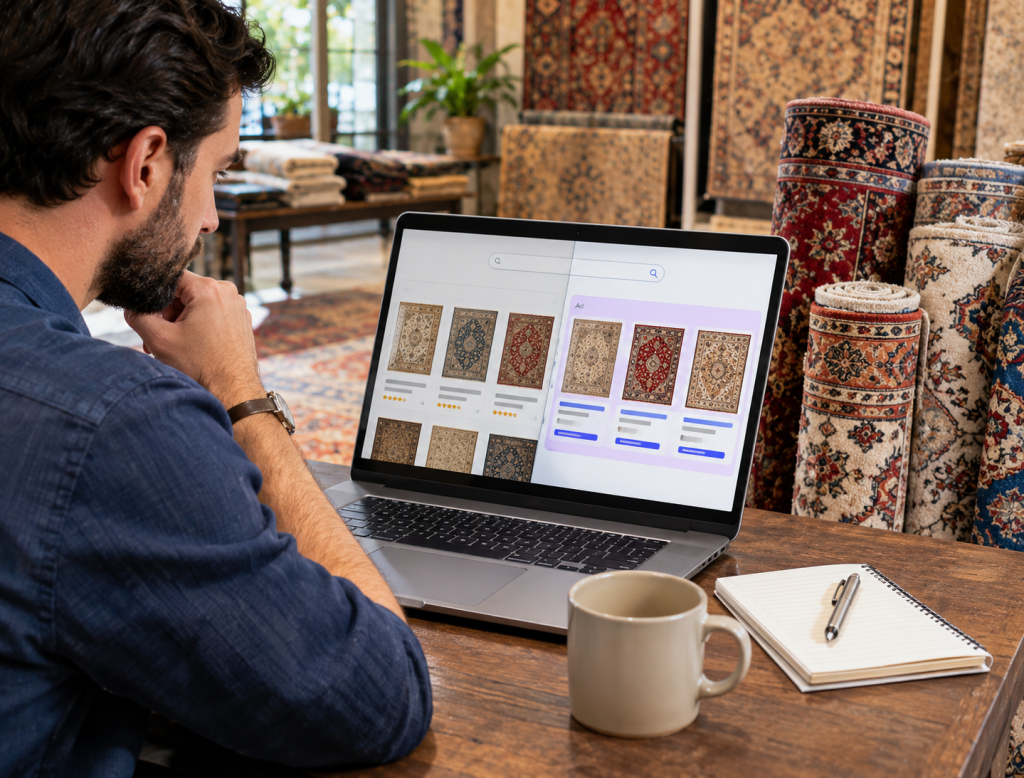
When we manage Merchant Center for a rug store, we do not treat free listings and Shopping ads as two competing strategies where the business must choose one and ignore the other. Both use Merchant Center product data, but they solve different acquisition problems. Free listings give eligible products an opportunity to appear organically across Google’s shopping surfaces without media spend, while Shopping ads use paid campaigns to increase product exposure and give the advertiser more control over budget, bidding, product selection, and performance goals. Google currently groups free listings and Shopping ads as separate marketing methods for online stores, and both can use the same Merchant Center product catalog.
For rug businesses, using both can be especially valuable because the catalog may contain a mixture of evergreen replenishable rugs, high-margin private-label products, one-of-a-kind handmade pieces, sale inventory, local showroom stock, and products with very different conversion rates. Free listings can broaden product discovery across a large catalog, while paid Shopping campaigns can concentrate budget on products or categories where the economics justify paying for additional visibility.
What Are Google Free Listings?
Google free listings allow eligible product offers to appear without an advertising charge across several Google surfaces. Google currently says eligible products may appear on Search, the Shopping tab, Google Images, Lens, YouTube, Gemini, Maps, and the product module on Business Profiles depending on the type of listing and availability.
The important word is “eligible.” Uploading a rug into Merchant Center does not guarantee that Google will show that product prominently for a particular search. Product data quality, relevance, eligibility, competition, landing-page quality, and Google’s systems all influence where and whether a free listing appears.
For us, free listings are therefore an organic product-discovery channel rather than guaranteed free advertising.
What Are Shopping Ads?
Shopping ads are paid product advertisements built from Merchant Center product data. Google can use the product image, title, price, store name, and other feed information to create visually rich ads that appear across eligible Google surfaces. Unlike traditional keyword-based text campaigns, Shopping ads rely heavily on product data and campaign settings to determine which products match user searches.
A rug retailer pays according to the advertising model and campaign behavior. Google states that Merchant Center campaigns use the connected Google Ads account and that advertisers pay for performance such as clicks or engagements. Campaigns created directly through Merchant Center currently use Performance Max.
This means Shopping ads can create visibility faster and more deliberately than waiting for organic product listings alone, but they introduce customer acquisition cost into every commercial decision.
Free Listings and Shopping Ads Use the Same Product Data Foundation
One of the most important strategic points is that free and paid product visibility are not separate feed projects.
The same core feed quality affects both.
Google’s product data specification states that accurate, correctly formatted information is essential for successful ads and free listings. Incorrect attributes, poor images, inaccurate prices, incorrect identifiers, conflicting website information, or category problems can reduce eligibility or create disapprovals.
That means we improve the product feed before trying to solve poor Shopping performance purely through bidding.
For a rug feed, we want accurate product titles, descriptions, URLs, images, prices, availability, identifiers, brand information where applicable, and useful categorization. If a one-of-a-kind rug sells, availability should change promptly. If its website price changes, Merchant Center needs to receive the same price.
A weak feed can limit both the free and paid opportunity at the same time.
We Use Free Listings Across the Broadest Eligible Rug Catalog
Free listings are particularly useful when a store has a large catalog and cannot economically advertise every product.
A rug website may contain several thousand products across styles, sizes, colors, constructions, origins, and price points. Paying for traffic to every SKU may not make sense, particularly when some products have low margin, uncertain conversion history, or limited demand.
If those products meet Merchant Center requirements, free listings can still give them an opportunity to appear organically when Google identifies a relevant shopper.
This makes free listings useful for catalog breadth.
We want the store’s strongest Merchant Center data applied across eligible inventory rather than restricting feed quality efforts only to products currently included in paid campaigns.
Shopping Ads Let Us Concentrate Budget
Paid campaigns give us a different tool. Instead of treating every rug as equally valuable, we can decide where advertising investment deserves to go.
We may prioritize rugs with stronger margin, reliable stock, proven conversion, high average order value, seasonal importance, or strategic value. We can also exclude products that repeatedly attract expensive clicks without creating profitable sales.
For a large rug retailer, this distinction is critical.
The store may want free visibility for 10,000 eligible rugs while actively advertising only the strongest 1,500 based on margin, availability, historical performance, or strategic category priorities.
Free listings expand the opportunity. Shopping ads concentrate investment.
One-of-a-Kind Rugs Need Different Paid Logic
A one-of-a-kind rug creates a unique Shopping challenge because the exact product cannot continue producing sales after one purchase.
If we invest heavily in advertising one individual antique rug and it sells after a single conversion, the campaign cannot scale that SKU the way it could scale a replenishable product.
That does not mean we should never advertise unique inventory. High-ticket one-of-a-kind rugs may justify paid acquisition when margins are strong enough.
We simply evaluate them differently.
The broader value may include acquiring a new customer, introducing the store to collectors, or generating interest in a category rather than expecting repeated sales from one SKU.
Our guide to one-of-a-kind rug SEO addresses the same inventory limitation from an organic-search perspective.
Replenishable Rugs Are Easier to Scale With Shopping Ads
Machine-made, private-label, or repeatable collections can be particularly well suited to paid Shopping campaigns because successful products can remain available after conversions occur.
If a certain 8×10 wool collection repeatedly generates profitable sales, the business can continue directing budget toward that product group while maintaining inventory.
This creates a stronger feedback loop for paid acquisition.
We can accumulate performance data, improve product titles, test images where appropriate, adjust budgets, and compare product groups over time without rebuilding the campaign every time one rug sells.
For this reason, replenishable products often deserve a different advertising strategy from unique handmade inventory.
Free Listings Are Not a Replacement for SEO
Free Merchant Center listings and traditional organic ecommerce SEO overlap in the customer’s search journey, but they are not the same thing.
Google’s free listings documentation specifically focuses on product pages, while traditional organic search can rank product pages, category pages, editorial guides, local pages, and other website content. Google notes that free listings help product pages appear rather than general pages such as homepages or shipping policies.
A rug store therefore still needs collection-page SEO, internal linking, technical SEO, useful product descriptions, and broader informational content.
Merchant Center adds another product-discovery layer rather than replacing the site’s organic-search strategy.
Shopping Ads Are Not Traditional Keyword Ads
Shopping ads are feed driven.
Google states that Shopping ads use Merchant Center product data rather than advertiser-selected keywords to decide how and where products can show.
This changes optimization priorities.
If a Persian rug has a vague title such as “PR-4921,” the feed provides Google far less useful context than a descriptive title that accurately communicates the product type and important attributes.
We therefore treat feed content as part of advertising targeting.
Titles should be accurate and descriptive without becoming keyword-stuffed strings built only for Google.
Both Channels Need Accurate Prices
A product price shown by Google should match the landing page.
Price inconsistencies can create Merchant Center problems and damage buyer trust even when the product remains technically eligible.
We monitor feed updates, sale pricing, automatic website changes, currency settings, and promotional price logic carefully.
This is particularly important for rug stores that run frequent discounts or manage inventory through multiple systems.
Our guide to Merchant Center price mismatch explains why discrepancies often originate in the connection between the website, feed, structured data, and Merchant Center rather than in Merchant Center itself.
Both Channels Need Accurate Availability
One-of-a-kind rug stores need exceptionally strong inventory synchronization.
If a rug sells in the showroom but remains marked in_stock in Merchant Center, both free listings and Shopping ads may continue sending customers to an unavailable product.
That creates wasted paid spend when ads are active and poor customer experience regardless of channel.
We therefore make sold-product updates part of the feed process instead of waiting for someone to manually correct Merchant Center.
The site’s sold-out product strategy should also define what happens to the landing page after inventory becomes unavailable.
Free Listings Can Help Discover Unexpected Demand
One advantage of broad free-listing coverage is that it can reveal categories or products that attract shoppers without paid promotion.
A retailer may discover that a particular rug size, material, color, or style generates meaningful product visibility even though the business has never prioritized it in paid campaigns.
That information can become input for merchandising and advertising decisions.
We do not automatically launch ads because one product received free impressions, but organic product discovery can help identify areas worth investigating.
This makes free listings a useful learning channel as well as a traffic source.
Paid Performance Should Be Judged Against Margin
Shopping campaign performance should not be evaluated by revenue alone.
A $1,000 sale with $200 of gross margin cannot support the same acquisition cost as a $1,000 sale with $600 of gross margin.
We therefore connect paid product performance to category economics whenever possible.
This is especially useful in rug stores where product types can have very different landed costs, shipping costs, return rates, and margins.
Our break-even ROAS framework helps establish how much advertising efficiency each category actually needs rather than applying one ROAS goal to the entire catalog.
Use Product Segmentation Before Increasing Budget
Before spending more on Shopping ads, we organize products into commercially useful groups.
Those groups might include one-of-a-kind versus replenishable, handmade versus machine-made, private label versus third-party brands, high-margin versus lower-margin, in-stock versus limited availability, or important category clusters.
Google product category and the retailer’s own product_type hierarchy can also support campaign organization and reporting.
The purpose is making sure we can answer a simple question: which kinds of rugs are actually producing profitable paid growth?
Without segmentation, an overall campaign can look acceptable while one group consumes most of the budget and another produces most of the profit.
Free Listings Need Optimization Too
Because free traffic does not create direct ad spend, businesses sometimes assume it does not justify ongoing work.
We disagree.
Product-feed improvements can expand free visibility while simultaneously improving the data used by paid Shopping campaigns.
A better title, correct product category, clean image, reliable identifier, and accurate availability can benefit the complete Merchant Center setup.
We therefore treat feed quality as shared ecommerce infrastructure rather than a paid-media task.
Physical Showrooms Should Consider Local Product Visibility
Rug stores with physical locations have another Merchant Center opportunity.
Google supports free local listings and local inventory ads for participating retailers. Free local listings can display product and store information to nearby shoppers without paid media, while local inventory ads can add paid visibility for local stock.
This can be especially useful for high-intent searches where the customer wants to see a rug in person before buying.
A showroom should therefore not limit Merchant Center strategy to national ecommerce if local inventory is commercially important.
We Measure Free and Paid Performance Separately
Free listings and Shopping ads can both generate product traffic, but they should not be combined into one unexplained Merchant Center result.
We want to understand how much traffic, revenue, or conversion activity is associated with organic product listings versus paid campaigns.
Paid activity has an advertising cost attached. Free-listing traffic does not have the same media cost, although maintaining the feed and ecommerce infrastructure still requires resources.
Separating the channels helps us understand incremental paid performance rather than taking credit for sales that may have occurred organically.
We Do Not Turn Off Free Listings Because We Run Ads
There is usually no strategic advantage in disabling eligible free product exposure merely because the business has launched paid campaigns.
Google itself describes free listings as working alongside paid advertising and recommends maximizing catalog reach through the available marketing methods.
We generally want both active where the products and account are eligible.
The decision to advertise a specific SKU can then be based on economics rather than whether the product is permitted to appear organically.
We Do Not Run Ads to Fix Feed Problems
If Merchant Center shows disapprovals, price mismatches, incorrect categorization, broken landing pages, poor images, or identifier issues, increasing Shopping budget will not repair those problems.
We fix feed health first.
Google’s product data specification specifically warns that incorrect or missing information can create disapprovals, limited eligibility, and display issues across both ads and free listings.
For rug businesses, this is why Merchant Center optimization belongs partly to technical ecommerce operations rather than only to the advertising team.
A Practical Rug Store Strategy Uses Both
For most eligible rug ecommerce stores, our preferred strategy is straightforward.
We keep the broad eligible catalog available for free listings, maintain high feed quality across that catalog, and then use paid Shopping campaigns selectively where margins, inventory, conversion performance, and business priorities justify additional exposure.
We continually feed performance information back into product segmentation.
A product that performs strongly in free listings may become a paid test. A product group with high paid acquisition costs may remain available organically while its ad budget is reduced. A high-margin private-label collection may deserve aggressive paid promotion even before significant organic Merchant Center visibility develops.
Final Thoughts
Free listings and Shopping ads should work together rather than compete for ownership of the rug store’s Merchant Center strategy.
Google’s current Merchant Center setup treats them as separate marketing methods using the same underlying product data. Free listings can expose eligible products across surfaces including Search, Shopping, Images, Lens, YouTube, Maps, Gemini, and Business Profile experiences, while Shopping ads use paid campaigns to increase product visibility and give the advertiser more control over investment.
For rug retailers, we use free listings for broad catalog discovery and Shopping ads for deliberate investment. One-of-a-kind products, replenishable products, local showroom stock, private-label collections, and high-margin categories may all deserve different paid strategies even though they share one Merchant Center account.
The common foundation is feed quality. Accurate titles, prices, availability, images, identifiers, categories, and landing pages support both channels. When that foundation is strong, free listings can expand organic product visibility while Shopping ads can accelerate the parts of the catalog where paying for additional demand makes commercial sense.
FAQs
Are Google free listings really free?
Yes. Google does not charge an advertising fee for eligible free product listings, although the business still incurs normal costs associated with maintaining its website, Merchant Center data, product feed, and ecommerce operations.
Are Shopping ads based on keywords?
Shopping ads primarily use Merchant Center product data and campaign information rather than advertiser-selected keywords to determine relevant product matches.
Can we use free listings and Shopping ads at the same time?
Yes. They are separate Merchant Center marketing methods and can operate together using the same product catalog.
Should we advertise every rug in Merchant Center?
Not necessarily. We can keep broad eligible inventory available for free listings while concentrating paid budget on products or groups with suitable margin, availability, strategic importance, and conversion performance.
Are free listings useful for one-of-a-kind rugs?
Yes. They can create product discovery without a direct media charge. However, the feed needs to update availability quickly when the rug sells because the exact product cannot be replenished.