


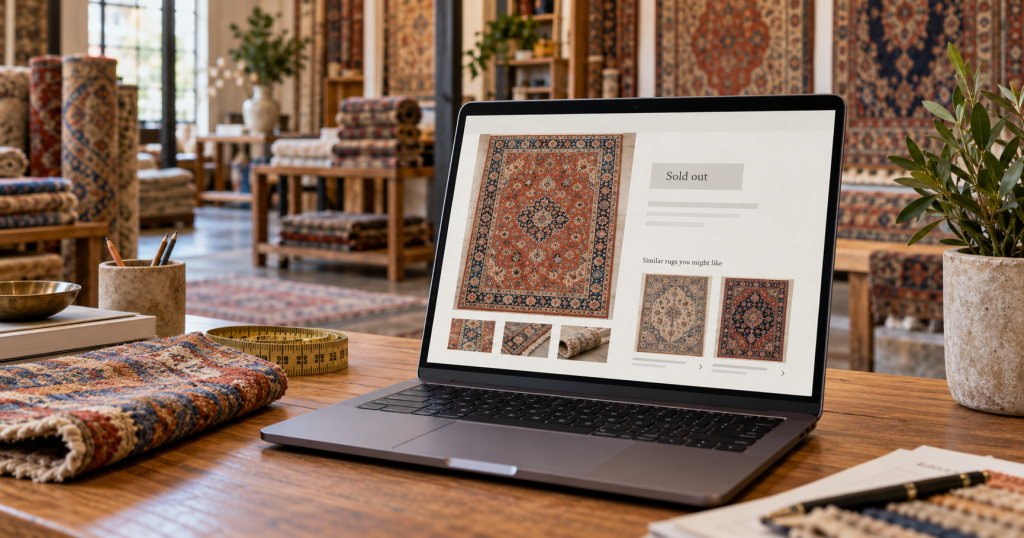
For most ecommerce businesses, a product selling out is an inventory issue. For a rug store, it can also become an SEO issue.
This is especially true for businesses selling handmade, antique, vintage, Persian, Oriental, tribal, or other one-of-a-kind rugs. A rug may exist as a single piece. Once a customer purchases it, the store cannot simply replenish the same SKU next week. Yet the product page may already be ranking in Google, appearing in image search, receiving links, or attracting shoppers looking for that particular style, size, origin, or color combination.
That creates an important question. What should happen to the URL after the rug has sold?
Deleting every sold product page is usually too simplistic. Keeping every page forever is not automatically the right answer either. A better strategy is to decide what should happen based on the type of inventory, whether the item will return, whether the URL already has organic value, and whether another page can genuinely satisfy the same search intent.
For rug retailers, this distinction matters because constantly changing inventory can otherwise create a cycle in which the website builds organic visibility and then repeatedly removes the very URLs that earned it.
The Best Decision Starts With One Question: Is the Rug Coming Back?
Before thinking about redirects, canonicals, XML sitemaps, or indexing, determine what “sold out” actually means.
If the product is a repeatable rug design that is temporarily unavailable, the decision is relatively straightforward. The product URL should normally remain live. The customer should clearly see that the rug is currently out of stock, and the page should provide a useful next step such as a restock notification or related products.
This situation is common with machine-made collections, contemporary rug lines, rug pads, accessories, and standardized designs that can be ordered again.
One-of-a-kind inventory is different.
An antique Heriz rug that has been sold is not temporarily unavailable. That exact piece will probably never return. The same is true for many vintage, handmade, collectible, or individually sourced rugs. In these situations, the store needs to decide whether the old product page still has value after the transaction has finished.
That value may be much greater than it first appears.
A strong product URL can rank for long-tail searches related to style, dimensions, color, material, region, weaving technique, and product type. It may also have been shared by a designer, linked from a blog, bookmarked by a customer, or indexed in Google Images. For businesses managing unique inventory, automatically deleting those pages can mean repeatedly throwing away organic assets the website has already built.
A Sold Rug Can Still Be a Valuable Search Result
Imagine a rug store sells a 9×12 hand-knotted Heriz rug with a rust-red field, navy border, and geometric medallion. The customer who purchased that exact piece is gone, but search demand around the product does not disappear.
Another shopper may search for a 9×12 Heriz rug several months later. A designer may search for red Persian rugs with geometric patterns. Someone researching antique rugs may discover the product through Google Images. A collector may search for examples from the same weaving region.
If the old product page still contains detailed photographs, accurate dimensions, construction information, material, origin, and a useful description, it can continue satisfying part of that research intent.
The commercial purpose of the page simply changes.
When the rug was available, the objective was to sell that specific product. Once it has sold, the page can help the visitor discover the next closest option. That might mean another Heriz rug, another rug in the same size, a similar color palette, or an invitation to contact the showroom for sourcing assistance.
This is a much stronger customer journey than sending the visitor to a 404 page.
It is also why rug stores should think about sold inventory differently from an online store selling generic replacement products.
Keep Temporarily Out-of-Stock Product Pages Live
When an item is expected to return, keeping the original product URL is usually the cleanest approach.
Do not create a new page when the stock returns. Do not redirect the URL somewhere else and then recreate it later. Keep the product page in place, update the visible availability status, and prevent customers from attempting to purchase something that cannot currently be fulfilled.
The page should still look like a useful product page rather than an abandoned listing. Keep the original photographs, description, specifications, dimensions, material details, reviews where appropriate, and any other information customers would normally use when evaluating the rug.
A simple message near the purchasing area can explain the situation:
Currently Out of Stock
This rug is temporarily unavailable. Check back for availability or explore similar rugs currently in our collection.
If the store knows when inventory is expected back, a notification option can be even more useful. Instead of losing the visitor, the business creates an opportunity to bring them back when the product becomes available.
For SEO, the important point is consistency. The page should remain accessible, its visible stock status should be accurate, and the technical product information should not claim that an unavailable rug can still be purchased.
One-of-a-Kind Rugs Need a Different Strategy
This is where rug ecommerce becomes much more interesting.
A conventional retailer may have 5,000 products but continue selling the same SKUs for years. A handmade rug dealer could publish hundreds of products in a year and never receive another identical piece.
If the dealer deletes every product page after each sale, the website constantly loses URLs.
Consider a store that adds 1,000 unique rugs during a year and sells 600 of them. If all 600 pages are immediately removed, a large percentage of the site’s product-level content disappears. New inventory replaces it, but the website is continually rebuilding organic visibility from scratch.
That is not always necessary.
A well-built sold archive can preserve useful product history while separating unavailable inventory from the active shopping experience.
The key is quality.
A sold page should not remain online merely because the URL exists. It should contain enough unique information to remain useful. Detailed photography, accurate dimensions, origin, construction, material, age where known, pattern characteristics, color information, and a well-written product description can make the page valuable even after the item has sold.
This is also where good product descriptions become more valuable. A thin description such as “beautiful handmade rug, 8×10” offers very little once the product is unavailable. A detailed description of the actual rug can continue helping search engines and customers understand what the page represents.
Do Not Let the Sold Page Become a Dead End
Keeping a sold product page live only works if the page gives the customer somewhere useful to go.
One of the worst experiences is finding the perfect rug in Google, opening the page, seeing “SOLD,” and finding nothing else except the navigation menu.
The visitor has already revealed something valuable about their preferences. They may like the rug’s style, color, size, weaving region, age, or price range. The store should use that information to present the closest available inventory.
For example, a sold antique Oushak product page could display current Oushak rugs first, followed by handmade rugs of similar dimensions or colors. A sold 10×14 contemporary wool rug could recommend current large wool rugs rather than unrelated runners or small accent rugs.
This sounds obvious, yet generic ecommerce recommendation systems frequently miss it. They often recommend whatever products are popular rather than whatever products most closely reflect the visitor’s original intent.
Rug retailers can do better because their inventory has meaningful attributes.
Size, region, material, construction, design, color, age, and price range can all be used to create more intelligent relationships between products.
A simple call to action can also turn a sold product into a lead:
Looking for something similar?
This rug has sold, but our inventory changes regularly. Contact our showroom and tell us what you liked about this piece. We can help you find a similar rug currently available.
For higher-value rugs, that may be more useful than any automated recommendation.
Keep the Original Content and Photography
When a rug sells, some ecommerce systems strip the product page down until almost nothing remains. The images disappear, the description disappears, and the customer is left with a product title followed by “Out of Stock.”
That approach removes most of the reasons Google or customers might still find the page useful.
If you decide the page deserves to remain indexed, preserve its core content.
The photographs can be particularly valuable. Rugs are highly visual products, and an individual rug can continue attracting discovery through image search or visual research even after it sells.
The description should remain specific to that rug rather than being replaced with generic archive text.
For example, instead of leaving only:
Antique Persian Rug – Sold
the page could continue explaining that the rug was a hand-knotted wool Heriz measuring approximately 9×12 feet, with a central medallion, warm red field, navy detailing, and geometric border.
Then the sold status and alternative inventory can be introduced naturally.
This keeps the page useful without misleading anyone into believing the original rug is still available.
When Should You 301 Redirect a Sold Product?
A permanent redirect is appropriate when the old product has a genuinely relevant replacement and there is little reason to maintain the original page independently.
The word “relevant” matters.
Imagine a standardized contemporary rug collection releases a revised version of an existing design. The old model is permanently discontinued, and the new version effectively replaces it. Redirecting the previous URL to the new product may provide a good experience because the customer’s intent remains largely the same.
Now compare that with a one-of-a-kind antique Persian rug.
If the rug sells and the store redirects the URL to the homepage, the visitor loses nearly all context. The person searched for a specific rug and suddenly lands on a generic company page. The same problem can occur when hundreds of unrelated sold products are redirected to an “All Rugs” category.
The redirect may technically work, but the destination does not necessarily solve the visitor’s problem.
Before creating a permanent redirect, ask a simple question:
If someone intentionally visited the old product URL, would the new page feel like a logical replacement?
If the answer is yes, the redirect may be appropriate.
If the answer is no, keeping the original page useful or allowing it to disappear naturally may be better.
When Is It Fine to Remove a Product Page?
Not every sold product deserves permanent preservation.
A page with no search visibility, no backlinks, no useful content, no external shares, no meaningful imagery, and no relevance to future shoppers may provide little value once the product has permanently disappeared.
In that case, removing it can be perfectly reasonable.
Before doing so, however, check whether the URL has actually accumulated value.
Google Search Console can show whether the page has been receiving impressions or clicks. Backlink tools can reveal whether other websites reference it. Analytics may show whether people continue entering through the page.
This matters because the person managing inventory may see a dead SKU while Google sees a page that has been appearing in search results for two years.
The decision should therefore be based on both inventory status and page performance.
If the page genuinely has no value and there is no appropriate replacement, allowing it to return a normal 404 is not automatically an SEO problem. Websites naturally gain and lose pages over time.
The real mistake is deleting valuable pages indiscriminately.
A Practical Decision Framework for Rug Stores
A rug retailer can simplify the process by creating a consistent product lifecycle policy.
| Product Situation | Recommended Approach |
|---|---|
| Temporarily out of stock | Keep the same URL live and indexable |
| Restock expected soon | Show availability message and restock option |
| One-of-a-kind rug sold | Keep valuable page, mark Sold, show similar rugs |
| Discontinued with close replacement | Consider a relevant 301 redirect |
| Sold page with traffic or backlinks | Preserve or redirect carefully |
| Sold page with strong imagery | Consider keeping it as useful archive content |
| Thin page with no traffic or links | Removal may be appropriate |
| Duplicate obsolete product | Consolidate with the correct relevant page |
The advantage of a policy like this is consistency.
Store staff no longer need to make a different SEO decision every time a rug sells. Developers also have clearer rules for how the ecommerce system should behave.
Internal Linking Changes After a Rug Sells
Product availability can also change how a page should participate in the internal linking structure.
Suppose an available rug is prominently linked from a category page, homepage feature, buying guide, and blog article. Once the rug sells, keeping every one of those links in exactly the same position may not provide the best shopping experience.
Active inventory should normally receive priority in product grids.
That does not mean every internal link to a sold rug must disappear.
A blog about Heriz rugs may still legitimately link to a sold Heriz product as a visual example if the page remains useful. An educational guide about antique rug construction may also reference previous inventory.
The important distinction is whether the internal link still serves the reader.
Strong internal linking should create meaningful relationships between pages, not simply preserve links because they already exist.
For category and collection pages, available inventory should generally be easier to reach than sold inventory. If the store keeps a large archive, placing sold products in a clearly identified archive can preserve their discoverability without forcing shoppers to browse unavailable rugs before finding something they can purchase.
What Should Happen to Product Schema?
Availability data should reflect what is actually happening on the page.
If the rug has sold, the structured information should not continue indicating that it is in stock. If the item is temporarily unavailable, that should also be communicated accurately.
This is important because product structured data can help search engines understand information such as price and availability.
The visible page and the technical data should agree.
A customer should not see “Sold” while structured data tells search engines “InStock.”
For unique rugs, it is also worth considering what the page becomes after the sale. If it still functions as a product page containing the original product information, maintaining appropriate product data may make sense. If it has been transformed into a purely historical or editorial archive, the structured-data implementation should reflect the actual purpose of the page.
Schema should describe reality. It should not be used to make an unavailable product look commercially active.
Should Sold Products Stay in the XML Sitemap?
The XML sitemap should primarily help search engines discover canonical pages the website actually wants indexed.
If a sold product page remains useful, indexable, self-canonical, and part of the site’s long-term strategy, there can be a reason for keeping it in the sitemap.
If the URL has been redirected, permanently removed, or intentionally excluded from search, it should not continue sitting in the sitemap indefinitely.
Large ecommerce websites often create unnecessary technical clutter because their sitemaps include years of redirected, broken, canonicalized, or non-indexable product URLs.
Inventory management and sitemap management should therefore work together.
The product status changes first. The sitemap should then reflect the SEO decision associated with that status.
Do Not Automatically Noindex Every Sold Rug
Automatic noindex rules can be convenient, but they can also remove valuable pages from search before anyone checks whether those pages are performing.
This can be especially harmful for one-of-a-kind rug retailers.
Imagine a sold antique rug page ranking on page one for a long-tail query and receiving consistent image traffic. If the ecommerce system automatically applies noindex the moment inventory reaches zero, that visibility can eventually disappear even though the page could still have guided customers toward similar rugs.
A better system considers performance and inventory type.
Temporary shortages should not normally require removing the page from search.
Unique sold products should be evaluated according to their usefulness and organic value.
Low-quality pages can be removed when appropriate.
The rule should not simply be:
Stock = 0, therefore noindex.
Avoid Turning the Site Into a Sold-Product Museum
There is an opposite mistake too.
Some stores hear that sold pages can retain SEO value and decide to keep every product page forever.
That can create thousands of weak archive pages with almost no useful content.
Preserving pages only makes sense when those pages continue serving a purpose.
A product page with excellent images, meaningful details, historical relevance, organic visibility, backlinks, or useful related products can remain valuable.
A product page containing only a stock number, a tiny image, and “Sold Out” may not deserve long-term indexation.
The quality threshold should be real.
This becomes increasingly important as the website grows.
A well-managed rug ecommerce site should give search engines a clear picture of the inventory and expertise of the business rather than flooding the index with low-value URLs. A properly planned rug website needs to account for both active inventory and what happens after products leave the collection.
Sold Products Can Become a Merchandising Signal
There is another advantage to monitoring sold pages that many stores overlook.
Search demand around unavailable rugs can tell the merchandising team what people want.
Suppose several sold Oushak rugs continue receiving organic impressions months after they disappear. That suggests ongoing interest in that type of inventory.
Maybe several 10×14 rugs receive more searches than smaller sizes.
Perhaps blue Persian rugs outperform red ones in image search.
Perhaps a particular weaving region continues attracting visitors even though current inventory is limited.
This information can influence future sourcing.
Instead of treating Search Console only as an SEO tool, the business can use search behavior as a form of market intelligence.
Inventory and marketing begin supporting each other.
Sold Product Pages Can Also Generate New Content Ideas
The queries leading to old product pages can reveal questions customers are asking.
A Persian rug page may receive searches about age, authenticity, knotting, origin, or value. A vintage rug may attract questions about cleaning and restoration. A tribal rug may generate searches around patterns or weaving regions.
Those queries can become educational content.
The product page then links into a larger topic cluster, and the educational content can link back toward relevant current inventory.
This is much stronger than treating product pages and blogs as two unrelated parts of the website.
Good ecommerce SEO connects product discovery, education, category pages, and commercial intent.
That broader approach should also fit within the store’s overall rug marketing strategy rather than being handled as a purely technical SEO task.
What a Strong Sold Rug Page Should Look Like
A strong sold page should feel intentional.
The visitor should immediately understand that the original rug is unavailable, but the page should still feel useful.
The top of the page might show the original rug photography, title, dimensions, origin, construction, and a clear Sold label. Instead of an inactive Add to Cart button, the visitor could see a “Find a Similar Rug” option.
Below that, the original product description can remain intact.
Then the page can introduce a carefully selected group of available alternatives.
For a unique antique piece, the store may also provide a short explanation that similar inventory arrives regularly and invite the visitor to contact the showroom with their size, style, and budget.
This changes the experience completely.
The shopper no longer reaches the end of the journey simply because one rug has sold.
The page becomes a bridge into current inventory.
Why This Matters for Rug Stores More Than Many Other Retailers
Rug inventory often carries more individuality than standard ecommerce products.
Even two rugs described with the same style name may differ in color, pattern placement, age, dimensions, condition, weaving characteristics, or visual character.
That means a sold product page can remain useful as an example in a way that an obsolete replacement part or discontinued commodity product often cannot.
Rugs are also highly visual.
A shopper may fall in love with a sold piece and still want something that creates the same feeling in a room.
A skilled salesperson would not respond by saying, “That one is gone,” and ending the conversation.
They would ask what the customer liked about it and show alternatives.
The website should do the same thing.
This is ultimately the most useful way to think about sold-product SEO.
The objective is not merely preserving rankings.
It is preserving the customer journey.
Final Thoughts
A sold rug does not automatically create a useless product page.
Sometimes the right decision is to keep the page live. Sometimes it is better to redirect it. Sometimes the page has served its purpose and can be removed.
The difference depends on context.
If the rug is temporarily unavailable, preserve the URL and make the stock status clear.
If a one-of-a-kind rug has sold but the page continues receiving traffic, links, image visibility, or customer interest, keeping it as a useful sold page can protect existing value while guiding visitors toward similar inventory.
If a discontinued product has a genuinely equivalent replacement, a relevant redirect may provide the cleanest experience.
If the page is thin, receives no traffic, has no links, offers no historical value, and cannot help future shoppers, there may be little reason to preserve it indefinitely.
The mistake is creating one automatic rule for every product.
For rug stores, sold out product pages SEO works best when inventory decisions, customer experience, and search performance are considered together.
A product may only sell once.
The URL can sometimes continue working for the business long afterward.
FAQs
Should I delete a rug product page after the rug sells?
Not automatically. First check whether the page receives organic traffic, impressions, backlinks, image visibility, or other meaningful engagement. A useful sold page can continue directing customers toward similar inventory.
Should temporarily out-of-stock rugs remain indexed?
In most cases, yes. If the product is expected to return, keep the existing page live, communicate the availability clearly, and provide a way for customers to check back or receive an update.
Should a sold rug redirect to the homepage?
Usually not. The homepage often does not match the searcher’s original intent. Redirect only when the destination is genuinely relevant to the product the visitor expected to find.
Can one-of-a-kind sold rugs stay on the website?
Yes. High-quality pages for handmade, antique, vintage, or other unique rugs can remain useful when they contain detailed product information, strong photography, and relevant paths to available inventory.
Can sold-out product pages still rank?
Yes. A page does not automatically lose all search relevance simply because the product is unavailable. Its long-term performance depends on the usefulness of the content, indexing, links, search demand, and how the page is managed.
Should I noindex every sold-out product?
No. Automatic noindex rules can remove valuable URLs from search. Evaluate whether the product is returning and whether the page still has organic or customer value before deciding.
Should sold products remain in category pages?
Available inventory should normally receive priority. Sold products can be moved lower, filtered out of the main shopping experience, or placed in a separate archive while valuable individual URLs remain accessible.
What should replace the Add to Cart button?
For permanently sold unique rugs, a useful alternative is a “Find a Similar Rug,” “View Similar Rugs,” or showroom contact option that keeps the customer’s buying journey moving.
Should a sold product keep its photographs and description?
If the page remains live, keeping high-quality photographs and useful product information can preserve its value for searchers, designers, collectors, and customers looking for similar rugs.
How should rug stores decide whether to keep or remove a sold page?
Consider whether the product will return, whether the page receives search visibility or backlinks, whether the content remains useful, whether a relevant replacement exists, and whether the page can still guide shoppers toward current inventory.