


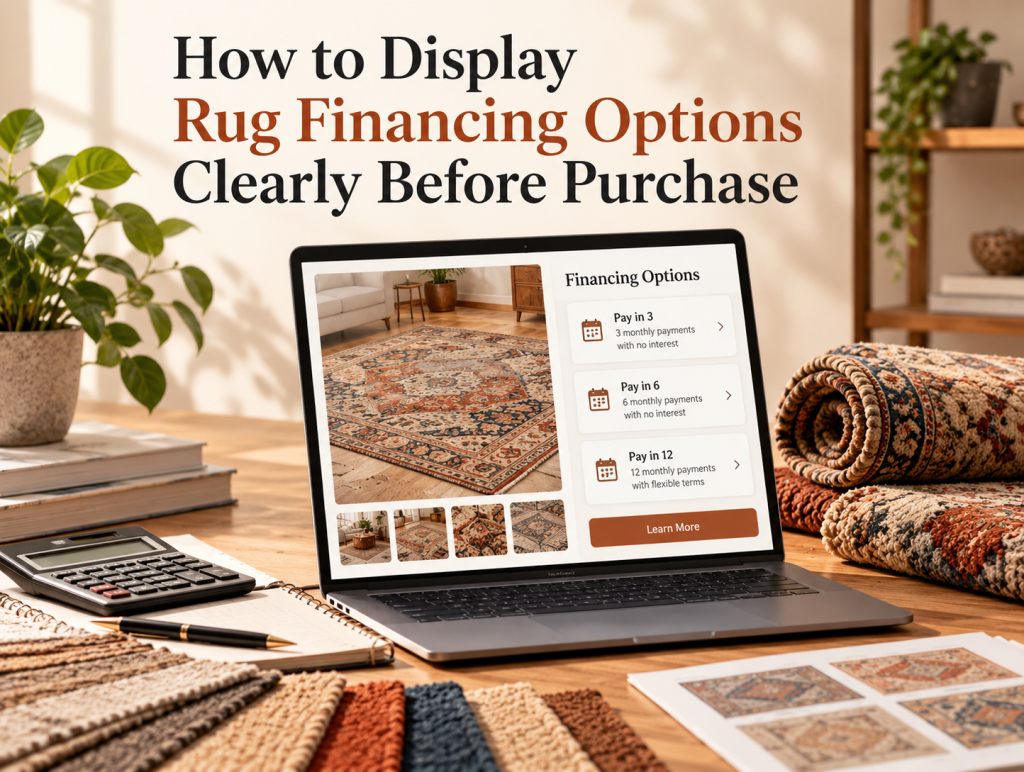
Financing can make a high-value rug purchase feel more manageable, but simply adding a small “financing available” message near checkout does not give shoppers enough information to decide whether the option is useful to them. A customer considering a handmade Persian rug, antique piece, large room-size rug, or premium designer rug may spend considerable time comparing the product, imagining it in the room, and deciding whether the price fits the household budget. If financing is available, the website should explain that option early enough to influence the purchasing decision while avoiding confusing or exaggerated claims about monthly cost, approval, or payment terms.
For a rug retailer, the goal is not to make financing the main selling point of every product. The goal is to reduce uncertainty. A shopper should be able to understand whether financing is available, which provider handles it, whether the option applies to the product being viewed, what general payment structure may be available, and where the customer can review the actual terms before committing to the purchase. When that information is presented clearly, financing can support conversion without making the website feel aggressive or overly promotional.
Introduce Financing Before the Customer Reaches Checkout
Financing information should not appear for the first time after a shopper has already added a rug to the cart and begun entering payment details. Customers evaluating a higher-priced rug may decide whether the purchase is realistic long before reaching checkout, so financing information is most useful when it appears during product research.
A short message near the product price can make the option visible without overwhelming the page. For example, a product page can indicate that eligible customers may have access to installment payments or other financing through the store’s financing partner. The wording should direct the shopper toward more information rather than trying to explain every financing condition beside the price.
This can be particularly valuable on a rug website where product prices vary substantially between smaller decorative pieces and large handmade or antique rugs. A $500 product and an $8,000 product may create very different payment considerations, so visibility should be designed around the customer’s decision process.
Show Financing Near the Product Price
The product price is usually the most logical place for an initial financing message because that is where the shopper is evaluating affordability. The message should be visually connected to the price but secondary to the actual purchase price so there is no confusion about what the rug costs.
If the financing provider supports estimated installment messaging, the website may show an example such as an estimated monthly payment or a general statement that payment plans are available. However, any example should be presented carefully because the customer’s real terms may depend on the provider, eligibility, loan amount, promotional conditions, or other factors.
The actual rug price should always remain obvious. Financing should not make it difficult to determine whether a rug costs $2,400, $4,500, or another amount simply because the website emphasizes a smaller estimated payment figure.
Create a Dedicated Financing Information Page
A dedicated financing page gives the business space to explain the option properly without placing long financial information on every rug listing. The page can describe the financing partner, general application process, eligible purchase types, how customers view their terms, where financing appears during checkout, and whom to contact if they need help understanding the store’s purchase process.
The page should also clearly distinguish between information provided by the rug store and terms controlled by the financing company. The store should avoid promising approval or specific terms that it does not control. Where rates, eligibility, or promotional plans vary, shoppers should be directed to the provider’s current disclosures and application information.
From a website structure perspective, this page can be linked from product pages, the cart, checkout, FAQ content, and relevant showroom information. It can also become a useful resource for customers who discovered the financing option during an in-store visit and want to review the process later.
Explain Which Purchases Are Eligible
If financing applies only above a certain purchase amount, only to selected products, or only through certain sales channels, the website should make that clear before the shopper invests time in the application process.
For example, the store may allow financing for online and showroom purchases but not for trade invoices, custom orders, or certain final-sale items. Another retailer may offer financing only above a minimum transaction value. Whatever the actual rules are, the website should reflect them accurately.
Customers should not see a financing message on every product only to discover during checkout that the rug they selected is not eligible.
A clear eligibility explanation improves trust and reduces support enquiries.
Explain the Application Process in Simple Language
The financing page should describe what the customer can expect when choosing the financing option without trying to reproduce the provider’s entire application agreement.
A simple process might explain that the customer selects financing at checkout, continues to the financing provider, reviews available terms, completes the required information, and returns to the store when the transaction is approved.
If the store uses a financing system for showroom sales, explain that process separately. A salesperson may provide a link, QR code, tablet, or other method that allows the customer to review financing privately.
The important point is that the shopper knows where the process begins and who handles the application.
Avoid Promising Approval
One of the most important wording rules is avoiding language that implies everyone will qualify.
Statements such as “Everyone approved” or “Guaranteed financing” should not be used unless the financing program genuinely and lawfully supports that claim, which is uncommon.
A more accurate approach is to say that financing is available to eligible customers through the store’s financing partner, subject to the provider’s approval and terms.
The purpose of the website is to explain access to the financing option, not to make underwriting promises on behalf of another company.
Make Monthly Payment Examples Easy to Interpret
Estimated monthly payment messaging can help customers understand the potential structure of a purchase, but it should not replace the actual price.
Suppose a rug costs $3,600 and the financing provider displays an illustrative monthly amount. The customer should still be able to see immediately that the rug costs $3,600.
Any estimate should be clearly identified as an example where appropriate, and the customer should be able to access the financing provider’s actual terms before making a commitment.
Avoid designing product cards where the monthly amount is large and prominent while the real purchase price is small or difficult to find. That approach may create short-term attention but can reduce trust.
Add Financing Information to High-Value Product Pages
Financing may matter more for some products than others.
A shopper buying a small decorative rug may not care about payment plans, while a customer considering a large handmade Persian, antique, or designer rug may find the option much more relevant.
The store can therefore adjust the prominence of financing information based on product value or category rather than using exactly the same messaging everywhere.
This does not mean hiding financing from lower-priced products if it remains available. It simply means designing the page around customer intent.
For high-value products, financing can appear near the price, beside the primary purchase action, and within a short explanatory section lower on the page.
Include Financing in the Cart
The cart is another important point because shoppers may combine several products and begin evaluating the total purchase rather than an individual rug price.
If financing is available for the total cart value, the cart can remind the customer that the option will be available during checkout.
The message should remain concise. The cart is not the place for a full explanation of rates, underwriting, or legal terms. A link to the dedicated financing page can provide more detail.
This helps ensure that shoppers who missed the product-page message still understand the available payment methods before abandoning the purchase because the total feels too high.
Keep Financing Clear at Checkout
Checkout should show the financing option alongside the other available payment methods in a way that makes the choice understandable.
The provider name should be recognizable, and the customer should know that selecting the option may continue the payment process through that provider.
Avoid custom labels that make the financing method difficult to identify. If the provider calls the product “Pay Monthly,” for example, the store can present that name while still making clear that it is a financing option rather than a normal credit-card payment.
The checkout experience should also work well on mobile because a significant percentage of shoppers may complete the purchase from a phone.
Explain Financing for Showroom Customers
A rug business with a physical showroom should not design its financing experience only for ecommerce customers.
A customer may visit the showroom, compare several rugs, ask about pricing, and then want time to review financing before deciding.
The website can support that interaction by providing a financing page that sales staff can share through a QR code, email, or text message.
This gives the customer a consistent source of information rather than relying entirely on the salesperson’s verbal explanation.
For stores trying to increase showroom visits, connecting the online and in-store financing experience can make higher-value purchases easier to evaluate without changing the consultative nature of the showroom.
Keep Financing Messaging Consistent Across the Site
A customer should not see different financing information on the product page, FAQ, cart, and checkout.
If one page says “0% financing,” another says “monthly payments available,” and a third displays different promotional terms, the shopper may not know which information is current.
The business should identify one authoritative source for financing details and update the website whenever the provider changes its program.
Dynamic provider widgets can sometimes help maintain consistency, but they should still be monitored because a third-party script can fail or display information differently after provider updates.
Routine website maintenance should therefore include checking important financing elements as part of ecommerce QA.
Add Financing to Relevant FAQs
Financing frequently generates the same customer questions, so the website should answer them directly.
Useful topics may include whether financing is available online and in the showroom, whether approval is guaranteed, where terms are shown, whether custom rugs qualify, and whether a deposit can be combined with financing.
Only answer questions that reflect the actual financing arrangement.
If the store does not know whether a specific factor affects approval, direct the customer to the financing provider instead of guessing.
The strongest FAQ is accurate, not merely reassuring.
Do Not Use Financing to Hide the Real Price
Rug websites should avoid designs where monthly payment messaging is used to make an expensive product appear artificially inexpensive.
A $6,000 rug is still a $6,000 rug even if a financing option divides the payment over time.
The actual price should remain prominent and easy to understand.
Financing should function as a payment option rather than a substitute for transparent pricing.
This is especially important for luxury and handmade rug retailers because trust plays a significant role in the purchase. The customer may already be evaluating craftsmanship, provenance, dimensions, condition, shipping, and return policies. Confusing financial presentation adds another source of hesitation.
Test the Financing Journey Regularly
The store should periodically test the financing experience from the product page through checkout.
Check whether financing messages appear on eligible products, links open correctly, provider widgets load, mobile layouts remain usable, and checkout routes customers to the correct financing process.
If a financing provider updates its integration, website plugins or scripts may also require changes.
A customer discovering a broken financing button during a high-value purchase may leave rather than contact support.
For businesses focused on improving rug conversions, this type of practical ecommerce testing can matter as much as adding new marketing content.
Measure Whether Financing Actually Helps Conversion
The business should track whether visitors who interact with financing information behave differently from other shoppers.
Useful questions include whether customers who view financing complete purchases at a higher rate, whether financing is used more often on certain price ranges, whether financed orders have a higher average order value, and whether the option reduces cart abandonment among high-value purchases.
Do not assume financing improves performance simply because it exists.
If almost nobody uses it, the issue may be visibility, provider fit, product eligibility, or customer preference.
If many customers begin the process but fail to complete it, investigate whether the transition between the website and financing provider is confusing.
Final Thoughts
A rug financing website experience should make payment options easier to understand without distracting from the rug itself. Financing information belongs early enough in the buying journey to influence affordability decisions, but the actual product price should remain clear and prominent throughout the experience.
Start with a concise financing message near the product price, provide a dedicated page for more detailed information, explain eligibility and application flow, and reinforce the option in the cart and checkout. For physical showrooms, make the same information easy for sales staff to share with customers who want to review financing after seeing a rug in person.
Most importantly, keep the language accurate. Do not promise approval, hide the actual product price, or present estimated monthly payments as though they are guaranteed terms.
When financing is presented transparently, it can give customers another way to approach a significant rug purchase while allowing the store to maintain the trust and clarity expected from a premium retail experience.
FAQs
Where should financing information appear on a rug website?
It should usually appear near the product price, with additional information available on a dedicated financing page and reminders in the cart and checkout.
Should a rug store display estimated monthly payments?
It can when the financing provider supports that information, but the actual rug price should remain clear and any payment estimate should not be presented as guaranteed terms.
Should every rug display financing information?
That depends on the store’s financing program and product eligibility. Financing may be especially relevant for higher-value rugs, but messaging should accurately reflect which products qualify.
Can a rug store guarantee financing approval?
The store should not promise approval when the decision is made by a third-party financing provider. Eligibility and approval should be described according to the provider’s actual process.
Should financing information also be available for showroom customers?
Yes, when financing is offered in-store. A dedicated web page can give showroom customers a consistent place to review the process and available information.