


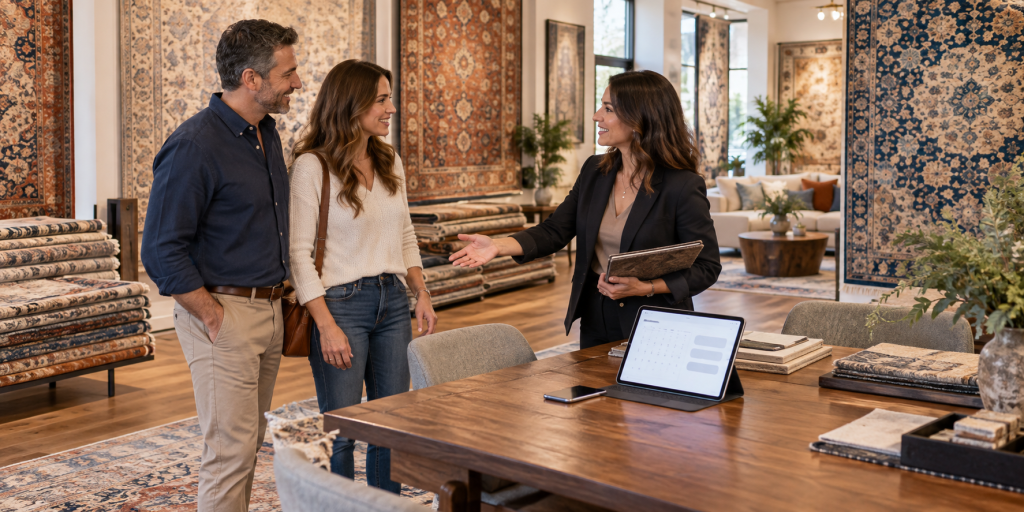
Getting people to visit a rug website is only the first step. A rug store can rank on Google, publish useful content, run paid advertising, receive social media traffic, and still struggle to turn those visitors into showroom appointments.
The problem is often not traffic. The problem is what happens after the visitor reaches the website.
A potential customer may browse several rugs, look at showroom photos, check opening hours, read a few reviews, and then leave without contacting the business. They may like what they see but still have questions. They may not know whether they need an appointment, whether the showroom has rugs within their budget, whether someone can help with sizing, or whether they can simply walk in.
Every unanswered question creates friction.
For rug businesses, the website should not function only as an online brochure. It should help visitors understand the products, build trust, and guide them toward the next logical action. For a local rug store, that action is often booking a showroom visit.
A strong rug marketing strategy should therefore connect traffic generation with conversion. SEO can bring visitors to the website, but the website itself must convince those visitors that seeing the rugs in person is worth their time.
Why Showroom Appointments Matter for Rug Businesses
Rugs are especially well suited to in-person selling because customers often need to see and feel the product before making a decision. Colors can look different on a screen. Texture, pile height, weaving quality, fringe, construction, and condition are also easier to evaluate in person.
A showroom appointment gives the customer something that a large online retailer cannot easily reproduce. It provides direct access to a rug specialist who can help the buyer compare products, understand materials, choose the right size, and determine which styles will work best in a particular room.
A customer may arrive thinking they need an 8×10 rug but discover that a 9×12 is better for the furniture layout. Another customer may be considering a synthetic rug but decide that wool makes more sense after seeing the difference in person. These conversations can make the buying process easier and increase confidence.
The website should therefore sell the value of the showroom experience instead of simply publishing the store address.
Why Website Visitors Leave Without Booking
There are many reasons a visitor may leave without scheduling an appointment. The booking button may be difficult to find. The website may not explain why an appointment is valuable. The customer may not know what inventory is available or whether the showroom carries rugs in the right size, style, or price range.
Some visitors may also be unsure whether appointments are required or whether walk-ins are welcome. Others may worry about sales pressure. A slow website, outdated design, weak photography, limited reviews, or an unnecessarily long booking form can create additional hesitation.
These problems may appear small, but together they can prevent qualified customers from visiting the showroom.
The goal should be to remove as much uncertainty as possible before asking someone to book.
Create a Dedicated Showroom Page
A rug showroom should have its own dedicated page rather than relying only on a general contact page.
The page should help potential customers understand exactly what they can expect when visiting. It should include the showroom address, business hours, phone number, booking option, map, parking information, interior photos, exterior photos, available rug categories, delivery information, and answers to common appointment questions.
Showroom photography is especially important. A visitor should be able to see the environment and understand that the business has real inventory before making the trip.
The page can also explain whether customers can browse without an appointment and whether private consultations are available.
Good website design makes this information easy to find while keeping the customer focused on the next step.
Explain Why Someone Should Book an Appointment
A simple “Book an Appointment” button does not explain what the customer receives.
The website should describe the benefit of the visit.
A showroom appointment may allow customers to compare several rugs side by side, inspect colors and textures in person, receive professional sizing guidance, discuss room dimensions, explore different materials, compare handmade and machine-made options, and get recommendations that fit their budget.
This changes the message from asking someone to schedule time with a salesperson to offering useful professional help.
Instead of presenting the visit as an obligation, present it as an easier way to choose the right rug.
A message such as “Get expert help finding the right rug for your space” can feel more valuable than a generic booking button.
Make Appointment Calls to Action Easy to Find
If showroom appointments are important to the business, the booking option should not be hidden at the bottom of the website.
It should appear naturally on pages where customers are likely to make decisions. This can include the homepage, main navigation, product pages, collection pages, local landing pages, contact page, and relevant blog content.
The call to action should also be specific. “Schedule a Rug Consultation” or “Book a Showroom Visit” tells the customer exactly what will happen. Generic wording such as “Learn More” creates more uncertainty.
Mobile visitors should be able to reach the appointment form without searching through several menus.
Keep the Booking Form Simple
A customer should not have to complete a long questionnaire just to visit the showroom.
The first booking form can ask for the customer’s name, email address, phone number, preferred date, preferred time, and a short description of what they are looking for.
Additional information such as room type, approximate size, budget, or preferred style can be optional.
Do not assume customers understand rug terminology. Someone may not know whether a rug is Persian, Oriental, transitional, hand-knotted, or hand-tufted. They may simply know that they want a large blue rug for a living room.
That is enough information to begin the conversation.
The specialist can help with the details later.
Offer Different Types of Appointments
Not every visitor has the same objective.
Some customers may simply want to browse the showroom. Others may want detailed assistance choosing a rug. Interior designers may be sourcing several pieces for a project, while an out-of-town customer may prefer a virtual consultation.
A rug business can therefore offer different appointment options such as a standard showroom visit, private rug consultation, designer appointment, collection review, or virtual consultation.
The names and options should reflect the actual services offered by the business.
This makes the booking experience feel more relevant and can also help the sales team prepare before the customer arrives.
Show Real Inventory Online
Customers are more likely to visit a showroom when they believe the store has something that matches their needs.
The website should show enough inventory to demonstrate the range available. It can organize rugs by categories such as Persian rugs, handmade rugs, wool rugs, vintage rugs, contemporary rugs, runners, oversized rugs, antique rugs, and custom rugs.
If inventory changes frequently, the website can explain that new pieces arrive regularly.
Customers do not need to see every item before visiting. They simply need enough information to believe the trip is worthwhile.
A strong product catalog can also help customers identify rugs they want to see during their appointment.
Use Better Rug Photography
Photography has a major influence on showroom conversion because rugs are highly visual products.
A strong website should show full rug views, detailed pattern shots, texture, fringe, backing, and rugs displayed in real rooms. Showroom photographs can also help visitors understand the scale of the inventory.
Real photos usually create more confidence than generic stock images. If customers can see stacks of rugs, showroom walls, styled rooms, and individual pieces, the business feels more tangible.
The purpose of the photography is not only to make the website attractive. It should help visitors imagine themselves visiting the store and comparing rugs in person.
Make Rug Size Education Part of the Conversion Strategy
Rug sizing is one of the most common sources of uncertainty.
Many buyers do not know whether they need an 8×10, 9×12, 10×14, runner, or custom size. If the website helps solve this problem, it can move the visitor closer to an appointment.
Create helpful content explaining rug sizing for living rooms, dining rooms, bedrooms, hallways, and open-plan spaces.
At the end of those guides, explain that customers can bring room measurements and photos to the showroom for personalized recommendations.
This turns informational content into a natural path toward a showroom visit.
Help Customers Prepare for Their Visit
A customer who knows what to bring will often have a better showroom experience.
The website can explain that room measurements, photos of the space, furniture images, fabric samples, inspiration pictures, preferred colors, and an approximate budget can make the consultation more productive.
This advice can appear on the confirmation page and in the appointment reminder email.
The goal is not to create homework for the customer. It is to help the customer arrive with enough information for the salesperson to make useful recommendations quickly.
Build Trust Before Asking for the Appointment
Customers may hesitate to visit an unfamiliar rug store, especially when they are considering an expensive handmade or antique rug.
The website should therefore establish trust before asking for a commitment.
Customer reviews, real showroom photographs, staff biographies, years of experience, rug expertise, delivery information, designer relationships, and industry mentions can all strengthen credibility.
If the business specializes in Persian rugs, antique rugs, restoration, or luxury inventory, that expertise should be clearly explained.
Customers should understand why this showroom is worth visiting rather than simply ordering from a large marketplace.
Use Customer Reviews Near Conversion Points
Reviews can be particularly valuable when they describe the showroom experience.
A visitor may want to know whether the staff is helpful, knowledgeable, patient, and respectful of budget. They may also want reassurance that the showroom has a good selection and does not create a high-pressure sales environment.
Place relevant testimonials near the showroom information and appointment section rather than hiding every review on a separate page.
Detailed reviews that mention helpful advice, rug selection, delivery, sizing support, or designer service can reduce hesitation.
Use Local SEO to Drive More Qualified Visitors
Local SEO is one of the strongest channels for rug stores with physical showrooms.
Customers frequently search for terms such as “rug store near me,” “Persian rugs near me,” “handmade rug showroom,” “Oriental rug store,” “antique rug dealer,” or city-specific rug searches.
These searches often indicate stronger purchase intent than broad informational searches.
A strong SEO strategy should make sure the website clearly communicates the showroom location, service area, rug categories, phone number, business hours, and services.
The objective should not simply be ranking for a keyword. The objective should be turning those rankings into calls, directions, appointments, and showroom visits.
Optimize Google Business Profile
For local businesses, customers may interact with Google Business Profile before visiting the main website.
The profile should contain accurate business hours, address, phone number, website, relevant categories, photos, reviews, and updated business information.
Showroom images can be particularly useful because they help people know what to expect.
A customer comparing several rug stores in Google Maps may make a decision based on distance, rating, photos, business hours, and the quality of the reviews.
The profile should therefore represent the showroom as carefully as the website does.
Build Strong Local Landing Pages
If a rug business genuinely serves multiple markets, location-specific landing pages can help customers understand local availability.
A strong page should explain the actual service area, products available, delivery options, showroom details, customer reviews, relevant services, appointment process, and local contact information.
Avoid creating dozens of pages that use the same content with only the city name changed.
Useful local content should reflect the customers and services available in that market.
Use Blog Content to Generate Showroom Interest
Blog content can attract potential customers long before they are ready to purchase.
A person may search for advice on choosing the right rug size, comparing wool and synthetic materials, understanding handmade rugs, selecting rugs for pets, or styling a living room.
A useful article builds trust. Once the visitor understands the subject, the article can naturally mention that additional options can be compared in the showroom.
The internal link should make sense within the article rather than appearing as an aggressive sales pitch.
Educational content works best when it helps the customer first and sells second.
Turn Product Pages Into Showroom Opportunities
Not every customer who visits a product page is ready to buy online.
For expensive, handmade, vintage, or one-of-a-kind rugs, some customers may prefer to inspect the piece first.
Product pages can therefore provide options such as scheduling a viewing, checking availability, requesting additional photos, or contacting the showroom about the rug.
This creates a conversion path for customers who have genuine interest but are not comfortable completing the purchase online.
Use Google Ads for Local High-Intent Searches
Paid search can also generate showroom appointments when campaigns focus on strong local intent.
Searches such as “rug showroom near me,” “Persian rug store,” “handmade rugs near me,” “luxury rug showroom,” or “antique rugs near me” may indicate that a customer is actively looking for somewhere to shop.
A focused Google Ads campaign should send the customer to the most relevant page.
If the search is about Persian rugs, the landing page should show Persian inventory and showroom information. If the search is specifically about a local rug showroom, the visitor should arrive on a showroom or location page.
Sending every visitor to the homepage creates unnecessary work for the customer.
Use Advertising to Sell the Showroom Experience
Advertising does not always need to promote discounts.
A local rug store can advertise the experience itself.
The message might emphasize comparing handmade rugs in person, getting help choosing the right size, exploring one-of-a-kind inventory, or receiving professional design guidance.
This gives independent rug businesses an advantage over online-only competitors.
A national retailer may have thousands of products, but a local showroom can offer real textures, expert guidance, and direct comparison.
That difference should be visible in the marketing.
Follow Up Quickly After an Appointment Request
A customer who submits an appointment request should receive confirmation immediately.
The confirmation should make the next step clear by providing the appointment date, time, showroom address, phone number, directions, and any useful preparation information.
The sales team should also receive the lead immediately so they can prepare.
Slow follow-up can create doubt and gives the customer time to contact another store.
Fast, professional communication reinforces the decision to visit.
Use Email Automation to Reduce Lost Appointments
Email automation can support the showroom process without making communication feel impersonal.
A confirmation email can arrive immediately after booking. A reminder can be sent before the appointment with directions and preparation tips. After the visit, the customer can receive a thank-you message and information about the rugs they considered.
If the customer does not purchase immediately, future follow-up can include relevant new arrivals or useful content.
A good email marketing system helps the business stay organized while keeping the customer journey consistent.
Personalize the Showroom Experience
The information provided during booking should be used.
If a customer says they want a neutral 9×12 wool rug for a living room, the salesperson can prepare relevant pieces before the appointment.
The customer then arrives and finds that the showroom already understands what they are looking for.
That creates a much stronger experience than simply telling the customer to browse hundreds of rugs.
Personalization can make an independent showroom feel like a professional design service rather than a traditional retail store.
Create a Better Experience for Interior Designers
Interior designers have different needs from retail buyers.
They may be sourcing several rugs, working within client budgets, requesting custom sizes, looking for specific colors, or coordinating several projects.
A separate designer appointment option can make the showroom more useful for trade professionals.
The website can explain whether the business provides trade pricing, private sourcing appointments, custom options, product specifications, high-resolution images, new arrival previews, and delivery support.
A designer who has a good experience may return repeatedly, making this a particularly valuable customer segment.
Offer Virtual Consultations
Not every qualified customer lives close enough to visit immediately.
Virtual appointments can help rug businesses reach customers outside the immediate showroom area.
During a virtual consultation, the salesperson can show rugs on video, compare several options, demonstrate texture and color, discuss measurements, review room photos, and answer questions about shipping.
For some customers, the virtual appointment may eventually lead to an in-person visit. For others, it may be enough to complete the sale remotely.
The same principles still apply. Make the process simple, useful, and personalized.
Reduce Fear of Sales Pressure
Some customers avoid appointments because they assume the visit will involve aggressive selling.
The website can reduce this concern by explaining the nature of the experience.
Messaging can emphasize professional guidance, comfortable browsing, comparison, education, and personalized support.
Customers should understand that the purpose of the appointment is to help them make a better decision.
This is particularly important for first-time buyers who may feel intimidated by handmade or antique rugs.
Give Customers Some Pricing Context
Price uncertainty can stop customers from booking.
When possible, show individual prices or general price ranges.
If exact pricing cannot be published for every rug, explain that the showroom carries different price levels or that pricing depends on size, age, material, construction, and condition.
This helps customers determine whether the store fits their needs.
Complete uncertainty can discourage visitors who assume the products are either much cheaper or much more expensive than they actually are.
Make Mobile Booking Easy
Many local searches happen on smartphones, so the appointment process must work well on mobile devices.
Customers should be able to see the address, call the store, check business hours, browse rugs, open directions, and schedule an appointment without struggling with small buttons or complicated forms.
Test the booking process on several screen sizes.
A website that works beautifully on a desktop but poorly on mobile can quietly lose local customers.
Improve Website Speed
Rug websites often contain many large images, which can slow down performance.
Images should be optimized so they remain visually impressive without unnecessarily increasing page load time.
The business should also review hosting, scripts, plugins, fonts, and other technical elements that affect speed.
Visitors should be able to browse rug collections quickly. A slow site creates frustration before the customer has even considered making an appointment.
Track Showroom Conversions
Traffic numbers alone do not show whether the strategy is working.
A rug business should track appointment submissions, phone calls, direction requests, showroom visits, sales generated from appointments, and the original marketing source.
This allows the business to understand which channels actually bring people into the store.
Organic search may generate the most website visits, while Google Maps could generate the most showroom sales. Designer referrals may produce fewer appointments but much higher order values.
Without proper tracking, those differences remain hidden.
Measure Lead Quality Instead of Traffic Alone
A marketing campaign with fewer visitors can still be more valuable if those visitors have stronger intent.
For example, a broad blog may attract thousands of readers but generate few showroom appointments. A local page targeting “handmade rug showroom near me” may receive far less traffic but create several qualified visits.
The business should therefore measure conversion rate, completed appointments, purchase rate, average order value, and revenue rather than focusing only on page views.
This is especially important when deciding where to spend advertising budgets.
Build a Connected Showroom Funnel
The strongest showroom marketing strategy connects every stage of the buyer journey.
A customer may first discover the business through Google. They browse inventory, read an educational guide, review customer testimonials, visit the showroom page, and then book an appointment.
After booking, they receive confirmation and preparation information. During the showroom visit, the salesperson already understands what they need. If the customer does not buy immediately, the business follows up with relevant information.
Each step supports the next.
That is much more effective than treating SEO, advertising, website design, email, and showroom sales as separate activities.
Common Showroom Conversion Problems
One of the most common problems is hiding the appointment option. Visitors should not have to search for a way to visit the showroom.
Another problem is using a long booking form. A customer who simply wants to see rugs does not need to complete an extensive questionnaire.
Weak photography can also reduce confidence. Customers want to see real rugs and a real showroom before making the trip.
Missing reviews, slow follow-up, unclear pricing, poor mobile usability, and sending every advertising visitor to the homepage can further reduce conversions.
Many of these issues are relatively simple to fix.
A Simple 30-Day Improvement Plan
During the first week, review the website experience. Improve the showroom page, make appointment buttons more visible, add accurate contact information, upload stronger photographs, and test the mobile booking process.
During the second week, focus on trust. Add genuine customer reviews, explain staff expertise, describe what happens during an appointment, improve product information, and answer common customer questions.
During the third week, improve lead management. Set up confirmation emails, appointment reminders, CRM tracking, conversion tracking, and a clear internal follow-up process.
During the fourth week, increase qualified traffic. Improve local SEO, update Google Business Profile, launch focused local search advertising, promote the showroom through useful content, and reconnect with relevant past leads.
At the end of the month, compare appointment volume, completed showroom visits, sales, and lead sources. Use those results to decide what should be improved next.
Final Thoughts
A rug store does not always need more website traffic. Sometimes the bigger opportunity is converting the visitors it already has.
The ideal customer journey is straightforward.
A buyer searches for rugs and discovers the business. They see products that match their interests, read useful information, look at real showroom photographs, check reviews, and understand why visiting in person would help.
They schedule an appointment, receive clear confirmation, arrive prepared, and meet a salesperson who already understands what they are looking for.
That is more than a website.
It is a conversion system.
Independent rug stores have an important advantage over many large online retailers. Customers can see colors in person, feel materials, compare rugs side by side, ask detailed questions, and receive direct guidance from someone who understands the product.
The website should make that advantage clear.
When SEO, website design, photography, local search, paid advertising, email follow-up, and showroom service work together, website visitors become much more than analytics numbers.
They become real customers walking through the door.
And for a rug showroom, that is where some of the strongest customer relationships and most valuable sales can begin.
FAQs
How can a rug store get more showroom appointments?
A rug store can generate more appointments by making the booking option easy to find, explaining the benefits of visiting, displaying real inventory, improving local SEO, adding customer reviews, and following up quickly with interested buyers.
Should rug stores require appointments?
Not necessarily. A store can welcome walk-ins while offering appointments for customers who want more personalized assistance or want specific rugs prepared in advance.
What should a rug appointment form ask?
The form should request basic information such as the customer’s name, email, phone number, preferred date, preferred time, and general rug needs. Additional questions should normally be optional.
Why is local SEO important for showroom appointments?
Local SEO helps rug stores appear when nearby customers search for rug stores, showrooms, Persian rugs, handmade rugs, or other location-based terms. These customers often have stronger intent to visit.
Can Google Ads generate rug showroom appointments?
Yes. Local campaigns targeting high-intent searches can produce showroom appointments when the ads lead to relevant landing pages with clear booking options.
Should rug showrooms send appointment reminders?
Yes. Confirmation and reminder emails can reduce confusion, improve attendance, and help customers prepare room measurements, photos, and other useful information.
Can virtual appointments help rug stores?
Yes. Virtual consultations can help customers outside the immediate service area compare rugs, discuss room dimensions, review products, and make purchasing decisions remotely.
What should a rug store measure?
A rug business should track appointment bookings, phone calls, direction requests, completed showroom visits, sales, lead sources, conversion rates, and revenue generated from each marketing channel.