

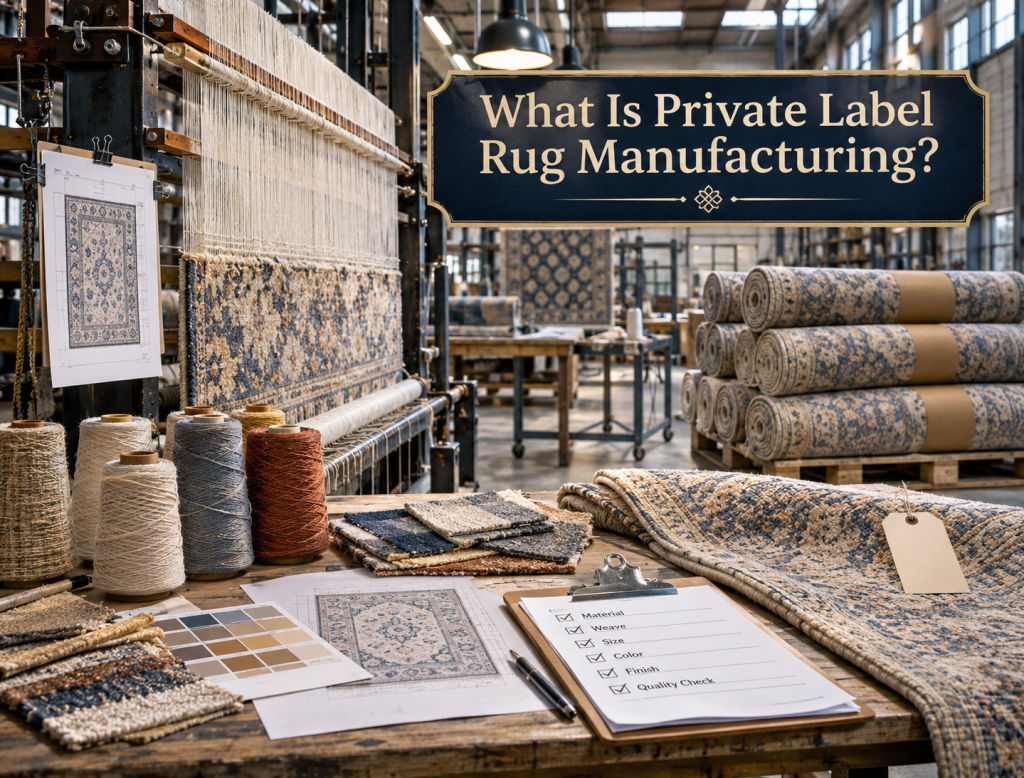
When we talk about private label rug manufacturing, we mean a business arrangement in which a retailer, marketplace seller, designer brand, furniture company, or rug business sells rugs under its own brand while a third-party manufacturer produces them. The brand controls important parts of the commercial product, which may include design direction, materials, construction, sizes, colors, labels, packaging, or specifications, while the manufacturer operates the production process. The exact degree of customization varies significantly, so we do not assume that every product called “private label” is completely original.
Current private-label guidance defines the broader model similarly: a third-party manufacturer produces goods that are sold under the retailer’s brand, with the brand typically determining important specifications and presentation. In rugs, that model can range from adding a private brand to an existing manufacturer’s design with agreed modifications to developing a more distinctive collection with exclusive colors, constructions, dimensions, patterns, labels, and packaging.
We Separate Private Label From White Label
We use these terms carefully because they are often treated as though they mean exactly the same thing. In a typical white-label arrangement, a manufacturer has an existing product that several businesses can sell under their own branding. Customization is usually limited, and the main distinction is the brand applied to the product or packaging.
Private label generally gives the seller more influence over the product specification or commercial presentation. A retailer might choose an existing base construction but develop its own color palette, sizes, finishing, labels, packaging, and collection identity. Another private-label project may involve an entirely custom design developed from artwork supplied by the brand.
The boundary is not always perfectly consistent between manufacturers, which is why we do not rely on the label alone. We ask exactly which parts of the rug can be changed, which are exclusive, what other buyers can purchase, and who owns the design rights.
We Decide Why We Want a Private Label Collection Before Designing It
Private label is not automatically better than buying established wholesale collections. We begin by identifying the business reason.
A furniture retailer may want rugs that cannot be price-compared directly with the same SKU sold by competitors. A marketplace seller may want to build a proprietary assortment rather than depend entirely on third-party brands. An interior design company may want a small collection reflecting its design identity. A rug wholesaler may want exclusive products it can offer to furniture stores under a controlled distribution model.
If we cannot explain what strategic advantage the private label creates, we do not assume adding our logo to a rug will create one.
The broader rug marketplace model can help expose demand before private-label investment because marketplace performance can reveal which styles, sizes, price ranges, and materials customers actually respond to.
We Start With the Product Architecture, Not the Logo
Branding is visible, but product architecture determines whether the collection works commercially.
We first decide which constructions belong in the line, what retail price range we want to serve, how the target buyer uses the rugs, what margin the channel requires, and which sizes are important. Only then can we work backward toward the manufacturing cost and specifications.
A furniture retailer selling affordable living-room packages may need a completely different product from a boutique design brand selling hand-knotted rugs. Both can use private-label manufacturing, but their construction, MOQ, lead time, price, and merchandising strategies will be very different.
We want the rug to fit the buyer and channel before we spend time designing labels and packaging.
We Choose the Degree of Customization Deliberately
Private label does not require us to customize every component. In fact, excessive customization can raise MOQs, development costs, and lead times without creating equal customer value.
We may begin with an existing construction that the manufacturer already produces efficiently, then customize the pattern, palette, size assortment, edge finishing, label, and packaging. Another project may justify custom yarn, weave density, backing, or other technical changes because those characteristics are central to the brand promise.
We ask which customization creates a reason for the customer or retailer to choose the collection. Changes that cannot be seen, explained, or valued still need a commercial reason.
This discipline helps prevent private-label projects from becoming expensive design exercises disconnected from actual demand.
We Evaluate the Manufacturer Before We Evaluate the Sample
A good sample does not automatically prove that a manufacturer is a good long-term supplier. We also evaluate production capability, communication, capacity, lead times, quality-control process, export experience where relevant, material sourcing, packaging capability, and ability to reproduce approved products consistently.
If we are working through an importer, sourcing partner, or wholesaler rather than directly with the factory, we clarify who is responsible for each part of the relationship.
Private-label guidance also emphasizes manufacturer dependency as a real business risk because production problems, quality issues, and supply disruptions directly affect the brand selling the finished product.
The manufacturer’s reliability becomes part of our brand reputation once its rug carries our name.
We Treat Sampling as Product Development
A sample is not simply something we request so we can say we checked quality. It is part of product development.
We review the sample against the intended specification and decide whether construction, hand feel, color, pile, scale, dimensions, pattern clarity, backing, finishing, and packaging match the product we want to sell.
If the rug is intended for photography and online sales, we also consider how the pattern and texture reproduce visually. Some products look strong in person but lose definition in marketplace thumbnails. Others photograph beautifully but feel less convincing when customers handle them.
Current private-label manufacturing guidance recommends requesting samples using the same intended materials and production process, comparing manufacturers where appropriate, and checking durability and packaging rather than accepting a generic manufacturer’s sample.
We Expect MOQ to Shape the Collection
Minimum order quantity can determine whether a private-label concept is commercially realistic.
A manufacturer may offer an excellent price at a quantity that creates too much inventory risk for an untested design. We therefore model the MOQ across SKUs, colors, and sizes before approving the assortment.
Suppose we want six colors in four sizes. Even a reasonable per-SKU minimum can become a substantial total commitment when multiplied across twenty-four variants. We may need to reduce the opening palette, concentrate on the strongest sizes, or negotiate whether MOQ can be combined across related products.
Private-label manufacturing normally requires more upfront inventory commitment than models using already-produced products, making demand forecasting and SKU discipline particularly important.
We Build the Price Backward From the Selling Channel
We do not approve a factory cost simply because it appears affordable. We calculate backward from the final channel.
If the rug will be sold directly to consumers, we need enough gross margin to cover fulfillment, marketing, returns, payment costs, and operating expenses. If we plan to wholesale the private-label rug to furniture retailers, the economics need room for our wholesale margin and the retailer’s margin as well.
This is where businesses sometimes discover that a product that works perfectly for direct-to-consumer sales cannot support wholesale distribution at the same specification and retail price.
We model those economics before production because it is much easier to change a specification or assortment during development than after several hundred rugs have reached the warehouse.
We Define Brand Ownership and Design Rights
If we pay to develop a pattern, we want to understand whether that pattern is exclusive to us or whether the factory can sell the same design to another buyer under a different name.
There is no universal answer. Some manufacturers offer exclusivity only at certain volumes. Others treat modifications to an existing design differently from completely original artwork.
We clarify ownership of supplied artwork, production files where relevant, labels, packaging designs, photography, and trademarks. We also clarify whether exclusivity applies globally, within a country, within a sales channel, or only for a defined period.
Private-label manufacturing guidance commonly identifies intellectual property and confidentiality as issues that should be addressed in manufacturing agreements.
We Create a Product Naming System That Can Scale
A private-label line needs more than customer-facing collection names. We create a SKU structure that can distinguish construction, design, color, size, and sometimes production batch.
This helps inventory management, retailer ordering, marketplace feeds, replacements, photography, and future reorders.
We avoid building the SKU around temporary marketing language because product names may change while operational identifiers need to remain stable.
For marketplaces, clean identifiers also reduce duplicate listings. If the same private-label rug reaches several sales channels, we want every system to understand that those listings refer to the same underlying SKU rather than accidentally creating multiple versions in the same catalog.
We Decide Whether the Brand Should Be Visible or Invisible
Some private-label programs prominently display the retailer’s brand on the rug label and packaging. Others use subtle labeling because the retail environment matters more than the manufacturer identity.
We decide how the brand appears based on the selling model.
A consumer-facing rug brand may want hang tags, sewn labels, packaging, care cards, and branded product photography. A furniture retailer using rugs as part of a broader assortment may prefer a quieter label that supports the store brand without dominating the product.
Branding should be consistent enough that customers know what they purchased and retailers can identify the product later.
We Build Quality Control Around the Approved Sample
Once we approve a private-label sample, we treat it as the reference for production rather than allowing each run to become a new interpretation.
We document relevant specifications, acceptable tolerances, color references, finishing, labeling, and packaging. Depending on product value and manufacturing arrangement, inspections may occur during production, before shipment, or at receipt.
For handmade rugs, we allow for the natural variation inherent in the construction while still defining what would constitute an unacceptable manufacturing problem.
A private label places our brand on the product, so quality control is not something we can outsource emotionally to the manufacturer. The customer sees our name, not the production agreement behind it.
We Plan Reorders Before Launch
A private-label collection can become more difficult when it succeeds unexpectedly. If a design sells quickly but the manufacturer needs four months for the next run, the business may lose momentum while inventory is unavailable.
Before launch, we ask how reorders work, whether the same MOQ applies, how long yarn or materials remain available, whether approved colors can be reproduced, and how production scheduling changes during peak periods.
We also decide whether some inventory should be reordered automatically according to sales thresholds or reviewed manually.
For wholesalers and importers, this supply-side planning needs to support the demand generated by B2B marketing. There is little benefit in acquiring furniture retailers for a proprietary rug line if the core designs cannot be replenished reliably.
We Build Marketplace Content That Explains the Private Label Honestly
If a private-label rug appears in a marketplace, we do not need to hide the fact that it is made by a third-party manufacturer. What matters to the buyer is whether the listing accurately represents who is selling the rug, what the product is, how it was designed or specified, where it was made when relevant, and what the brand stands behind.
We avoid implying that a retailer owns a factory if it does not.
At the same time, we do not reduce private label to “generic products with a logo.” A well-developed private-label collection may involve substantial design, material, specification, quality-control, and merchandising work from the brand.
The marketplace description should communicate the product value rather than overexplaining the supply-chain structure unless that information matters to the buyer.
We Decide Which Products Should Not Become Private Label
Not every successful product needs to become proprietary.
Established brands can bring recognition, proven demand, product development expertise, and consumer trust. Private-label rugs require more inventory commitment and more responsibility for branding, merchandising, quality, and demand generation.
We prefer private label when we can identify a meaningful assortment gap, margin opportunity, retailer need, design opportunity, or competitive advantage.
If the only reason is “we want our name on something,” we usually need a stronger commercial case before committing inventory.
We Use Existing Marketplace Data to Reduce Product Risk
One advantage of operating a marketplace is access to demand signals across many products. We can analyze which rug styles receive product views, saves, enquiries, sample requests, repeat orders, or sales before building our own line.
We do not copy another brand’s protected design. Instead, we look for broader demand patterns such as popular size ranges, construction preferences, color families, price bands, room applications, and gaps in supply.
That turns private label into a response to observed market demand rather than a collection built only from internal taste.
The distinction is important because inventory risk is one of the fundamental challenges of private-label manufacturing.
We Plan How Private Label Fits With Existing Brands
A marketplace or retailer does not necessarily need to choose between branded rugs and private label. The two can serve different purposes.
Established brands can attract buyers already searching for those manufacturers, while private label can fill assortment gaps and create products unavailable through direct competitor comparison.
We decide where each belongs in the assortment and avoid designing a private-label line that simply duplicates everything already selling successfully from existing partners.
For dealers evaluating owned versus third-party inventory, the broader marketplace comparison can help frame how inventory ownership and sales models influence risk.
We Treat the Manufacturer Relationship as Part of Brand Strategy
Once a product carries our private label, sourcing is no longer merely a purchasing function. Manufacturing performance directly affects customer reviews, retailer confidence, repeat sales, returns, and brand reputation.
We therefore evaluate a manufacturer based on whether it can support the brand we are trying to build, not simply whether it can produce a rug at the lowest initial quote.
A slightly more expensive supplier with consistent quality, responsive communication, stable reorders, accurate documentation, and strong packaging can produce better economics over time than a cheaper source that repeatedly creates operational problems.
Final Thoughts
Private label rug manufacturing gives a retailer, marketplace, wholesaler, or design brand the ability to sell rugs under its own brand while working with a third-party manufacturer to produce them. The model can range from modest customization of an existing construction to a highly developed proprietary collection.
We approach private label as product and supply-chain strategy rather than a branding shortcut. We define the target buyer, price architecture, construction, assortment, customization, MOQ, sampling, design rights, quality standards, packaging, reorders, and distribution model before committing to a production run.
The strongest private-label rug programs give the business a reason to own the assortment. They create useful differentiation, appropriate margins, and products that fit a clear market need. When we combine that product strategy with reliable manufacturing and marketplace demand data, private label can become much more than a different tag sewn onto an existing rug. It can become a defensible part of the business’s long-term inventory and brand strategy.
FAQs
What is a private label rug?
A private label rug is produced by a third-party manufacturer and sold under another company’s brand. The brand may control elements such as design, colors, materials, sizes, specifications, labeling, and packaging depending on the manufacturing agreement.
What is the difference between private label and white label rugs?
We generally use white label for an existing manufacturer product offered to multiple businesses with limited customization, while private label usually involves more brand-specific control over the product or assortment. Individual manufacturers may use the terminology differently, so we always confirm the actual arrangement.
Do private label rug manufacturers require minimum orders?
Many do because production requires setup, material purchasing, and production capacity. MOQ varies by manufacturer, construction, customization, size assortment, and other specifications.
Should we request a sample before ordering private label rugs?
Yes. We want production-relevant samples so we can review materials, construction, color, finishing, dimensions, labeling, and packaging before approving a larger order.
Can we sell private label rugs wholesale?
Yes. A private-label collection can be sold directly to consumers, through a marketplace, or wholesale to retailers, but the product economics need enough margin to support each level of distribution.