


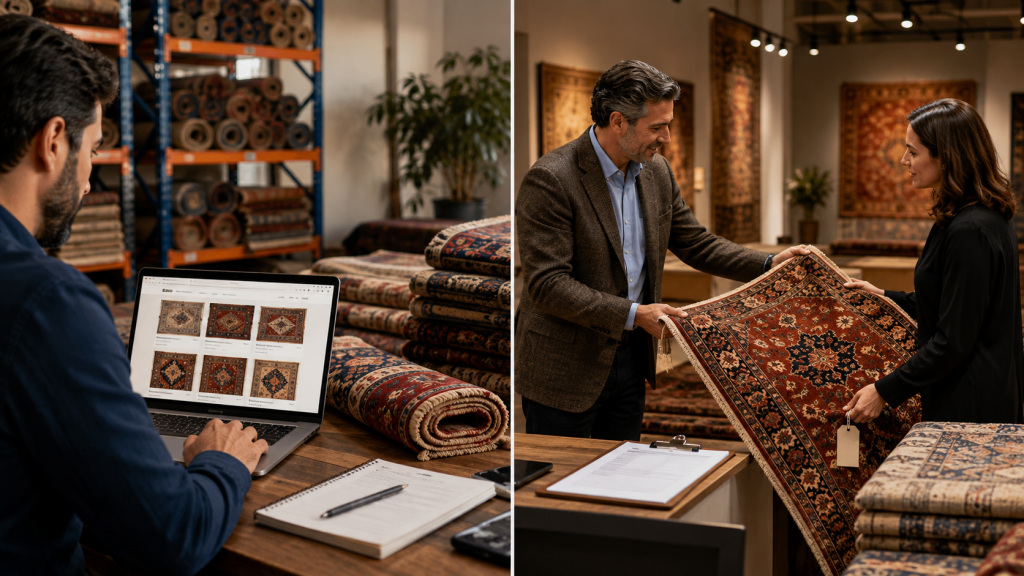
For rug sellers, the difference between a marketplace and consignment can be confusing. Both models can help a seller reach buyers, but they do not work the same way.
A rug marketplace usually lets sellers list their rugs online while keeping control of their inventory. Consignment usually means the seller gives the rug to another business, gallery, showroom, or platform to sell on their behalf. The biggest differences are possession, payment timing, control, and commission structure.
For rug dealers, galleries, collectors, importers, and private sellers, understanding this difference is important before choosing where to sell. The wrong model can create delays, unclear expectations, or lower profit. The right model can help sellers reach more buyers while keeping the process simple.
This guide explains how rug marketplaces and consignment work, where they differ, and which option may be better for different rug sellers.
Quick Answer
A rug marketplace lets sellers list rugs for sale while usually keeping possession of the inventory until a buyer purchases. Consignment usually requires the seller to hand over the rug to another party, which then stores, promotes, and sells it for a commission.
A marketplace gives sellers more control and faster flexibility. Consignment may offer more hands-on selling support, but the seller may have less control over timing, pricing, and access to the rug.
What Is a Rug Marketplace?
A rug marketplace is an online platform where sellers can list rugs for buyers to discover. The marketplace connects sellers and buyers but does not always take physical possession of the rug.
In this model, a seller usually creates a listing with product details, photos, measurements, material, origin, condition, price, and shipping information. Buyers browse the platform, compare rugs, and make purchase decisions.
The marketplace may provide visibility, product organization, payment support, seller tools, or buyer traffic. The seller remains responsible for accurate information and, depending on the platform, may still handle storage, packing, shipping, or fulfillment.
For rug sellers, this model can be useful because it creates online exposure without requiring the seller to give up inventory control.
What Is Rug Consignment?
Rug consignment is a selling model where the owner gives a rug to another party to sell on their behalf. This party may be a gallery, showroom, auction house, dealer, or consignment platform.
The consignee usually holds the rug, presents it to buyers, and completes the sale. After the rug sells, the original owner receives payment minus commission or agreed selling fees.
Consignment can be helpful when a seller wants someone else to handle presentation, storage, customer communication, and sales. But it also means the seller may not have immediate access to the rug and may need to wait longer for payment.
The rug may sit in a showroom or storage space for weeks or months before selling. If it does not sell, the seller may need to arrange return, pickup, or renegotiation.
Marketplace vs Consignment: Main Differences
The table below shows the most important differences for rug sellers.
| Factor | Rug Marketplace | Rug Consignment |
|---|---|---|
| Possession | Seller usually keeps the rug until sale | Consignee usually holds the rug |
| Payment timing | Seller is paid after marketplace sale is completed | Seller is paid after consignee sells the rug |
| Inventory control | Seller usually keeps more control | Seller gives up some control |
| Pricing control | Seller often sets or approves price | Price may be set or adjusted with consignee |
| Commission | Marketplace may charge listing, transaction, or commission fees | Consignee usually takes a sales commission |
| Speed | Can be listed quickly | May take longer due to intake and approval |
| Seller access | Seller can usually access the rug | Rug may be offsite |
| Sales support | Platform provides exposure and tools | Consignee may handle selling directly |
| Best for | Sellers who want control and online reach | Sellers who want someone else to manage the sale |
| Risk | Seller must manage listing quality and fulfillment | Seller may wait longer and lose flexibility |
Who Keeps Possession of the Rug?
Possession is one of the biggest differences.
In a marketplace model, the seller usually keeps the rug until it is sold. This means the rug can remain in the seller’s showroom, warehouse, collection, or inventory system. The seller can still show it to local customers, use it for photography, or move it if needed.
In consignment, the seller typically gives the rug to the consignee. The consignee may display it in a showroom, store it, photograph it, or present it to buyers. The seller no longer has direct access unless the agreement allows it.
This matters because rugs are physical, valuable, and sometimes one of a kind. A seller may want to keep the rug available for other buyers or local showroom traffic. If the rug is consigned, that flexibility may be reduced.
When Does the Seller Get Paid?
Payment timing is another major difference.
With a marketplace, the seller is usually paid after the rug sells and the transaction is completed according to the platform’s rules. The timing may depend on payment processing, buyer confirmation, shipping, delivery, or return policy.
With consignment, the seller is paid after the consignee sells the rug and collects payment from the buyer. In some cases, there may also be a waiting period before the seller receives funds.
This means consignment can take longer. The rug may need to be accepted, displayed, promoted, sold, delivered, and settled before the seller gets paid.
For sellers who want faster control over sales and cash flow, a marketplace may feel more direct. For sellers who do not want to manage the process themselves, consignment may still be worth the wait.
How Commission Works
Both marketplaces and consignment can involve fees, but the structure is different.
A rug marketplace may charge a listing fee, subscription fee, transaction fee, commission, payment processing fee, or a combination of these. The seller should review the fee structure before listing.
Consignment usually works through a commission percentage. The consignee takes a portion of the final sale price, and the seller receives the remaining amount. The commission may vary depending on rug value, selling effort, storage, photography, restoration, cleaning, or negotiation.
The key question is not only how much the fee is. Sellers should also ask what they receive in return.
Sellers should ask:
- Does the platform bring qualified buyers?
- Does the consignee actively promote the rug?
- Are photos included?
- Who handles buyer questions?
- Who handles shipping?
- Who handles returns?
- Who controls pricing?
A lower commission is not always better if the seller receives little support. A higher commission may be reasonable if the seller receives strong exposure, expert selling, and better buyer trust.
Which Model Gives More Control?
A marketplace usually gives the seller more control.
The seller can often control product information, pricing, availability, photos, and how quickly the rug is listed. The seller may also be able to update or remove the listing if the rug sells elsewhere.
Consignment usually gives the consignee more involvement. The consignee may decide how the rug is displayed, how it is described, how it is priced, and how it is negotiated with buyers.
This can be good if the consignee has strong expertise and buyer access. But it can be frustrating if the seller wants more control over pricing, timing, or presentation.
For professional rug dealers with existing inventory systems, marketplace selling may fit better. For private owners or sellers who do not want to handle buyer communication, consignment may be easier.
Which Model Is Better for Rug Dealers?
For active rug dealers, a marketplace is often more practical because it supports inventory control and online visibility.
A dealer may have many rugs in stock and may want to sell through multiple channels at the same time. The rug may be available in a showroom, online catalog, trade network, and marketplace listing. Keeping possession helps the dealer move faster when buyers ask questions or request photos.
A marketplace can also help dealers test demand. If a rug receives views, saves, inquiries, or offers, the dealer gains market feedback without giving the rug to another party.
Consignment may still make sense for dealers in some cases. For example, a dealer may consign rare, high-value, or slow-moving pieces to a trusted gallery with the right clientele. But for everyday inventory, a marketplace may offer more flexibility.
Which Model Is Better for Private Sellers?
Private sellers may prefer consignment if they do not know how to photograph, price, describe, store, ship, or negotiate a rug sale. A trusted consignee can manage the process and reduce the seller’s workload.
However, private sellers should understand the trade-off. They may receive payment later, pay a higher commission, and have less control over the rug during the sales period.
A marketplace can also work for private sellers if the platform is easy to use and offers enough guidance. If the seller can provide accurate photos, measurements, condition notes, and pricing, a marketplace may be a more direct option.
The best choice depends on how involved the seller wants to be.
Which Model Is Better for One-of-a-Kind Rugs?
One-of-a-kind rugs need careful handling because each piece is unique. If the rug is handmade, antique, vintage, Persian, Turkish, Caucasian, or collectible, the listing must be accurate.
A marketplace can work well when the seller has good photos, detailed descriptions, and direct access to the rug. The seller can answer questions quickly and provide additional information when buyers ask.
Consignment can work well when the rug needs expert presentation, appraisal, restoration advice, or access to a specific collector audience.
For valuable rugs, trust matters more than speed. Sellers should choose the model that protects the rug, explains it properly, and reaches the right buyer.
Common Seller Mistakes
One common mistake is assuming marketplace and consignment are the same. They are not. A marketplace connects buyers and sellers. Consignment usually means giving another party the rug to sell.
Another mistake is not asking who holds the rug. This should be clear before signing or listing.
A third mistake is not understanding the payment timeline. Sellers should know when they get paid and what conditions must be completed first.
A fourth mistake is focusing only on commission. A lower fee may not help if the platform has weak traffic or the listing gets no attention. A higher commission may be acceptable if the seller gets serious buyers and professional support.
A fifth mistake is unclear pricing. Sellers should know whether they control the asking price, whether offers are allowed, and whether the consignee can discount the rug.
Questions Rug Sellers Should Ask First
Before choosing a marketplace or consignment model, sellers should ask:
- Who keeps the rug before it sells?
- Who sets the price?
- Can the price be changed?
- What commission or fees apply?
- When does the seller get paid?
- Who handles photography?
- Who writes the product description?
- Who answers buyer questions?
- Who handles packing and shipping?
- What happens if the rug does not sell?
- Can the seller remove the listing?
- Are there storage or return fees?
These questions help avoid confusion and protect the seller’s expectations.
Marketplace Benefits for Rug Sellers
A rug marketplace can offer several advantages.
The seller can usually keep control of inventory. Listings can be created faster than traditional consignment intake. The rug can remain available through other sales channels. Sellers may also benefit from marketplace traffic and buyer discovery.
A marketplace can be especially useful for professional rug sellers who already have inventory, photos, descriptions, and shipping processes. It can help them reach more buyers without handing over physical control of every rug.
This model is also useful for sellers who want transparency. They can see their listings, manage availability, and often control pricing more directly.
Consignment Benefits for Rug Sellers
Consignment can also be useful in the right situation.
A seller may choose consignment when they want another business to handle selling, presentation, storage, and buyer communication. This can be helpful for private sellers, estates, collectors, or people who are unfamiliar with the rug market.
Consignment may also work when the consignee has a strong buyer network. A gallery with the right clients may be able to sell a special rug more effectively than the owner could alone.
The main benefit is convenience. The main trade-off is control.
Which Option Should You Choose?
Choose a marketplace if you want more control, faster listing, direct inventory access, and online exposure. This model is often better for rug dealers, importers, wholesalers, and sellers who already know their inventory.
Choose consignment if you want someone else to manage the selling process and you are comfortable giving up possession for a period of time. This model may be better for private sellers, estate sellers, or owners with a few special pieces.
Choose carefully if the rug is rare, high-value, damaged, antique, or difficult to price. In those cases, expert advice may be important before choosing either model.
Final Thoughts
Marketplace and consignment models both help rug sellers reach buyers, but they are built differently.
A rug marketplace usually gives sellers more control over possession, pricing, and inventory. Consignment gives another party more responsibility for selling, but it may also mean slower payment and less flexibility.
The best option depends on the seller’s goals. A professional rug dealer may prefer a marketplace because it supports active inventory and online reach. A private seller may prefer consignment because it reduces the work involved. A collector with a rare rug may compare both options before deciding.
For rug sellers, the most important thing is clarity. Know who holds the rug, who controls the price, when payment happens, and how commission is calculated. Once those details are clear, choosing between a marketplace and consignment becomes much easier.
FAQs
What is the difference between a rug marketplace and consignment?
A rug marketplace lets sellers list rugs for buyers to find, while consignment usually means giving the rug to another party to sell on the seller’s behalf.
Who keeps the rug in a marketplace model?
In many marketplace models, the seller keeps the rug until it sells. The exact process depends on the platform rules.
Who keeps the rug in consignment?
In consignment, the consignee usually holds the rug and sells it for the owner.
When does a rug seller get paid?
In a marketplace, the seller is usually paid after the transaction is completed. In consignment, the seller is paid after the consignee sells the rug and collects payment.
Is marketplace selling better than consignment?
Marketplace selling is often better for sellers who want control and online exposure. Consignment may be better for sellers who want someone else to manage the sales process.
Does consignment charge commission?
Yes, consignment usually charges a commission based on the final sale price. The percentage should be agreed before the rug is accepted.
Do rug marketplaces charge commission?
Many marketplaces charge listing fees, transaction fees, commission, subscription fees, or payment processing fees. Sellers should review the fee structure before joining.
Which model is better for rug dealers?
A marketplace is often better for active rug dealers because it allows them to keep control of inventory while reaching more buyers online.
Which model is better for private rug sellers?
Private sellers may prefer consignment if they want help with pricing, presentation, and buyer communication. A marketplace may work if they want more direct control.
What should rug sellers ask before choosing?
Sellers should ask who keeps the rug, who controls pricing, what fees apply, when payment happens, who handles shipping, and what happens if the rug does not sell.