


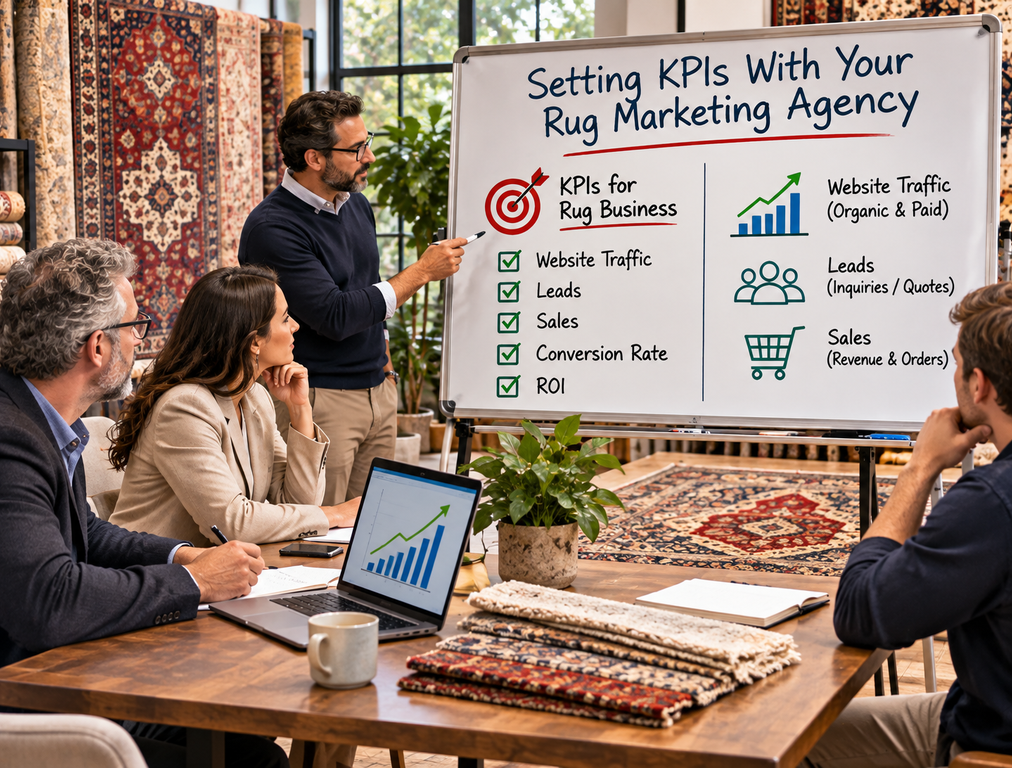
A rug business and its marketing agency can both work hard and still disagree about performance when they never agreed on what success actually means. The agency may report that organic impressions increased, Google Ads produced more conversions, and social engagement improved, while the business owner asks why showroom traffic, ecommerce revenue, or wholesale enquiries have not changed. Neither side necessarily has the wrong data. The problem is that they are evaluating different outcomes.
Key performance indicators should connect marketing activity with the objectives of the rug business. That means a showroom focused on high-value appointments needs different KPIs from an ecommerce retailer selling machine-made rugs nationwide, while a wholesaler looking for designer and dealer relationships needs another measurement structure again. The strongest KPI framework begins with the business model, defines the commercial outcome, and then identifies the marketing metrics that indicate progress toward that outcome.
Start With the Business Goal Before Choosing the Metric
A KPI should answer an important business question.
If the goal is growing ecommerce revenue, useful metrics might include qualified organic traffic, product-view engagement, ecommerce conversion rate, revenue, average order value, customer acquisition cost, and contribution after advertising.
If the goal is increasing showroom business, the measurement system may focus on local visibility, calls, appointment requests, directions, qualified leads, completed appointments, and showroom sales.
If the goal is expanding designer and wholesale relationships, the agency may track qualified trade applications, sample requests, active designer accounts, quote opportunities, and revenue from trade customers.
Choosing the metric first creates the opposite problem. The business begins optimizing whatever is easiest to measure instead of what actually matters.
Separate Primary KPIs From Supporting Metrics
Not every number in a marketing report deserves to be called a KPI.
A rug store may monitor hundreds of metrics, including impressions, clicks, rankings, sessions, engagement rate, product views, email opens, CPC, CTR, and keyword positions. These can help diagnose performance but do not all need to determine whether the marketing program succeeded.
Primary KPIs should represent the outcomes the business cares about most. Supporting metrics explain how those outcomes are developing.
For example, organic clicks may be a useful supporting indicator for SEO, while qualified organic leads or ecommerce revenue may be closer to the primary commercial result.
This distinction prevents dashboards from becoming crowded with metrics that increase without creating meaningful business growth.
Set Different KPIs for Different Marketing Channels
SEO, paid search, email, social media, and local search operate differently and should not always be judged by identical metrics.
SEO may be evaluated through non-branded visibility, qualified organic clicks, important landing-page performance, conversions, revenue, and growth in strategically important topic clusters.
Paid search may require conversion value, qualified leads, cost per acquisition, ROAS, and profitability.
Email marketing may focus on revenue from campaigns and automation, repeat purchases, lead nurturing, and customer engagement.
Local SEO may focus more heavily on visibility for high-intent local searches, calls, directions, appointments, and showroom visits.
Danabak’s guide to rug-store marketing channels helps illustrate why different acquisition channels need different expectations rather than one universal KPI.
Organic Impressions Can Be Useful, but They Need Context
Impressions are often important during SEO growth because they can reveal that Google is beginning to show more pages and queries even before clicks increase substantially.
However, impressions should not be interpreted without context.
An increase from relevant searches such as “Persian rug store Dallas,” “handmade rugs near me,” or commercially useful product queries may support business objectives. An increase caused mainly by broad informational queries unrelated to the store’s products may create less commercial value.
The agency should therefore connect impression growth with query type, landing pages, position, geographic relevance, and later conversion behavior.
The same metric can represent very different outcomes depending on where the visibility came from.
Rankings Should Focus on Strategic Queries
Keyword rankings remain useful for diagnosis, but they should not become the entire SEO KPI framework.
A rug retailer may rank number one for an obscure term nobody searches while remaining invisible for commercially valuable category and local searches.
The agency should group rankings according to business importance rather than celebrating every upward movement equally.
Priority groups might include commercial category terms, location-based searches, designer or wholesale searches, branded queries, and informational topics supporting important commercial pages.
A strong keyword strategy should therefore influence KPI reporting so the business sees whether visibility is improving in areas connected with actual buyer intent.
Measure Qualified Leads, Not Only Forms
A form submission is easy to track. A good lead is harder to define.
A rug showroom may receive twenty enquiries in one month, but if twelve are spam, three are unrelated vendor pitches, and two are outside the service area, the raw conversion total creates an inaccurate picture.
The business and agency should agree on what makes a lead valid and what makes it qualified.
For example, a qualified designer lead may require a legitimate design firm, project information, and genuine interest in purchasing or specifying rugs. A showroom lead may need to come from the relevant geographic market and represent real buying intent.
Reporting both raw and qualified leads creates much better visibility into marketing quality.
Ecommerce Revenue Needs Profitability Context
Revenue is one of the most useful ecommerce KPIs, but it should not be treated as identical to profit.
Two rug categories can generate the same revenue while having very different product costs, shipping expenses, discount levels, and return rates.
For advertising, ROAS should therefore be connected with category margins and break-even thresholds rather than choosing an arbitrary target.
For organic search, the agency may also look at revenue by landing-page group, product category, new versus returning customer, and other segments that explain where profitable growth is coming from.
A strong ROI framework should connect marketing results with business economics rather than reporting revenue in isolation.
Showroom Businesses Need Offline KPIs
A rug showroom can have a website that generates substantial commercial value without processing the final transaction online.
A shopper may discover the business through Google, browse several rugs, book an appointment, visit the showroom, and purchase a rug through the point-of-sale system.
If reporting measures only ecommerce revenue, that journey disappears.
The business should therefore track appointment requests, calls, showroom visits where possible, CRM opportunities, and offline revenue influenced by digital marketing.
The exact attribution may never be perfect, but a reasonable connection between digital leads and offline sales provides a more complete picture than treating the website as though it exists only for ecommerce.
Designer and Wholesale KPIs Need a Longer View
Trade relationships can have longer sales cycles than ordinary consumer purchases.
An interior designer may request samples today, specify rugs several weeks later, and place a significant order after client approval. A retailer evaluating a new wholesaler may need several conversations before opening an account.
Measuring these programs only by immediate online revenue can make valuable acquisition activity appear unsuccessful.
Useful milestones can include qualified trade applications, sample requests, active opportunities, first orders, repeat orders, and revenue by trade account.
The agency should understand how the sales process works before deciding which stage represents meaningful progress.
Cost Per Lead Should Use Qualified Leads Where Possible
A campaign can appear extremely efficient when every submitted form counts as a lead.
Suppose one campaign spends $2,000 and produces forty forms, creating a reported cost per lead of $50. If only ten of those forms represent legitimate opportunities, the effective cost per qualified lead is $200.
That difference can completely change how the business evaluates the campaign.
When CRM or sales data is available, qualified-lead cost should be included in reporting instead of relying entirely on the easiest conversion event available inside the advertising platform.
This gives the agency stronger signals for optimization as well.
Use Baselines Before Setting Growth Targets
Targets should be based on actual historical performance rather than arbitrary percentages.
If a rug store currently receives 2,000 organic clicks per month, generates twenty qualified leads, and converts five into customers, the agency has a meaningful baseline.
A target can then be established according to expected opportunity, competitive environment, planned investment, technical condition, and implementation resources.
A business with no historical data may need an initial measurement period before reliable targets can be set.
Setting a 50 percent growth target simply because it sounds ambitious does not make it realistic or strategically useful.
Targets Need a Time Frame
A KPI without a period is incomplete.
“Increase organic traffic” does not say when the increase should happen.
“Improve qualified organic leads over the next six months” provides a clearer framework, although the exact numerical target still needs to be justified.
Different channels also move at different speeds. Paid campaigns can often generate data quickly, while SEO improvements may require crawling, indexing, ranking changes, and enough user activity before the impact becomes visible.
The reporting cadence should therefore match the expected pace of the strategy.
Avoid Guaranteeing Rankings as a KPI
A business can reasonably ask its agency to improve organic visibility for strategically important searches. It should be more cautious about contractual guarantees that a particular keyword will reach position one by a fixed date.
Search rankings depend on many factors outside an agency’s direct control, including competitors, Google systems, user intent, website authority, and changes across the search landscape.
A more practical KPI framework combines rankings with impressions, clicks, landing-page performance, conversions, and commercial outcomes.
The goal is sustainable visibility and business growth rather than one isolated ranking screenshot.
Report Branded and Non-Branded Search Separately
A business with strong offline recognition can generate substantial branded search even without major SEO improvements.
If branded queries and non-branded discovery are combined, a marketing report may make organic acquisition look stronger than it really is.
Separating the two helps the business understand whether SEO is reaching people who already knew the company or attracting new search demand.
Both are valuable, but they represent different marketing outcomes.
This distinction can be especially useful for established rug showrooms with decades of local brand recognition.
Local SEO KPIs Should Include Commercial Actions
Local rankings can be useful, but the ultimate goal of local SEO is usually customer action.
For a rug showroom, that may mean phone calls, direction requests, appointments, website visits, and completed sales.
Track visibility for important local queries, but connect those rankings with the actions that follow.
A business that moves from position seven to position three for a high-intent local term and begins receiving more qualified calls has a much stronger result than one that improves rankings for a low-value query with little customer activity.
Content KPIs Should Reflect the Role of the Content
Not every blog needs to generate an immediate sale.
Some articles introduce potential buyers to the brand, answer questions before purchase, support product categories through internal links, earn backlinks, or improve topical visibility.
The agency should define why a content cluster exists before deciding how to measure it.
A bottom-of-funnel article may reasonably be evaluated through conversions and assisted revenue. An educational article may be measured through qualified impressions, clicks, engagement, backlinks, and whether it helps users move toward relevant commercial pages.
Content KPIs should follow search intent rather than expecting identical outcomes from every article.
Set Reporting Definitions in Writing
Small differences in definitions can create major disagreements later.
Does “lead” mean every form or only validated enquiries? Does “revenue” mean gross ecommerce revenue or net revenue after refunds? Does ROAS use purchase value from Google Ads or actual completed order revenue? Does organic traffic include branded searches?
The business and agency should define these terms during onboarding.
This is particularly important when several platforms report different versions of the same metric.
A clear KPI document can prevent future meetings from becoming arguments about which dashboard is correct.
Review KPIs When the Strategy Changes
KPIs should remain stable enough to track progress, but they should not be permanent when the business model changes.
A rug retailer that begins the year focused on ecommerce might later prioritize designer accounts. A showroom may open a new location. A wholesaler may enter another regional market.
The measurement framework should evolve with those decisions.
The important rule is to document the change rather than quietly replacing one metric when it becomes inconvenient.
Connect Agency Fees With the Scale of the Goal
Marketing expectations should also reflect investment.
A company cannot reasonably expect an agency to execute technical SEO, paid advertising, local SEO, content production, email marketing, social media, conversion optimization, and extensive development within a budget designed for one channel.
The existing Danabak guide to marketing budgets can help businesses think about how scope and investment influence what a realistic KPI plan can include.
Targets should challenge the marketing program while remaining connected to the resources available to execute the work.
Final Thoughts
Setting KPIs with a rug marketing agency should begin with the business result, not with the marketing platform.
A showroom may care most about qualified appointments and offline sales. An ecommerce store may prioritize revenue, acquisition cost, and profitable category growth. A wholesaler may care about trade accounts and repeat orders. SEO, advertising, content, and local visibility then provide the supporting metrics that explain how those outcomes are developing.
Separate primary KPIs from diagnostic metrics, define qualified leads clearly, connect ecommerce revenue with profitability, establish historical baselines, and set realistic time frames. Document what every important metric means so the client and agency are reading the same numbers in the same way.
When KPIs are structured properly, reporting stops being a monthly collection of charts and becomes a decision-making system. The business can see which channels are creating commercially useful progress, where investment should change, and whether the marketing agency is helping move the company toward the goals both sides agreed to pursue.
FAQs
What KPIs should a rug store track?
The correct KPIs depend on the business model but may include qualified leads, ecommerce revenue, showroom appointments, acquisition cost, ROAS, organic clicks, trade enquiries, and sales.
Are keyword rankings a good SEO KPI?
They are useful as supporting indicators, especially for strategically important queries, but they should be evaluated alongside visibility, clicks, conversions, and business outcomes.
Should impressions be included in SEO reporting?
Yes, when they help explain changes in search visibility. They are most useful when segmented by relevant queries, pages, positions, and buyer intent.
What is the difference between a lead and a qualified lead?
A raw lead is an enquiry received by the business. A qualified lead meets defined criteria showing that the person or company represents a legitimate and commercially relevant opportunity.
How often should marketing KPIs be reviewed?
Most businesses benefit from monthly performance reviews, while some campaign metrics may be monitored more frequently. The KPI framework itself should also be reviewed when business goals or marketing strategy change.