


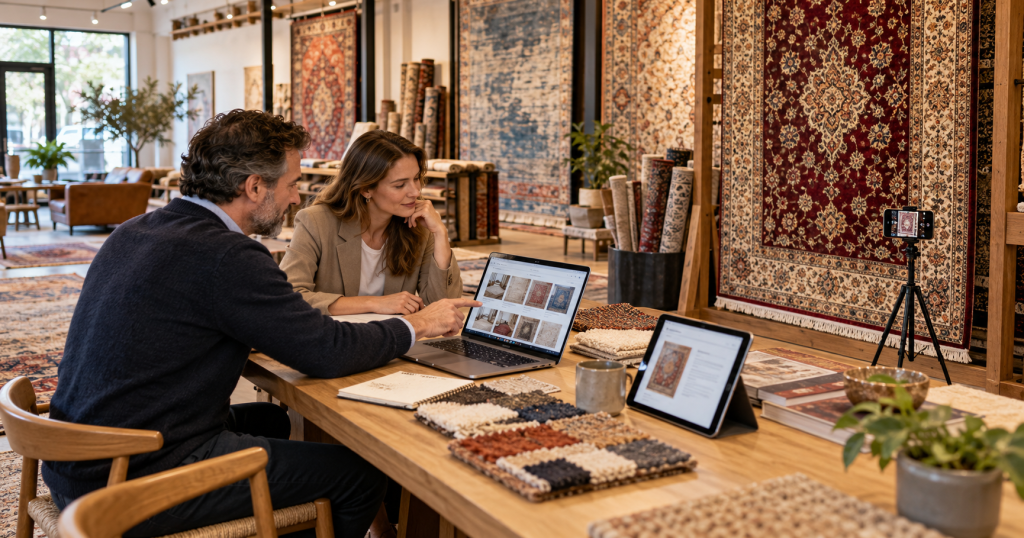
Rug businesses have more marketing options than ever, but having more channels does not automatically make marketing easier.
A rug store can invest in SEO, Google Ads, Google Maps, email, social media, content, marketplace listings, designer outreach, industry publications, review generation, and many other activities.
The challenge is deciding which channels deserve the most attention.
For most rug businesses, the best answer is not choosing one marketing channel.
Different channels support different stages of the customer journey.
Someone searching Google for a rug store near them may be ready to visit a showroom today. Someone reading about handmade rug construction may still be researching. An interior designer browsing a trade page may represent a long-term professional relationship rather than an immediate retail sale.
A strong rug marketing strategy connects these different audiences instead of treating every channel as an isolated campaign.
The right marketing mix depends on the type of rug business, its customers, geographic reach, inventory, margins, and growth objectives.
What Is the Best Marketing Channel for a Rug Store?
There is no single best marketing channel for every rug business.
The most effective channel depends on what the business is trying to achieve.
A local showroom may receive the strongest return from local SEO, Google Maps, reviews, and high-intent paid search.
An e-commerce rug seller may depend more heavily on organic product visibility, category SEO, Google Shopping, email, and conversion optimization.
A luxury or antique rug dealer may benefit from educational content, search visibility, industry authority, designer relationships, and strong brand presentation.
A wholesaler may care more about trade relationships, email, LinkedIn, and direct outreach than consumer social media.
The best strategy begins by matching the channel with the buyer.
Why Rug Marketing Requires Multiple Channels
Rug purchases can involve a long decision process.
A customer may first discover a store through Google.
They may visit the website, browse several rugs, read a guide about sizing, check reviews, leave the site, return through a branded search, and finally visit the showroom.
Another customer may discover the company through an interior designer.
Another may see a rug on social media and later search for the business directly.
This means the final sale may have been influenced by several channels.
That is why successful rug marketing often works as a system.
• SEO creates long-term discoverability.
• Google Ads captures immediate search demand.
• Local SEO drives nearby customers.
• Content answers questions and builds authority.
• Email brings interested buyers back.
• Reviews strengthen trust.
• Social media supports visual discovery.
• Designer marketing creates professional relationships.
The most effective mix depends on which of these activities supports the business model.
SEO Is One of the Strongest Long-Term Channels
Search engine optimization can be especially valuable for rug businesses because customers actively search for specific products, services, styles, and local stores.
Someone may search for Persian rugs, handmade rugs, area rugs, oversized rugs, rug cleaning, rug repair, antique rugs, or a showroom near their city.
These searches represent existing demand.
A strong SEO strategy helps the business become visible when those searches happen.
Unlike advertising, organic visibility does not disappear immediately when the daily budget stops.
A well-ranked category page, location page, or educational article can continue attracting potential customers over time.
That makes SEO particularly useful for businesses that want to reduce long-term dependence on paid customer acquisition.
What Rug Store SEO Should Focus On
Rug SEO should not be limited to publishing blog articles.
The entire website needs to support search visibility.
Important areas include:
• Product category pages
• City and showroom pages
• Service pages
• Product descriptions
• Technical SEO
• Internal linking
• Structured data
• Educational content
• Google Business Profile
• Review signals
A business selling rugs in several cities may need a different SEO structure from a national e-commerce seller.
The search strategy should reflect how customers actually find and purchase the products.
SEO Works Best for Existing Search Demand
SEO is particularly effective when customers already search for what the business offers.
For example, a showroom does not need to convince people that rug stores exist.
Customers are already searching for local rug stores.
The goal is to become one of the businesses they discover.
The same applies to searches for rug cleaning, repair, Persian rugs, antique rugs, runners, and other product categories.
This existing demand makes SEO a strong foundation for many rug businesses.
Local SEO Is Essential for Physical Showrooms
A physical rug showroom should treat local search as a major marketing channel.
Customers often search for nearby businesses using queries such as rug store near me, Persian rugs near me, rug cleaning near me, or rug showroom in a specific city.
Google may display map results prominently for these searches.
That means visibility in local results can directly influence store visits.
Local SEO includes the website, Google Business Profile, reviews, local citations, location information, photos, service details, and local relevance.
The goal is not simply ranking.
The goal is making it easy for nearby buyers to discover, trust, contact, and visit the showroom.
Google Business Profile Can Influence Showroom Traffic
For local rug stores, Google Business Profile may be one of the most important digital assets outside the website.
Potential customers can see the business name, photos, reviews, address, directions, hours, phone number, and website before ever visiting the site.
A complete profile helps reduce uncertainty.
Customers should be able to understand what type of rug business they are considering.
Real showroom photos can be particularly useful because rugs are visual products.
Customers may want to know whether the store offers handmade rugs, antique pieces, modern designs, cleaning services, or designer support before making the trip.
Reviews Strengthen Local Marketing
Reviews support both trust and local visibility.
A buyer considering an expensive handmade rug may want reassurance that the business is knowledgeable, reliable, and established.
Strong reviews can provide that reassurance.
Rug stores should therefore make review generation part of normal customer follow-up.
The goal should be natural, consistent review growth rather than sudden bursts of low-quality feedback.
Helpful reviews often mention specific experiences such as:
• Rug selection
• Staff knowledge
• Showroom experience
• Delivery
• Cleaning or repair
• Designer support
• Product quality
These details help future buyers understand what the business actually does.
Google Ads Works for Immediate Demand
SEO can take time.
Google Ads provides a way to become visible more quickly for searches that matter.
A rug business can advertise for high-intent searches related to products, services, or local showroom visits.
A carefully structured Google Ads campaign can be useful when the business wants immediate lead generation while organic rankings continue developing.
The key is targeting intent.
Someone searching for a rug store near them may be closer to purchasing than someone searching for general rug decorating ideas.
Advertising budgets should prioritize searches that have a realistic connection to revenue.
Google Search Ads Work Well for Local Intent
Search ads can be particularly useful for showrooms.
A customer searching for a rug store, Persian rug dealer, or rug cleaning service is actively looking for a solution.
The advertisement can send that person directly to the relevant page.
The landing page should match the search.
A customer searching for rug cleaning should not land on a generic homepage if a dedicated cleaning page exists.
A customer searching for a showroom in Dallas should see the Dallas location.
Relevance helps both conversion and advertising efficiency.
Google Shopping Can Support E-Commerce Rug Sellers
E-commerce rug stores have additional advertising opportunities.
Shopping campaigns can display product images, prices, and merchant information directly in search results.
This visual format can work well for rugs because appearance is central to the buying decision.
However, Shopping campaigns need strong product data.
Titles, images, pricing, availability, categories, and landing pages all influence performance.
A large advertising budget cannot compensate for weak product feeds and poor product presentation.
Paid Advertising Should Not Replace Organic Growth
Advertising can produce fast visibility, but relying entirely on paid traffic creates risk.
When advertising stops, paid visibility stops.
This is why SEO, content, email, reviews, and brand development should continue alongside paid campaigns.
Paid acquisition works best when it complements owned marketing assets.
The goal should be a balanced system where the business does not need to purchase every customer interaction indefinitely.
Content Marketing Helps Rug Businesses Build Authority
Rugs create many customer questions.
Buyers want to know how to choose the right size, what materials mean, how handmade rugs differ from machine-made rugs, how rugs should be cleaned, and which styles work in certain rooms.
These questions create content opportunities.
Educational content can attract potential customers while they are researching.
It can also support commercial pages through internal linking and topical relevance.
A blog about choosing a living room rug can support rug category pages.
An article about handmade construction can support handmade inventory.
A guide about rug store marketing channels can support a broader marketing service page.
The strongest content is connected to the business rather than published randomly.
Content Should Support Commercial Pages
Traffic alone should not determine whether a blog is successful.
A useful article should have a role inside the website.
It may:
• Support a product category
• Strengthen a service page
• Answer a common customer question
• Build internal links
• Attract backlinks
• Introduce buyers to the brand
• Support a local page
• Help a designer research products
This approach turns content into part of the marketing structure.
The goal is not publishing for the sake of publishing.
The goal is building topic authority that supports commercial performance.
Email Marketing Helps Convert Existing Interest
Many rug businesses focus heavily on acquiring new visitors while doing little with people who already know the company.
Email can help close that gap.
A customer may not purchase during the first website visit.
An interior designer may not need inventory today.
A showroom visitor may still be comparing options.
A structured email marketing program allows the business to continue the relationship.
Email can support:
• New arrivals
• Designer updates
• Showroom events
• Product education
• Review requests
• Abandoned inquiries
• Seasonal collections
• Past customers
• Trade communication
The strongest email strategy is usually segmented rather than sending the same message to everyone.
New Arrival Emails Can Work Well for Rug Stores
Rug inventory changes constantly.
This gives businesses a natural reason to communicate with subscribers.
A customer who did not find the right rug last month may be interested in a new arrival today.
Designers may want to know when particular sizes, styles, colors, or antique pieces become available.
Instead of sending generic promotional emails, stores can make inventory itself part of the communication strategy.
That keeps email useful rather than repetitive.
Email Is Especially Important for High-Value Purchases
Expensive purchases often require time.
A customer may browse an antique rug several times before making a decision.
Email allows the business to stay visible during that period.
This can be especially valuable when combined with good website tracking and lead segmentation.
A potential luxury buyer should not necessarily receive the same follow-up as someone browsing lower-priced machine-made rugs.
Customer intent should influence communication.
Social Media Works Best as a Visual Discovery Channel
Rugs are highly visual products, which makes social media useful for discovery.
Platforms built around imagery can help stores showcase new inventory, styling ideas, showroom scenes, designer projects, restoration work, and behind-the-scenes content.
However, businesses should be realistic about social media.
A large follower count does not necessarily translate into sales.
The channel is most useful when it supports broader business goals.
For example, social content can lead customers toward:
• Product pages
• Showroom visits
• Designer programs
• Email signup
• New collections
• Educational content
• Events
Social media should support the customer journey instead of becoming a separate popularity contest.
Use Real Rug Photography
Authenticity matters.
Rug businesses already have a major visual advantage because the inventory itself can provide content.
Real rug photography can showcase texture, colors, scale, craftsmanship, and showroom atmosphere.
This can be more valuable than relying heavily on generic stock imagery.
Customers want to understand what they can actually buy or experience.
The closer social content reflects the real inventory and business, the stronger the connection between marketing and sales.
Designer Marketing Can Be Extremely Valuable
Interior designers can become highly valuable customers because they purchase for multiple projects.
One strong designer relationship may produce more long-term revenue than many one-time retail customers.
Rug businesses targeting designers should therefore consider trade marketing as a separate channel.
The strategy may include:
• Trade programs
• Designer pricing
• Professional photography
• Trade newsletters
• Product sourcing support
• Project quotes
• Appointment scheduling
• Custom rug information
• New-arrival communication
The goal is not simply attracting a designer once.
The goal is becoming a reliable sourcing partner.
Designer Relationships Need Dedicated Website Support
A designer should not need to search through a consumer website to understand whether trade services exist.
A dedicated trade page can explain how the business works with professionals.
The site can include information about product sourcing, pricing, custom rugs, shipping, photography, reserves, appointments, and project support.
Good website design becomes important because the site needs to serve several customer types without becoming confusing.
A retail shopper and a professional designer may have different needs.
The website should support both.
Industry Publications Can Build Authority
Industry visibility can support credibility and discovery.
A rug business featured in a respected publication, market report, designer resource, or industry directory may gain exposure beyond traditional advertising.
These mentions can also strengthen brand recognition.
In some cases, they may generate valuable backlinks.
For specialist rug businesses, authority matters because buyers may research the company before making a high-value purchase.
Industry coverage can become part of that trust-building process.
Marketplaces Can Be a Useful Distribution Channel
Marketplaces can expose rug businesses to audiences they may not reach independently.
This can help sellers test products, expand geographic reach, and generate additional sales.
But marketplaces should be treated as channels rather than complete marketing strategies.
The business does not fully control the audience, platform, search system, or customer relationship.
A strong independent website remains important for brand development, direct traffic, email growth, SEO, and customer ownership.
Marketplaces can complement the website.
They should not necessarily replace it.
Referral Marketing Is Often Underused
Rug businesses can generate powerful referrals through existing relationships.
Past customers may recommend the showroom to friends.
Interior designers may recommend the business to clients.
Realtors, builders, architects, home stagers, furniture stores, and other home professionals may also create relevant referrals.
These relationships may not generate thousands of website sessions, but they can produce highly qualified leads.
That makes referral marketing especially valuable for premium and local rug businesses.
Partnerships Can Extend Local Reach
Local partnerships can increase visibility without relying only on advertising.
A rug store might collaborate with interior designers, furniture showrooms, art galleries, architects, home renovation companies, or design events.
The most effective partnerships have genuine audience overlap.
A rug store does not need to partner with every local company.
It needs relationships with businesses serving similar customers.
This can support referrals, events, content, and local brand awareness.
Which Channels Work Best for Local Rug Stores?
For a showroom-focused business, the strongest combination will often include:
• Local SEO
• Google Business Profile
• Reviews
• Google Search Ads
• Website conversion
• Email follow-up
• Referral relationships
• Interior designer marketing
Social media and content can support these channels, but they should not distract from high-intent local discovery.
The primary objective is usually getting the right nearby customers into the showroom.
Which Channels Work Best for E-Commerce Rug Stores?
Online rug businesses typically need a different mix.
Priority channels may include:
• Product and category SEO
• Google Shopping
• Search advertising
• Email automation
• Content marketing
• Retargeting
• Marketplace visibility
• Organic social content
• Conversion optimization
An online store needs enough traffic, but traffic quality and website conversion are equally important.
Increasing traffic without improving product pages or checkout can simply increase marketing waste.
Which Channels Work Best for Luxury Rug Dealers?
Luxury rug marketing should emphasize trust and expertise.
The best channels may include organic search, educational content, designer relationships, industry authority, email, strong photography, and highly targeted paid search.
Luxury customers may take longer to make decisions.
The business therefore needs a marketing system that supports research and relationship building rather than relying entirely on immediate transactions.
Which Channels Work Best for Antique Rug Dealers?
Antique rugs often require explanation.
Buyers may care about age, origin, condition, restoration, craftsmanship, and provenance.
This makes educational SEO and content particularly useful.
Specialist publications, collector visibility, email, designer relationships, and high-quality product presentation can also contribute.
The goal is to communicate why the piece is valuable rather than simply showing the price.
Which Channels Work Best for Rug Cleaning and Repair?
Service-focused businesses rely heavily on local intent.
A strong mix may include local SEO, Google Business Profile, reviews, search ads, service pages, local content, and referral relationships.
Customers searching for rug cleaning or repair often have a clear immediate need.
This makes search visibility especially important.
The business should make contacting the company simple.
Phone calls, quote forms, and service information should be easy to find.
Avoid Spreading Budget Across Too Many Channels
Being present everywhere can sound appealing.
In practice, it can dilute the marketing budget.
A small rug business may not have enough resources to manage SEO, five social platforms, paid ads, YouTube, newsletters, marketplaces, influencer campaigns, and events simultaneously.
Doing ten channels poorly is rarely better than doing four important channels well.
Choose channels based on:
• Customer intent
• Business model
• Available budget
• Internal capacity
• Measurable results
• Long-term value
Expansion can happen after the core system performs consistently.
Start With High-Intent Channels
When budgets are limited, prioritize customers closest to buying.
For many rug stores, this means search.
Someone actively searching for a rug store, Persian rug, antique rug, rug cleaning service, or nearby showroom has already demonstrated intent.
SEO, local search, and Google Ads can capture this demand.
Once the business has a reliable system for high-intent customers, it can invest more heavily in awareness channels.
This approach is often more efficient than starting with broad audience building.
Then Build Long-Term Demand
High-intent channels capture people already searching.
Content, social media, designer relationships, PR, and email can expand the audience beyond immediate search demand.
These channels help the business create recognition and remain visible until customers are ready.
A balanced strategy does both.
It captures demand that exists today while developing future demand and brand awareness.
Measure Every Channel Against Its Purpose
Do not judge email based on keyword rankings.
Do not judge SEO based on Instagram followers.
Do not judge local SEO only by national traffic.
Each channel has a job.
SEO should improve relevant organic discovery.
Paid search should capture profitable intent.
Email should nurture and retain customers.
Local SEO should support showroom discovery.
Social media should strengthen visual awareness and engagement.
Designer marketing should create professional relationships.
The metrics should reflect the channel’s purpose.
Connect Marketing Channels Through Internal Processes
The strongest results often come from connection between channels.
SEO can bring a customer to the website.
Good content can answer their question.
Website design can help them find relevant inventory.
Email can bring them back later.
Reviews can strengthen trust.
Google Ads can reintroduce the brand during another search.
A salesperson can complete the purchase in the showroom.
None of these channels needs to receive all the credit.
Together they created the customer journey.
That is why marketing should be managed as a connected system.
Build Around Owned Assets
Marketing channels controlled by the business deserve special attention.
A website is owned.
An email database is owned.
Original content is owned.
Customer relationships are owned.
A strong local reputation belongs to the business.
Social platforms and marketplaces can be extremely useful, but they are controlled by other companies.
Algorithms, policies, fees, and visibility can change.
A healthy marketing strategy should use outside platforms while continuing to strengthen assets the business controls.
How Should a Rug Store Allocate Its Marketing Budget?
There is no universal percentage.
Budget should follow opportunity and business objectives.
A new showroom with weak local visibility may need heavier local SEO and advertising investment.
An established store with strong rankings may focus more on conversion, email, and designer relationships.
An e-commerce company with strong traffic but low sales may need website improvements before buying more visitors.
A store entering a new city may invest more heavily in location pages, local links, Google Business Profile, and paid search.
The strongest budget addresses the biggest growth bottleneck.
Review Channel Performance Regularly
Marketing channels should not run indefinitely without evaluation.
A rug business should review performance monthly and examine broader trends quarterly.
Look at:
• Spend
• Leads
• Sales
• Customer acquisition cost
• Organic visibility
• Showroom appointments
• Calls
• Designer inquiries
• Repeat purchases
• Revenue by source
The goal is not to eliminate every channel that has a slow month.
The goal is identifying consistent patterns.
Invest More in Channels That Prove Their Value
If a channel repeatedly produces profitable customers, it may deserve more resources.
If local SEO is generating showroom visits, strengthen it.
If designer email campaigns produce repeat orders, expand them.
If a product category is gaining organic search visibility, support it with stronger content and internal links.
If Google Ads is generating profitable service calls, consider increasing budget carefully.
Marketing should evolve based on evidence.
Final Thoughts
The best marketing channels for rug stores depend on the business, audience, inventory, location, and growth strategy.
There is no single platform that can solve every marketing problem.
SEO helps customers discover the business through search.
Local SEO connects nearby customers with showrooms.
Google Ads captures immediate demand.
Content builds relevance and authority.
Email develops existing relationships.
Social media supports visual discovery.
Reviews strengthen trust.
Designer marketing creates professional relationships.
Marketplaces expand distribution.
Referrals connect the business with highly qualified customers.
The strongest strategy combines the channels that fit the business rather than trying to be everywhere.
For many rug businesses, the foundation should begin with high-intent search visibility, a strong website, clear local presence, customer reviews, and reliable follow-up.
From there, content, designer marketing, email, social media, and other channels can expand the system.
The important question is not which marketing channel is the most popular.
The important question is which combination consistently brings the right customers to the rug business and turns those relationships into profitable, repeatable growth.
FAQs
What is the best marketing channel for a rug store?
There is no single best channel. Local SEO, organic search, Google Ads, email, reviews, content, and designer marketing can all perform well depending on the business model.
Is SEO worth investing in for rug stores?
Yes. Rug buyers actively search for products, services, styles, and local showrooms, which gives rug businesses many opportunities to attract relevant organic traffic.
Does Google Ads work for rug stores?
Google Ads can work well when campaigns target high-intent searches and send visitors to relevant landing pages with accurate conversion tracking.
Is social media important for rug businesses?
Yes, particularly for visual discovery and brand awareness. However, follower growth should not replace high-intent channels such as search and local SEO.
What marketing channels should a local rug showroom prioritize?
Local SEO, Google Business Profile, reviews, search advertising, website conversion, email, designer relationships, and local referrals are often particularly valuable.
What channels should an online rug store prioritize?
E-commerce rug sellers often benefit from product SEO, category SEO, Google Shopping, paid search, email automation, content, retargeting, and conversion optimization.
Is email marketing useful for rug stores?
Yes. Email can help rug stores promote new inventory, follow up with interested buyers, communicate with designers, request reviews, and encourage repeat purchases.
Should rug businesses sell through marketplaces?
Marketplaces can be valuable distribution channels, but businesses should continue investing in their own website, customer relationships, SEO, and brand.
How many marketing channels should a small rug store use?
A small store should focus on a manageable number of channels that match customer intent and available resources rather than trying to maintain every possible platform.
How can a rug business know which channel performs best?
Track qualified leads, calls, showroom appointments, customer acquisition cost, sales, repeat purchases, and revenue by channel instead of judging performance only by traffic or impressions.