


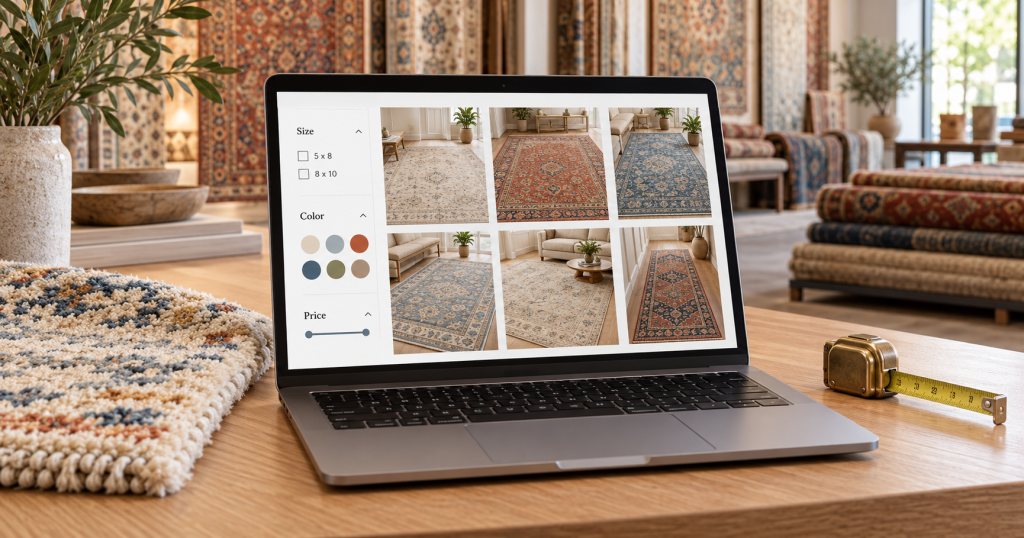
Filters make a large rug website easier to shop. A customer looking through hundreds or thousands of rugs may want to narrow the collection by size, color, style, material, origin, construction, price, shape, or availability. From a user experience perspective, that is exactly what a good ecommerce website should allow.
SEO becomes more complicated when every filter selection creates a new URL.
A rug category might begin with a simple page such as /persian-rugs/. A customer then selects blue, 8×10, wool, and a particular price range. Depending on how the website is built, that one filtering session may create several crawlable URLs. Change the order of the filters or add another attribute and the website can generate even more variations.
Multiply that across dozens of colors, sizes, materials, origins, styles, shapes, and price ranges, and a rug website with 2,000 actual products can theoretically expose search engines to many thousands of filtered URLs.
That does not mean filters are bad for SEO. It means the business needs to distinguish between filters that help shoppers navigate the website and filtered pages that deserve to become search results themselves.
For most rug stores, the correct answer is no, Google should not index every size, color, price, material, and filter combination. Some filtered pages can become valuable SEO landing pages when they match meaningful search demand. Most combinations should remain tools for customers rather than independent pages competing in Google’s index.
This distinction is one of the most important parts of rug website filter SEO.
Filters and SEO Pages Are Not the Same Thing
A filter exists primarily to help someone already on the website narrow a product selection.
An SEO landing page exists because people search for that collection independently.
Those two purposes can overlap, but they are not automatically identical.
Imagine a rug store has a category containing 800 area rugs. Giving visitors filters for size, color, material, shape, style, and price makes the collection much easier to use. Someone can quickly narrow 800 products down to the twelve that match their room.
Now imagine that every selection creates an indexable URL.
The website could potentially create pages for blue rugs, blue wool rugs, blue wool 8×10 rugs, blue wool 8×10 rectangular rugs, blue wool 8×10 rectangular rugs under $1,500, and hundreds of other combinations.
A shopper may find those combinations useful while browsing. That does not mean people search Google for every one of them.
The SEO opportunity begins when a filtered combination represents a real search concept with enough demand and enough inventory to deserve its own persistent page.
For example, “8×10 rugs” can represent a meaningful collection. “Round rugs” can represent a meaningful collection. “Blue rugs” may also deserve a dedicated landing page for some retailers.
A page representing “blue wool 8×10 rugs between $1,200 and $1,400,” however, may exist only because one shopper happened to click several filters.
That is the difference a rug business needs to manage.
Why Uncontrolled Filters Can Create Thousands of URLs
The problem with filters grows mathematically.
Suppose a rug website allows customers to filter by ten colors, ten sizes, eight styles, six materials, five shapes, and six price ranges. The store may never intentionally create thousands of category pages, but combinations of those options can generate an enormous number of possible URLs.
Even worse, the same product set can sometimes be represented by several URLs depending on how parameters are ordered.
A visitor could reach a collection by selecting blue first and wool second, while another selects wool first and blue second. If the ecommerce platform creates different URLs for those actions, search engines may discover multiple addresses showing essentially the same inventory.
For customers, none of this matters. They see the products they wanted.
For search engines, it can create a much larger website than the business intended.
Google has specifically warned that faceted navigation can generate very large or effectively unlimited URL spaces, leading search crawlers to spend resources on low-value filter combinations instead of discovering more important pages efficiently.
For a rug retailer adding new inventory frequently, that matters. You want search engines spending their time finding important category pages, new products, updated collections, valuable articles, and location pages rather than repeatedly crawling endless combinations of price and color parameters.
Indexing Every Filter Can Create the Wrong Kind of Growth
Seeing more indexed pages in Google Search Console can look positive.
It is not always positive.
If a website grows from 5,000 indexed URLs to 40,000 because thousands of filter combinations have become indexable, the business has not necessarily created 35,000 new search opportunities.
It may simply have created index bloat.
The extra URLs may have almost identical products, identical category copy, similar titles, little independent search demand, and no meaningful external or internal authority.
Ahrefs highlights this exact risk with faceted navigation, noting that large numbers of filter-generated pages can create low-value indexation, duplication, and potential keyword cannibalization.
For a rug website, the objective is not to maximize the number of indexed pages.
The objective is to have the right pages indexed.
A smaller set of useful, differentiated category pages can often create a much cleaner SEO structure than allowing every filter combination to compete in search.
Size Filters Can Be Excellent SEO Opportunities
Rug size is one of the first filters I would evaluate for potential indexation because size often reflects genuine purchasing intent.
Customers frequently know approximately what size rug they need before they know the exact product they will purchase.
A shopper furnishing a dining room may specifically need an 8×10 rug. Someone furnishing a large living room may be looking for 9×12 or 10×14 rugs. Hallways create demand for runners. Entryways and small rooms may create demand for smaller formats.
When keyword research confirms that people search directly for important rug sizes, the business may benefit from creating stable, optimized landing pages around those sizes.
Examples might include:
• 5×7 rugs
• 6×9 rugs
• 8×10 rugs
• 9×12 rugs
• 10×14 rugs
• Large rugs
• Runner rugs
But the key word is stable.
An important size page should ideally be treated as a deliberate collection page, not merely as a temporary parameter URL that happens to display filtered products.
That gives the business much more control over the SEO title, H1, descriptive copy, internal links, breadcrumb structure, canonical implementation, inventory experience, and long-term URL.
The same thinking that applies to unique inventory also applies here. A rug website needs a structure that remains useful even while the individual products inside each collection change.
Color Filters Need More Selective Treatment
Color is also important in rug shopping because rugs are visual design products. People may specifically search for blue rugs, red rugs, green rugs, neutral rugs, beige rugs, black rugs, or ivory rugs.
That creates legitimate SEO opportunities.
But indexing every color variation is rarely necessary.
A website may have useful primary colors alongside extremely specific shades such as stone gray, smoke gray, ash gray, silver gray, charcoal gray, blue-gray, and warm gray. Those distinctions might be valuable to someone already browsing the catalog, yet they may not justify separate search landing pages.
The better approach is to identify broad color concepts with meaningful demand and sufficient inventory.
If a store consistently carries dozens of blue rugs and customers search for blue rugs, a dedicated collection can make sense.
If the website currently has only two purple rugs and inventory changes constantly, creating a permanent indexable purple-rug landing page may produce a weak page that frequently becomes nearly empty.
The SEO decision should therefore consider both search demand and merchandising depth.
Price Filters Are Usually Different
Price is useful to shoppers, but dynamic price filters are often poor candidates for indexation.
A customer already browsing the website may absolutely want to see rugs under $500, rugs between $1,000 and $2,000, or rugs above $5,000.
That does not mean every price range generated by the ecommerce system should become a Google landing page.
Price filtering can produce enormous numbers of combinations, particularly when customers can use custom minimum and maximum amounts.
For example:
?price_min=1200&price_max=1700
and
?price_min=1300&price_max=1800
may return very similar products while creating separate crawlable URLs.
Indexing those combinations usually adds little independent search value.
There can be exceptions.
If keyword research shows meaningful demand for a concept such as “rugs under $500” and the store maintains enough qualifying inventory, the business could intentionally create a dedicated collection for that search.
That is different from allowing every dynamic price parameter to become indexable.
One is an SEO strategy.
The other is a side effect of the filtering system.
Material Filters Can Deserve Dedicated Pages
Material often represents a meaningful product distinction and can therefore produce valuable landing pages.
Customers may specifically look for:
• Wool rugs
• Silk rugs
• Cotton rugs
• Jute rugs
• Synthetic rugs
• Wool and silk rugs
Material can affect appearance, texture, durability, maintenance, price, and customer expectations. That means these searches often represent much stronger product intent than a random technical filter.
If the store consistently carries enough inventory, creating dedicated material categories can make good sense.
These pages can contain useful introductory information explaining what the material means and then display the current products.
The important point is to create intentional category architecture rather than assuming the raw filtered URL is automatically the best SEO page.
Style and Origin Filters Can Be Even More Valuable for Rug Stores
Rug shoppers often search by style, weaving tradition, or origin.
A customer may not begin by searching for an individual SKU. They may search broadly for Persian rugs, Moroccan rugs, Oushak rugs, Oriental rugs, Turkish rugs, contemporary rugs, traditional rugs, vintage rugs, or antique rugs.
These are not merely interface filters.
They can represent major search categories.
A rug website should therefore evaluate which of these attributes deserve first-class collection pages in the site structure.
A strong Persian rug page should not feel like a temporary filtered view of “all rugs.” It can become a central commercial page with a stable URL, clear H1, relevant copy, strong product inventory, breadcrumb placement, and supporting content.
This is an important distinction when building a high-performing rug website. Filters should make a large catalog easier to browse, while important commercial categories should exist as durable pages that search engines and customers can understand independently.
Search Demand Should Decide What Becomes Indexable
This is where keyword research becomes essential.
Do not decide which filters to index because they look important inside the ecommerce backend.
Decide based on customer demand.
Suppose the website has filters for:
• 8×10
• Blue
• Wool
• Geometric
• Afghanistan
• $1,000 to $2,000
Technically, all six can create filtered pages.
Keyword research may show strong demand for 8×10 rugs, blue rugs, wool rugs, and geometric rugs. It may also show useful demand for Afghan rugs.
The specific price filter might have almost no consistent search demand.
That information should influence indexation.
A good keyword strategy helps distinguish product attributes shoppers use inside the website from categories people actively search for before reaching the website.
Only the second group has a strong case for becoming dedicated SEO landing pages.
Inventory Depth Matters as Much as Search Volume
Search volume alone is not enough.
Imagine keyword research identifies demand for “round Persian rugs,” but the store usually has only one or two qualifying products.
Creating a heavily optimized permanent collection could produce a weak search experience.
The page may frequently display one product or no products.
A competing retailer may have forty rugs matching the same intent.
Google is trying to send users to useful results. A collection with consistently thin inventory may struggle even if its keyword has demand.
Before indexing a filtered collection, ask whether the business can maintain enough inventory for that page to remain useful.
For rug stores with unique inventory, this is especially important because stock changes rapidly.
A broad page such as Persian rugs may remain healthy even as individual rugs sell.
A narrow page such as “green 12×15 antique Persian rugs” may repeatedly become empty.
The narrower the filter combination, the more fragile the landing page often becomes.
The Best Indexable Filter Pages Usually Sit Between Broad and Extremely Specific
The strongest opportunities often exist in the middle.
“Rugs” is extremely broad.
“Blue hand-knotted wool Persian rugs 8×10 under $1,500” may be too specific to justify a dedicated page.
But searches such as “blue rugs,” “8×10 rugs,” “wool rugs,” “Persian rugs,” or “round rugs” can describe useful product collections.
This is why faceted SEO should not be treated as a simple technical rule such as “index filters” or “noindex filters.”
It is a search-demand architecture problem.
The business needs to determine which product attributes represent meaningful customer categories and then intentionally promote those categories into SEO pages.
Everything else can remain a filtering function.
Do Not Let Multiple URLs Compete for the Same Keyword
Filter systems can accidentally create several pages targeting almost identical searches.
For example, the website might have:
/rugs/blue/
/area-rugs/blue/
/all-rugs/?color=blue
/rugs/?shade=blue
If all four are indexable and contain similar products, Google may struggle to determine which page should rank for “blue rugs.”
This is where cannibalization becomes possible.
The business has created several URLs around the same intent instead of building one strong destination.
A clean structure chooses a preferred landing page and supports it consistently.
Important pages should receive clear internal linking from related categories, product guides, navigation, and relevant content. Less useful filter variants should not compete for the same internal authority.
The goal is consolidation.
One strong page for an important query is usually easier to build than several nearly identical pages dividing the signals.
Canonical Tags Help, but They Are Not a Complete Filter Strategy
Canonical tags are frequently used in ecommerce systems to indicate the preferred version of similar URLs.
For example, a filtered page might point its canonical toward the main category page.
That can be useful in some situations.
But a canonical tag should not become an excuse to generate unlimited crawlable URLs.
Google notes that canonicalization can help consolidate signals, but faceted URLs can still consume crawling resources before search engines process those signals.
In practical terms, imagine a rug website creates 200,000 filter URLs and canonicalizes nearly all of them back to a few hundred category pages.
The canonical tags may help Google understand preferred pages eventually, but Google still needs to encounter and process many of those URLs.
A better technical architecture tries to prevent unnecessary URL expansion in the first place.
Canonicalization is part of the solution, not the entire solution.
Noindex Also Solves a Different Problem
Another common response is to apply noindex to filtered pages.
That can help prevent unwanted pages from remaining in Google’s index once they are crawled and the directive is processed.
But noindex does not mean “Google will never crawl this URL.”
The crawler may still need to access the page to see the directive.
That distinction matters on very large ecommerce websites.
If the central problem is thousands or millions of unnecessary URLs being generated and crawled, simply adding noindex may not fully solve the crawl-efficiency problem.
This is why technical implementation needs to begin with understanding which URLs should exist for search engines at all.
Robots.txt Is Powerful but Needs Care
For filter patterns that should not be crawled, robots.txt can be part of the solution.
Google’s official faceted navigation guidance specifically discusses blocking unwanted parameter patterns when filtered URLs do not need to appear in search.
However, this needs to be planned carefully.
Blocking a URL prevents Google from crawling its content. That means robots.txt should not be used casually on pages you actually want Google to evaluate for ranking.
If some filtered URLs should rank and others should not, the site needs a rule structure capable of distinguishing them.
For example, the website may deliberately allow stable landing pages such as /rugs/8x10/ while preventing crawl access to dynamic combinations generated through parameters.
The exact implementation depends on the CMS, platform, URL structure, and filtering technology.
This is one area where ecommerce SEO and development need to work together.
Parameter Order Should Not Create Duplicate Experiences
Filters often use query parameters.
A visitor might generate:
?color=blue&size=8x10
while another sequence generates:
?size=8x10&color=blue
If both URLs return exactly the same products, the website should avoid treating them as entirely separate search destinations.
Consistent URL generation helps reduce unnecessary duplication.
Google’s ecommerce URL guidance recommends predictable parameter structures and consistent handling because poor URL design can make crawling and indexing more difficult.
For a customer, filter order is irrelevant.
For technical SEO, unnecessary URL permutations can become expensive at scale.
Sorting Should Rarely Create SEO Landing Pages
Sorting is different from filtering.
A user may choose:
• Price low to high
• Price high to low
• Newest
• Best selling
• Most popular
These settings usually rearrange the same collection rather than creating a genuinely new search topic.
There is normally little reason for Google to index separate versions of a Persian rug category simply because the products are displayed in a different order.
If every sort option creates a unique crawlable URL, the website can produce additional duplicate variations with almost no SEO benefit.
Sorting should improve the on-site shopping experience.
It generally should not expand the site’s indexable keyword footprint.
What About Multiple Filters That Have Real Search Demand?
Sometimes a combination of two attributes can represent a meaningful query.
“8×10 wool rugs” is more specific than “8×10 rugs” or “wool rugs,” but it can still be a reasonable commercial search.
“Blue Persian rugs” may also have meaningful buyer intent.
This is where the strategy becomes selective rather than absolute.
A combination page can deserve indexation when:
• The keyword has genuine search demand.
• The intent is clearly commercial.
• The store consistently has enough matching inventory.
• The page can remain useful over time.
• It does not duplicate an existing category.
• The business can give it a stable URL.
• The page can receive meaningful internal links.
• The content can be differentiated naturally.
If those conditions are not met, the combination can remain a shopper filter without becoming an SEO page.
There is no benefit in creating thousands of pages simply because the technology makes it possible.
Avoid Creating SEO Copy for Every Filter Combination
Another common mistake is attempting to solve thin filtered pages by automatically generating text.
A website may create a paragraph template such as:
“Shop our selection of [COLOR] [SIZE] [MATERIAL] rugs. Browse the best [COLOR] rugs in [SIZE] made from [MATERIAL].”
Then the CMS produces hundreds of nearly identical introductions.
This does not turn weak combinations into strong landing pages.
If a filtered collection deserves indexation, treat it as a real page.
Create a useful title, clear H1, meaningful description, suitable metadata, relevant internal links, and a product selection that actually satisfies the query.
This follows the same principle as strong product content. Search optimization works better when information is written to help people understand the product or collection, not merely to insert interchangeable keywords into templates.
Empty Filter Pages Need Special Attention
Inventory changes constantly.
A page that shows fifteen rugs today may show zero six months from now.
This is particularly common when several filters are combined.
An empty page saying “0 products found” is usually not a useful search result.
Google’s ecommerce URL guidance recommends avoiding the indexation of category pages without useful content and notes that sites can use appropriate handling such as noindex or a not-found response depending on the situation.
For important permanent categories, a temporary period of zero inventory may deserve different treatment.
If the store normally carries Oushak rugs but happens to sell the final piece today, deleting the whole Oushak category immediately may not be sensible. The page could remain useful by explaining that inventory changes frequently and directing visitors to related rugs or a sourcing inquiry.
Again, the distinction is between a genuine long-term category and a temporary filter combination.
Filters Should Not Replace Proper Category Architecture
A rug store should not rely on the filtering system to create every important search landing page.
If “wool rugs” is an important category, build wool rugs into the site’s architecture.
If “8×10 rugs” is commercially important, make it accessible in a stable way.
If “Persian rugs” is central to the business, it deserves more than a parameter attached to /all-rugs/.
Google says internal links help it understand relationships and relative importance among ecommerce pages.
That means strategic categories should be connected through navigation, breadcrumbs, relevant articles, and other meaningful internal pathways.
A page that can only be generated after selecting three filters may receive very different internal signals from a major collection page linked throughout the site.
How Rug Stores Should Choose Which Filter Pages to Index
The decision becomes much easier when evaluated through a consistent framework.
Start with the search query rather than the filter.
Ask whether customers actually search for the category represented by the page.
Then consider whether the business can satisfy that search consistently.
A practical evaluation might look like this:
| Filter Type | Typical SEO Potential | Recommended Approach |
|---|---|---|
| Major rug sizes | High | Consider dedicated pages |
| Major colors | Medium to High | Index selectively |
| Rug styles | High | Strong category candidates |
| Rug origins | High | Strong when inventory supports them |
| Materials | High | Often useful categories |
| Shapes | Medium to High | Evaluate demand |
| Broad price groups | Low to Medium | Only when demand exists |
| Custom price ranges | Low | Usually keep non-indexable |
| Availability filters | Low | Usually browsing only |
| Sort order | Very Low | Do not treat as SEO pages |
| Multi-filter combinations | Variable | Index only proven opportunities |
This avoids the two extremes of indexing everything or blocking everything.
Use Google Search Console to Find Filter Opportunities
Search Console can reveal search demand that keyword tools sometimes miss.
Look at queries already generating impressions for category and product pages.
You might discover searches such as:
• 8×10 handmade rugs
• blue Persian rugs
• round wool rugs
• large Oushak rugs
• neutral area rugs
If the business has inventory matching these searches but no dedicated landing page, there may be an opportunity.
Before creating something new, however, check which existing URL is already receiving the impressions.
If a broad Persian rug page is already ranking for “blue Persian rugs,” creating a new page may help if there is strong demand and sufficient inventory. But it could also split relevance if the search opportunity is too small.
Search Console should therefore be used for discovery, not automatic page creation.
Look at impressions, ranking position, clicks, existing landing pages, inventory depth, and keyword overlap together.
Watch for Filter URLs Appearing in GSC
Search Console can also reveal technical problems.
If large numbers of strange parameter URLs begin appearing under indexed or crawled pages, investigate.
Examples might look like:
?color=red&size=8x10
?price=1000-2000&material=wool
?sort=price-desc
?shape=round&color=blue&style=traditional
A few parameter URLs are not automatically a crisis.
The important question is whether the website is allowing search engines to spend excessive resources on pages that have little or no independent search value.
If thousands of combinations begin appearing, the filter architecture deserves a technical review.
Crawl the Website Like Google Would
Search Console shows what Google has encountered.
A technical crawler can show what the website exposes internally.
For a large rug ecommerce site, crawl the category structure and examine the number of URLs generated by filters.
Look for:
• Parameter explosions
• Duplicate combinations
• Sort URLs
• Empty filter pages
• Canonical inconsistencies
• Indexable low-value facets
• Filter loops
• Duplicate titles
• Duplicate H1s
• Thin category content
• Unnecessary internal links to filter URLs
Sometimes a store believes it has 8,000 pages while a crawler discovers 150,000 URLs because the navigation continuously generates filter combinations.
Finding that problem early can prevent a much larger indexing issue.
Internal Links Should Favor Pages You Actually Want to Rank
This is one of the simplest ways to reinforce the architecture.
If “8×10 rugs” is an important SEO landing page, link to it deliberately.
If a dynamic filter URL such as ?price=1250-1775 has no search value, do not give it the same internal prominence.
The internal linking system communicates hierarchy.
High-value category pages should receive stronger, cleaner connections.
Low-value navigation states should not accidentally become some of the most-linked URLs on the website simply because every filter widget generates crawlable links.
This can become particularly important on very large catalog sites where the faceted navigation appears on hundreds of category pages.
User Experience Still Comes First
None of this means removing useful filters.
A rug store should absolutely let customers refine inventory.
Forcing someone to browse 900 rugs manually because SEO rules eliminated filters would be a terrible solution.
SEO and user experience can coexist.
Customers can have detailed filters without every filtered state becoming a Google landing page.
The goal is to separate the shopping interface from the search index strategy.
Customers receive the flexibility they need.
Search engines receive a cleaner, more intentional set of pages.
That is what good faceted navigation should accomplish.
How This Changes for Large Rug Marketplaces
A rug marketplace with tens of thousands of products has a bigger challenge than a small showroom website with 300 rugs.
More products create more potential filter combinations.
The marketplace may also have additional facets such as dealer, country, age, condition, weave, knot type, collection, shipping availability, and price.
At this scale, allowing every combination to be crawled can become particularly inefficient.
Large sites need explicit rules about which facets create search landing pages and which exist only for navigation.
This is also where automation becomes useful.
The system might allow indexation only when a collection meets defined requirements around inventory volume, search demand, URL structure, and approved taxonomy.
The decision should not be left entirely to whichever parameter combination Google happens to discover.
Small Rug Stores Still Need to Care
A store does not need millions of products to create faceted navigation problems.
Even 500 rugs can generate thousands of URL variations when enough filters are available.
The technical problem is based on combinations, not merely the number of products.
A smaller store also has fewer resources and fewer strong pages, so letting low-value URLs dominate crawling can still be undesirable.
The advantage is that a smaller business can often create a cleaner strategy manually.
The store may decide that only core size, material, style, and color pages should be indexable while all other filtering remains purely functional.
Simple architecture can be a competitive advantage.
A Practical Rug Website Filter Strategy
For most rug businesses, I would begin with the main commercial taxonomy rather than the filter system.
Create strong permanent pages for the categories customers consistently search for and the business consistently stocks. These may include important rug types, materials, styles, origins, sizes, and possibly major colors.
Then allow the filtering interface to help customers refine those collections further.
Only promote an additional filter combination into an SEO landing page when search data demonstrates a legitimate opportunity.
This creates three layers:
Primary category pages represent the major inventory structure.
SEO subcategory pages represent proven search opportunities.
Dynamic filters help users browse without automatically becoming new search landing pages.
That structure is far easier to manage than treating every possible combination equally.
Questions to Ask Before Indexing Any Rug Filter
Before turning a filter into an indexable page, answer these questions:
• Do people actually search for this collection?
• Does the query have commercial relevance?
• Is there enough inventory to satisfy the search?
• Will inventory remain reasonably stable?
• Does another page already target the same intent?
• Can the page have a permanent clean URL?
• Can it offer unique and useful information?
• Can we link to it naturally?
• Will it remain useful when individual rugs sell?
• Does indexing it improve the website rather than simply increase the URL count?
If the answer to most of these questions is yes, the filter may deserve promotion into a dedicated landing page.
If not, it is probably better kept as a shopping function.
Common Rug Website Filter SEO Mistakes
The most common problem is not having a strategy at all.
The ecommerce platform is installed, filters are enabled, and whatever URLs the software generates are left available to search engines.
Months later, Search Console contains thousands of parameter variations.
Other common mistakes include:
• Indexing every possible filter combination
• Indexing sort-order URLs
• Creating multiple URLs for the same filter state
• Canonicalizing everything without controlling crawling
• Noindexing valuable categories automatically
• Creating SEO pages with almost no inventory
• Generating near-identical copy for every facet
• Allowing multiple pages to target the same keyword
• Leaving empty filtered pages indexable
• Linking heavily to URLs that should never rank
• Blocking valuable pages accidentally
• Changing filter URLs whenever the platform is redesigned
Most of these problems are easier to prevent than fix after tens of thousands of URLs have been discovered.
What Should Rug Stores Do First?
Do not begin by changing robots.txt or adding noindex tags across the entire website.
First map the current structure.
Identify the filters customers use, the URLs those filters create, the pages Google currently indexes, and the queries already producing visibility.
Then divide the filters into two groups.
The first group contains categories that have real SEO potential.
The second contains filters useful mainly for on-site browsing.
From there, the business can develop permanent pages for the strongest opportunities and control unnecessary URL generation more carefully.
This approach keeps technical decisions connected to actual search demand.
It also fits naturally into a broader rug marketing strategy because the objective is not merely technical cleanliness. The objective is helping more qualified rug shoppers reach the most relevant inventory.
Final Thoughts
Rug stores should not index every size, color, material, price, style, and filter combination simply because the website can generate a URL for it.
Filters and SEO landing pages have different jobs.
Filters help shoppers narrow inventory once they are already on the website.
SEO landing pages help shoppers discover the website through search.
Some filter concepts belong in both categories. Important sizes, popular colors, materials, styles, origins, and shapes can become valuable organic landing pages when search demand and inventory support them.
Other filters should remain navigation tools.
Dynamic price ranges, sort orders, extremely narrow combinations, temporary inventory states, and low-demand facets often provide little reason to become independent Google results.
The strongest rug website filter SEO strategy is therefore selective.
Identify the categories customers genuinely search for. Build those into stable, high-quality pages. Give them strong internal relationships and enough inventory to satisfy the query. Then let the rest of the filters do what they were designed to do: help customers shop.
A rug website does not need Google to index every possible path through its catalog.
It needs Google to index the paths that matter.
When that distinction is handled properly, the website can provide sophisticated filtering for customers without allowing faceted navigation to create unnecessary crawl waste, duplicate URLs, weak pages, or competing search results.
FAQs
Should every rug website filter be indexed?
No. Only filter pages that represent meaningful search demand, contain enough inventory, and provide independent value should normally be considered for indexation.
Are size filters good for rug SEO?
They can be. Important rug sizes such as 8×10, 9×12, and 10×14 may represent strong commercial searches and can justify dedicated landing pages when inventory supports them.
Should color filter pages be indexed?
Popular color categories may deserve indexable pages, but there is usually little reason to index every minor shade or highly specific color combination.
Should rug price filters be indexed?
Most dynamic price filters should remain browsing tools. A deliberate landing page such as “rugs under $500” may make sense when there is genuine search demand and sufficient inventory.
What is faceted navigation SEO?
Faceted navigation SEO is the process of managing filter-generated URLs so customers can refine products without creating excessive low-value, duplicate, or competing pages for search engines.
Can filters create duplicate content?
Yes. Different filter combinations or parameter orders can sometimes produce pages containing identical or very similar product selections and content.
Can too many filter URLs affect crawling?
Yes. Google warns that faceted navigation can create very large URL spaces and consume crawling resources that could otherwise be used to discover more useful content.
Should filtered pages use canonical tags?
Canonical tags can help consolidate signals in appropriate cases, but they should not be treated as the only solution to uncontrolled faceted navigation.
Should all non-SEO filters use noindex?
Not necessarily. The correct technical approach depends on how the filters are generated and whether the main goal is controlling indexing, crawling, or both.
Should rug stores block filter URLs in robots.txt?
Some unwanted faceted URL patterns can be blocked from crawling, but the rules need to be implemented carefully so valuable SEO pages are not accidentally blocked.
Should material filters become SEO pages?
Major material categories such as wool, silk, jute, and cotton can be strong SEO candidates when customers search for them and the store consistently carries enough inventory.
Should multi-filter combinations be indexed?
Only selectively. A combination should normally have demonstrated search demand, adequate inventory, a stable URL, and a clearly different search intent before becoming a dedicated landing page.
What happens when a filtered category becomes empty?
Temporary empty inventory on an important permanent category may require different handling from an obscure filter combination that will never be useful. The decision should reflect the long-term purpose of the page.
How can a rug store find filter SEO opportunities?
Use keyword research, Google Search Console queries, category performance, inventory depth, and competitor analysis to identify product attributes customers already search for.
What is the biggest filter SEO mistake?
The biggest mistake is allowing the ecommerce platform to decide the indexable site structure automatically. Filter technology should support the SEO strategy, not create it.