


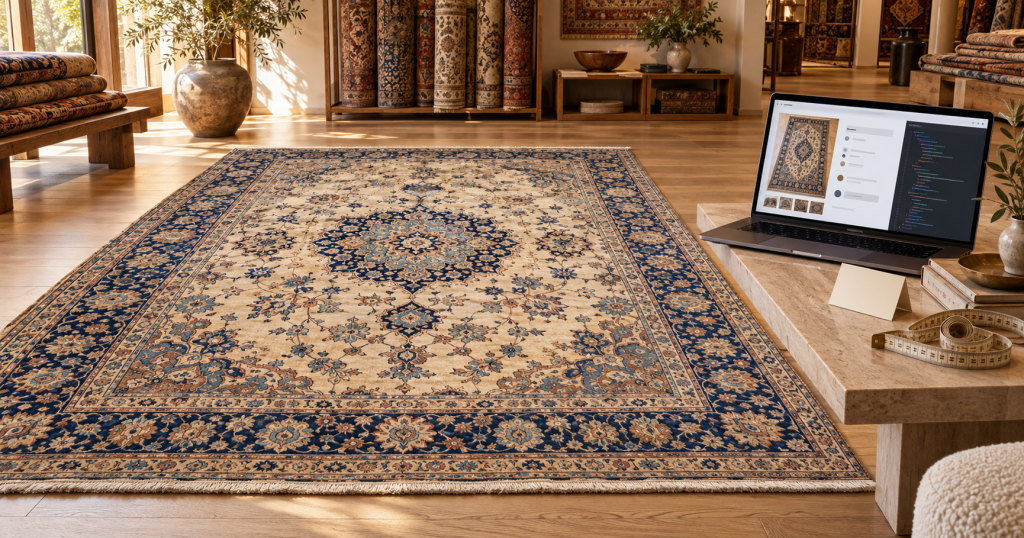
Product schema helps search engines understand that a page represents a product and provides structured information about that product, such as its name, images, price and availability.
For rug businesses, structured data becomes especially useful when the inventory consists of one-of-a-kind handmade, antique or vintage pieces.
A one-of-a-kind rug is not simply another quantity of a mass-produced SKU. There may be only one physical item, its exact dimensions may be unique, and once it sells the same piece will not return.
That makes accuracy particularly important.
The goal of rug product schema is not to fill every possible Schema.org property. It is to describe the actual rug clearly and make sure the structured data matches what customers can see on the page.
Start With Product
The main entity on an individual rug listing should normally be represented as a Product.
The markup should identify the same rug the shopper sees on the page.
At a minimum, a strong implementation will usually consider information such as:
• Product name
• Product images
• Description
• SKU or internal product identifier
• Offer information
• Price
• Currency
• Availability
Additional properties can then provide more context when the business has reliable information.
The structured data should never describe a different product from the one shown visually.
Use the Real Product Name
The structured name should correspond closely with the visible product title.
For example:
Antique Persian Heriz Rug, 8’7″ x 11’4″
is far more useful than a vague name such as:
Rug 1847
The visible page can contain more descriptive information, but the structured name should still clearly identify the product.
Good product descriptions and accurate structured data should work together rather than presenting different versions of the inventory.
Include Strong Product Images
Rugs are highly visual products, so image information matters.
The structured data should reference high-quality photographs that genuinely represent the rug.
Whenever possible, the product page itself should provide several useful views such as the full rug, pattern details, fringe, texture and condition details where relevant.
Do not mark up generic showroom images as though they were photographs of the individual rug.
For one-of-a-kind inventory, the images should represent the exact item being sold.
Use a Stable SKU
Even when a rug has no manufacturer GTIN, the dealer should normally have an internal inventory identifier.
For example:
SKU: HRZ-1847
This helps distinguish one unique rug from another.
Do not invent a GTIN, UPC or other manufacturer identifier merely because the structured-data field exists.
If the rug genuinely does not have such an identifier, focus on the identifiers the business actually uses.
One-of-a-kind inventory benefits from clear internal identification because similar handmade pieces may otherwise appear very close in titles and descriptions.
Offer Data Should Match the Page
When customers can purchase the rug, Offer information can communicate important commercial details.
Typical information may include:
• price
• priceCurrency
• availability
• url
• itemCondition when relevant
The price in structured data should match the visible price customers can actually pay.
Do not show one price in the schema and a different price on the product page.
The same rule applies to currency and availability.
For an ecommerce rug website, consistency between visible product information and structured data should be part of normal inventory QA.
Availability Matters for Unique Rugs
One-of-a-kind inventory makes availability particularly important.
There may be only one rug.
When it sells, the availability needs to change.
Depending on the real situation, Schema.org availability values can communicate states such as in stock, out of stock, sold out or discontinued.
The exact status should reflect what the customer sees.
If the page says the rug is sold, the structured data should not continue claiming it is available.
This is important even when the store chooses to keep the sold product page online for SEO or historical value.
The URL may continue to exist while the commercial availability changes.
Add Material When It Is Known
Material is highly relevant for rug buyers.
Examples can include:
Wool
Silk
Wool and silk
Cotton foundation
Only provide information the business can verify.
A rug should not be marked as silk merely because it has a sheen, and an antique rug should not receive a guessed fiber composition because the schema looks more complete that way.
For unique inventory, trustworthy data is more valuable than maximum field coverage.
Dimensions Deserve Special Attention
Exact dimensions can be important for handmade rugs because a piece categorized as 8×10 may not measure exactly eight feet by ten feet.
The visible product page should clearly show the precise measurement.
Where the structured-data implementation supports useful dimensions or additional properties, the store can also describe length and width in a machine-readable way.
For example, the product may be commercially grouped under 8×10 Rugs while its actual dimensions are:
8’1″ x 10’3″
Those exact dimensions are what the customer ultimately needs.
The same information can also help distinguish the product from another visually similar rug.
Additional Properties Can Describe Rug-Specific Details
A one-of-a-kind rug contains useful attributes that do not always fit neatly into the most common Product properties.
Where appropriate, additionalProperty can be used to represent verified characteristics such as:
• Origin
• Weaving technique
• Rug style
• Approximate age
• Knot type
• Pattern
• Exact dimensions
• Foundation material
• Pile material
Do not turn structured data into a keyword list.
Only add attributes that genuinely describe the product and that customers can reasonably verify from the page.
Brand Is Not Always Necessary
Some rugs have a clear manufacturer or brand.
Others do not.
A machine-made rug from a known manufacturer may have an obvious brand value.
A nineteenth-century handmade Persian rug does not necessarily have a commercial brand in the same sense.
Do not invent one.
If the rug has no genuine brand, the markup should not falsely assign the dealer’s company name as the manufacturer simply to complete a field.
Structured data should reflect the product truthfully.
Reviews Must Be Real
If a specific rug product has legitimate reviews that comply with the relevant requirements, review or aggregate rating information may be appropriate.
Do not add fabricated ratings.
Do not mark up a general store rating as though it belongs to one individual rug.
For one-of-a-kind products, product-specific review volume may naturally be low because only one customer can ultimately purchase the piece.
That is fine.
Schema is not a checklist where every optional property needs to be filled.
Use One Clear Product URL
Structured data should reinforce the primary product URL.
If the same rug can be accessed through several collection paths, the canonical product page should remain the main identity.
This is particularly important for unique inventory.
One physical rug should not appear to search engines as several separate products simply because the customer can discover it through Persian Rugs, Wool Rugs and 9×12 Rugs.
Keep the product identity consistent.
Update Schema When the Product Changes
Product structured data should not be created once and forgotten.
For unique rugs, important fields can change:
• Price may change.
• Availability may change.
• A sale may end.
• The product may sell.
• A listing error may be corrected.
When visible product information changes, structured data should be updated as part of the same workflow.
This is especially important for price and availability because outdated information can create a poor search experience.
Test Before Publishing
After implementing Product structured data, validate it.
Google’s Rich Results Test can help identify whether the markup contains errors or important missing information for supported search features.
Search Console can then be used after indexing to monitor structured-data issues across the website.
Testing matters even more when schema is generated automatically across hundreds or thousands of rug products.
One template mistake can affect the entire catalog.
Final Thoughts
One-of-a-kind rug schema should be accurate before it is extensive.
Start with a clear Product entity and describe the rug customers actually see.
Include useful product information such as the name, images, SKU, description, price, currency and real availability. Add material, dimensions and other rug-specific characteristics when they are known and useful.
Do not invent GTINs, brands, reviews or product details simply to make the markup appear complete.
The strongest structured data reflects the same inventory information the showroom or ecommerce team would confidently give to a customer.
When that information stays accurate, Product schema can give search engines a much clearer understanding of unique rug inventory.
FAQs
Should every one-of-a-kind rug use Product schema?
An individual ecommerce product page can generally benefit from accurate Product structured data when the markup matches the visible content.
What should happen to the schema after the rug sells?
Update the availability to reflect the actual product status rather than continuing to mark the rug as in stock.
Does a handmade rug need a GTIN?
Not every rug has one. Do not invent a GTIN when no legitimate identifier exists.
Can I use an internal SKU?
Yes. A stable inventory SKU can help identify a unique rug.
Should rug dimensions appear in structured data?
Exact dimensions can be useful, especially for handmade rugs, as long as they are accurate and consistent with the visible listing.
Can I add origin and weaving technique?
Verified rug-specific information can be represented through appropriate properties, including additional properties where suitable.
Should every rug have review schema?
No. Only use review information when genuine qualifying reviews exist for the product.