


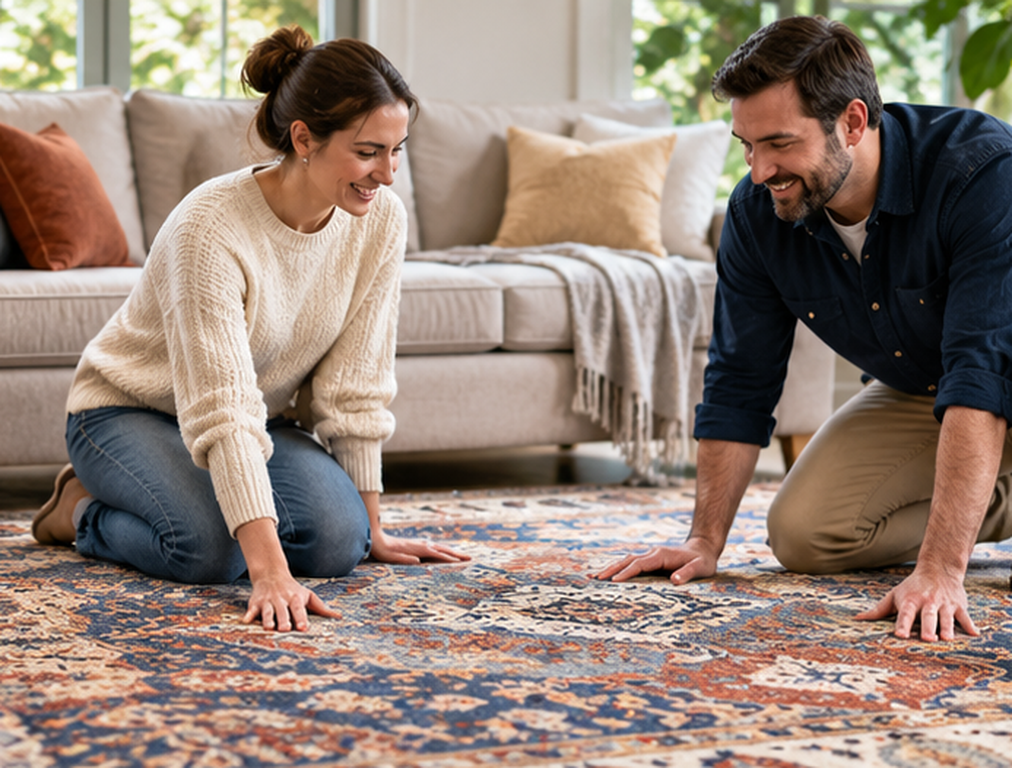
When we help a rug showroom present an in-home trial service online, we do not position it as a vague luxury benefit such as “See rugs in your space.” We build the page around the questions a serious buyer needs answered before deciding whether to contact the showroom: which rugs can be trialed, where the service is available, whether the customer visits the showroom first, how many rugs can be compared, whether there is a fee or deposit, how long the trial lasts, who transports the rugs, what happens if none of them work, and how the customer books the service. If those details are hidden until after an enquiry, the website creates unnecessary friction around a service that is supposed to make the buying decision easier.
The underlying value proposition is strong because rugs are unusually sensitive to context. Color can appear different under daylight and artificial lighting, scale can feel different once the rug sits beneath real furniture, and a pattern that looks balanced in a showroom may feel much busier in a smaller room. Current rug retailers offering home trials consistently frame the service around seeing the rug with the customer’s actual floor, furniture, wall colors, and lighting before making a final decision. We use that real buying problem as the foundation of the page rather than treating the trial as another generic showroom promotion.
We Explain the Service in One Clear Sentence Near the Top
The first section should tell the customer exactly what the service does. We prefer language such as: “Our in-home rug trial lets qualified local customers see selected rugs in their own room before making a final purchase decision.” That sentence establishes the service, the audience, and the purpose without implying conditions the business may not actually offer.
We avoid using “free,” “no obligation,” “unlimited trial,” or similar promises unless the showroom genuinely operates that way. Existing rug businesses use very different models. Some offer complimentary local trials, some require a card or deposit, some charge delivery or trial fees, and some restrict the service to specific areas or showroom-selected inventory. The website should describe the store’s real model accurately because the conversion value comes from reducing uncertainty, not from making the service sound more generous than it is.
We Explain Why Seeing a Rug at Home Changes the Decision
A strong service page needs more than the mechanics of booking. It should explain why a customer would use the service instead of simply buying the rug online or choosing in the showroom.
We tell shoppers that their own environment can change how a rug is perceived. Natural light, evening lighting, flooring, wall color, upholstery, furniture spacing, and room dimensions all affect how color, pattern, and scale read once the rug is installed. Current home-trial services make this same point explicitly, with several recommending that customers view the rug at different times of day and evaluate how it sits with their furniture.
This explanation is particularly useful for higher-value handmade, Persian, antique, vintage, and one-of-a-kind rugs because the customer’s decision may depend on subtle color relationships that are difficult to judge from a screen. We are not telling visitors that online photography is unreliable. We are giving them an additional decision tool when room context matters enough to justify it.
We Show Exactly Who the Service Is For
An in-home rug trial may not be appropriate for every visitor, every product, or every location. We therefore define eligibility clearly instead of inviting every website visitor to request a service the showroom cannot fulfill.
The page might explain that trials are available within a defined local service area, for customers considering rugs above a certain size or value, for selected showroom inventory, by appointment, or after an initial consultation. If designers and trade clients have a different process, we explain that separately.
Some existing rug businesses restrict the service to local showroom customers, while others extend delivery-based trials to designers or customers who agree to cover transportation costs. The right model depends on the showroom’s staffing, vehicle capacity, product value, insurance arrangements, and geographic market.
The website should therefore qualify enquiries before the sales team spends time coordinating an appointment that could never have been approved.
We Define the Service Area Visibly
If the trial is local, the customer should not need to submit a form before learning whether their address is eligible.
We recommend stating the primary service area on the page and providing a simple way to ask about locations near the boundary. A showroom serving Dallas, for example, might list the main city and nearby service areas rather than saying only “local delivery available.”
This also gives the service a stronger local-search connection. A customer searching for a rug showroom that offers in-home consultations is much more likely to recognize relevance when the page names the actual market being served.
We do not create dozens of thin location pages solely for this service. The service-area information should support a real local offering and fit naturally within the broader rug marketing and showroom acquisition strategy.
We Explain Whether the Customer Chooses Rugs First
A home trial becomes operationally difficult if the showroom sends a team to a house with no idea what the customer wants.
We therefore explain the selection process. In many cases, the strongest workflow begins with the customer browsing the website, visiting the showroom, speaking with a rug specialist, or sending room photographs and measurements. The showroom can then narrow the selection before transporting full-size rugs.
Several current rug trial services follow this approach by asking customers to select specific rugs first or visit the showroom before arranging the home trial. This makes the service more efficient and gives the website an important job: helping the customer create a shortlist before the appointment.
A strong rug website search experience therefore supports the in-home service directly. The easier it is to find rugs by size, color, style, material, and room need, the easier it becomes to begin the trial with a useful selection.
We Ask for Room Measurements Before the Trial
An in-home trial should help customers compare appropriate rugs, not demonstrate that obviously unsuitable dimensions do not fit.
We ask the customer to measure the room or relevant furniture arrangement before the appointment. For a living room, that may mean sofa width, seating layout, and available floor area. For a dining room, the table and chair footprint matters. For a bedroom, bed size and desired rug placement influence the useful dimensions.
Current rug trial services also encourage customers to bring or provide room photographs, measurements, fabric samples, flooring references, and related design information before selecting rugs.
On the website, we can make this preparation easy by telling the customer exactly what to send with the enquiry. Better information at the beginning usually produces a better shortlist and a more productive appointment.
We Ask Customers to Send Room Photos
Room photography is one of the most practical qualification tools for an in-home trial.
A few clear photographs can help the showroom understand wall color, flooring, furniture style, room proportions, existing patterns, and major color relationships before choosing inventory to bring.
The website does not need a complex design-upload system immediately. A form can allow image attachments, or the process can instruct the customer to send photos after the initial enquiry.
We explain that photographs help with selection but do not replace seeing the rugs in person. The purpose is narrowing the options, not pretending we can make the final decision from an uploaded image.
We State How Many Rugs Can Be Trialed
The customer should know whether the service allows one rug, two or three alternatives, or a larger curated selection.
This decision affects vehicle capacity, staff time, handling, product risk, and the quality of the consultation. More options are not automatically better. Too many rugs can make the decision harder and turn the appointment into an inefficient inventory-moving exercise.
Some existing rug services explicitly encourage comparing two or three rugs, while others allow a defined number of selected pieces.
We recommend setting a limit that fits the business and explaining whether additional rugs can be considered when the room or project justifies them.
We Explain Who Brings and Places the Rugs
“In-home trial” can mean very different things. One store may allow the customer to take a selected rug home personally. Another may deliver it. Another may send a rug specialist who brings several pieces, places each one in the room, and helps evaluate them.
The website should describe which experience the showroom actually offers.
If the team delivers and lays out the rugs, that is a meaningful part of the service and should be explained. If customers are responsible for pickup and return, that needs equal clarity.
Current services use both models, from customer-managed take-home trials to staff-assisted home presentations.
This information affects whether the customer sees the service as convenient and whether the enquiry is operationally appropriate for the showroom.
We State the Trial Period Precisely
A customer should know whether the decision happens during a scheduled consultation, over several hours, overnight, or across several days.
We avoid phrases such as “take some time to decide” unless the terms define what that means.
Existing rug trial programs vary substantially. Some allow a few days, while others use a scheduled in-home session with a defined appointment window.
The website should communicate the showroom’s actual trial period along with what needs to happen by the end of it. This prevents disagreements about when an unpaid rug was supposed to be returned or when a trial converts into a completed purchase.
We Make Fees, Deposits, and Card Holds Clear
Financial conditions can create the most damaging misunderstanding if they appear only after the appointment is scheduled.
If the service requires a delivery fee, refundable deposit, credit-card authorization, trial charge, or another security arrangement, we explain it before the customer books.
If the trial fee is credited toward a purchase, that can also be stated clearly. Existing services use a variety of approaches, including card details without upfront payment, paid trial fees credited against purchases, complimentary service, and customer-paid transportation.
We do not recommend one universal model because risk tolerance and service economics differ. The conversion principle is transparency.
We Explain What Condition the Rug Must Be Returned In
The customer needs to understand that a home trial is not the same as unrestricted household use.
We specify that rugs returned after a trial must remain in the condition required by the showroom’s policy. Depending on the business, that may involve restrictions involving damage, staining, excessive wear, pets, smoking, moisture, or other conditions that could make a rug difficult to resell.
Existing home-trial policies commonly require rugs to be returned without signs of wear, marks, or damage and by the agreed deadline.
The language should be firm but readable. The purpose is protecting valuable inventory and setting expectations, not making the service feel risky before the customer has even booked.
We Explain What Happens If None of the Rugs Work
A home trial should reduce pressure, so the customer needs to know that rejecting the initial options does not end the relationship.
We explain the next step. The customer might return the rugs and receive another set of recommendations based on what they learned. A photo of the rug in the room can help the showroom understand whether the problem was scale, color, pattern, or another factor.
Several current rug stores explicitly encourage customers to photograph unsuccessful trials because the image helps staff recommend better alternatives.
This turns a failed first trial into useful design information rather than treating it as a lost sale.
We Separate an In-Home Trial From an In-Home Design Consultation
These services can overlap, but the website should distinguish them when the business offers both.
A rug trial may begin after the customer has already selected rugs and simply wants to see them in the room. A design consultation may begin earlier, with a specialist evaluating the room, measuring the space, discussing color and furniture, and recommending suitable rug directions.
Current rug businesses use this distinction explicitly, offering home consultation for customers needing design help and trial services for customers who already know which rugs they want to see.
Clear naming helps customers choose the right service and gives the showroom cleaner enquiries.
We Put the Service on Relevant Product Pages
A dedicated service page is useful, but customers should also discover the option while evaluating rugs.
If eligible products can be trialed, we can place a contextual message or button on relevant product pages such as “Ask About an In-Home Trial” or “See This Rug in Your Home.” We do not add the option to products that are outside the service or geographic area without explaining the limitation.
One current rug retailer uses a “Try it at home” option directly from rug pages, allowing shoppers to identify a specific piece before contacting the showroom.
This reduces the distance between product interest and showroom enquiry.
We Add the Service to Showroom and Local Pages
The trial service is also a powerful differentiator for customers deciding which local showroom to contact.
We mention it on showroom, appointment, service, and relevant local landing pages when it is genuinely available in those markets.
The wording should remain consistent. If one page says the service is complimentary while another says fees apply, trust is lost before the customer has even made contact.
For a local rug business, the service can support the broader strategy of turning website traffic into appointments because it gives hesitant shoppers a concrete reason to begin a conversation.
We Create a Simple Booking Path
The page should end with a clear next action.
The form can ask for the customer’s name, contact details, location, room type, approximate rug size, products of interest, and room photographs where useful. We avoid asking for twenty fields simply because the sales team might eventually want that information.
If an appointment cannot be confirmed automatically because staff need to verify inventory and service area, the form should say that the submission is a request rather than a confirmed booking.
The acknowledgement email can then explain what happens next and how quickly the showroom normally responds.
We Avoid Making the Page Look Like a Generic Lead Form
An in-home trial page converts better when the visitor understands the experience before reaching the form.
We therefore build the page around service explanation, buyer benefit, process, eligibility, terms, and preparation rather than opening with a large form and asking the visitor to provide information without context.
The customer should feel that the showroom has a real process, not that “In-Home Rug Trial” is simply another headline created to collect phone numbers.
We Use Real Photography of the Service When Possible
Stock photography of a perfect living room does not explain how the showroom’s service works.
Where possible, we use authentic photographs showing rolled rugs being prepared, a specialist positioning a rug in a customer’s room, two rugs being compared, or another real step in the process, subject to appropriate customer permissions.
This reduces uncertainty because the visitor can visualize the appointment.
The photography should support the process rather than merely decorate the page.
We Track the Service as a Qualified Conversion
The success metric should not be page views alone.
We track trial enquiries, qualified requests, booked appointments, completed appointments, rugs sold after trials, average order value, and where possible which marketing source generated the original customer.
This allows the showroom to determine whether the service is creating profitable sales rather than simply generating operational activity.
For high-value rugs, a relatively small number of qualified home trials may be commercially significant, so we do not judge the service using the same conversion expectations as a low-ticket ecommerce product.
Final Thoughts
An in-home rug trial page should remove the exact uncertainties the service exists to solve. The customer needs to understand why seeing a rug at home can help, who qualifies, which rugs are eligible, how they are selected, how many can be tried, who transports them, what the service costs, how long the trial lasts, what condition is required, and how to arrange the appointment.
Current rug retailers using home trials consistently emphasize the same underlying buyer problem: rugs can look and feel different once they are placed with the customer’s own lighting, flooring, furniture, and proportions. That is the strongest message for the website because it explains the service without relying on promotional language.
When we combine that message with clear terms, local eligibility, a strong product-selection process, and an easy booking path, the in-home trial becomes more than a showroom perk. It becomes a conversion tool for buyers who like a rug but need one final piece of confidence before making the purchase.
FAQs
What should an in-home rug trial page include?
We recommend explaining the service area, eligible rugs, selection process, number of rugs, appointment or trial duration, fees or deposits, transportation, return condition requirements, and the exact process for requesting the service.
Should customers choose rugs before an in-home trial?
In many showroom models, yes. Allowing the customer and rug specialist to create a shortlist before transportation usually makes the appointment more efficient and improves the quality of the comparison.
Should an in-home rug trial be free?
There is no universal model. Some rug stores provide complimentary trials, while others charge delivery or trial fees, require a deposit, or take payment details as security. The website should explain the store’s actual policy clearly.
How long should customers be allowed to keep trial rugs?
That depends on the service model. Some businesses conduct a scheduled consultation, while others allow customers to keep selected rugs for several days. The important point is defining the period clearly before the rug leaves the showroom.
Where should we promote an in-home trial service?
We would use a dedicated service page and also reference the option from relevant product pages, showroom pages, appointment pages, and local landing pages so interested shoppers can discover it at the point where purchase hesitation occurs.