


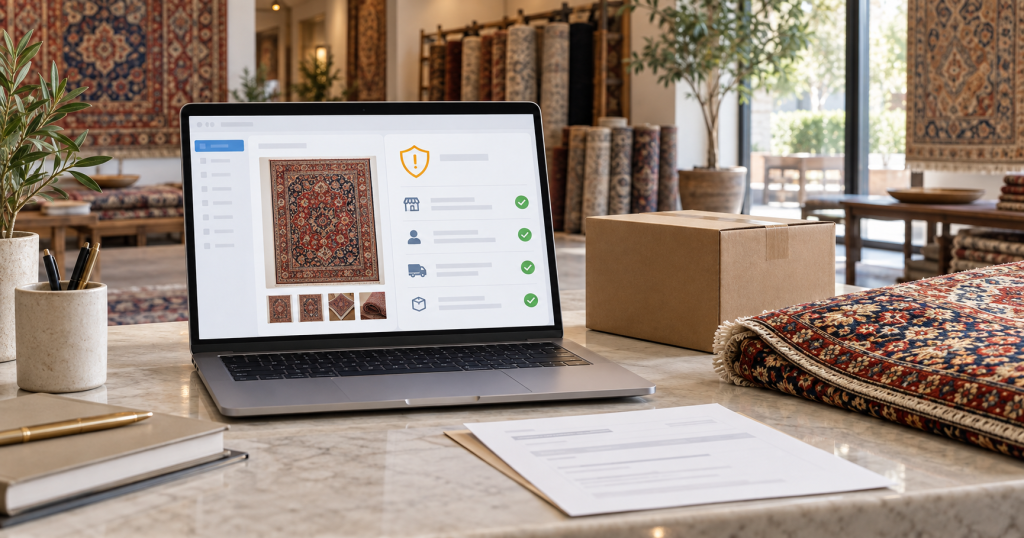
A Merchant Center misrepresentation issue can be frustrating because the notification may feel broader than a normal product-data error.
There may not be one broken field to change.
Instead, Google may be questioning whether the business, website, products, pricing or purchase experience gives shoppers enough accurate information to make an informed decision.
Google’s Misrepresentation policy says listings and destinations must represent products and businesses accurately and truthfully, without hiding important information from customers. Google may review signals from the listing, website, accounts and third-party sources when assessing compliance.
For a rug retailer, the right response is therefore not to change a few feed titles and immediately request another review.
Audit the entire customer journey.
A person who sees a rug on Google should be able to understand who is selling it, what the rug actually costs, whether it is available, how it will be delivered, what happens if it is returned, and how to contact the business if something goes wrong.
When those details are inconsistent or unclear, trust breaks down.
Start With Business Identity
The first question is simple:
Does the website clearly show who the customer is buying from?
Google’s trust guidance recommends using a consistent official business identity, an accurate domain, a clear About page and transparent contact information.
For a rug store, check whether the business name is presented consistently across:
• Merchant Center
• Website footer
• Contact page
• About page
• Checkout
• Payment profile
• Google Business Profile, when applicable
• Social business profiles
A minor branding variation may be understandable to a customer, but larger inconsistencies can create uncertainty.
For example, if Merchant Center belongs to “Heritage Rug Imports LLC,” the website calls itself “Luxury Carpet Gallery,” the checkout uses another company name and the return policy references a fourth business, the overall picture becomes difficult to verify.
The solution is not to hide the legal entity.
Explain the relationship clearly.
Make Contact Information Easy to Verify
A customer should not need to search the website for fifteen minutes to find a way to contact the store.
Google’s current Merchant Center guidance says clear contact details are an important part of website quality and trust. It specifically highlights contact methods such as a valid email address, phone number, business address, contact form or business social profile, with account details kept consistent.
For a rug retailer with a physical showroom, this is usually straightforward.
Provide the showroom address, phone number, customer-service email and normal business details.
For an online-only business, the presentation still needs to make the company understandable and reachable.
Do not use a contact page containing only:
“Send us a message.”
Give customers enough information to know there is a real business behind the catalog.
Audit the About Page Like a Customer Would
An About page is not just an SEO page.
For Merchant Center, it helps explain business identity.
A rug retailer’s About page can naturally answer questions such as:
Who operates the business?
Where is it based?
Does it sell directly to consumers, designers, dealers or all three?
Does it carry new rugs, antiques, handmade inventory or machine-made collections?
Does it operate a physical showroom?
How long has the business been operating?
What makes its inventory different?
Google specifically recommends having an About page that helps establish authenticity.
Avoid generic text such as:
“We are passionate about providing the best products and customer satisfaction.”
That sentence could describe almost any ecommerce business.
Specificity builds more trust.
Shipping Information Must Match Reality
A beautiful product page cannot compensate for unclear fulfillment terms.
A customer purchasing an expensive handmade rug may need to know:
• Where the business ships
• Expected processing time
• Estimated delivery timing
• Shipping cost or calculation method
• Whether oversized rugs have special freight conditions
• Whether international shipments create extra charges
• What happens if delivery fails
Google’s misrepresentation policy specifically prohibits hiding material transaction conditions, including shipping costs and fulfillment information that affect the customer’s final commitment.
Do not advertise “Fast Shipping” prominently and reveal a three-week handling period only after checkout.
The visible promise and the real process should agree.
Return and Refund Policies Need Real Detail
“Easy returns available” is not a complete return policy.
Google’s current professional requirements say return and refund information should clearly explain conditions such as timeframes, return methods, applicable shipping fees and refund processing.
For rugs, the policy may need additional clarity because products can be large, expensive and costly to ship back.
Customers should understand:
• How many days they have to request a return
• Whether the period starts at purchase or delivery
• What condition the rug must be in
• Who pays return shipping
• Whether original shipping is refundable
• Whether restocking fees apply
• Whether custom or final-sale rugs are excluded
• How refunds are processed
• Approximately how long processing takes
If antique, clearance, custom-size or one-of-a-kind products have different conditions, disclose that before purchase.
Do not let the first mention of a major return restriction appear after the customer has already paid.
Product Availability Must Be Real
This is particularly important for one-of-a-kind rugs.
There may be only one physical piece.
If the rug sells in the showroom while the website and Merchant Center still show it as available, Google can continue sending shoppers to an offer the retailer cannot fulfill.
Google’s misrepresentation documentation specifically identifies unavailable offers, including listing items as available when the merchant cannot fulfill the order.
For unique inventory, synchronize stock as quickly as practical across:
• Website
• Merchant Center data source
• Structured data
• Physical showroom inventory
• Marketplace listings
• Other sales channels
A good rug website should treat inventory accuracy as part of the ecommerce architecture rather than as an occasional manual cleanup task.
Product Information Should Describe the Rug Being Sold
Rug ecommerce sites are visually driven, but photographs alone are not enough.
The product title, images, dimensions, material, origin, condition, price and availability should describe the actual item.
Do not advertise a handmade rug using images that materially misrepresent the item the customer will receive.
Do not call a rug antique merely because the style looks traditional.
Do not describe a rug as silk unless that material is genuinely known.
Do not use “hand-knotted” for a product that is actually machine-made.
Google’s policy is built around accurate, realistic and truthful product representation.
Strong product descriptions improve SEO, but accuracy comes first.
Check Pricing Across the Full Journey
Misrepresentation can also involve pricing.
A Google listing may display $1,200.
The product page may show $1,200.
Then checkout unexpectedly adds a mandatory $250 handling charge.
From a customer’s perspective, the advertised cost was incomplete.
Google specifically prohibits hiding the total expense and transaction conditions a customer must bear.
Audit:
Merchant Center → Product Page → Cart → Checkout
The commercial story should remain consistent.
Taxes and shipping can vary legitimately, but required charges should not appear as hidden surprises.
If certain large rugs require freight shipping, communicate that clearly.
Review Website Functionality
Trust is also affected by whether the site feels complete and usable.
Google’s Merchant Center guidance specifically mentions broken links, placeholder content, insecure checkout and unfinished website elements as quality concerns.
Crawl the website and look for:
• Broken policy links
• Empty About pages
• Template text
• Placeholder images
• Dead social links
• Products that cannot be purchased
• Cart errors
• Checkout errors
• HTTP pages inside an HTTPS store
• Contact forms that do not work
• Mobile checkout problems
A “Return Policy” link leading to a 404 can undermine trust far more than another paragraph of SEO copy can repair.
Make the Store Look Like the Same Business Everywhere
Google says it can consider signals from across the web when assessing trust.
That means consistency matters beyond the website.
Check whether the company appears under the same identity across relevant external profiles.
A rug showroom should not have one address on Google Business Profile, another in Merchant Center and an outdated third location in its website footer.
If the business has moved, update old references where possible.
If a DBA or parent company relationship exists, explain it naturally.
The objective is not perfect formatting everywhere.
It is avoiding a confusing business identity.
Do Not Request Review Before the Audit Is Finished
This is one of the most important practical points.
Merchant Center review should come after the underlying issues have been fixed.
Google’s review guidance recommends conducting a broad audit of transparency, business details, return and shipping information, identity verification and product-data consistency before requesting review.
For serious misrepresentation violations, Google notes that suspension can occur without prior warning.
Treat the review request as the final step, not the diagnostic tool.
Before submitting it, test the store like a new customer.
Can you understand the business?
Can you contact it?
Can you buy a rug?
Does the advertised price remain accurate?
Can you understand shipping and returns before paying?
Does the checkout work?
If any answer is unclear, continue fixing.
A Rug Retailer Misrepresentation Audit
Use this as a practical pre-review check:
| Area | What to Verify |
|---|---|
| Business name | Consistent across site and Merchant Center |
| Address | Accurate and verifiable |
| Contact | Phone/email/form easy to find |
| About page | Real company information |
| Shipping | Costs and timing explained |
| Returns | Complete terms and fees |
| Privacy | Accessible policy |
| HTTPS | Secure browsing and checkout |
| Products | Accurate descriptions and images |
| Price | Consistent through checkout |
| Availability | Current inventory status |
| Checkout | Fully functional |
| Links | No important broken pages |
| Merchant data | Matches website |
| Identity | Verification completed if requested |
For a store running Google Shopping, this audit should become part of ongoing ecommerce maintenance rather than something performed only after an account problem occurs.
Final Thoughts
Merchant Center misrepresentation is not primarily an advertising-copy problem.
It is a trust problem.
Google wants the customer who clicks a product listing to encounter the same business, product, price, availability and purchasing conditions they were led to expect.
For rug retailers, that means the website needs to explain the company as clearly as it displays the inventory.
Use real business details.
Provide complete shipping and return information.
Keep one-of-a-kind inventory accurate.
Make product claims that can be supported.
Keep pricing consistent.
Maintain a secure, working checkout.
Then make sure Merchant Center reflects the same information.
A strong rug marketing strategy can bring more shoppers to the business, but Merchant Center compliance depends on whether those shoppers encounter a transparent store once they arrive.
Fix that foundation before requesting another review.
FAQs
What does Merchant Center misrepresentation mean?
It means Google has identified concerns that a business, offer or destination may be missing important information or presenting information in a misleading or inaccurate way.
Can Merchant Center be suspended for misrepresentation?
Yes. Google states that some egregious misrepresentation violations can result in suspension upon detection without prior warning.
Is missing contact information a problem?
Yes. Google expects customers to have clear ways to identify and contact the business.
Does a rug store need a return policy?
A clear, accessible return and refund policy is an important Merchant Center requirement for ecommerce stores.
Can inaccurate stock cause problems?
Yes. Listing a product as available when the merchant cannot fulfill the order can violate Google’s unavailable-offer requirements.
Should I request review immediately after suspension?
Audit and correct the entire issue first. Google recommends fixing relevant website and account problems before requesting review or appeal.