


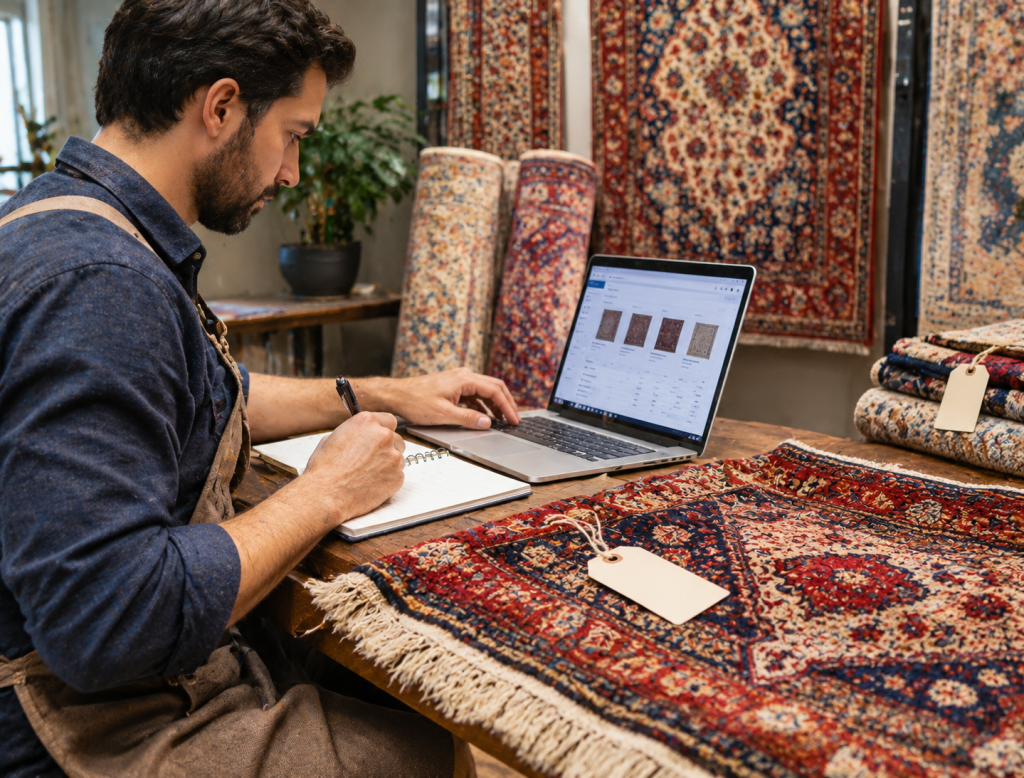
When we categorize rugs in Google Merchant Center, we separate Google’s taxonomy from the retailer’s own catalog taxonomy. The Google Product Category attribute, google_product_category, uses Google’s predefined classification system, while product_type allows the rug store to submit its own hierarchy such as Rugs > Persian Rugs > Handmade > Heriz. Mixing those two concepts is one of the easiest ways to make a product feed unnecessarily complicated.
Google currently assigns products to a Google product category automatically. The optional google_product_category attribute can be used to override that automated classification in specific cases, and Google recommends selecting the single category that most accurately describes the product’s main function. For standard area rugs, the current downloadable Google Product Taxonomy lists ID 598, Home & Garden > Decor > Rugs.
Standard Area Rugs Belong Under Rugs
For ordinary area rugs, including many Persian, Oriental, modern, traditional, wool, jute, cotton, synthetic, handmade, machine-made, vintage, and antique rug listings, the most relevant Google taxonomy category is generally:
598 - Home & Garden > Decor > Rugs
Google’s current taxonomy does not create separate predefined categories for Persian rugs, wool rugs, 8×10 rugs, handmade rugs, or most of the commercial distinctions rug retailers use inside their own websites.
That does not mean those distinctions should disappear from the feed.
They belong in other attributes and in the retailer’s own product_type hierarchy where appropriate.
Do Not Invent a More Specific Google Category
A common mistake is assuming that a highly specific store category must also exist in Google’s taxonomy.
A retailer may internally organize products as:
Rugs > Persian Rugs > Heriz Rugs > Vintage Heriz Rugs
That is useful for the store and can be submitted through product_type.
It should not be submitted as google_product_category unless that exact path exists in Google’s predefined taxonomy.
Google’s requirements state that google_product_category must use a predefined Google category. If no more specific predefined Google category exists, the retailer should not invent one.
For ordinary Heriz inventory, the broader Google category Home & Garden > Decor > Rugs can remain correct even though the store maintains a much more detailed classification.
Use Product Type for Your Rug-Specific Hierarchy
The product_type attribute exists precisely for the store’s own taxonomy.
Google says retailers can define their own product type hierarchy to reflect website navigation and use it for campaign organization, bidding, and reporting.
For example, we might submit:
Rugs > Persian Rugs > Heriz Rugs
or:
Rugs > Contemporary Rugs > Wool Rugs
or:
Rugs > Vintage Rugs > Turkish Rugs
This gives us commercially useful structure without trying to alter Google’s standard taxonomy.
For large rug catalogs, this can be far more useful for reporting because we can organize the feed according to how the business actually thinks about inventory.
Bath Mats and Bath Rugs Are Different
The word “rug” in a product title does not automatically mean the Google Rugs category is correct.
Google’s taxonomy currently includes a specific category for:
577 - Home & Garden > Bathroom Accessories > Bath Mats & Rugs
A bathroom mat designed primarily for use beside a shower, bath, or bathroom fixture should therefore be evaluated according to its main function rather than classified as a general decorative area rug simply because the product name contains “rug.”
This is exactly the kind of situation where Google’s main-function principle matters.
A decorative wool rug placed in a bathroom remains fundamentally an area rug. A purpose-built absorbent bath mat is a bathroom accessory.
Door Mats Also Have Their Own Category
Google’s taxonomy separately lists:
2675 - Home & Garden > Decor > Door Mats
A coir entry mat, welcome mat, or product specifically designed to sit at an entrance is therefore more accurately represented by the Door Mats category than the general Rugs category.
Again, the item’s commercial name alone is not the deciding factor.
Some retailers call these products entry rugs. We still look at the actual function.
If it is designed primarily as a doormat, we categorize it accordingly.
Runner Rugs Usually Remain Rugs
A hallway runner, kitchen runner, Persian runner, or long decorative runner is still fundamentally a rug.
We do not need a separate Google category merely because the shape or dimensions differ.
The current Google taxonomy’s general Rugs category is therefore the logical classification for standard decorative runners unless the product’s function places it in another defined category.
The specific term “runner” can remain visible in the title, description, size information, and retailer-defined product_type.
Round Rugs Usually Remain Rugs
Shape does not normally require a new Google Product Category.
Round rugs, oval rugs, square rugs, and rectangular rugs can all share the general Rugs category because they perform the same primary function.
We use product titles, descriptions, dimensions, product types, custom labels, and other applicable fields to distinguish them operationally.
This is useful because Merchant Center categorization should remain stable even when merchandising categories become much more granular.
Handmade Rugs Usually Remain Rugs
Handmade construction does not create a separate Google category for ordinary floor rugs.
A hand-knotted Persian rug and a machine-made modern rug can therefore both belong to Home & Garden > Decor > Rugs even though the products are commercially very different.
Their titles, descriptions, images, material details, brand or maker information where relevant, identifiers, condition, and retailer taxonomy can communicate those differences.
The Google category answers a broad classification question. It does not need to encode every product characteristic.
Antique and Vintage Rugs Usually Remain Rugs
Age does not automatically change the fundamental product category.
An antique Persian rug intended for floor use remains a rug, even though it may also have collectible or decorative significance.
For used or refurbished products, Merchant Center’s broader product data requirements may make condition information relevant, but we do not move the item into an unrelated Google Product Category merely because it is old.
We keep category and condition as separate concepts.
This makes feed logic cleaner and reduces the risk of categorizing the same type of physical product differently only because one piece is new and another is vintage.
Rug Pads Should Not Be Classified as Rugs Without Checking the Taxonomy
A rug pad is an accessory rather than the decorative rug itself.
We therefore do not automatically assign Home & Garden > Decor > Rugs because the word rug appears in the product name.
Google recommends choosing the most specific category matching the product’s primary function.
If a store sells accessories such as pads, grippers, or installation products, those items should be mapped separately according to the latest available Google taxonomy rather than inheriting the category of the rug they support.
The same principle applies to cleaning products, rug storage products, or other accessories.
Carpet Tiles and Installed Flooring Need Separate Review
A removable decorative area rug and an installed flooring product are not necessarily the same type of merchandise.
If the store also sells carpet tiles, broadloom carpet, flooring underlay, or installation products, we do not copy the Rugs category across the entire feed.
Those products should be mapped according to their primary function and the latest Google taxonomy available in Merchant Center.
This is particularly important for hybrid rug and flooring stores where one ecommerce catalog contains several fundamentally different product categories.
Use Only One Google Product Category Per Offer
Google’s current data specification says to include only one Google Product Category and choose the most relevant one. The value can be the numeric category ID or the full predefined category path, but not both in the same submitted value. Google recommends using the category ID.
For standard rugs, that means we might simply submit:
598
rather than maintaining the full text path.
Using the numeric ID can also reduce errors caused by punctuation, spelling, or language differences in text paths.
Google Already Categorizes Products Automatically
The google_product_category field is optional in Google’s current Merchant Center setup because Google automatically assigns a category based on product data.
That changes how we think about the field.
We do not need to hard-code a manual category for every product simply because an older feed template contains the column.
Instead, we verify whether Google’s automatic classification is accurate.
If standard rugs are consistently being categorized correctly, manual intervention may not be necessary.
If Google assigns an incorrect category that creates irrelevant requirements or poor campaign organization, then an explicit override can be useful.
Titles and Descriptions Still Influence Categorization
Google explicitly recommends accurate titles, descriptions, pricing, brand, and GTIN data to help its systems categorize products correctly.
That means category errors can sometimes be symptoms of weak product data.
If a title says only “Heriz 10824” and the description contains almost no useful product context, Google’s systems have less information to work with.
We therefore improve the core product data before assuming every classification issue requires manual overriding.
This also supports better Shopping relevance more broadly.
Avoid Using Google Product Category as a Keyword Field
The category field should not be used for SEO keyword insertion.
We do not submit:
Persian Rugs > Handmade Persian Rugs > Best Luxury Persian Rugs
unless it is a valid Google taxonomy path, which it is not in the current taxonomy.
Google’s documentation requires predefined category values.
The retailer’s own keyword and merchandising hierarchy belongs in product_type, titles, descriptions, and website structure.
Keeping these fields conceptually separate makes the feed easier to maintain.
Product Type Can Mirror the Website More Closely
For Danabak-style rug ecommerce planning, we often want product types to reflect meaningful buyer-facing categories.
A Persian Heriz rug could use:
Rugs > Persian Rugs > Heriz Rugs
A modern wool rug might use:
Rugs > Modern Rugs > Wool Rugs
A vintage Turkish runner might use:
Rugs > Vintage Rugs > Turkish Rugs > Runner Rugs
Google recommends using a full category path for product type rather than submitting only the final category because a hierarchical value provides more context and can improve campaign organization.
This also makes reporting more useful for the business.
Do Not Create Hundreds of Product Types Without a Reporting Purpose
Merchant Center can accept a detailed retailer taxonomy, but excessive fragmentation can make campaign reporting difficult.
We do not necessarily need a separate product type for every color, measurement, city, room, and pattern combination.
Product type should reflect stable product classification.
Attributes such as size, color, and custom labels can handle other segmentation needs.
A clean hierarchy is usually more useful than a feed containing hundreds of inconsistent paths created by individual merchandisers.
Keep Product Category Consistent Across Data Sources
If products are submitted through an ecommerce platform, supplemental feed, Merchant API, or another source, we make sure competing data sources are not assigning different categories unexpectedly.
Merchant Center data-source conflicts can be difficult to diagnose because the final value may come from an integration the merchandising team does not regularly inspect.
When category issues appear, we identify which source owns the attribute before changing values manually.
This is particularly important after migrations or app changes.
Check Merchant Center After Catalog Changes
A product that was correctly categorized yesterday can become problematic after titles, descriptions, feed apps, or store taxonomies are changed.
We periodically review Merchant Center’s product diagnostics and categorization rather than assuming the initial mapping remains correct forever.
Google describes its taxonomy as evolving, so maintaining awareness of the current classification system is also useful when the store expands into new product types.
Category Accuracy Helps Campaign Structure
In supported countries including the United States, Google Product Category can be used when organizing product groups for Shopping campaigns.
For a rug-only retailer, the broad Google category may not provide enough segmentation by itself because most standard inventory can fall under the same Rugs category.
This is where product_type and custom labels become more useful.
We might use Google’s category to confirm that the products are fundamentally rugs while using retailer-defined fields to distinguish Persian, modern, handmade, private-label, vintage, and other commercial groups.
Product Category Is Not a Substitute for Product Schema
Merchant Center categorization and website structured data solve related but different problems.
The feed tells Merchant Center how the item should be represented within Google’s shopping ecosystem.
Product structured data on the website gives Google machine-readable information directly from the landing page.
For one-of-a-kind rugs, both should remain accurate and consistent.
Our product schema guide explains the website side of that relationship.
Category Is Not a Substitute for Good Product Titles
Even a perfectly categorized rug can perform poorly if the title provides little information.
Merchant Center uses multiple product signals, not only category.
We want product titles that accurately identify the item and include useful distinguishing information where appropriate, without creating unnatural keyword strings.
The category helps Google understand the broad product family. The title helps communicate which specific rug the shopper is evaluating.
Final Thoughts
For most ordinary area rugs, the current Google Product Category is straightforward: 598, Home & Garden > Decor > Rugs. A standard Persian rug, wool rug, vintage rug, modern rug, handmade rug, or runner can generally remain within that broad category because style, age, construction, material, and shape do not change the product’s primary function.
The exceptions become important when the product has a genuinely different use. Google’s current taxonomy separately identifies Bath Mats & Rugs as ID 577 and Door Mats as ID 2675, so those products should not automatically inherit the standard Rugs category.
We use Google’s predefined taxonomy for google_product_category and the store’s own detailed hierarchy for product_type. Google currently assigns categories automatically, so manual category values are most useful when we need to correct or control that classification.
The best Merchant Center taxonomy is therefore not the most complicated one. It is the one that accurately describes the product’s main function while allowing the store’s own product-type structure to carry the detailed rug-specific merchandising logic.
FAQs
What is the Google Product Category for standard rugs?
The current Google Product Taxonomy lists 598, Home & Garden > Decor > Rugs.
What Google Product Category should we use for bath mats?
Google currently lists 577, Home & Garden > Bathroom Accessories > Bath Mats & Rugs.
What category should we use for door mats?
Google currently lists 2675, Home & Garden > Decor > Door Mats.
What is the difference between Google Product Category and product type?
Google Product Category uses Google’s predefined taxonomy. product_type uses the retailer’s own taxonomy and can reflect categories such as Persian Rugs, Vintage Rugs, or Heriz Rugs.
Do we have to submit Google Product Category manually?
Not always. Google currently categorizes products automatically, and the attribute can be used to override the automatic categorization when needed.