


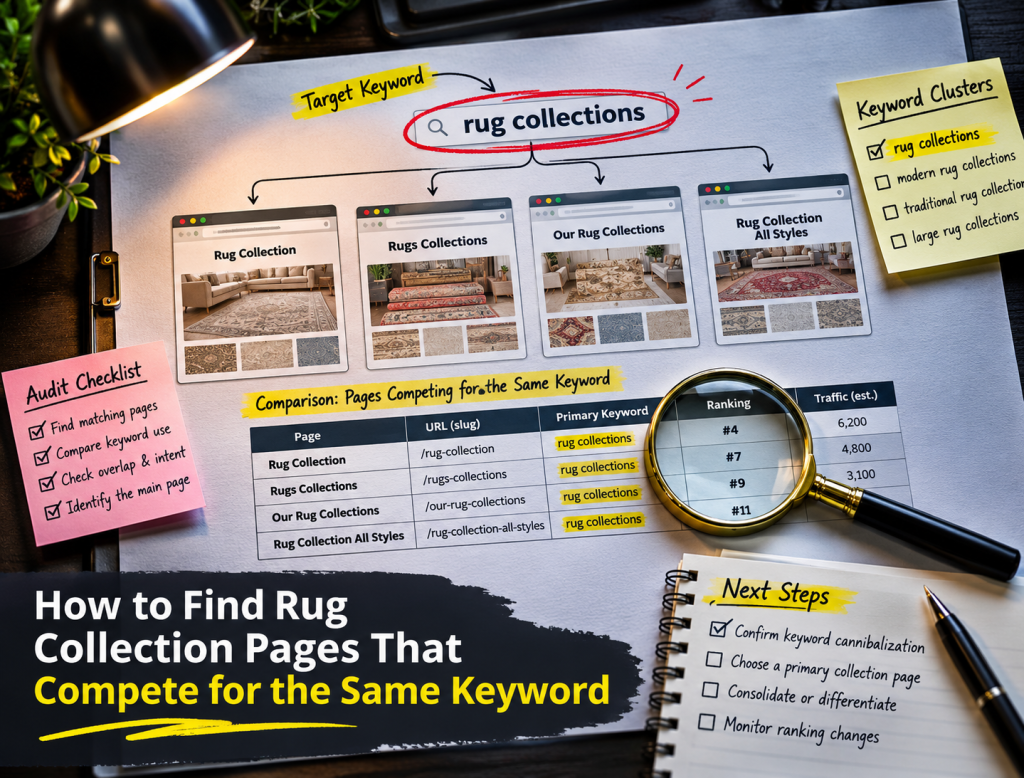
When we audit a large rug marketplace, we do not define keyword cannibalization as “two pages contain the same keyword.” That definition is too broad for ecommerce because overlapping language is normal. A Persian Rugs collection, an Antique Persian Rugs collection, and a guide to Persian rug history can all mention Persian rugs without automatically competing for the same search intent. We become concerned when two or more indexable pages are trying to satisfy essentially the same query for the same type of user, Google keeps switching between them, the wrong page ranks, or ranking signals appear to be divided across pages that should have had clearer roles.
This is a meaningful search opportunity as well as a technical topic. Our US keyword research shows around 390 monthly searches for “keyword cannibalization,” with additional demand around “how to fix keyword cannibalization,” “keyword cannibalization checker,” “SEO keyword cannibalization,” and related troubleshooting phrases. That tells us the article cannot stop at a definition. To compete, we need to show how to diagnose the problem, distinguish real cannibalization from harmless overlap, decide which page should win, and choose the correct fix for an ecommerce collection structure.
We First Define What True Keyword Cannibalization Looks Like
We treat cannibalization as an intent and page-role problem, not a keyword-density problem. If two collection pages are both built to rank for “Persian rugs,” contain almost the same inventory, use near-identical titles, and explain the category in nearly the same way, Google has little reason to understand why both pages exist. One may rank today and the other next week, or both may sit below the position a stronger consolidated page could potentially achieve.
By contrast, “Persian Rugs” and “Antique Persian Rugs” can coexist comfortably when the antique page contains a genuinely distinct subset of inventory and is written for shoppers specifically seeking antique pieces. “8×10 Rugs” and “8×10 Persian Rugs” can also target different intent when one covers all styles at that size and the other is limited to Persian inventory.
Our first question is therefore not “Do these pages share a keyword?” It is “Would the same searcher reasonably need both pages for the same search?” If the answer is no because each page solves a different shopping problem, the overlap may be completely healthy.
We Build a Collection Keyword Map Before Looking at Rankings
We find cannibalization faster when we know what each collection is supposed to rank for. We create a simple map connecting the collection URL, primary search intent, main keyword cluster, meaningful secondary terms, inventory definition, and parent category.
For example, Persian Rugs might target the broad commercial Persian-rug category. Antique Persian Rugs would target antique-specific commercial intent. Red Persian Rugs would target buyers narrowing by color. Persian Rug History would target informational research rather than shopping.
This exercise often reveals problems before we open Search Console. If two pages have the same intended query, same inventory, and same customer purpose, the duplication already exists at the strategy level.
Our keyword research framework is useful here because the goal is assigning search intent to the correct page rather than attaching keywords to every URL that happens to contain relevant products.
We Export Queries and Pages From Search Console
Search Console is one of the most useful starting points because it shows which URLs actually receive impressions for a query.
We review a meaningful period, often several months rather than only a few days, because ecommerce rankings can fluctuate with inventory and demand. We look at important category queries and examine the pages Google displayed for each one.
If “Persian rugs” generates impressions for /persian-rugs/, /traditional-rugs/, /handmade-rugs/, and a blog post about choosing Persian rugs, that does not automatically prove cannibalization. It tells us where to investigate.
We then compare whether one page clearly dominates or whether Google appears uncertain. If the intended Persian Rugs collection gets most impressions and the others receive occasional secondary visibility, the architecture may be fine. If impressions and positions constantly move between two nearly identical collection pages, we have a much stronger cannibalization signal.
We Look for URL Switching, Not Just Multiple Ranking URLs
One of the most useful signs is repeated switching.
Suppose /persian-rugs/ ranks around position nine for several weeks, then /handmade-persian-rugs/ replaces it around position eleven, then the original returns, while neither page establishes stable visibility. That pattern deserves investigation because Google may be struggling to determine which page best represents the query.
A single day of variation is not enough. Search results naturally change, and different pages can surface for query variations. We want a repeated pattern across a meaningful period.
We also compare impressions and clicks. If both pages split visibility for almost identical query sets and neither has a distinct purpose, consolidation may produce a clearer signal than continuing to optimize both independently.
We Check Whether the Wrong Collection Is Ranking
Cannibalization does not always mean two URLs are equally visible. Sometimes one page dominates, but it is the wrong page.
Imagine the marketplace has a strong “Vintage Rugs” collection and a more specific “Vintage Persian Rugs” page. If Google consistently ranks the broad Vintage Rugs page for searches specifically asking for vintage Persian rugs, we investigate why the intended collection is not being selected.
The problem may be weak internal linking, an unclear title, insufficient inventory, near-duplicate content, canonical confusion, or simply that the specific collection does not provide enough additional value.
This is why we do not measure cannibalization only through ranking overlap. Page selection matters. We want the URL that best satisfies the query to become the strongest candidate for that search.
We Compare the Inventory Overlap
Rug marketplaces create collection pages from product attributes, so two URLs can contain nearly identical product sets without anyone noticing.
If Persian Rugs contains 500 products and Handmade Persian Rugs contains 485 of the same products, we question whether users and search engines receive enough value from keeping both categories as separate primary landing pages. If Persian Rugs includes all Persian inventory while Antique Persian Rugs contains a distinctive 90-product subset with its own buyer intent, the separation is easier to justify.
Inventory overlap is not the only factor, but it is a powerful clue. Two collections with 95 percent identical products, similar headings, and similar copy are more likely to compete than pages with genuinely different selections.
Our guide to rug taxonomies helps explain why category logic needs to reflect meaningful product distinctions rather than every possible database attribute.
We Compare Titles, H1s, and Introductory Copy
When neighboring collection pages use almost identical titles, Google and shoppers receive weak differentiation.
For example, a marketplace might have:
“Persian Rugs | Shop Handmade Persian Rugs”
and:
“Handmade Persian Rugs | Shop Persian Rugs”
Those two titles communicate nearly the same promise.
If the actual categories are supposed to differ, we make that difference visible in the title, H1, introduction, product selection, filters, and supporting content. We do not solve the problem by changing one word while leaving the page experience identical.
This is where well-written collection introductions become strategically important. They should explain the buying difference between categories rather than merely repeat the target keyword.
We Inspect Internal Anchor Text
Internal links tell search engines which pages the site considers relevant to a topic. If every article, menu, and product breadcrumb links to three different URLs using the anchor “Persian rugs,” the site is sending mixed signals about which page should represent the broad category.
We create a more deliberate hierarchy. Broad anchors should normally point toward the broad canonical collection, while narrower anchors can point toward specific subcategories.
For example, “Persian rugs” can support the main category, while “antique Persian rugs” points to the antique subset and “8×10 Persian rugs” points to the size-specific page if that page is genuinely indexable and valuable.
A clear internal linking strategy helps reinforce the distinction created through page titles and inventory.
We Check Canonical Tags, but We Do Not Use Canonicals as a Shortcut
Canonical tags matter when pages are duplicates or near-duplicates, but we do not use them to avoid making a strategic decision about category architecture.
Google explains that canonicalization is its process for choosing a representative URL among duplicate or very similar pages, and rel="canonical" is one of several signals site owners can provide. Google can still choose a different canonical from the one we specify.
If two rug collections are genuinely different and both deserve rankings, each should normally be self-canonical and differentiated. If they are actually duplicates, consolidating or canonicalizing may make sense depending on why both URLs exist.
Our guide to canonical tags goes deeper into that technical decision. We do not point one valuable category at another merely because both mention the same keyword.
We Check Filter URLs That Quietly Compete With Curated Collections
Faceted navigation is a common source of ecommerce cannibalization.
A curated URL might exist at:
/8x10-persian-rugs/
while the filtering system also creates:
/persian-rugs/?size=8x10
If both become indexable and contain the same products, title, heading, and intent, the marketplace has created two candidate URLs for the same query.
Google’s ecommerce guidance recommends minimizing alternative URLs that return the same content and keeping canonical URLs consistent across internal links, sitemaps, and canonical markup.
We therefore compare curated collection pages with filter combinations during every cannibalization audit. In large marketplaces, the competitor is often not another carefully created category. It is an automatically generated URL nobody intended to rank.
We Use Site Search as a Diagnostic Tool, Not Proof
A Google site: search can help us discover pages that appear relevant to the same phrase, but we do not treat the results as a complete cannibalization report.
If site:example.com "Persian rugs" returns twenty URLs, that merely shows that many pages contain or relate to the phrase. It does not tell us that all twenty compete for the same intent.
We use the search to surface candidates, then validate through Search Console, actual SERPs, page purpose, internal links, and inventory overlap.
A keyword cannibalization checker can also help identify overlapping URLs, but no tool should replace the intent decision. The software can show us overlap. We still need to decide whether that overlap is harmful.
We Distinguish Healthy Supporting Content From Cannibalization
A commercial category and an informational article can both rank around the same topic without being competitors.
For example, the marketplace may have a Persian Rugs collection and an article titled “How to Choose a Persian Rug for a Living Room.” The collection should serve transactional or commercial browsing intent, while the article serves someone still researching the decision.
We support that relationship through internal links. The informational article can guide qualified readers toward the category once they are ready to browse.
Cannibalization becomes more likely if the blog article is written like a product category, the category is written like an informational guide, and Google has no clear evidence about which one should serve which stage.
Page format should reinforce intent.
We Decide Which Page Deserves to Win
Once we confirm true cannibalization, we choose a primary page before making changes. We consider which URL has stronger backlinks, historical visibility, better inventory, clearer category logic, more useful content, better conversion performance, and the most natural place in the site hierarchy.
We do not always keep the page that currently ranks higher. A weaker temporary ranking may belong to a URL that makes little sense long term.
The goal is to establish the page the marketplace wants to maintain for years, not preserve a confusing structure because one URL happened to perform better last month.
We Merge Pages When They Solve the Same Problem
If two pages genuinely serve the same audience and there is no meaningful reason to keep both, consolidation is often the cleanest solution.
We combine useful content and merchandising into the stronger destination, update internal links, remove the redundant page from the sitemap, and use an appropriate permanent redirect when the old URL is being retired.
The exact implementation depends on the pages involved, but the principle is simple: one strong collection is often better than two weak versions of the same collection.
We do not merge pages simply because they share products. We merge them when they share intent.
We Reposition Pages When Both Deserve to Exist
Many cannibalization problems do not require deletion. The pages simply need clearer roles.
A broad “Wool Rugs” collection and a narrower “Hand-Knotted Wool Rugs” category may both be useful. We can differentiate the narrower page through product selection, title, H1, copy, filters, internal anchors, and supporting links so it targets the construction-specific query rather than trying to become another generic wool-rug page.
Repositioning is especially valuable for marketplaces because a rich inventory legitimately supports many useful shopping paths. We do not want to collapse every category into a few broad pages simply to avoid keyword overlap.
Our goal is a taxonomy where each indexable page answers a distinct shopping question.
We Do Not Noindex Valuable Collections as the First Fix
When several pages compete, noindex can look like a quick solution. We use it carefully.
If the page is a low-value filter state that never needed organic visibility, noindex or crawl-control decisions may be appropriate depending on the architecture. If the page represents a useful collection with unique buyer intent, removing it from Search may sacrifice a legitimate opportunity instead of solving the underlying problem.
Before noindexing, we ask whether the page should be consolidated, repositioned, improved, or linked differently.
The marketplace should become clearer, not simply smaller.
We Rework Internal Links After Any Consolidation
A redirect alone does not finish a cannibalization fix.
If the website continues linking to the old URL in menus, breadcrumbs, blogs, related collections, and product templates, we leave unnecessary signals and extra redirects throughout the site.
We update internal links so the preferred collection receives direct links. We also adjust anchors to match the new hierarchy and remove the obsolete page from current sitemap files.
Google’s ecommerce guidance recommends using the same preferred URLs consistently in internal links, sitemaps, and canonical signals. This consistency is especially important after a marketplace has spent years accumulating categories and filter URLs.
We Track the Query-Page Relationship After the Fix
Cannibalization work should be measured by more than whether one URL disappears.
After making changes, we monitor the primary query cluster and confirm whether the preferred collection begins receiving a larger share of impressions, whether rankings stabilize, whether the page expands into related searches, and whether clicks or conversions improve.
We also watch for unexpected losses. If we merge two pages and the new destination fails to retain visibility for an important subtopic, the original pages may have served more distinct intent than we initially believed.
SEO consolidation should be evidence-driven and reversible in strategy, even when redirects themselves need careful handling.
We Prevent Future Cannibalization With a Collection Approval Process
The easiest cannibalization problem to fix is the one we never create.
Before launching a new indexable rug collection, we check whether another page already targets the same query and buyer intent. We compare the proposed inventory, title, filters, content, and role in the taxonomy.
If the new page adds a real shopping path, we publish it and connect it to the hierarchy. If it simply gives another name to an existing collection, we improve the existing page instead.
This process becomes increasingly important as a marketplace grows because automated category creation can generate hundreds of pages faster than an SEO team can review them later.
Final Thoughts
When we investigate ecommerce keyword cannibalization on a rug marketplace, we do not search for every instance where two pages mention the same phrase. We look for pages competing for the same user and the same search intent.
We start with a keyword map, compare Search Console queries and URLs, look for repeated page switching, identify cases where the wrong collection ranks, measure inventory overlap, inspect titles and H1s, review internal anchors, and check whether filter URLs duplicate curated categories. Only then do we decide whether to merge, redirect, reposition, canonicalize, or leave the pages alone.
This matters because a large rug catalog naturally contains overlapping products and terminology. Trying to remove every overlap would destroy useful navigation. The objective is not one keyword per page in a mechanical sense. The objective is one clear primary page for each important search intent.
When our category structure makes that relationship obvious to shoppers and search engines, the marketplace becomes easier to crawl, easier to understand, and far less likely to divide its own visibility across several pages that are trying to do the same job.
FAQs
What is keyword cannibalization in ecommerce SEO?
We define it as a situation where multiple indexable pages compete for substantially the same search intent and make it unclear which URL should rank. Simply mentioning the same keyword on several pages does not automatically create cannibalization.
How do we check for keyword cannibalization?
We usually start with a query-to-page analysis in Google Search Console, then compare page intent, ranking changes, titles, content, inventory overlap, internal links, canonicals, and filter URLs. A cannibalization checker can help surface candidates, but it cannot decide intent for us.
Can two rug collection pages rank for related keywords without cannibalizing each other?
Yes. Persian Rugs and Antique Persian Rugs can both exist when their inventory and buyer intent are genuinely different. The pages need clear roles rather than completely separate vocabulary.
Should we use a canonical tag to fix keyword cannibalization?
Only when pages are duplicates or highly similar and one should be the canonical representative. We do not canonicalize distinct, valuable collections simply because they share a keyword.
How do we fix two collections targeting the same keyword?
If they truly serve the same intent, we may consolidate them into one stronger page and redirect the redundant URL. If both collections deserve to exist, we reposition them through clearer inventory, titles, headings, content, internal anchors, and category structure.