


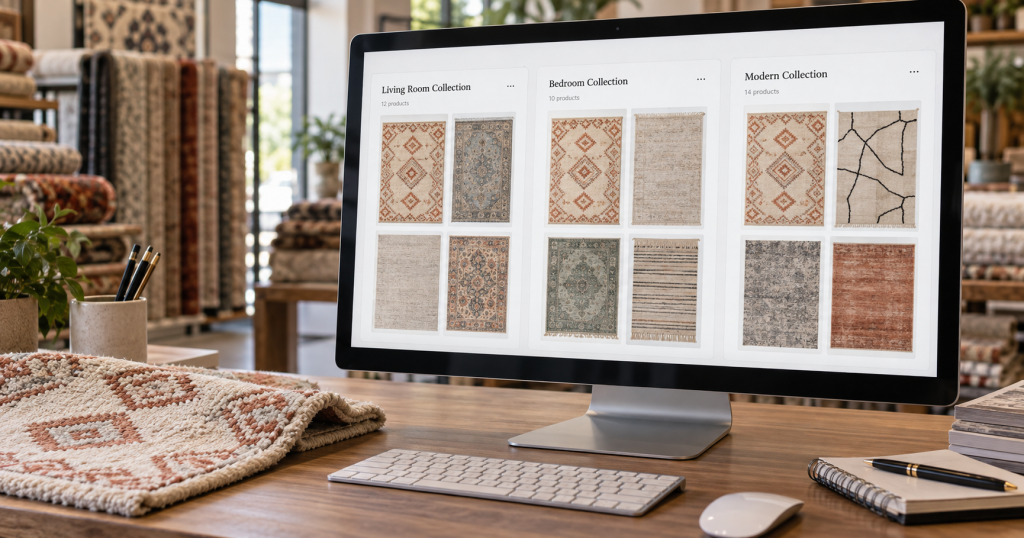
A single rug can logically belong to several collections at the same time.
An 8×10 blue hand-knotted Persian rug could appear under Persian Rugs, Blue Rugs, 8×10 Rugs, Wool Rugs, Traditional Rugs, and Hand-Knotted Rugs. From a merchandising perspective, that makes perfect sense. Customers do not all shop the same way, so giving them several paths to discover the same product can improve the shopping experience.
The SEO problem begins when those different collection paths create different indexable product URLs for the same rug.
Instead of Google seeing one authoritative product page appearing inside several useful collections, it may discover several URLs containing the same title, photographs, description, price, specifications, and availability. Internal links may point to different versions. Backlinks can become divided. Search Console data can become harder to interpret, and Google may need to determine which URL should represent the product in search.
That is why duplicate rug listings SEO is less about preventing a rug from appearing in multiple collections and more about making sure the website maintains one clear product identity.
For most rug stores, the ideal structure is straightforward: allow the same rug to appear in every relevant collection while keeping one primary, canonical product URL that represents that rug across the website.
A Rug Can Belong to Several Collections Without Being Duplicate Content
This distinction should come first because many ecommerce businesses misunderstand it.
Suppose a rug store sells a handmade Persian Tabriz rug. The product could reasonably appear inside these collections:
• Persian Rugs
• Handmade Rugs
• Wool Rugs
• 8×10 Rugs
• Blue Rugs
• Traditional Rugs
There is nothing inherently wrong with that.
Each collection serves a different browsing intent. Someone searching by origin may enter through Persian Rugs. Another customer may start with size. Someone designing a blue living room may browse by color.
The product appearing in six category grids does not mean the website contains six duplicate product pages.
The problem occurs only if those six paths create six separate crawlable URLs representing the same product.
For example, a technically messy setup might allow:
/persian-rugs/blue-tabriz-rug/
/blue-rugs/blue-tabriz-rug/
/8x10-rugs/blue-tabriz-rug/
/wool-rugs/blue-tabriz-rug/
If all four URLs display essentially the same product page, Google now has several addresses for one item.
A cleaner structure would give the rug one permanent product URL and let every collection link to that same address.
Something such as:
/products/blue-tabriz-rug/
can remain the product’s identity regardless of which collection the customer used to discover it.
This distinction is fundamental to a scalable rug website.
Why Rug Stores Are Particularly Vulnerable to This Problem
Rug websites often need more taxonomy than ordinary ecommerce stores.
A fashion store might categorize a shirt primarily by gender, type, and brand. A rug retailer may need to organize the same inventory according to style, size, color, material, origin, construction, age, shape, room, price, and collection.
A single product can therefore fit naturally into many categories.
This is useful for customers, but it creates many opportunities for ecommerce platforms, themes, plugins, or custom development to generate alternative product paths.
The problem becomes even larger for stores with thousands of products or one-of-a-kind inventory.
Imagine a dealer with 4,000 rugs and seven major collection systems. If the site architecture can generate several URLs for every product depending on the collection path, search engines may encounter far more URLs than the actual number of products.
The business thinks it has 4,000 product pages.
Technically, Google may discover many more URL variations.
That does not automatically create a penalty. Duplicate content within a website can occur naturally, and Google has systems for selecting representative canonical URLs. The concern is efficiency and clarity. A rug store should make it easy for Google to understand which URL is the primary version instead of forcing search engines to repeatedly make that decision.
Choose One Permanent URL for Each Rug
The cleanest rule is simple:
One rug should have one primary product URL.
That URL should remain the same whether the rug appears in one collection or ten collections.
The product should not need a different permanent identity simply because a customer reached it through a different part of the website.
This provides several benefits.
Internal links can consolidate around one URL. External websites are more likely to link to the same version. Analytics becomes easier to understand. Search Console performance stays concentrated. Product schema has a clear page to represent. Search engines have fewer competing URLs to process.
For one-of-a-kind rugs, URL consistency becomes even more valuable.
A unique antique Persian rug may accumulate search visibility, image traffic, links, and historical value during the months it remains available. A stable URL helps preserve those signals rather than dividing them among several collection-specific versions.
The same principle supports the SEO strategy for unique inventory, where every individual product may have a limited commercial lifespan but potentially longer search value.
How Shopify Can Create Multiple URLs for the Same Product
This issue deserves special attention because many ecommerce stores use Shopify.
Depending on the theme and implementation, a Shopify product may be available through its direct product URL while collection pages link to a version containing the collection path.
The product itself may have a canonical URL resembling:
/products/blue-persian-rug
while a collection creates a route such as:
/collections/persian-rugs/products/blue-persian-rug
The customer may see effectively the same product either way.
If the collection version correctly references the main product URL as canonical, the setup provides Google with an important consolidation signal.
However, internal linking still matters.
If every collection continuously links to non-canonical versions while the canonical /products/ URL receives few or no internal links, the architecture becomes unnecessarily messy.
Ahrefs has specifically documented this Shopify scenario, where collection-based URLs can produce duplicate product paths and canonical product URLs may end up with weak direct internal linking.
Where technically practical, collection grids should link directly to the primary product URL.
The customer experience remains the same, but the SEO structure becomes much clearer.
Canonical Tags Tell Search Engines Which Product URL You Prefer
When duplicate or near-duplicate product URLs cannot be avoided, canonicalization becomes important.
A canonical tag indicates the URL that should be treated as the preferred representative of a group of similar pages.
Suppose these URLs show the same rug:
/collections/persian-rugs/products/blue-tabriz
/collections/blue-rugs/products/blue-tabriz
/products/blue-tabriz
The first two versions can identify the direct product URL as canonical.
The preferred page should also normally contain a self-referencing canonical pointing to itself.
This gives search engines a consistent signal that /products/blue-tabriz is the main version.
Canonicalization can also help consolidate signals associated with duplicate URLs rather than leaving multiple versions competing independently. Ahrefs similarly recommends defining a canonical version for duplicate pages when several URLs contain the same or highly similar content.
The important detail is that canonical tags are not magic cleanup tools.
Google considers canonical signals alongside other signals and may choose a different canonical when the site sends conflicting information. That is why the entire architecture should reinforce the same preferred URL.
Your Internal Links Should Support the Canonical URL
A website can technically declare one product URL as canonical while repeatedly linking internally to other versions.
That sends mixed signals.
Imagine every rug collection links to:
/collections/collection-name/products/product-name
while the canonical points to:
/products/product-name
Search engines can understand the relationship, but the website is unnecessarily routing internal authority through duplicate URLs first.
A stronger approach is to make important internal links point directly to the version you want indexed.
That includes product links from:
• Collection grids
• Related products
• Blog articles
• Buying guides
• Homepage sections
• Designer resources
• Internal recommendation modules
This aligns with broader internal linking principles. The important URL should receive the signals.
A canonical product page should not become an orphan or near-orphan while duplicate collection versions receive all the internal links.
Multiple Collections Still Need Their Own Search Purpose
Solving duplicate product URLs does not mean collections themselves should become identical.
This is another important distinction.
A product may appear inside Persian Rugs and Blue Rugs, but those two collection pages represent different intents.
The Persian Rugs page should help someone interested in Persian rugs.
The Blue Rugs page should help someone shopping primarily by color.
Their product inventory can overlap without the collections themselves becoming duplicates.
A useful collection page can have its own:
• SEO title
• H1
• Introductory content
• Product assortment
• Internal links
• Supporting copy
• FAQs where useful
• Breadcrumb relationship
• Search intent
The objective is not to force every collection to contain completely different products.
The objective is to make sure each collection exists for a legitimate reason.
If Persian Rugs and Traditional Persian Rugs display the same products, contain nearly identical text, target the same keyword, and offer no meaningful difference for customers, then the collections themselves may be duplicative.
That is a separate problem from product duplication.
Avoid Creating Collections Only to Target Tiny Keyword Variations
Ecommerce SEO can become excessive when every keyword variation receives its own collection.
A rug website might eventually create:
/persian-rugs/
/persian-area-rugs/
/persian-rugs-for-sale/
/buy-persian-rugs/
/handmade-persian-rugs/
Some of these may represent legitimate differences. Others may simply be variations of the same search intent.
If each page displays essentially the same inventory and says nearly the same thing, the website may spread authority across several competing pages.
This is why keyword research should guide taxonomy rather than dictate that every query needs a URL.
A proper keyword strategy should identify when searches represent genuinely different product needs and when they are simply alternate wording for the same need.
One strong collection can often rank for several related keyword variations.
Creating three weaker collections is not automatically better.
Do Not Duplicate a Product Page Just to Change the Category
Some stores create a second product listing because they want the same rug to appear differently in another collection.
For example, the same rug may be uploaded once as:
Blue Persian Rug 8×10
and again as:
Traditional Wool Area Rug 8×10
The photographs, measurements, price, SKU, and physical product are identical. Only the title is changed to fit another category.
This is rarely a clean long-term solution.
The store now has two product records for one physical item.
Inventory synchronization becomes harder. Both listings may appear in search. Structured data may suggest two separate products. Reviews could be divided. One version may sell while the other still appears available.
Instead, one product page should describe the rug accurately and comprehensively enough to belong to multiple collections.
Its collection membership can then serve different customer paths without requiring duplicate product records.
Good product descriptions are particularly helpful here. A strong product page can naturally explain the rug’s origin, material, construction, color, size, pattern, and style without needing multiple keyword-specific duplicates.
Think About the Actual Physical Product
A useful way to make the decision is to ask:
Are these URLs representing the same physical rug?
If yes, there is usually a strong case for maintaining one primary product identity.
Suppose inventory number A1847 is one antique Persian rug.
It should not become six SEO product pages simply because it fits six collections.
The collections classify the product.
They do not create six different products.
This distinction becomes particularly important for inventory systems, merchant feeds, schema, analytics, and showroom management.
One physical product should ideally connect to one clear ecommerce record unless there is a genuine business reason to structure it differently.
What About Size or Color Variants?
Variants need slightly different treatment.
A machine-made collection might sell one design in multiple sizes and colors.
Unlike a one-of-a-kind rug appearing under several categories, these may be legitimate product variants.
Whether each variant should have a separate indexable URL depends on how the website and inventory are structured.
If all colors and sizes are selected on one parent product page, one canonical product page can often represent the group.
If individual variants have distinct URLs because customers can search for and land directly on a specific version, the implementation needs to make the relationship clear and ensure each URL accurately displays the selected variant.
Google supports structured data for product variants and distinguishes between single-page and multi-page product variant implementations. In a single-page implementation, Google recommends one canonical URL for the overall product group, while variant selection can still be represented appropriately.
For rug stores, the key is not confusing actual variants with collection membership.
An 8×10 and 9×12 version of the same manufactured design may be variants.
One antique rug appearing under Persian, Red, Wool, and 8×10 collections is still one product.
Do Not Canonicalize Distinct Products Just Because They Look Similar
Canonical tags can also be overused.
Suppose a rug store has two genuinely different handmade rugs that happen to look similar.
They might share the same size, region, material, and design family, but they are separate physical rugs with different inventory numbers, photographs, measurements, condition, or details.
Those are not necessarily duplicate pages.
One should not automatically canonicalize Product B to Product A merely because the descriptions overlap.
If both products are genuinely available and independently purchasable, each can deserve its own page.
Instead, improve the content so each page accurately reflects the specific rug.
This matters particularly for handmade inventory, where two rugs from the same collection or weaving tradition may still be distinct products.
Duplicate content management should not erase genuine product differences.
Use One Clear Product Title, Not Several SEO Identities
A rug appearing across several collections does not need a different SEO title depending on how the customer reached it.
The product page should maintain one consistent identity.
For example:
Vintage Persian Heriz Rug, Red Wool, 8’4″ x 11’6″
That title communicates several useful product attributes.
The rug can then appear naturally inside:
Persian Rugs, Vintage Rugs, Red Rugs, Wool Rugs, Large Rugs, and Heriz Rugs.
There is little benefit in dynamically changing the title tag to “Red Rug” when someone arrives through the red collection and “Persian Rug” when they arrive through the Persian collection.
Consistency makes the product easier for search engines, customers, analytics platforms, and internal systems to understand.
Breadcrumbs Need a Consistent Strategy
Multiple collection membership can make breadcrumbs complicated.
If one product belongs to six collections, which path should the breadcrumb show?
There is no universal answer, but the store should choose a logical hierarchy rather than allowing unpredictable collection paths to create duplicate product identities.
A primary taxonomy might look like:
Home > Rugs > Persian Rugs > Product
Even if the same rug is also accessible through Blue Rugs and 8×10 Rugs, it can retain the primary breadcrumb relationship.
The other collections can still link to it.
This provides a clearer hierarchy while preserving flexible browsing.
For larger rug websites, defining primary categories becomes increasingly useful because the collection structure can otherwise become a web of overlapping classifications.
Product Schema Should Describe One Product Consistently
Structured data should reflect the actual product shown on the page.
If several duplicate URLs for the same rug remain crawlable, each may expose similar Product markup. That adds another layer of duplication search engines need to interpret.
A cleaner implementation keeps the primary product URL consistent with the canonical and structured product information.
Important details such as SKU, availability, price, images, and product identity should accurately reflect the same rug.
For one-of-a-kind inventory, this becomes especially important after the rug sells.
The inventory status should be updated rather than leaving one duplicate URL saying In Stock while another says Sold.
Duplicate URLs can therefore become more than an SEO cleanliness issue. They can create inconsistent ecommerce data.
Keep Canonical URLs in the XML Sitemap
An XML sitemap should reinforce the preferred structure.
If the direct product URL is the canonical version, that is normally the product URL you want in the sitemap.
There is little reason to list several collection-specific versions of the same product.
A clean sitemap should help search engines discover the pages you actually want indexed.
For example, if the preferred product is:
/products/antique-heriz-1847/
the sitemap should not need:
/collections/antique-rugs/products/antique-heriz-1847/
/collections/persian-rugs/products/antique-heriz-1847/
/collections/red-rugs/products/antique-heriz-1847/
Listing only the canonical product page reinforces the preferred URL.
The same principle applies throughout ecommerce SEO: technical signals work best when they agree with one another.
Avoid Sending Conflicting Signals
Canonicalization becomes unreliable when different parts of the website communicate different preferences.
For example:
The canonical tag points to URL A.
The XML sitemap contains URL B.
Internal links mostly point to URL B.
External advertising uses URL C.
Breadcrumbs generate URL D.
All four display the same rug.
Google now needs to reconcile competing signals.
The goal should be alignment.
Ideally:
Canonical tag: URL A
XML sitemap: URL A
Internal links: URL A
Structured data: URL A page
Marketing links: URL A
Preferred share URL: URL A
This is much cleaner.
Google has stated that it can choose a canonical different from the one specified by the site when its systems consider another URL more representative. Consistent signals make your preferred choice easier to understand.
Duplicate URLs Can Distort Search Console Analysis
Duplicate product URLs can also make SEO reporting harder.
Imagine the same rug is receiving impressions through three URLs.
One version has ten clicks.
Another has three clicks.
The third has no clicks but appears for several keywords.
Someone reviewing Search Console may conclude that three pages are performing independently when they are actually three versions of the same product.
This can complicate decisions about:
• CTR optimization
• Keyword performance
• Internal linking
• Product page updates
• Indexation
• Backlink analysis
• Conversion performance
A clean canonical structure concentrates reporting around the URL the business actually cares about.
That makes Search Console much more useful.
Check Google’s Selected Canonical
Declaring a canonical does not mean the job is finished.
Use Google Search Console’s URL Inspection tool to check what Google considers the canonical for important product pages.
There are two concepts to pay attention to:
User-declared canonical is the URL specified by the website.
Google-selected canonical is the URL Google has chosen.
Ideally, they match.
If Google repeatedly chooses a different version, investigate the reason.
Look at internal links, redirects, sitemaps, content differences, canonical tags, and URL accessibility.
A recurring mismatch can reveal broader site architecture problems.
Do Not Use Robots.txt as a Substitute for Canonicalization
Some businesses discover duplicate collection URLs and immediately block them in robots.txt.
That may prevent crawling, but it does not automatically solve every canonical problem.
If search engines cannot crawl a URL, they may not be able to see the canonical tag on that page.
The correct technical solution depends on how the duplicates are generated and whether they need to remain accessible.
For many collection-path duplicates, clean internal linking plus correct canonicalization can be more appropriate than blindly blocking everything.
Technical changes should be made after understanding the URL patterns.
A broad robots.txt rule can accidentally block useful collection or product URLs when implemented without careful testing.
When Should Duplicate Product URLs Be Redirected?
A 301 redirect can be appropriate when a duplicate URL serves no useful customer purpose and the site can safely consolidate it.
For example, perhaps a previous website structure created:
/rugs/persian/sku1847/
and a redesign moved the permanent product to:
/products/sku1847/
If both URLs represent the same product and the old path is no longer needed, redirecting the old address directly to the current product can be a clean solution.
However, some ecommerce systems depend on alternative routes for navigation, so automatically redirecting every collection-specific path can require platform-specific development.
The principle is still the same.
If a duplicate URL does not need to exist, removing the duplication entirely can be cleaner than maintaining it indefinitely.
Collection Pages Should Link to Available Inventory Intelligently
Another issue appears when one rug belongs to many collections and later sells.
Suppose a sold rug remains visible prominently across Blue Rugs, Persian Rugs, Wool Rugs, and 8×10 Rugs.
Now customers encounter the same unavailable product repeatedly.
This is not primarily a duplicate-content problem. It is a merchandising problem.
Available products should normally receive priority in active collections.
The canonical sold product page may still remain useful for SEO, especially for one-of-a-kind inventory, but it does not need to dominate current shopping grids.
Your collection architecture and sold-product strategy should work together.
A product can retain its historical URL while active categories focus on inventory customers can actually purchase.
Prevent Pagination and Filters From Multiplying the Problem
Collections themselves may also include filters, sorting options, and pagination.
That means a product duplication problem can overlap with faceted-navigation issues.
A rug might appear in Persian Rugs, then in:
Persian Rugs + Blue
Persian Rugs + 8×10
Persian Rugs + Wool
Persian Rugs + Blue + 8×10
Persian Rugs + Blue + Wool + 8×10
If each filter state creates crawlable URLs and each links to a collection-specific version of the product, the technical footprint grows rapidly.
This is why ecommerce architecture must be considered as a system.
Collections, filters, product URLs, canonicalization, internal linking, and inventory management are connected.
Fixing only one part may leave the rest generating unnecessary complexity.
How to Audit Duplicate Rug Listings
A technical audit should begin by selecting several products that appear in multiple collections.
Open the same rug from each collection and record the URL.
If the URL remains identical each time, that is a good sign.
If the path changes, inspect the canonical tags.
Then crawl the website and look for duplicate product titles, duplicate content, canonicalized URLs, and multiple URLs sharing the same SKU.
For a larger store, useful checks include:
• Number of crawlable product URLs
• Number of actual products
• Canonical destinations
• Duplicate title groups
• Duplicate descriptions
• Internal links to non-canonical URLs
• Product URLs in XML sitemaps
• Redirected product paths
• Search Console indexed URLs
• Google-selected canonicals
If the site has 5,000 products but a crawl discovers 25,000 product-style URLs, investigate where those additional URLs are coming from.
That discrepancy often reveals collection paths, filters, parameters, pagination, or legacy URLs.
A Practical Decision Framework
Rug stores can use a simple framework to keep collection architecture manageable.
| Situation | Recommended Approach |
|---|---|
| One rug in several collections | Keep one primary product URL |
| Collection creates alternate product path | Canonicalize to primary URL |
| Internal links use duplicate URLs | Update links to canonical version |
| Same physical rug uploaded twice | Consolidate into one product record |
| Two genuinely different handmade rugs | Keep separate product pages |
| Size/color product variants | Use appropriate variant structure |
| Legacy duplicate URL | Consider relevant 301 redirect |
| Duplicate URL in sitemap | Remove non-canonical version |
| Multiple useful collections | Keep collections if intent differs |
| Near-identical collections | Consolidate when intent overlaps |
This gives merchandising flexibility without allowing taxonomy to create unnecessary product duplication.
The Ideal Architecture for Most Rug Stores
A clean rug ecommerce architecture can look surprisingly simple.
The site has one product database.
Each rug receives one stable product URL.
The product is assigned attributes such as size, color, material, origin, construction, style, and collection.
Customers use those attributes to browse the inventory in different ways.
Important attributes with meaningful search demand become dedicated collection pages.
Filters provide more detailed browsing without automatically creating unlimited SEO pages.
Every collection links to the same canonical product URL.
The sitemap includes the canonical product.
Structured data describes that product accurately.
When the rug sells, its availability and collection visibility are updated according to the store’s sold-product policy.
This structure allows the merchandising system to remain flexible while the SEO architecture stays controlled.
Why This Matters Beyond Duplicate Content
The real benefit is not simply avoiding duplicate URLs.
Clean product architecture makes the entire website easier to grow.
SEO teams know which URL to optimize.
Content writers know where to link.
Google Ads campaigns use consistent landing pages.
Designers can bookmark reliable product URLs.
Analytics does not split data unnecessarily.
Backlinks consolidate naturally.
Inventory teams manage one product record.
Developers have clearer technical rules.
Search engines receive a more coherent website.
For a business investing seriously in rug marketing, this consistency is valuable because every marketing channel ultimately depends on the underlying website structure.
Common Mistakes to Avoid
Duplicate rug listing problems usually come from systems rather than deliberate SEO decisions.
The most common mistakes include:
• Uploading the same physical rug as several products
• Creating category-specific product URLs without a clear canonical
• Linking mainly to non-canonical versions
• Putting duplicate URLs in XML sitemaps
• Creating several collections for the same search intent
• Canonicalizing genuinely different rugs together
• Letting sold and active duplicates show different availability
• Using different SKUs for the same physical inventory
• Blocking duplicate URLs before planning canonicalization
• Leaving legacy product paths accessible after migrations
• Dynamically changing product titles based on collection paths
• Ignoring Google-selected canonical data
The solution is rarely “remove the rug from all but one collection.”
The better solution is usually to improve the relationship between collections and the product’s primary URL.
Final Thoughts
A rug should be able to appear wherever customers reasonably expect to find it.
A blue Persian rug can belong in Persian Rugs, Blue Rugs, Handmade Rugs, Wool Rugs, Traditional Rugs, and 8×10 Rugs without creating an SEO problem.
The problem begins when every collection gives the same physical rug a different search identity.
For most rug stores, the cleanest approach is to maintain one primary product URL and allow multiple collections to reference it.
If alternative product paths exist, canonicalization should consistently identify the preferred version. Internal links, sitemaps, structured data, and marketing links should reinforce that same URL whenever practical.
At the same time, collection pages should remain useful in their own right. They can share products while targeting different customer needs. A Persian Rugs collection and a Blue Rugs collection may contain some of the same inventory but still serve clearly different shopping journeys.
The objective is not to eliminate overlap.
Overlap is natural in rug merchandising.
The objective is to prevent that overlap from turning into unnecessary duplicate product URLs, fragmented signals, inconsistent inventory data, and confusing search performance.
A good rule to remember is:
One physical rug, one primary product URL, multiple relevant discovery paths.
That structure gives customers flexibility while giving search engines clarity.
FAQs
Can the same rug appear in multiple collections?
Yes. The same rug can appear in several relevant collections without creating an SEO problem as long as the website maintains a clear primary product URL.
Does showing one product in several categories create duplicate content?
Not by itself. Duplicate-content concerns arise when the same product content becomes accessible through several separate URLs rather than simply appearing in multiple category grids.
Should each collection create a different product URL?
Usually no. A stable canonical product URL is generally cleaner than giving the same physical rug a different URL for every collection.
What is a canonical product URL?
It is the preferred URL representing a product when the same or highly similar content can be accessed through multiple URLs.
Should collection product links point to the canonical URL?
Where technically practical, yes. Linking directly to the preferred product URL helps keep internal linking signals consistent.
Can two collections contain many of the same rugs?
Yes, if the collections serve genuinely different customer intents. A Blue Rugs collection and an 8×10 Rugs collection may naturally contain overlapping products.
Should similar handmade rugs use the same canonical?
Not automatically. If they are genuinely different physical products, they can deserve separate product pages even if their styles and descriptions are similar.
What should happen if the same rug was accidentally uploaded twice?
Choose the correct primary product record, consolidate the inventory, and redirect or otherwise appropriately handle the duplicate URL depending on the technical setup.
Should non-canonical product URLs appear in the sitemap?
Generally, the sitemap should reinforce the canonical URLs the website wants search engines to index rather than listing multiple versions of the same product.
How can I find duplicate rug product URLs?
Crawl the website, compare the number of product URLs with actual inventory, review duplicate content groups, inspect canonical tags, and check Google Search Console’s URL Inspection data.
Can duplicate URLs split SEO signals?
They can make signals and reporting less clear. Consistent canonicalization and internal linking help consolidate the website around the preferred version.
What if Google chooses a different canonical?
Use URL Inspection to compare the user-declared and Google-selected canonical, then review internal links, sitemaps, redirects, page quality, and other technical signals.
Should I create separate pages for every color and size?
Not automatically. Genuine variants and high-demand collection pages may deserve dedicated URLs, but creating duplicate product pages simply to target each attribute is usually unnecessary.
Is duplicate content a Google penalty?
Normal internal duplicate content is not automatically a spam violation. The bigger concerns are inefficient crawling, unclear canonical selection, fragmented signals, and poor site architecture.
What is the best rule for duplicate rug listings?
Keep one primary URL for each physical rug and allow all relevant collections, filters, and navigation paths to lead customers toward that same product identity.
SEO Title: Duplicate Rug Listings SEO: What Stores Should Do
Meta Description: Learn how rug stores should handle the same rug across multiple collections without creating duplicate URLs, split rankings, crawl waste, or SEO confusion.
Slug: duplicate-rug-listings-multiple-collections
Focus Keyword: duplicate rug listings SEO
Secondary Keywords: duplicate product pages SEO, rug ecommerce SEO, canonical product URLs, multiple collection SEO, duplicate rug products
How to Handle Duplicate Rug Listings Across Multiple Collections
Last Updated: October 11, 2026
A single rug can logically belong to several collections at the same time.
An 8×10 blue hand-knotted Persian rug could appear under Persian Rugs, Blue Rugs, 8×10 Rugs, Wool Rugs, Traditional Rugs, and Hand-Knotted Rugs. From a merchandising perspective, that makes perfect sense. Customers do not all shop the same way, so giving them several paths to discover the same product can improve the shopping experience.
The SEO problem begins when those different collection paths create different indexable product URLs for the same rug.
Instead of Google seeing one authoritative product page appearing inside several useful collections, it may discover several URLs containing the same title, photographs, description, price, specifications, and availability. Internal links may point to different versions. Backlinks can become divided. Search Console data can become harder to interpret, and Google may need to determine which URL should represent the product in search.
That is why duplicate rug listings SEO is less about preventing a rug from appearing in multiple collections and more about making sure the website maintains one clear product identity.
For most rug stores, the ideal structure is straightforward: allow the same rug to appear in every relevant collection while keeping one primary, canonical product URL that represents that rug across the website.
A Rug Can Belong to Several Collections Without Being Duplicate Content
This distinction should come first because many ecommerce businesses misunderstand it.
Suppose a rug store sells a handmade Persian Tabriz rug. The product could reasonably appear inside these collections:
• Persian Rugs
• Handmade Rugs
• Wool Rugs
• 8×10 Rugs
• Blue Rugs
• Traditional Rugs
There is nothing inherently wrong with that.
Each collection serves a different browsing intent. Someone searching by origin may enter through Persian Rugs. Another customer may start with size. Someone designing a blue living room may browse by color.
The product appearing in six category grids does not mean the website contains six duplicate product pages.
The problem occurs only if those six paths create six separate crawlable URLs representing the same product.
For example, a technically messy setup might allow:
/persian-rugs/blue-tabriz-rug/
/blue-rugs/blue-tabriz-rug/
/8x10-rugs/blue-tabriz-rug/
/wool-rugs/blue-tabriz-rug/
If all four URLs display essentially the same product page, Google now has several addresses for one item.
A cleaner structure would give the rug one permanent product URL and let every collection link to that same address.
Something such as:
/products/blue-tabriz-rug/
can remain the product’s identity regardless of which collection the customer used to discover it.
This distinction is fundamental to a scalable rug website.
Why Rug Stores Are Particularly Vulnerable to This Problem
Rug websites often need more taxonomy than ordinary ecommerce stores.
A fashion store might categorize a shirt primarily by gender, type, and brand. A rug retailer may need to organize the same inventory according to style, size, color, material, origin, construction, age, shape, room, price, and collection.
A single product can therefore fit naturally into many categories.
This is useful for customers, but it creates many opportunities for ecommerce platforms, themes, plugins, or custom development to generate alternative product paths.
The problem becomes even larger for stores with thousands of products or one-of-a-kind inventory.
Imagine a dealer with 4,000 rugs and seven major collection systems. If the site architecture can generate several URLs for every product depending on the collection path, search engines may encounter far more URLs than the actual number of products.
The business thinks it has 4,000 product pages.
Technically, Google may discover many more URL variations.
That does not automatically create a penalty. Duplicate content within a website can occur naturally, and Google has systems for selecting representative canonical URLs. The concern is efficiency and clarity. A rug store should make it easy for Google to understand which URL is the primary version instead of forcing search engines to repeatedly make that decision.
Choose One Permanent URL for Each Rug
The cleanest rule is simple:
One rug should have one primary product URL.
That URL should remain the same whether the rug appears in one collection or ten collections.
The product should not need a different permanent identity simply because a customer reached it through a different part of the website.
This provides several benefits.
Internal links can consolidate around one URL. External websites are more likely to link to the same version. Analytics becomes easier to understand. Search Console performance stays concentrated. Product schema has a clear page to represent. Search engines have fewer competing URLs to process.
For one-of-a-kind rugs, URL consistency becomes even more valuable.
A unique antique Persian rug may accumulate search visibility, image traffic, links, and historical value during the months it remains available. A stable URL helps preserve those signals rather than dividing them among several collection-specific versions.
The same principle supports the SEO strategy for unique inventory, where every individual product may have a limited commercial lifespan but potentially longer search value.
How Shopify Can Create Multiple URLs for the Same Product
This issue deserves special attention because many ecommerce stores use Shopify.
Depending on the theme and implementation, a Shopify product may be available through its direct product URL while collection pages link to a version containing the collection path.
The product itself may have a canonical URL resembling:
/products/blue-persian-rug
while a collection creates a route such as:
/collections/persian-rugs/products/blue-persian-rug
The customer may see effectively the same product either way.
If the collection version correctly references the main product URL as canonical, the setup provides Google with an important consolidation signal.
However, internal linking still matters.
If every collection continuously links to non-canonical versions while the canonical /products/ URL receives few or no internal links, the architecture becomes unnecessarily messy.
Ahrefs has specifically documented this Shopify scenario, where collection-based URLs can produce duplicate product paths and canonical product URLs may end up with weak direct internal linking.
Where technically practical, collection grids should link directly to the primary product URL.
The customer experience remains the same, but the SEO structure becomes much clearer.
Canonical Tags Tell Search Engines Which Product URL You Prefer
When duplicate or near-duplicate product URLs cannot be avoided, canonicalization becomes important.
A canonical tag indicates the URL that should be treated as the preferred representative of a group of similar pages.
Suppose these URLs show the same rug:
/collections/persian-rugs/products/blue-tabriz
/collections/blue-rugs/products/blue-tabriz
/products/blue-tabriz
The first two versions can identify the direct product URL as canonical.
The preferred page should also normally contain a self-referencing canonical pointing to itself.
This gives search engines a consistent signal that /products/blue-tabriz is the main version.
Canonicalization can also help consolidate signals associated with duplicate URLs rather than leaving multiple versions competing independently. Ahrefs similarly recommends defining a canonical version for duplicate pages when several URLs contain the same or highly similar content.
The important detail is that canonical tags are not magic cleanup tools.
Google considers canonical signals alongside other signals and may choose a different canonical when the site sends conflicting information. That is why the entire architecture should reinforce the same preferred URL.
Your Internal Links Should Support the Canonical URL
A website can technically declare one product URL as canonical while repeatedly linking internally to other versions.
That sends mixed signals.
Imagine every rug collection links to:
/collections/collection-name/products/product-name
while the canonical points to:
/products/product-name
Search engines can understand the relationship, but the website is unnecessarily routing internal authority through duplicate URLs first.
A stronger approach is to make important internal links point directly to the version you want indexed.
That includes product links from:
• Collection grids
• Related products
• Blog articles
• Buying guides
• Homepage sections
• Designer resources
• Internal recommendation modules
This aligns with broader internal linking principles. The important URL should receive the signals.
A canonical product page should not become an orphan or near-orphan while duplicate collection versions receive all the internal links.
Multiple Collections Still Need Their Own Search Purpose
Solving duplicate product URLs does not mean collections themselves should become identical.
This is another important distinction.
A product may appear inside Persian Rugs and Blue Rugs, but those two collection pages represent different intents.
The Persian Rugs page should help someone interested in Persian rugs.
The Blue Rugs page should help someone shopping primarily by color.
Their product inventory can overlap without the collections themselves becoming duplicates.
A useful collection page can have its own:
• SEO title
• H1
• Introductory content
• Product assortment
• Internal links
• Supporting copy
• FAQs where useful
• Breadcrumb relationship
• Search intent
The objective is not to force every collection to contain completely different products.
The objective is to make sure each collection exists for a legitimate reason.
If Persian Rugs and Traditional Persian Rugs display the same products, contain nearly identical text, target the same keyword, and offer no meaningful difference for customers, then the collections themselves may be duplicative.
That is a separate problem from product duplication.
Avoid Creating Collections Only to Target Tiny Keyword Variations
Ecommerce SEO can become excessive when every keyword variation receives its own collection.
A rug website might eventually create:
/persian-rugs/
/persian-area-rugs/
/persian-rugs-for-sale/
/buy-persian-rugs/
/handmade-persian-rugs/
Some of these may represent legitimate differences. Others may simply be variations of the same search intent.
If each page displays essentially the same inventory and says nearly the same thing, the website may spread authority across several competing pages.
This is why keyword research should guide taxonomy rather than dictate that every query needs a URL.
A proper keyword strategy should identify when searches represent genuinely different product needs and when they are simply alternate wording for the same need.
One strong collection can often rank for several related keyword variations.
Creating three weaker collections is not automatically better.
Do Not Duplicate a Product Page Just to Change the Category
Some stores create a second product listing because they want the same rug to appear differently in another collection.
For example, the same rug may be uploaded once as:
Blue Persian Rug 8×10
and again as:
Traditional Wool Area Rug 8×10
The photographs, measurements, price, SKU, and physical product are identical. Only the title is changed to fit another category.
This is rarely a clean long-term solution.
The store now has two product records for one physical item.
Inventory synchronization becomes harder. Both listings may appear in search. Structured data may suggest two separate products. Reviews could be divided. One version may sell while the other still appears available.
Instead, one product page should describe the rug accurately and comprehensively enough to belong to multiple collections.
Its collection membership can then serve different customer paths without requiring duplicate product records.
Good product descriptions are particularly helpful here. A strong product page can naturally explain the rug’s origin, material, construction, color, size, pattern, and style without needing multiple keyword-specific duplicates.
Think About the Actual Physical Product
A useful way to make the decision is to ask:
Are these URLs representing the same physical rug?
If yes, there is usually a strong case for maintaining one primary product identity.
Suppose inventory number A1847 is one antique Persian rug.
It should not become six SEO product pages simply because it fits six collections.
The collections classify the product.
They do not create six different products.
This distinction becomes particularly important for inventory systems, merchant feeds, schema, analytics, and showroom management.
One physical product should ideally connect to one clear ecommerce record unless there is a genuine business reason to structure it differently.
What About Size or Color Variants?
Variants need slightly different treatment.
A machine-made collection might sell one design in multiple sizes and colors.
Unlike a one-of-a-kind rug appearing under several categories, these may be legitimate product variants.
Whether each variant should have a separate indexable URL depends on how the website and inventory are structured.
If all colors and sizes are selected on one parent product page, one canonical product page can often represent the group.
If individual variants have distinct URLs because customers can search for and land directly on a specific version, the implementation needs to make the relationship clear and ensure each URL accurately displays the selected variant.
Google supports structured data for product variants and distinguishes between single-page and multi-page product variant implementations. In a single-page implementation, Google recommends one canonical URL for the overall product group, while variant selection can still be represented appropriately.
For rug stores, the key is not confusing actual variants with collection membership.
An 8×10 and 9×12 version of the same manufactured design may be variants.
One antique rug appearing under Persian, Red, Wool, and 8×10 collections is still one product.
Do Not Canonicalize Distinct Products Just Because They Look Similar
Canonical tags can also be overused.
Suppose a rug store has two genuinely different handmade rugs that happen to look similar.
They might share the same size, region, material, and design family, but they are separate physical rugs with different inventory numbers, photographs, measurements, condition, or details.
Those are not necessarily duplicate pages.
One should not automatically canonicalize Product B to Product A merely because the descriptions overlap.
If both products are genuinely available and independently purchasable, each can deserve its own page.
Instead, improve the content so each page accurately reflects the specific rug.
This matters particularly for handmade inventory, where two rugs from the same collection or weaving tradition may still be distinct products.
Duplicate content management should not erase genuine product differences.
Use One Clear Product Title, Not Several SEO Identities
A rug appearing across several collections does not need a different SEO title depending on how the customer reached it.
The product page should maintain one consistent identity.
For example:
Vintage Persian Heriz Rug, Red Wool, 8’4″ x 11’6″
That title communicates several useful product attributes.
The rug can then appear naturally inside:
Persian Rugs, Vintage Rugs, Red Rugs, Wool Rugs, Large Rugs, and Heriz Rugs.
There is little benefit in dynamically changing the title tag to “Red Rug” when someone arrives through the red collection and “Persian Rug” when they arrive through the Persian collection.
Consistency makes the product easier for search engines, customers, analytics platforms, and internal systems to understand.
Breadcrumbs Need a Consistent Strategy
Multiple collection membership can make breadcrumbs complicated.
If one product belongs to six collections, which path should the breadcrumb show?
There is no universal answer, but the store should choose a logical hierarchy rather than allowing unpredictable collection paths to create duplicate product identities.
A primary taxonomy might look like:
Home > Rugs > Persian Rugs > Product
Even if the same rug is also accessible through Blue Rugs and 8×10 Rugs, it can retain the primary breadcrumb relationship.
The other collections can still link to it.
This provides a clearer hierarchy while preserving flexible browsing.
For larger rug websites, defining primary categories becomes increasingly useful because the collection structure can otherwise become a web of overlapping classifications.
Product Schema Should Describe One Product Consistently
Structured data should reflect the actual product shown on the page.
If several duplicate URLs for the same rug remain crawlable, each may expose similar Product markup. That adds another layer of duplication search engines need to interpret.
A cleaner implementation keeps the primary product URL consistent with the canonical and structured product information.
Important details such as SKU, availability, price, images, and product identity should accurately reflect the same rug.
For one-of-a-kind inventory, this becomes especially important after the rug sells.
The inventory status should be updated rather than leaving one duplicate URL saying In Stock while another says Sold.
Duplicate URLs can therefore become more than an SEO cleanliness issue. They can create inconsistent ecommerce data.
Keep Canonical URLs in the XML Sitemap
An XML sitemap should reinforce the preferred structure.
If the direct product URL is the canonical version, that is normally the product URL you want in the sitemap.
There is little reason to list several collection-specific versions of the same product.
A clean sitemap should help search engines discover the pages you actually want indexed.
For example, if the preferred product is:
/products/antique-heriz-1847/
the sitemap should not need:
/collections/antique-rugs/products/antique-heriz-1847/
/collections/persian-rugs/products/antique-heriz-1847/
/collections/red-rugs/products/antique-heriz-1847/
Listing only the canonical product page reinforces the preferred URL.
The same principle applies throughout ecommerce SEO: technical signals work best when they agree with one another.
Avoid Sending Conflicting Signals
Canonicalization becomes unreliable when different parts of the website communicate different preferences.
For example:
The canonical tag points to URL A.
The XML sitemap contains URL B.
Internal links mostly point to URL B.
External advertising uses URL C.
Breadcrumbs generate URL D.
All four display the same rug.
Google now needs to reconcile competing signals.
The goal should be alignment.
Ideally:
Canonical tag: URL A
XML sitemap: URL A
Internal links: URL A
Structured data: URL A page
Marketing links: URL A
Preferred share URL: URL A
This is much cleaner.
Google has stated that it can choose a canonical different from the one specified by the site when its systems consider another URL more representative. Consistent signals make your preferred choice easier to understand.
Duplicate URLs Can Distort Search Console Analysis
Duplicate product URLs can also make SEO reporting harder.
Imagine the same rug is receiving impressions through three URLs.
One version has ten clicks.
Another has three clicks.
The third has no clicks but appears for several keywords.
Someone reviewing Search Console may conclude that three pages are performing independently when they are actually three versions of the same product.
This can complicate decisions about:
• CTR optimization
• Keyword performance
• Internal linking
• Product page updates
• Indexation
• Backlink analysis
• Conversion performance
A clean canonical structure concentrates reporting around the URL the business actually cares about.
That makes Search Console much more useful.
Check Google’s Selected Canonical
Declaring a canonical does not mean the job is finished.
Use Google Search Console’s URL Inspection tool to check what Google considers the canonical for important product pages.
There are two concepts to pay attention to:
User-declared canonical is the URL specified by the website.
Google-selected canonical is the URL Google has chosen.
Ideally, they match.
If Google repeatedly chooses a different version, investigate the reason.
Look at internal links, redirects, sitemaps, content differences, canonical tags, and URL accessibility.
A recurring mismatch can reveal broader site architecture problems.
Do Not Use Robots.txt as a Substitute for Canonicalization
Some businesses discover duplicate collection URLs and immediately block them in robots.txt.
That may prevent crawling, but it does not automatically solve every canonical problem.
If search engines cannot crawl a URL, they may not be able to see the canonical tag on that page.
The correct technical solution depends on how the duplicates are generated and whether they need to remain accessible.
For many collection-path duplicates, clean internal linking plus correct canonicalization can be more appropriate than blindly blocking everything.
Technical changes should be made after understanding the URL patterns.
A broad robots.txt rule can accidentally block useful collection or product URLs when implemented without careful testing.
When Should Duplicate Product URLs Be Redirected?
A 301 redirect can be appropriate when a duplicate URL serves no useful customer purpose and the site can safely consolidate it.
For example, perhaps a previous website structure created:
/rugs/persian/sku1847/
and a redesign moved the permanent product to:
/products/sku1847/
If both URLs represent the same product and the old path is no longer needed, redirecting the old address directly to the current product can be a clean solution.
However, some ecommerce systems depend on alternative routes for navigation, so automatically redirecting every collection-specific path can require platform-specific development.
The principle is still the same.
If a duplicate URL does not need to exist, removing the duplication entirely can be cleaner than maintaining it indefinitely.
Collection Pages Should Link to Available Inventory Intelligently
Another issue appears when one rug belongs to many collections and later sells.
Suppose a sold rug remains visible prominently across Blue Rugs, Persian Rugs, Wool Rugs, and 8×10 Rugs.
Now customers encounter the same unavailable product repeatedly.
This is not primarily a duplicate-content problem. It is a merchandising problem.
Available products should normally receive priority in active collections.
The canonical sold product page may still remain useful for SEO, especially for one-of-a-kind inventory, but it does not need to dominate current shopping grids.
Your collection architecture and sold-product strategy should work together.
A product can retain its historical URL while active categories focus on inventory customers can actually purchase.
Prevent Pagination and Filters From Multiplying the Problem
Collections themselves may also include filters, sorting options, and pagination.
That means a product duplication problem can overlap with faceted-navigation issues.
A rug might appear in Persian Rugs, then in:
Persian Rugs + Blue
Persian Rugs + 8×10
Persian Rugs + Wool
Persian Rugs + Blue + 8×10
Persian Rugs + Blue + Wool + 8×10
If each filter state creates crawlable URLs and each links to a collection-specific version of the product, the technical footprint grows rapidly.
This is why ecommerce architecture must be considered as a system.
Collections, filters, product URLs, canonicalization, internal linking, and inventory management are connected.
Fixing only one part may leave the rest generating unnecessary complexity.
How to Audit Duplicate Rug Listings
A technical audit should begin by selecting several products that appear in multiple collections.
Open the same rug from each collection and record the URL.
If the URL remains identical each time, that is a good sign.
If the path changes, inspect the canonical tags.
Then crawl the website and look for duplicate product titles, duplicate content, canonicalized URLs, and multiple URLs sharing the same SKU.
For a larger store, useful checks include:
• Number of crawlable product URLs
• Number of actual products
• Canonical destinations
• Duplicate title groups
• Duplicate descriptions
• Internal links to non-canonical URLs
• Product URLs in XML sitemaps
• Redirected product paths
• Search Console indexed URLs
• Google-selected canonicals
If the site has 5,000 products but a crawl discovers 25,000 product-style URLs, investigate where those additional URLs are coming from.
That discrepancy often reveals collection paths, filters, parameters, pagination, or legacy URLs.
A Practical Decision Framework
Rug stores can use a simple framework to keep collection architecture manageable.
| Situation | Recommended Approach |
|---|---|
| One rug in several collections | Keep one primary product URL |
| Collection creates alternate product path | Canonicalize to primary URL |
| Internal links use duplicate URLs | Update links to canonical version |
| Same physical rug uploaded twice | Consolidate into one product record |
| Two genuinely different handmade rugs | Keep separate product pages |
| Size/color product variants | Use appropriate variant structure |
| Legacy duplicate URL | Consider relevant 301 redirect |
| Duplicate URL in sitemap | Remove non-canonical version |
| Multiple useful collections | Keep collections if intent differs |
| Near-identical collections | Consolidate when intent overlaps |
This gives merchandising flexibility without allowing taxonomy to create unnecessary product duplication.
The Ideal Architecture for Most Rug Stores
A clean rug ecommerce architecture can look surprisingly simple.
The site has one product database.
Each rug receives one stable product URL.
The product is assigned attributes such as size, color, material, origin, construction, style, and collection.
Customers use those attributes to browse the inventory in different ways.
Important attributes with meaningful search demand become dedicated collection pages.
Filters provide more detailed browsing without automatically creating unlimited SEO pages.
Every collection links to the same canonical product URL.
The sitemap includes the canonical product.
Structured data describes that product accurately.
When the rug sells, its availability and collection visibility are updated according to the store’s sold-product policy.
This structure allows the merchandising system to remain flexible while the SEO architecture stays controlled.
Why This Matters Beyond Duplicate Content
The real benefit is not simply avoiding duplicate URLs.
Clean product architecture makes the entire website easier to grow.
SEO teams know which URL to optimize.
Content writers know where to link.
Google Ads campaigns use consistent landing pages.
Designers can bookmark reliable product URLs.
Analytics does not split data unnecessarily.
Backlinks consolidate naturally.
Inventory teams manage one product record.
Developers have clearer technical rules.
Search engines receive a more coherent website.
For a business investing seriously in rug marketing, this consistency is valuable because every marketing channel ultimately depends on the underlying website structure.
Common Mistakes to Avoid
Duplicate rug listing problems usually come from systems rather than deliberate SEO decisions.
The most common mistakes include:
• Uploading the same physical rug as several products
• Creating category-specific product URLs without a clear canonical
• Linking mainly to non-canonical versions
• Putting duplicate URLs in XML sitemaps
• Creating several collections for the same search intent
• Canonicalizing genuinely different rugs together
• Letting sold and active duplicates show different availability
• Using different SKUs for the same physical inventory
• Blocking duplicate URLs before planning canonicalization
• Leaving legacy product paths accessible after migrations
• Dynamically changing product titles based on collection paths
• Ignoring Google-selected canonical data
The solution is rarely “remove the rug from all but one collection.”
The better solution is usually to improve the relationship between collections and the product’s primary URL.
Final Thoughts
A rug should be able to appear wherever customers reasonably expect to find it.
A blue Persian rug can belong in Persian Rugs, Blue Rugs, Handmade Rugs, Wool Rugs, Traditional Rugs, and 8×10 Rugs without creating an SEO problem.
The problem begins when every collection gives the same physical rug a different search identity.
For most rug stores, the cleanest approach is to maintain one primary product URL and allow multiple collections to reference it.
If alternative product paths exist, canonicalization should consistently identify the preferred version. Internal links, sitemaps, structured data, and marketing links should reinforce that same URL whenever practical.
At the same time, collection pages should remain useful in their own right. They can share products while targeting different customer needs. A Persian Rugs collection and a Blue Rugs collection may contain some of the same inventory but still serve clearly different shopping journeys.
The objective is not to eliminate overlap.
Overlap is natural in rug merchandising.
The objective is to prevent that overlap from turning into unnecessary duplicate product URLs, fragmented signals, inconsistent inventory data, and confusing search performance.
A good rule to remember is:
One physical rug, one primary product URL, multiple relevant discovery paths.
That structure gives customers flexibility while giving search engines clarity.
FAQs
Can the same rug appear in multiple collections?
Yes. The same rug can appear in several relevant collections without creating an SEO problem as long as the website maintains a clear primary product URL.
Does showing one product in several categories create duplicate content?
Not by itself. Duplicate-content concerns arise when the same product content becomes accessible through several separate URLs rather than simply appearing in multiple category grids.
Should each collection create a different product URL?
Usually no. A stable canonical product URL is generally cleaner than giving the same physical rug a different URL for every collection.
What is a canonical product URL?
It is the preferred URL representing a product when the same or highly similar content can be accessed through multiple URLs.
Should collection product links point to the canonical URL?
Where technically practical, yes. Linking directly to the preferred product URL helps keep internal linking signals consistent.
Can two collections contain many of the same rugs?
Yes, if the collections serve genuinely different customer intents. A Blue Rugs collection and an 8×10 Rugs collection may naturally contain overlapping products.
Should similar handmade rugs use the same canonical?
Not automatically. If they are genuinely different physical products, they can deserve separate product pages even if their styles and descriptions are similar.
What should happen if the same rug was accidentally uploaded twice?
Choose the correct primary product record, consolidate the inventory, and redirect or otherwise appropriately handle the duplicate URL depending on the technical setup.
Should non-canonical product URLs appear in the sitemap?
Generally, the sitemap should reinforce the canonical URLs the website wants search engines to index rather than listing multiple versions of the same product.
How can I find duplicate rug product URLs?
Crawl the website, compare the number of product URLs with actual inventory, review duplicate content groups, inspect canonical tags, and check Google Search Console’s URL Inspection data.
Can duplicate URLs split SEO signals?
They can make signals and reporting less clear. Consistent canonicalization and internal linking help consolidate the website around the preferred version.
What if Google chooses a different canonical?
Use URL Inspection to compare the user-declared and Google-selected canonical, then review internal links, sitemaps, redirects, page quality, and other technical signals.
Should I create separate pages for every color and size?
Not automatically. Genuine variants and high-demand collection pages may deserve dedicated URLs, but creating duplicate product pages simply to target each attribute is usually unnecessary.
Is duplicate content a Google penalty?
Normal internal duplicate content is not automatically a spam violation. The bigger concerns are inefficient crawling, unclear canonical selection, fragmented signals, and poor site architecture.
What is the best rule for duplicate rug listings?
Keep one primary URL for each physical rug and allow all relevant collections, filters, and navigation paths to lead customers toward that same product identity.