


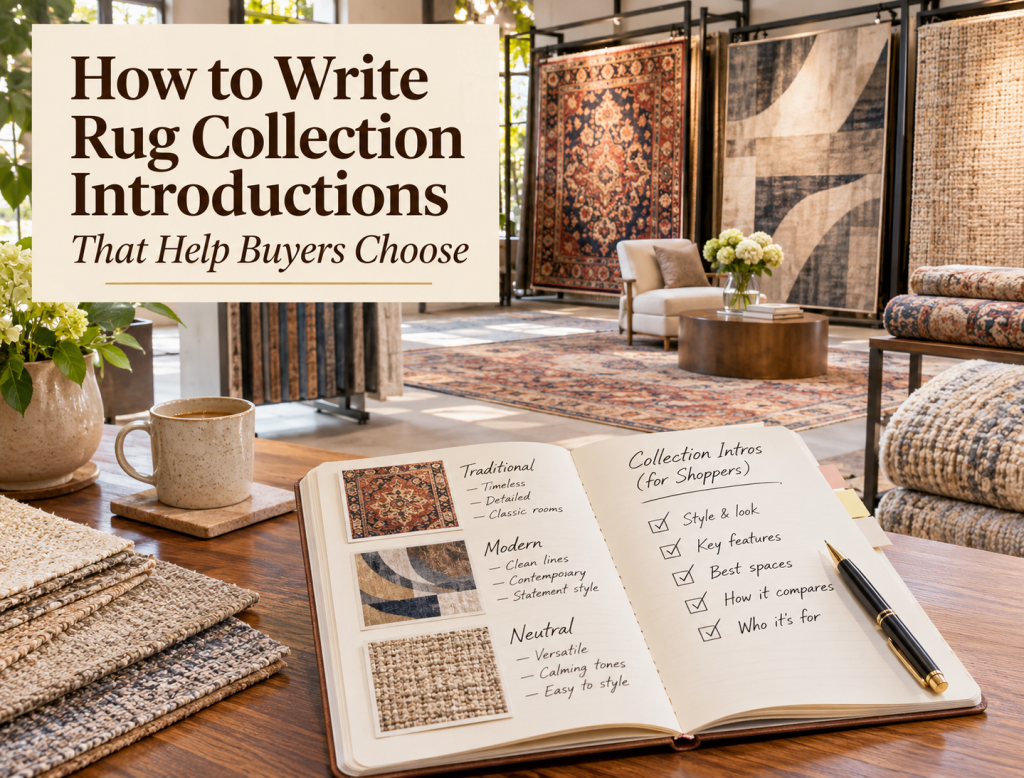
When we write content for a rug marketplace, we do not think of a collection introduction as a paragraph that exists simply because an SEO tool says the category page needs text. We treat it as the first piece of buying guidance a shopper receives after entering a collection. Someone arriving on a Persian rugs page, an 8×10 rugs page, a wool rugs page, or a vintage rug collection is usually trying to narrow a decision. If the opening copy tells that person only that the collection contains “beautiful, high-quality rugs for every home,” we have used valuable page space without helping the shopper understand anything about the products in front of them.
This matters for SEO as well as conversion. Our keyword research for the US market shows that broader phrases around category page SEO have more measurable demand than the exact phrase “rug collection page content,” which means a strong article or marketplace category strategy needs to satisfy both the SEO question and the actual ecommerce problem behind it. Google also emphasizes that useful content should provide original value beyond obvious summaries, while its ecommerce guidance recommends clear, crawlable structures that help users and Google understand product relationships. For us, that means the best rug collection introduction is not the longest one. It is the one that makes the collection easier to understand and gives the shopper a better reason to continue browsing.
We Start With the Decision the Buyer Is Trying to Make
Before we write the introduction, we ask what decision brought someone to this particular collection. A shopper entering an 8×10 rug category may already understand the size they need and now be deciding between style, material, construction, color, and budget. A shopper entering a Persian rugs category may still need to understand how Persian rugs differ from broader handmade or Oriental rug groupings. Someone landing on a washable-rug collection may care less about weaving history and more about cleaning, households with children, pets, pile height, and whether the available styles fit a living room or dining space.
That buyer decision should determine the opening content. We do not begin every category with a dictionary definition because not every shopper needs one. We also do not repeat the same paragraph structure across dozens of collections with only the category name changed. Instead, we identify what a visitor needs to know before the product grid becomes useful. This is where a well-planned keyword strategy becomes important because the queries around a category often reveal the uncertainty behind the search, not merely the phrase that should appear in the heading.
If buyers repeatedly search questions about whether an Oushak rug works in a contemporary room, whether wool is suitable for a high-traffic area, or what size fits beneath a dining table, those questions tell us what information should influence the collection experience. The introduction does not have to answer every question in full, but it should orient the visitor so the available products make more sense.
We Do Not Write Collection Copy as a Generic Definition
One of the easiest ways to create weak category content is to define the term and stop. A Persian rug introduction that says Persian rugs are rugs traditionally made in Iran may be factually relevant, but it does almost nothing to help a customer choose among the available inventory. The buyer still needs to understand what they are likely to notice in the collection, how designs differ, what materials or constructions are common in the marketplace inventory, and which product attributes should influence their shortlist.
When we define a category, we immediately connect the definition to the shopping decision. If we describe hand-knotted rugs, we explain what the construction means for the type of products the buyer is browsing rather than turning the introduction into an encyclopedia entry. If we describe vintage rugs, we explain why age, condition, restoration, color variation, and individual measurements deserve closer attention. If the category contains one-of-a-kind pieces, we make it clear that the selection changes as individual rugs sell instead of writing as though every design is permanently stocked.
The goal is to move from “What is this category?” to “What should I pay attention to while comparing these products?” That transition makes the content useful to someone who came to shop rather than simply to read.
We Use the Introduction to Explain Why Products Belong Together
A marketplace collection should have a reason for existing beyond a shared tag in the database. If we create a collection called Neutral Living Room Rugs, the page should help the shopper understand what unifies the products. That might involve the visual palette, practical room use, dimensions, style flexibility, or another meaningful characteristic. If the collection exists only because the marketplace software can automatically combine several filters, it may not deserve its own indexable landing page or substantial SEO copy.
This distinction becomes especially important on rug marketplaces because individual rugs can fit several taxonomies simultaneously. One rug might be Persian, wool, handmade, red, rectangular, traditional, and approximately 8×10. We do not need seven near-identical collection pages all describing the same piece in the same way. We need category architecture that reflects meaningful buyer journeys. Our guide to rug taxonomies supports this approach by treating classification as an information architecture problem rather than simply a tagging exercise.
When the collection itself is coherent, writing the introduction becomes much easier. We can explain the shared characteristics honestly instead of inventing generic benefits that could apply to every rug on the marketplace.
We Put the Most Useful Information Before the Product Grid
We want the first section of collection content to earn its space. If a shopper must scroll through 600 words before seeing a single rug, the page has probably prioritized SEO copy over shopping. If there is no useful context at all, the marketplace may force a visitor to interpret hundreds of products without guidance. We prefer a concise but substantive opening that establishes what the collection contains, identifies the main decision factors, and gives the shopper enough context to begin comparing products confidently.
For example, if we were introducing a marketplace collection of one-of-a-kind vintage Persian rugs, we might write something like this: “This collection brings together individually listed vintage Persian rugs with their own measurements, color variation, condition, and design details. Because these are individual pieces rather than repeatedly stocked designs, we recommend comparing the exact dimensions and close-up photographs of each listing rather than choosing by style name alone. If you are narrowing options for a particular room, start with size and condition, then compare palette, pattern density, and how much visual contrast you want the rug to introduce.”
That paragraph contains category context, marketplace-specific information, and a buying method without stuffing keywords or pretending that one rug is right for everyone. It also prepares the customer for the product grid rather than competing with it.
We Write Around Product Differences That Actually Change the Choice
The strongest collection introductions explain the differences that can change which rug a shopper selects. For a wool rug category, that may include construction, pile, texture, maintenance expectations, and use. For a traditional rug collection, it may be pattern density, medallion versus all-over designs, palette, border structure, and room style. For handmade rugs, it may be construction method, variation between individual pieces, material, origin information, and whether the rug is new, vintage, or antique.
We do not need to cover every attribute in every collection. We choose the attributes that genuinely matter for that category. That approach also prevents duplicate content because the introduction to a size collection should naturally differ from the introduction to an origin collection or material collection even when many of the same rugs appear in all three.
The same principle applies to individual listings. Collection content should help shoppers compare groups of products, while product descriptions should explain the specific rug. When those two content levels perform different jobs, we avoid repeating product-level details across collection pages and create a clearer path from browsing to evaluation.
We Use Search Language Without Turning the Page Into Keyword Copy
If the collection targets “8×10 Persian rugs,” we use that wording naturally because it accurately describes the page. We may also cover related language such as handmade Persian rugs, 8×10 area rugs, traditional rugs, or wool Persian rugs when those concepts genuinely belong to the collection. We do not create sentences whose only purpose is to fit every secondary keyword into the opening section.
This is especially important because category-page search intent is often broader than one exact phrase. The US SERP for category-page SEO itself contains guides focused on ecommerce category optimization, category landing pages, and product category structure rather than pages repeating one keyword. A strong marketplace collection should follow the same principle: cover the complete buying intent around the collection rather than optimize every sentence around one keyword variation.
When we find several phrases that appear to represent the same intent, we treat them as one topic cluster rather than assigning each variation to a separate page. This also reduces the risk of creating unnecessary collections that later compete with one another.
We Make the Marketplace Value Visible
A marketplace category page has a different job from a manufacturer’s collection page. A manufacturer may be presenting one controlled product line, while a marketplace may contain inventory from multiple dealers, sellers, origins, periods, or price points. That breadth can be an advantage, but the collection introduction should explain how the shopper can use it.
We might explain that listings are individually represented, that measurements can vary, that several sellers may offer comparable styles, or that availability changes as unique rugs sell. We may tell buyers to compare seller information, condition details, shipping terms, or exact dimensions when those details are part of the marketplace experience. The goal is not to turn the introduction into marketplace terms and conditions. It is to make the breadth of inventory easier to navigate.
This is where the wider rug marketplace model should influence the writing. The introduction should sound like it belongs on a marketplace with real inventory and real buying choices, not like a generic SEO paragraph that could be pasted onto any furniture store.
We Avoid Claims the Inventory Cannot Support
Collection copy becomes weak when it makes absolute claims that are not true for every product in the category. A marketplace should not say that all rugs in a collection are handmade if the feed includes machine-made products. It should not promise that every vintage rug is in excellent condition when condition varies by listing. It should not claim that every wool rug is easy to clean, every Persian rug is antique, or every neutral rug works with every interior.
We prefer language that describes the collection accurately and leaves product-specific claims to the individual listing. If the marketplace contains mixed sellers, the introduction can also explain when details such as origin, age, provenance, or condition should be verified on the individual product page.
Accuracy makes the page more credible and also reduces the maintenance burden. A collection introduction that depends on one temporary product or promotional claim can become inaccurate as inventory changes.
We Separate the Intro From the Deeper Buying Guide
Not every useful answer belongs above the product grid. We often prefer a layered collection page where the opening section handles orientation and the lower part of the page provides deeper educational support. The introduction might explain what the collection contains and how to begin choosing, while lower sections answer questions about sizing, construction, material, care, style, or how the category compares with another type of rug.
This approach lets us satisfy informational search intent without delaying product discovery. It also makes the page easier to scan because shoppers who already understand the category can move directly into products, while visitors who need more help can continue reading.
The marketplace becomes more useful when content and inventory support each other instead of competing for attention. Our broader guidance on a high-converting website follows the same principle: content should remove buying friction and make the next decision easier.
We Use Internal Links to Continue the Decision, Not Interrupt It
Collection introductions can create natural paths toward deeper information, but we do not force links into sentences simply because another page needs internal authority. If a buyer is reading a vintage rug category and needs help understanding one-of-a-kind inventory, we can link to a relevant guide. If the collection involves complex sizing, we can link to sizing guidance. If a user is still deciding between marketplaces and retailer websites, a supporting article may help at another stage of the journey.
The anchor should describe what the reader will get next. We avoid anchors such as “click here,” promotional calls to action, or unrelated links added merely to reach an internal-link quota.
A marketplace with hundreds of categories needs this discipline because careless cross-linking can make every collection look equally related to everything else. Internal links should reinforce category relationships and buyer intent rather than flattening the site’s structure.
We Keep Collection Introductions Distinct Even When Inventory Overlaps
Rug marketplaces naturally reuse products across several collections. A red Persian rug may appear under Persian Rugs, Red Rugs, Wool Rugs, Handmade Rugs, and 8×10 Rugs. That inventory overlap does not mean every collection introduction should reuse the same description.
We differentiate the pages according to the reason the shopper entered them. On the Persian collection, we may focus on regional and design characteristics. On the Red Rugs page, we may focus on palette, tone, visual weight, and room coordination. On the 8×10 collection, we may focus on dimensions, furniture layout, and room suitability. On the Handmade Rugs page, construction and individual variation may be more important.
This is one of the most effective ways to create useful category content without mass-producing near-duplicate copy. We are not inventing different facts about the same rugs. We are explaining the same inventory through different legitimate buyer questions.
We Give Collection Pages a Clear Primary Intent
Before publishing any collection, we want to be able to complete one sentence: “This page is the best page on the marketplace for someone searching for ______.” If we cannot complete that sentence without naming another existing collection, the architecture may contain unnecessary overlap.
For example, “Persian Rugs” and “Persian Area Rugs” may be competing for essentially the same buyer unless the marketplace has a deliberate distinction between the two. “Persian Rugs” and “Antique Persian Rugs,” however, can represent different intent when the second category genuinely contains antique inventory and helps shoppers specifically seeking older pieces.
The collection introduction should reinforce that distinction. Titles, headings, copy, filters, products, and internal links should all tell the same story about why the page exists.
We Measure Whether the Introduction Improves Search and Shopping
We do not judge a collection introduction because it sounds polished. After publication, we review whether the page begins appearing for the intended query family, whether impressions expand into relevant long-tail searches, whether the correct collection ranks rather than a competing page, and whether users continue into product views.
Search Console can reveal whether the page is gaining visibility for the concepts we intended to cover. Analytics and marketplace behavior can reveal whether users continue browsing, apply filters, open product listings, save items, or move toward purchase.
If the page gains impressions for irrelevant queries, we revisit the content and category definition. If another collection continues ranking for the target keyword, we investigate possible cannibalization rather than simply adding more text.
Final Thoughts
When we write rug collection page content, we treat the introduction as a decision tool first and an SEO asset second. The two goals are not in conflict. A page that explains what the collection contains, identifies the differences that matter, uses the language shoppers actually search, and guides people toward the right products is also giving search engines clearer evidence about the purpose of the page.
We avoid generic definitions, repeated templates, keyword stuffing, unsupported claims, and long blocks of copy that push the inventory out of sight. Instead, we write around buyer questions, marketplace realities, category-specific attributes, and the relationship between the collection and the products underneath it.
The strongest collection introduction does not try to sell every rug to every visitor. It helps the visitor understand whether they are in the right collection and what they should compare next. When we can accomplish that clearly, the page becomes more useful to shoppers, easier to differentiate from neighboring collections, and better positioned to earn search visibility across the broader category query rather than depending on one exact keyword.
FAQs
How long should a rug collection introduction be?
We do not use a fixed word count. We write enough above the product grid to explain what the collection contains and how buyers should begin comparing products, then place deeper educational content lower on the page when the topic needs additional explanation.
Should every rug collection page have unique content?
If the collection is intended to be an important indexable landing page, we want its content to explain the specific buyer intent behind that collection rather than reusing the same paragraph with a different category name.
Where should collection page SEO content appear?
We generally use a useful introductory section near the top and place longer supporting guidance below the product grid. This allows buyers to reach inventory quickly while still giving the page enough depth to answer broader questions.
Should we include the focus keyword in every paragraph?
No. We use the main topic naturally and cover related concepts where they help the buyer. Repeating the exact keyword unnecessarily makes the page less useful and does not create a stronger category experience.
Can the same rug appear in several marketplace collections?
Yes, when those collections serve different legitimate buyer needs. The important issue is making each collection distinct in intent, navigation, content, and merchandising rather than creating several pages that target the same search purpose.