


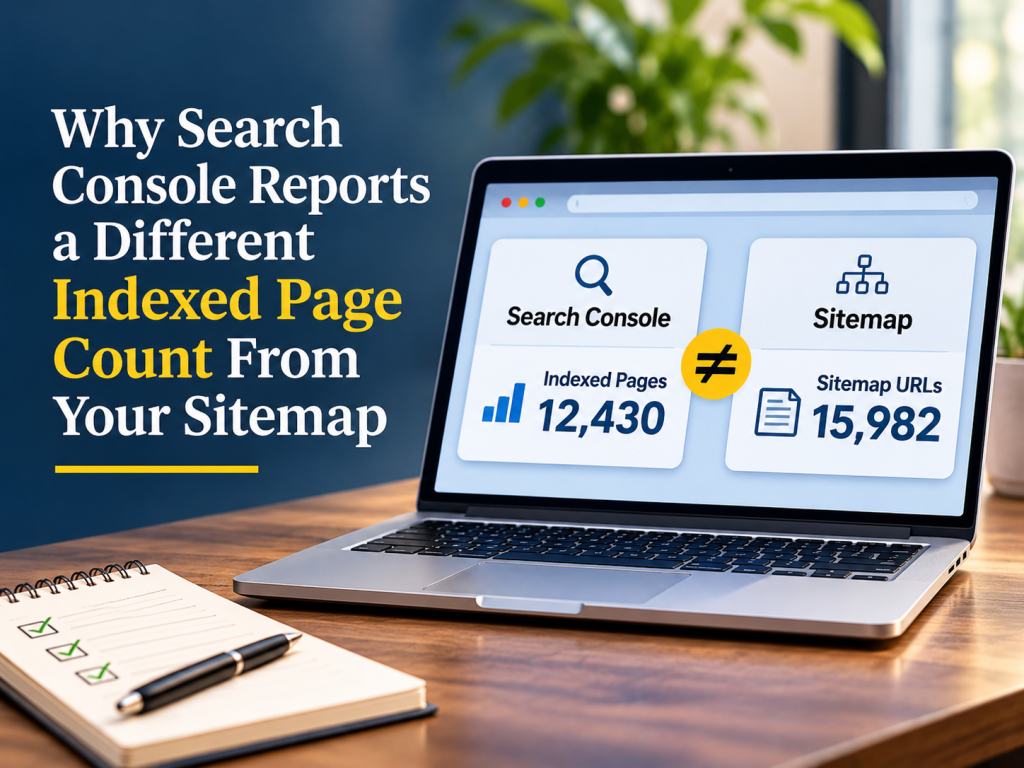
A rug store submits an XML sitemap containing 8,000 URLs, opens Google Search Console a few weeks later, and sees only 5,600 indexed pages. The immediate assumption is often that Google has failed to index 2,400 important pages. Sometimes there is a real indexing problem, but the difference between a sitemap URL count and the Page indexing report is not automatically an error. A sitemap is primarily a discovery signal that tells Google which URLs the website considers important. It is not a request that obligates Google to index every listed URL.
Google states this directly in its sitemap documentation: submitting URLs through a sitemap does not guarantee that every URL will be crawled or indexed. Google also tells site owners not to expect 100 percent index coverage because duplicate, alternate, blocked, redirected, low-value, or otherwise unnecessary URLs may legitimately remain outside the index. The useful SEO task is therefore not trying to make the two numbers identical. It is determining whether the missing URLs are pages the rug business genuinely needs indexed.
Understand What the Sitemap Count Represents
An XML sitemap is a list of URLs supplied by the website.
For an ecommerce rug store, that might include:
• Product pages
• Collection pages
• Blog posts
• Service pages
• Location pages
• Other important canonical URLs
The sitemap count tells you how many URLs were included in that file or set of files.
It does not tell you how many Google selected for its index.
A URL can be perfectly valid inside the sitemap and still remain unindexed because Google considers another URL canonical, the page redirects, the content is not useful enough to index, the URL was recently discovered, or another indexing condition applies.
Understand What the Page Indexing Report Represents
Search Console’s Page indexing report shows URLs Google knows about and groups them according to whether they are indexed or not indexed.
Google specifically warns that the total shown in this report should not be expected to match your own estimate of the number of URLs on the website exactly.
This is because Google’s known URL set is not limited to your current sitemap.
Google may know URLs from:
• Previous sitemaps
• Internal links
• External backlinks
• Redirect history
• Parameter URLs
• Old product pages
• Filter combinations
• Canonical references
• Historical crawls
This explains why Search Console can sometimes show more known URLs than the website’s current sitemap contains.
The reports are measuring related but different things.
Sitemap Submission Does Not Guarantee Indexing
This is the most important concept.
Google describes a sitemap as a way to help discover URLs, particularly on large or complex sites, but explicitly says it does not guarantee crawling or indexing.
For a rug store with thousands of products, the sitemap can make new inventory easier for Google to discover. However, after discovery Google still evaluates the URL through its normal crawling, rendering, canonicalization, and indexing processes.
A sitemap is therefore closer to saying:
These are URLs we want you to know about.
It does not mean:
These URLs must all appear in Google’s index.
Start With the Non-Indexed Reasons, Not the Total Difference
Suppose the sitemap contains 8,000 URLs and Search Console reports 5,600 indexed pages.
Do not begin by asking how to force the remaining 2,400 into Google.
Open the Page indexing report and identify why the pages are not indexed.
Google recommends examining the specific reason for non-indexed URLs because many exclusions are legitimate.
You may find that the 2,400 URLs consist of:
700 redirects
600 duplicate pages
300 intentionally noindexed URLs
400 recently crawled but not indexed pages
250 missing products
150 other technical cases
Now you have five different problems or non-problems instead of one mysterious indexing gap.
Redirect URLs Should Not Be in the Index
A sitemap should ideally list final canonical URLs rather than addresses that immediately redirect elsewhere.
If an old product URL redirects permanently to a new URL, Google normally indexes the destination rather than the redirecting address. Search Console can therefore classify the old URL as a redirect while the sitemap may still contain it.
This can make the sitemap count larger without representing a genuine indexing loss.
For a store that has undergone migrations or changed product URL structures, inspect whether obsolete addresses remain inside automatically generated sitemaps.
The correct fix is normally cleaning the sitemap, not trying to index redirecting URLs.
Duplicate URLs Can Explain Large Gaps
Large ecommerce websites commonly generate multiple URLs representing the same or substantially similar content.
A rug might appear through several collection paths, parameters, tracking URLs, or product variants.
Google’s indexing documentation says duplicate and alternate pages do not necessarily need to be indexed because Google normally chooses a canonical representative.
For example, if five URLs represent the same rug and Google indexes one canonical version, the index may be functioning correctly even though four known URLs are not individually indexed.
A good rug website should make the preferred product URLs clear through canonicals, internal links, and sitemap consistency.
Google May Choose a Different Canonical
Another common scenario is:
Submitted URL: Product A
User-declared canonical: Product A
Google-selected canonical: Product B
When that happens, Google may not index Product A independently.
This is particularly important when similar rug products use extremely repetitive descriptions or when several URLs lead to essentially identical product content.
Inspect affected pages through URL Inspection and compare the user-declared canonical with Google’s selected canonical.
If Google consistently selects another URL incorrectly, review duplication, canonical tags, internal linking, redirects, and content differentiation.
For unique inventory, make sure genuinely different physical rugs are not being made unnecessarily similar through templated content and confusing URL architecture.
Noindex Pages Should Not Be in the Sitemap
A sitemap should contain URLs the website wants indexed.
If a URL contains noindex, including it in the sitemap sends conflicting signals.
The page itself says:
Do not index me.
The sitemap effectively says:
This is an important URL we are submitting.
Google can still respect the noindex instruction, leaving the URL outside the index while it remains inside the sitemap count.
Audit the sitemap for intentionally noindexed pages such as internal search results, special account pages, certain filters, campaign pages, or other URLs that do not need search visibility.
Remove them from the sitemap rather than trying to change Search Console.
Robots.txt Can Create Another Mismatch
If sitemap URLs are blocked from crawling, Google may know the addresses without being able to inspect their content properly.
Google’s technical requirements state that Googlebot needs access to public pages intended for indexing, and the Page indexing documentation recommends investigating accidental crawl blocks when indexed counts decline.
Check whether recent robots.txt changes blocked:
• Product directories
• Collection paths
• JavaScript resources
• Country folders
• Blog sections
• Newly created URL patterns
Do not assume the sitemap overrides robots.txt.
It does not.
Login Requirements Can Prevent Indexing
An ecommerce migration or development change can accidentally place important pages behind authentication.
Google specifically notes that pages requiring login are not publicly available to Googlebot in the normal way.
This can happen when staging security is copied to production, wholesale restrictions are applied too broadly, or certain catalog pages become visible only after a customer account is created.
If an important sitemap URL requires authentication, it should not be surprising when the indexed count remains lower.
Test affected URLs from a completely logged-out session.
Newly Submitted Pages May Need Time
A sitemap can update instantly while Google’s crawling and indexing process does not.
If 500 new rugs are uploaded today, the sitemap may contain them immediately. Search Console may take days or longer to reflect their final indexing status.
Google repeatedly states that crawling and indexing take time and that indexing is not guaranteed simply because a URL was submitted.
This is why a sudden sitemap increase followed by a temporary indexing gap should not automatically trigger emergency changes.
First separate newly added URLs from older pages that have remained unindexed for a meaningful period.
“Crawled, Currently Not Indexed” Needs Separate Review
This status means Google already visited the URL but did not include it in the index at that point.
The problem is different from discovery.
For important product pages, investigate whether the content is highly repetitive, whether another URL is more canonical, whether the product provides enough independent value, and whether the internal architecture treats it as important.
Do not repeatedly resubmit thousands of affected pages without understanding the pattern.
For a rug catalog, group affected URLs by product type, template, inventory status, or collection to determine whether the issue comes from one systemic source.
“Discovered, Currently Not Indexed” Is Different Again
A discovered URL is known to Google but has not yet necessarily been crawled.
For a very large catalog, this can indicate that Google is prioritizing other URLs, the site has generated more URLs than are useful, or important products are too weakly connected internally.
Review whether the site creates unnecessary filters, sorting combinations, tracking parameters, or other URL variations that compete for crawling attention.
A clean internal linking structure and well-maintained sitemap can help focus discovery on the pages the store actually wants indexed.
Sold Products Can Inflate the Sitemap
One-of-a-kind rug stores need to decide what happens when inventory sells.
If sold product pages remain in the sitemap indefinitely while some are redirected, noindexed, removed, or consolidated, the sitemap can become a mixture of URLs with different indexing intentions.
Create a clear lifecycle rule.
For example, valuable sold rugs may remain indexable because they have backlinks, traffic, historical significance, or useful content. Other low-value sold URLs may eventually be removed or redirected according to the site’s strategy.
The sitemap should follow that decision.
Do not allow every historical product URL to remain indefinitely simply because the ecommerce platform never removes it automatically.
Parameter and Filter URLs Can Increase Google’s Known URL Count
Sometimes Search Console shows far more URLs than the sitemap.
This frequently happens when Google discovers filters, sorting parameters, tracking URLs, or other variants through internal links.
Google’s Page indexing documentation specifically notes that large numbers of non-indexed duplicates can come from parameters used to sort or filter collections.
For a rug store, URLs might represent:
color=blue
size=8×10
sort=price
material=wool
or combinations of several filters.
Those URLs may never have appeared in the XML sitemap, but Google can still know about them.
This is another reason the Page indexing total should not be expected to mirror the sitemap count.
Check Whether the Sitemap Contains Only Canonical URLs
Google recommends listing the URLs you want to appear in search results.
For each product or collection, the sitemap should normally contain the preferred canonical version.
If a sitemap includes alternate versions while canonical tags point somewhere else, the sitemap becomes less clean as an indexing signal.
Audit representative URLs and compare:
Sitemap URL
Canonical tag
Final redirect destination
Internal link destination
These should usually agree for important pages.
A broader SEO audit should treat those signals as one system rather than checking the sitemap independently.
Use Separate Sitemaps to Diagnose Large Catalogs
Large ecommerce sites become easier to diagnose when URLs are separated logically.
Instead of one sitemap containing every URL type, use sitemap files for categories such as:
Products
Collections
Blog posts
Pages
The exact structure depends on the platform.
This makes patterns much easier to see. If collection URLs have a high indexing rate but product URLs show a large unexplained gap, the problem is probably within the product catalog rather than the entire website.
For very large stores, product sitemaps can also be segmented further where operationally useful.
The goal is not creating unnecessary sitemap complexity. It is making monitoring actionable.
Compare the Right Numbers
When conducting an indexing audit, create a simple reconciliation:
| URL Group | Submitted | Indexed | Review Needed |
|---|---|---|---|
| Active products | 5,000 | 4,200 | 800 |
| Collections | 300 | 286 | 14 |
| Blog posts | 500 | 472 | 28 |
| Core pages | 100 | 96 | 4 |
Now investigate the difference within each group.
This tells you far more than comparing one 5,054 indexed-page number with an 8,000-URL sitemap total.
For ecommerce, the most important question is whether active, canonical, commercially valuable URLs are being indexed.
Do Not Aim for 100 Percent Indexing
Google explicitly advises site owners not to expect every known URL to be indexed.
For a rug store, 100 percent indexing could actually indicate a problem if thousands of filter combinations, tracking URLs, duplicate product routes, and obsolete pages are all appearing independently in search.
A healthy index should contain the canonical pages that deserve search visibility.
Duplicate, alternate, redirected, noindexed, private, or unnecessary URLs can remain outside the index without harming the site.
Index quality matters more than index quantity.
Monitor Changes Rather Than One Static Number
The indexed count becomes more useful when viewed as a trend.
If the store normally has around 6,000 important indexed pages and suddenly drops to 3,000 after a website update, investigate immediately.
If the sitemap grows by 200 new products this week and the indexed count rises gradually over the following period, that may be completely normal.
Google recommends looking for unexpected drops and spikes in the Page indexing report rather than treating every non-indexed URL as an error.
Connect significant changes with development releases, migrations, canonical updates, robots.txt changes, product imports, and inventory cleanup.
Final Thoughts
A sitemap indexed pages mismatch is normal because a sitemap and the Google index are not the same database.
The sitemap tells Google which URLs the website considers important and helps with discovery. Search Console reports what Google knows about those URLs and which canonical pages have actually been selected for indexing.
Instead of trying to make the counts identical, examine the reasons behind the difference. Redirects, duplicate pages, noindex directives, alternate canonicals, sold products, login restrictions, crawl blocks, recently discovered pages, filtered URLs, and low-value pages can all create legitimate differences.
The key metric for a rug store is not the percentage of every possible URL that Google indexed. It is whether the active products, meaningful collections, commercial pages, and useful supporting content that deserve search visibility are actually indexed.
When those important URLs are present and unnecessary duplicates are excluded, a lower indexed count can represent a cleaner search footprint rather than an SEO failure.
FAQs
Should every URL in my sitemap be indexed?
No. Google explicitly states that sitemap submission does not guarantee that every listed URL will be crawled or indexed.
Why can Search Console show more URLs than my sitemap?
Google can discover URLs through internal links, external links, historical crawls, parameters, redirects, and other sources outside your current sitemap.
Should noindex pages be included in the sitemap?
Generally no. A sitemap should normally contain canonical URLs that the website actually wants indexed.
Is it a problem if Search Console shows fewer indexed pages than the sitemap?
Not automatically. Investigate which URLs are missing and why. Duplicates, redirects, recently discovered URLs, and intentionally excluded pages can create legitimate differences.
Should I try to achieve 100 percent index coverage?
No. Google specifically says you should not expect every URL to be indexed. Focus on getting the canonical versions of important pages indexed.