


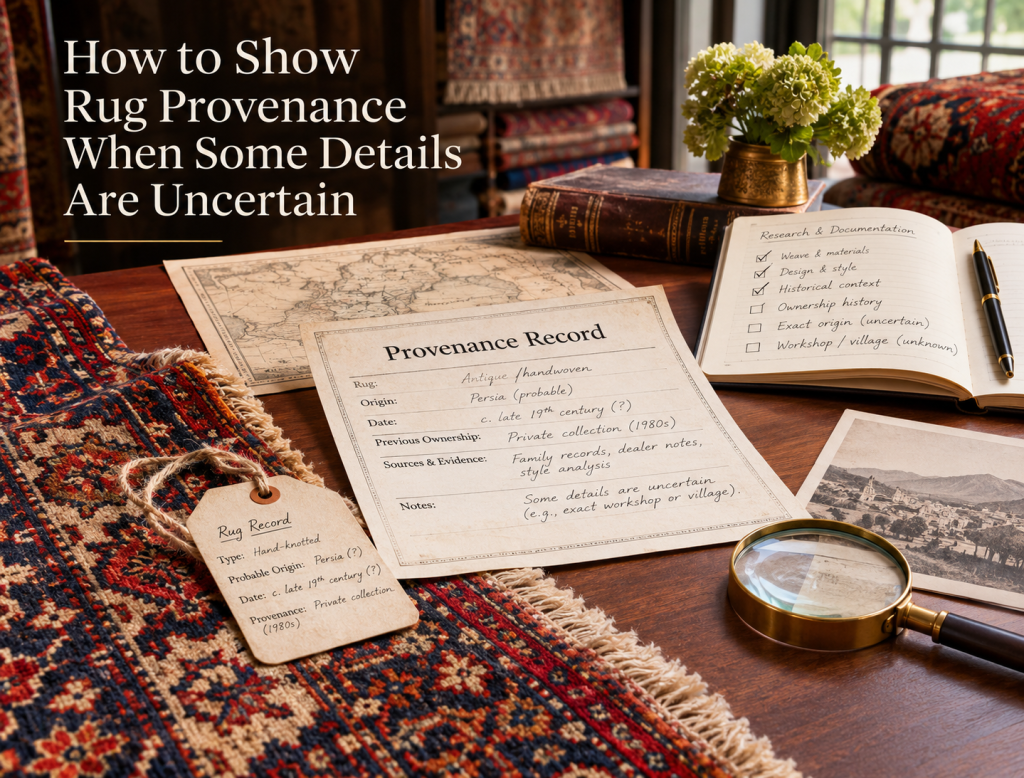
Provenance can add important context to an antique, vintage, handmade, or collectible rug, but many rugs do not arrive with a complete documented history. A dealer may be confident that a rug is Persian but less certain about the exact village. The construction and design may suggest a particular weaving tradition, but the workshop may be unknown. A previous owner may have described the rug as nineteenth century, while the available evidence supports only a broader age range. In these situations, the strongest product page is not the one that sounds most certain. It is the one that clearly separates what is documented, what is supported by physical characteristics, and what remains unknown.
For rug retailers, this matters for both customer trust and long-term catalog quality. Once an uncertain statement is published as a definitive fact, it can be copied into marketplaces, social posts, sales materials, search results, and future descriptions until the original uncertainty disappears. A more disciplined approach preserves useful context without turning an informed attribution into a claim the business cannot support.
Start by Separating Provenance From Description
Provenance is often used loosely, but it should not simply mean everything known about the rug.
A product description may cover color, design, material, dimensions, condition, and construction. Provenance concerns the rug’s origin, history, attribution, previous ownership, acquisition background, or documented chain of custody where available.
These areas can overlap, but they should not be treated as identical.
For example, the store may confidently identify wool pile, cotton foundation, approximate dimensions, and a geometric medallion while having very little documentary evidence about ownership history.
That is not a weak listing. It simply means the page should be precise about which details are observational and which are historical.
Use Different Confidence Levels
A practical way to present uncertain provenance is to create internal confidence levels.
For example:
Documented: Supported by invoice, appraisal, label, archive, family record, or other documentation.
Strongly attributed: Physical characteristics strongly support the attribution, but documentary proof is incomplete.
Probable: Several characteristics point toward the attribution, but meaningful uncertainty remains.
Possible: The attribution is plausible but should not be presented as established fact.
Unknown: There is not enough reliable information to make the claim.
These labels do not all need to appear literally on the product page, but the internal system helps writers maintain consistent language.
A strong product description should communicate confidence accurately rather than making every detail sound equally certain.
Use Language That Reflects the Evidence
Wording can preserve useful information without overstating certainty.
Instead of:
Made in Heriz in 1890
use:
Attributed to the Heriz weaving region, likely late nineteenth to early twentieth century.
Instead of:
Woven by the XYZ workshop
use:
The structure and design have characteristics associated with rugs attributed to the XYZ workshop.
Instead of:
Owned by a European collector
use:
Acquired from a European private collection; earlier ownership history is not documented.
These distinctions may appear small, but they materially change what the store is claiming.
The objective is not making every description cautious to the point of being useless. It is matching the confidence of the language to the confidence of the evidence.
Separate Documented Facts From Seller Attribution
If a rug arrives with paperwork, identify what the document actually says.
An old invoice stating “Tabriz rug” supports the fact that the rug was previously sold under that description. It does not automatically prove every historical claim contained on the invoice.
Likewise, a note from a previous owner can be useful provenance evidence while still being a secondary source.
A product page might state that the rug was “described as Tabriz in accompanying family documentation” rather than presenting the family document as definitive scholarly proof.
This approach preserves the history while remaining transparent about where the information came from.
Make Age Ranges More Useful Than False Precision
Exact dates are attractive because they make a product page feel authoritative, but handmade rugs often cannot be dated to an exact year without reliable documentation.
If the evidence supports only a broader period, publish the broader period.
A rug that appears to be from the early twentieth century does not become more valuable or useful to the customer because the page invents “1912.”
Reasonable phrasing might include:
Circa 1920
Early twentieth century
Likely first quarter of the twentieth century
Estimated 1920s to 1940s
The correct wording depends on the evidence and how the business normally describes age.
For unique inventory, accurate age descriptions are more valuable than artificial precision because the product page may remain searchable long after the rug has sold.
Treat Geographic Origin Carefully
Rug origin can be difficult because design traditions, trade names, weaving regions, and modern geographic boundaries do not always align neatly.
A rug may be marketed under a familiar regional name even when its precise place of manufacture is uncertain.
The product page should therefore distinguish between a confirmed origin and an attribution based on structure, materials, design, knotting, palette, or established trade classification.
If experts within the business use a traditional market term, it can still be useful, but the wording should not imply documentation that does not exist.
For example, “Heriz-type rug” communicates something different from “documented Heriz rug.”
The best wording is the one the business can defend if a knowledgeable buyer asks why the attribution was made.
Explain What Supports the Attribution
When appropriate, the product page can briefly explain the features that informed the classification.
These might include:
• Weave structure
• Knot characteristics
• Foundation material
• Border design
• Medallion style
• Color palette
• Wool characteristics
• Typical dimensions
• Construction technique
This gives the customer more useful information than simply attaching a regional label.
It also creates stronger content because the page explains why the rug is being described in a certain way rather than expecting the shopper to accept the label without context.
However, the explanation should remain concise and product-specific. The page should not become a long academic essay unless the rug’s historical significance genuinely justifies that level of treatment.
Do Not Turn Uncertainty Into Marketing Language
Phrases such as “mysterious origin,” “possibly royal,” or “believed to have belonged to an important family” may sound compelling, but they can create misleading impressions when no evidence supports them.
Unknown history does not need to be romanticized.
A simple statement such as “Earlier ownership history is not documented” is often stronger because it tells the customer exactly what is known.
The rug itself can still be commercially attractive based on quality, design, age, construction, rarity, and condition.
Provenance should support the product story rather than become a substitute for evidence.
Keep Internal Notes More Detailed Than Public Copy
The internal catalog should preserve more information than the customer-facing description.
Staff notes might include:
• Source of acquisition
• Seller statements
• Previous labels
• Expert opinions
• Conflicting attributions
• Old photographs
• Appraisal references
• Previous auction descriptions
• Supporting documents
• Reason for current attribution
This allows future staff or specialists to understand how the current description was reached.
If new evidence appears later, the business can update the product page without losing the original research trail.
A strong rug catalog therefore needs both public-facing clarity and internal documentation.
Photograph Provenance Documents When Appropriate
When a rug has genuine supporting documents that can be shown publicly, photographs or scans can strengthen the listing.
Examples may include an old purchase receipt, exhibition label, previous appraisal, collection tag, or other relevant record.
The page should explain what the document is rather than simply displaying it without context.
Sensitive personal information should be removed where appropriate, and the business should ensure it has the right to publish the material.
Documentation can be particularly useful for high-value rugs where provenance contributes meaningfully to the purchase decision.
Handle Previous Owner Stories Carefully
Previous owners sometimes provide valuable oral history. A family may say that the rug was purchased during travel in the 1960s or inherited from a grandparent who owned it for decades.
That information can enrich the product page when it is presented as reported history rather than verified fact.
For example:
According to the previous owner, the rug had been in the family since the 1960s. Earlier records were not available.
This preserves the story while clearly identifying its source.
The difference between “according to the previous owner” and “provenance confirms” is important, particularly for valuable antiques.
Avoid Copying Auction or Dealer Claims Without Verification
A rug may arrive with an old auction listing or another dealer’s description containing specific claims about age, origin, rarity, or attribution.
Those claims can be useful research material, but they should not automatically become the new store’s facts.
Review the available evidence and decide which details the business is comfortable repeating.
If the previous attribution is worth mentioning but remains uncertain, identify it as such.
This prevents unsupported claims from becoming stronger simply because they have been copied repeatedly across different sales channels.
Make Provenance Easy to Find on the Product Page
For rugs where history matters, provenance should not be buried inside a long paragraph.
A product page can include a dedicated section such as:
- Origin & Attribution
- Age
- Known History
- Documentation
- Notes
This gives shoppers a quick way to understand what is known.
The structure can vary according to the inventory. A new machine-made rug may not need a provenance section at all, while an antique or collectible rug may benefit significantly from one.
The page design should follow the importance of the information to the buyer.
Do Not Let Schema Overstate Uncertain Information
Structured data should reflect the same level of certainty as the visible page.
If the public listing says the origin is uncertain, avoid creating machine-readable product information that presents a speculative origin as definitive.
The same principle applies to brand, manufacturer, date, material, or other attributes.
A good rug website should keep visible content, product data, structured data, and internal catalog information aligned rather than letting different systems tell different versions of the product story.
Update Provenance When Better Information Appears
Product information does not need to remain frozen forever.
If new documentation appears, a specialist provides stronger attribution, or earlier information is shown to be inaccurate, update the page.
For sold rugs that remain online, consider updating important historical information there as well because those pages may continue receiving search traffic and may be used as references by collectors or future customers.
Maintaining accurate sold-product archives can strengthen the store’s overall catalog quality and demonstrate expertise beyond current inventory.
Provenance Can Support Trust Without Being Complete
A partial history is still useful when it is presented properly.
A product page might truthfully state that the rug was acquired from a private collection in New York, that ownership before that point is undocumented, and that the rug is attributed to a particular weaving region based on construction and design.
That information is far more useful than either extreme of inventing a complete story or omitting all historical context simply because some gaps remain.
For rug marketing, this kind of transparency can also distinguish specialist sellers from generic ecommerce listings that provide little explanation for their claims.
Final Thoughts
Rug provenance should communicate what the business knows, not what it wishes it knew. When details are incomplete, the product page can still provide meaningful historical context by separating documented facts, informed attribution, probable conclusions, and unknown information.
Use language such as “attributed to,” “likely,” “circa,” and “according to the previous owner” when those phrases accurately reflect the evidence. Avoid exact dates, workshops, ownership claims, or geographic origins that cannot be supported simply because they make the listing sound more valuable.
The strongest provenance section is often the one that explains both the information and its limits. Customers buying antique and handmade rugs do not necessarily expect every piece to arrive with a complete documented chain of ownership. They do expect the seller to distinguish between evidence and assumption.
When that distinction is maintained consistently, provenance becomes a source of trust instead of a source of uncertainty.
FAQs
What does rug provenance mean?
Rug provenance refers to information about a rug’s origin, attribution, ownership history, acquisition background, and supporting documentation where available.
Should uncertain rug origins be published?
Yes, when useful, but the language should clearly indicate the level of uncertainty rather than presenting an attribution as a confirmed fact.
Is it acceptable to use terms such as “circa” or “attributed to”?
Yes. These terms can communicate uncertainty appropriately when they reflect the actual evidence available.
Should previous owner stories be included?
They can be included when relevant, but they should be identified as information reported by the previous owner rather than independently verified history.
Should provenance information remain on sold rug pages?
It can be valuable to keep accurate provenance and attribution information on sold pages, particularly when those pages remain useful as references or continue receiving search traffic.