


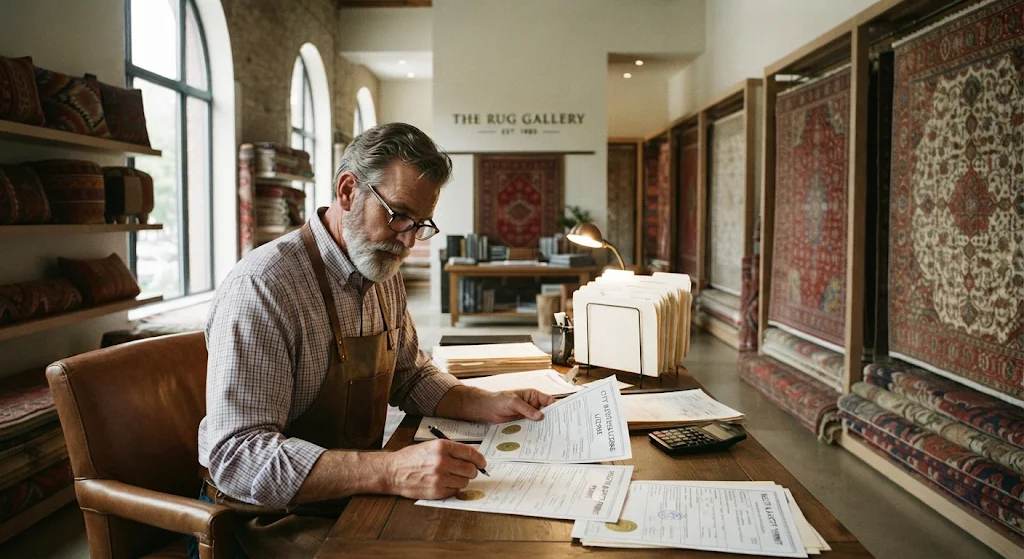
There is no single “rug store license.” The licenses needed to open a rug store are usually a combination of a registered business, a federal tax ID in many cases, a state sales tax permit, a local business license, and zoning approval for the location. The exact names, fees, and rules depend on your state, county, and city, so confirm each item with the office that issues it.
This guide explains what each piece does, who usually issues it, and the order that makes the process easier. It covers the United States only and is general information, not legal or tax advice.
Quick Overview: Licenses and Registrations a Rug Store May Need
| Item | What it does | Usually issued by |
|---|---|---|
| Business registration | Creates your legal structure, such as an LLC | State |
| DBA (trade name) | Lets you operate under a name other than your legal one | State, county, or city |
| EIN | Federal tax ID, free from the IRS | IRS |
| Sales tax permit (seller’s permit) | Lets you collect sales tax from customers | State tax agency |
| Local business license | Allows you to operate within a city or county | City or county |
| Zoning approval | Confirms your location can be used as a store | City or county planning office |
| Resale certificate | Lets you buy stock without paying sales tax, where allowed | State, based on your tax registration |
Not every item applies to every store. A home-based online seller has different needs than a showroom on a main street.
1. Business Registration and Structure
Your first decision is the legal structure, because it affects liability and taxes. The U.S. Small Business Administration explains that a sole proprietorship does not create a separate business entity, so the owner can be personally liable for business debts. An LLC generally protects owners from personal liability, and a corporation offers the strongest protection but costs more to set up and maintain.
Registration usually happens with your state, often through the Secretary of State’s office. If you plan to start a rug business with a brand name that differs from your own, you may also need a DBA, also called a trade name or assumed name. Most states require one when you use a different name, and it is registered at the state, county, or city level.
If you are still working through the bigger picture, our guide on how to start a rug business walks through the full sequence.
2. Federal EIN
An Employer Identification Number is your business’s federal tax ID. The IRS says you need one if you have employees, and that partnerships, LLCs, and corporations need one too. You can also get an EIN for banking or state tax purposes even when federal rules do not require it.
Applying is free through the IRS employer identification number page, and the IRS warns against paying a third party for it. Many banks ask for an EIN before opening a business account, which is why most rug store owners get one early.
3. State Sales Tax Permit
If you sell rugs to consumers in a state that charges sales tax, you will generally need to register with the state tax agency and receive a permit or tax ID. This is often called a seller’s permit, sales tax permit, or sales tax license, depending on the state. It authorizes you to collect sales tax from customers and send it to the state.
Names and processes vary, so search your state’s Department of Revenue or equivalent site. A few states, including Delaware, Montana, New Hampshire, and Oregon, have no state sales tax, though other rules and local taxes may still apply.
4. Local Business License
Many cities and counties require a general business license or tax certificate before you open. The SBA notes that state and local requirements depend on what your business does and where it is located, and that retail is among the activities commonly regulated at the local level.
To find yours, check your city or county website, or contact the clerk or business licensing office. Some licenses expire, so track renewal dates. The SBA points out that renewing is often easier than applying again.
5. Zoning and Location Approval
Zoning rules decide whether a property can be used as a retail store. If you rent or buy a space, the SBA says it must conform to local zoning rules, and zoning can restrict or ban certain businesses in an area. Contact your city planning department before you sign a lease.
Some cities may also require building or occupancy approvals for a new retail tenant. Ask the planning or building department what applies to your address. A home-based business may face fewer zoning restrictions, but local rules can still apply, so check before you store stock or see customers at home.
6. Resale Certificate for Buying Stock
A resale certificate lets a retailer buy goods tax-free when it plans to resell them. The sales tax is collected later from the final customer. According to Avalara’s state-by-state guide to resale certificates, a business generally needs a sales tax permit before it can get one, and about 12 states require the permit first.
Some key points for rug dealers:
- Forms and rules vary by state, and expiration periods range from never to annually.
- A seller is not required to accept your certificate.
- If a supplier or customer gives you a certificate, keep it on file. A seller who cannot produce a valid one during an audit may owe the tax.
This matters on both sides of your business. You may present a certificate to your suppliers, and a designer or dealer may present one to you when you run a trade program.
Do Rug Stores Need a Federal License?
For most rug retailers, probably not. The SBA says federal licenses apply only when your activity falls under a federal agency’s regulation, and its examples include alcohol, aviation, firearms, and broadcasting. General retail is not on that list. If you import rugs yourself, though, customs requirements apply, and a licensed customs broker can guide you through them. Those requirements are separate from your store licenses.
Special Cases for Rug Businesses
A few activities can add extra requirements:
- Auctions. The SBA lists auctions among the activities commonly regulated at the local level. If you plan to run rug auctions, ask your state and city about auctioneer rules.
- Antique or secondhand dealing. Some places have separate rules for secondhand or antique dealers. Ask your city or county if you will buy and resell vintage rugs.
- Cleaning or restoration services. If you add services alongside retail, ask your state and city whether any extra permits apply to that work.
- Selling online. You may still owe sales tax in your home state, and rules for out-of-state buyers vary. Confirm with your state tax agency or an accountant.
The Order to Do It In
The SBA suggests registering your business and getting a federal EIN before you apply for licenses and permits. A practical order for most rug stores is:
- Choose your legal structure and register the business.
- Register a DBA if you will use a different name.
- Get your free EIN from the IRS.
- Open a business bank account.
- Register for your state sales tax permit.
- Apply for your local business license.
- Confirm zoning and any occupancy approvals for your location.
- Get a resale certificate for wholesale purchases, where your state allows it.
- Put renewal dates on a calendar.
You can often handle some of these steps in parallel, but your state and city will have the final say on order.
What This Usually Costs
Fees range from small filing costs to larger local charges, and they differ widely by place. One third-party startup model for a rug store budgets $2,000 to $10,000 for compliance and licensing, though that is an estimate and can include professional help as well as fees. For the rest of your budget, see our breakdown of startup costs.
Common Mistakes to Avoid
- Collecting sales tax before getting a permit, or selling without one
- Signing a lease before checking zoning
- Paying a third-party site for an EIN, which is free from the IRS
- Forgetting renewal dates for licenses
- Assuming an online business needs no registration
Once you are licensed and open, a verified business profile helps local customers find you, and it is worth knowing how stores rank in Google Maps.
Frequently Asked Questions
Do I need a license to sell rugs online?
Usually you still need a registered business, and often a sales tax permit if you sell to customers in a state that charges tax. Local business licenses may apply even if you sell from home. Requirements vary, so check with your state tax agency and city.
Do I need a resale certificate to open a rug store?
Not to open, but it is useful if you buy inventory from wholesalers and want to avoid paying sales tax on stock you will resell. In most states you need a sales tax permit first, and rules differ by state.
Is an EIN required for a rug business?
Not always. The IRS requires one if you have employees and for partnerships, LLCs, and corporations. A sole proprietor with no employees may not need one, but many owners get one anyway for banking or state tax purposes. It is free from the IRS.
How much does a rug store business license cost?
Costs vary by city and county, and some places charge based on revenue or business type. Check your local licensing office for current fees.
Can I run a rug business from home?
Often yes, but zoning, licensing, and tax rules can still apply to a home-based business. Check your local zoning rules before you store inventory or meet customers at your address.
Final Thoughts
The short answer is that licensing for a rug store is a stack of small registrations, not one big permit. Handle them in order, keep copies of everything, and track renewal dates. When in doubt, call the state or local office that issues the license, or ask an accountant or attorney before you open.
This article is for general information only and is not legal, tax, or professional advice. Requirements change, so verify with the relevant agency.