


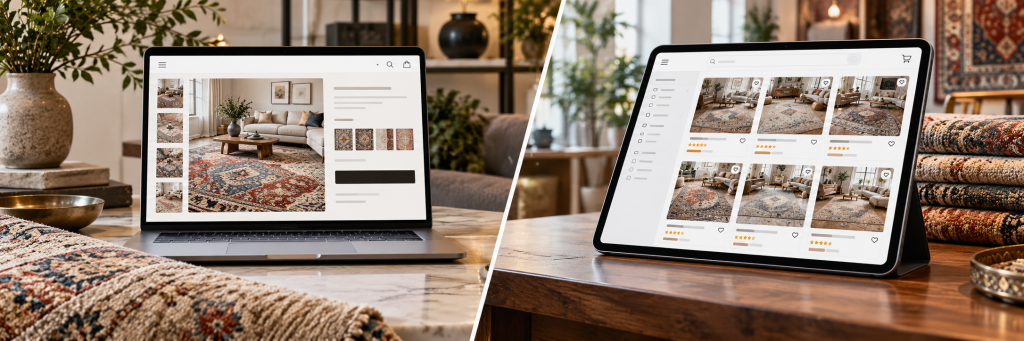
A rug business planning to grow online eventually faces an important investment decision. Should more marketing money go toward its own website, or should the business focus on established online marketplaces where customers are already shopping?
Both options can generate sales, but they build very different kinds of value.
A marketplace can put rugs in front of an existing audience relatively quickly. The seller may benefit from an established shopping environment, familiar checkout process, search tools, and existing buyer traffic. For a business trying to move inventory or reach customers beyond its local market, that exposure can be attractive.
A business-owned website works differently. Building meaningful organic traffic usually takes more time, and the business is responsible for design, SEO, advertising, product presentation, analytics, email capture, and conversion. In return, the company has far more control over its brand, customer experience, content, data, and long-term marketing assets.
For most serious rug businesses, the real question is not whether websites or marketplaces are universally better. The better question is how much of the marketing budget should build assets the company owns and how much should be used to access audiences controlled by other platforms.
That distinction matters because a rug dealer is not selling an ordinary commodity. Buyers may care about material, construction, provenance, size, color, condition, craftsmanship, delivery, restoration, or professional design support. How that information is presented can influence both trust and price perception.
A connected rug marketing strategy should therefore evaluate websites and marketplaces based on profitability, customer ownership, brand development, acquisition cost, inventory type, and long-term growth rather than traffic alone.
Why This Decision Matters More for Rug Businesses
Rug businesses often hold expensive and visually distinctive inventory. Some pieces may be produced in large quantities, while others may be handmade, vintage, antique, or completely unique.
The selling environment can change how those rugs are perceived.
On a large marketplace, a handmade wool rug may appear beside dozens or hundreds of alternatives. The buyer can quickly compare price, size, color, shipping, and reviews. That convenience helps customers, but it can also place greater pressure on sellers to compete within the platform’s structure.
On a specialist website, the same rug can be supported by a detailed story, high-resolution photography, construction information, room guidance, related educational content, a consultation option, and the broader reputation of the dealer.
One environment emphasizes comparison.
The other can emphasize differentiation.
A successful rug business needs to understand when each approach is useful.
What a Marketplace Gives Rug Sellers
The main attraction of a marketplace is access.
Building an audience from zero is difficult. Marketplaces already have people searching, browsing, comparing, and purchasing.
For a new rug seller, this can reduce one of the hardest parts of e-commerce: getting people to discover the inventory.
The seller may also benefit from systems that already exist for product search, payments, customer accounts, reviews, order management, and sometimes shipping support.
That can make marketplaces useful for testing online demand.
A business may discover that certain rug sizes, styles, colors, or price ranges perform particularly well without first investing heavily in building its own customer acquisition system.
Marketplaces can therefore be valuable distribution channels.
The problem begins when the marketplace becomes the entire business strategy.
What Your Own Website Gives You
A website gives the rug business control.
The company determines how products are categorized, how the brand is presented, what information appears on a product page, how leads are captured, how designers are served, which collections receive attention, and what happens after the purchase.
That control becomes increasingly valuable as the business grows.
A professional website can support retail customers, interior designers, showroom visitors, wholesale inquiries, custom rug requests, cleaning services, restoration services, and educational content inside one controlled environment.
The website also creates a foundation for other marketing channels.
Google Ads can send traffic to it.
SEO can build organic visibility.
Email can bring customers back to it.
Social media can send followers to collections.
Industry publications can reference it.
Designer referrals can point to trade pages.
The website becomes a central business asset instead of simply another place to display products.
Website vs Marketplace: The Main Differences
| Area | Business Website | Online Marketplace |
|---|---|---|
| Ownership | Controlled by the rug business | Controlled by the platform |
| Customer relationship | Direct | Often platform-mediated |
| Branding | Highly customizable | Usually limited |
| Traffic | Must be developed | Existing marketplace audience |
| SEO value | Builds the business domain | Often strengthens marketplace pages |
| Competition | Controlled presentation | Competitors may appear nearby |
| Product storytelling | Highly flexible | Usually template-based |
| Data access | Broad analytics potential | Depends on platform |
| Email growth | Strong opportunity | Often restricted |
| Fees | Website and marketing costs | Platform and transaction fees may apply |
| Pricing control | Usually high | Subject to platform policies |
| Long-term asset | Strong | Limited outside the platform |
| Speed to market | Requires setup | Often faster |
| Customer experience | Fully customizable | Controlled by platform rules |
The biggest difference is ownership.
A marketplace rents access to an audience.
A website builds an audience around the business itself.
The Customer Ownership Question
Customer ownership is one of the most important differences and one of the easiest to overlook.
When a person buys through a marketplace, the platform often remains an important part of the relationship. The buyer may think of the purchase as something they bought from the marketplace rather than from the individual rug seller.
That can weaken brand recall.
When someone buys directly from the rug business’s website, the company has a better opportunity to build its own relationship.
The customer sees the branding, explores other collections, joins an email list, learns about services, reads articles, contacts the showroom, and may return directly in the future.
This matters because the first sale is not always the most valuable sale.
A homeowner may eventually need rugs for several rooms.
An interior designer may source repeatedly.
A collector may return when new inventory becomes available.
A customer may later need cleaning, repair, or restoration.
Owning the relationship makes those future opportunities easier to develop.
Marketplace Traffic Can Be Valuable, but It Is Not Fully Yours
Marketplace traffic can produce sales quickly, which makes it attractive.
However, businesses should distinguish between platform visibility and independent brand visibility.
If a marketplace changes its search algorithm, advertising system, seller rules, fee structure, or product presentation, the rug seller may have limited control over the impact.
A business that depends almost entirely on one marketplace therefore carries platform risk.
The audience exists, but the seller does not own the environment.
A strong website reduces that dependency.
This does not mean leaving marketplaces. It means avoiding a situation where another company controls nearly every path between the rug business and its customers.
Websites Take Longer to Build
One advantage of marketplaces should be acknowledged clearly: they can be faster.
Launching a product on an established marketplace may take much less time than building a website that generates consistent organic traffic.
A new website does not automatically attract customers.
It needs strong product architecture, content, technical performance, SEO, advertising, local visibility, email, and conversion optimization.
A business should therefore not expect the website to replace marketplace traffic immediately.
The value compounds over time.
Every useful category page, blog article, backlink, customer review, email subscriber, and ranking can strengthen the business’s owned digital presence.
This is why website investment should usually be viewed as a long-term asset rather than a short promotional campaign.
SEO Makes the Website More Valuable Over Time
Organic search is one of the strongest arguments for investing in an owned website.
A rug business can create pages around specific customer needs such as handmade rugs, Persian rugs, wool rugs, runners, vintage rugs, oversized rugs, cleaning, restoration, or local showroom searches.
An effective SEO strategy can gradually make those pages discoverable through Google.
The benefit is cumulative.
If the business publishes a strong guide about choosing a living room rug, that content may continue attracting visitors long after publication.
A local showroom page may generate calls and directions repeatedly.
A Persian rug category may continue bringing interested customers.
Unlike paid marketplace placement, an organic asset does not necessarily disappear when an advertising campaign stops.
That makes SEO an important part of long-term customer acquisition.
Marketplaces Can Win on Product Discovery
Marketplaces are especially strong when buyers already know they want a product but do not know which seller they will choose.
A customer might browse by rug size, color, style, material, or price and discover a seller they had never heard of.
That discovery mechanism can be extremely useful for independent businesses.
It means the seller does not need to create all demand independently.
For commodity-style or highly searchable inventory, this can work particularly well.
The challenge is standing out.
If twenty similar rugs appear on one results page, photography, price, reviews, shipping, and product presentation become critical.
The seller may have less room to communicate broader expertise.
Websites Are Better for Complex Purchases
Some rug purchases need more explanation.
Consider a customer evaluating a handmade Persian rug.
They may want to understand origin, material, knotting, condition, age, pattern, craftsmanship, restoration history, or how the rug differs from cheaper alternatives.
A marketplace template may not always give the seller enough space or flexibility to build that level of trust.
A dedicated website can.
The product page can connect to educational guides, staff expertise, detailed photographs, consultation options, delivery information, and related collections.
This is particularly useful for antique, handmade, luxury, custom, or unusual rugs where value cannot be communicated through price and size alone.
Product Photography Matters on Both Channels
Whether the rug is sold on a website or marketplace, photography can determine whether someone stops scrolling.
Rug sellers should provide accurate full-rug images as well as details that help buyers understand pattern, texture, fringe, backing, condition, and scale.
On marketplaces, photography helps the listing compete.
On the business website, photography also helps build brand identity.
A seller can maintain a consistent visual style across product pages, collection pages, blogs, email campaigns, and social media.
That consistency becomes part of how customers recognize the business.
Price Competition Is Usually Stronger on Marketplaces
Marketplaces make comparison easy.
That is useful for customers but can create pressure for sellers.
A buyer may compare several rugs within seconds based on price, delivery, rating, and appearance.
If the products look similar, price can become one of the strongest differentiators.
Independent rug businesses should be cautious about entering a race to the bottom.
Discounting may create short-term sales while damaging margin and positioning.
A business-owned website gives more room to explain why one rug costs more than another.
Material, construction, rarity, craftsmanship, condition, origin, service, delivery, and professional guidance can all contribute to value.
Price still matters, but it is not the only information presented.
Marketplaces Can Work Well for Certain Inventory
The best strategy does not require every rug to be sold through the same channel.
A rug business may decide that some inventory is especially suitable for marketplaces.
For example, standardized or competitively priced pieces may perform well where buyers are comparing many products quickly.
Other inventory may deserve a more controlled sales environment.
Rare antique rugs, expensive handmade rugs, unusual sizes, custom pieces, or designer-focused collections may benefit from the deeper presentation available on the company website.
The smartest channel strategy may therefore operate at the inventory level rather than making one decision for the entire business.
Website Investment Builds Brand Equity
Brand equity is difficult to measure in the short term, but it can become extremely valuable.
When customers repeatedly encounter the same rug business through Google, email, industry content, designer referrals, social media, and the company’s website, familiarity increases.
The business becomes more than a product listing.
It becomes a brand.
That recognition can influence future purchasing decisions.
Someone may discover the company through a marketplace but later search for the business directly.
This is why marketplace packaging, communication, and brand presentation should encourage legitimate brand recognition whenever platform rules permit.
The marketplace can become an acquisition source while the website becomes the long-term brand destination.
Marketplaces Do Not Replace a Professional Website
Some sellers assume that strong marketplace sales mean a website is unnecessary.
That can limit future growth.
Potential customers often research a business even after discovering it elsewhere.
They may search the company name to learn whether it is legitimate, where it is located, how long it has operated, or what other products it carries.
Interior designers may want trade information.
Wholesale customers may need business details.
Local buyers may want showroom appointments.
Journalists may look for company information.
A weak or outdated website can reduce confidence even when marketplace listings are performing well.
The website should therefore support reputation as well as direct e-commerce.
Paid Advertising Works Differently
Advertising a marketplace listing and advertising your own website have different economics.
Sending paid traffic to a marketplace may benefit from the platform’s familiar checkout experience, but the seller may have limited control over what else the customer sees.
Competitor products may appear nearby.
The platform may also retain much of the customer relationship.
Sending traffic to the business website gives the company greater control over landing pages, tracking, retargeting, email capture, product recommendations, and conversion paths.
A focused Google Ads campaign can send a high-intent searcher directly to the most relevant rug category or showroom page.
This can create more strategic value than simply purchasing generic traffic.
Consider Customer Acquisition Cost, Not Just Fees
Marketplace sellers often focus on commission or transaction fees.
Website owners often focus on advertising and development costs.
Neither number tells the whole story.
Businesses should calculate customer acquisition more broadly.
If a marketplace takes a fee but generates sales without significant additional advertising, that channel may still be profitable.
If the company spends heavily on its website but acquires customers who return repeatedly and join the email database, the long-term economics may be stronger.
The useful comparison is not marketplace fee versus hosting fee.
The useful comparison is how much it costs to acquire a profitable customer and how much value that customer creates over time.
Email Changes the Economics of a Website
A website can turn a one-time visitor into a long-term audience member.
Someone who is not ready to purchase today may join an email list, request information, book an appointment, or inquire about a specific rug.
That creates another chance to continue the relationship.
Marketplaces may restrict how sellers communicate with customers outside their platform.
An owned website gives the business more flexibility to build appropriate first-party relationships.
Email can then support new arrivals, designer programs, showroom events, educational guides, abandoned inquiries, and past customers.
This makes every website visitor potentially more valuable than a single-session transaction.
Interior Designers Often Need More Than a Marketplace Listing
Interior designers can be particularly valuable for rug businesses because one professional may source products for many projects.
Their needs often extend beyond simple online checkout.
They may require trade pricing, product specifications, high-resolution photos, custom sizes, availability confirmation, project quotes, shipping coordination, and direct communication.
A dedicated trade section on the company website can support these needs.
Marketplaces can still introduce designers to products, but the business website is usually better suited to developing the deeper professional relationship.
For rug companies targeting designers, that relationship should influence how marketing dollars are allocated.
Local Rug Stores Need Their Own Website
A physical showroom should almost always treat its website as a priority.
Marketplaces can sell products nationally, but they usually cannot fully support local showroom discovery.
The business website can rank for local searches, show the store location, publish directions, display opening hours, promote appointments, feature customer reviews, and explain what shoppers can expect when visiting.
The same website can also support Google Business Profile.
For stores that depend on showroom traffic, website investment is therefore not optional infrastructure. It directly supports local customer acquisition.
Marketplace Reviews and Website Reviews Serve Different Purposes
Marketplace reviews usually support confidence within the marketplace.
They help customers decide whether to buy that product or trust that seller.
Business reviews elsewhere may influence the broader company reputation.
A rug business should ideally develop both.
If a customer discovers the brand outside the marketplace and searches for it on Google, they should find a credible company.
Reviews, website quality, contact information, industry mentions, and local presence all contribute to that credibility.
A strong seller reputation should travel beyond one platform.
Use Marketplaces as Channels, Not Foundations
One of the healthiest ways to think about marketplaces is as distribution channels.
A rug business might have several channels.
The website is one.
The showroom is another.
Marketplaces are another.
Interior designers are another.
Email is another.
Industry publications and directories can create additional discovery.
When several channels contribute to sales, the business becomes more resilient.
If one channel becomes more expensive or less effective, growth does not stop completely.
That diversification reduces risk.
A Website Gives You Better Testing Opportunities
Owned websites offer greater flexibility for conversion testing.
The business can experiment with product page layouts, consultation buttons, bundles, category navigation, payment options, designer forms, financing messages, shipping information, or showroom appointments.
Analytics can reveal where visitors leave and which pages generate leads.
Marketplaces usually offer much less control.
Sellers operate within the interface provided.
That simplicity can be useful, but it limits experimentation.
For businesses that want to continuously improve conversion, ownership becomes increasingly valuable.
When Should a Rug Business Invest More in Marketplaces?
Marketplace investment may deserve a larger share of the budget when the business is relatively new online and needs exposure quickly.
It can also make sense when marketplace demand is already proven, products fit the platform well, listing operations are efficient, and margins remain healthy after all fees.
A marketplace may also be valuable when the company wants to test a new style or product category before building a larger campaign around it.
If a channel reliably generates profitable sales, it should not be ignored simply because the company also wants direct traffic.
Performance should guide investment.
When Should a Rug Business Invest More in Its Website?
Website investment becomes increasingly important when the business wants to build a recognizable brand rather than remain primarily a platform seller.
It is also critical when the company relies on local showroom traffic, trade customers, high-value inventory, repeat relationships, custom services, or educational selling.
Businesses that want more control over SEO, email, customer data, conversion, and long-term digital assets should prioritize their own website.
The more complex the customer journey becomes, the more valuable that control usually becomes.
The Strongest Strategy Is Often Both
Website versus marketplace does not need to become an either-or decision.
For many rug businesses, the strongest strategy uses both while assigning each channel a clear purpose.
Marketplaces provide reach and product discovery.
The website provides ownership, brand development, SEO, content, customer relationships, and broader services.
A customer may first encounter a rug through a marketplace.
Another may discover the company through Google.
A designer may find the business through an industry publication.
A local customer may discover the showroom through Maps.
All of these paths can contribute to growth.
The important part is making sure the company is not building its entire future on a channel it does not control.
How to Divide Marketing Dollars
There is no universal percentage that every rug business should use.
Budget allocation should depend on profitability and business goals.
A new online seller may initially invest more heavily in marketplace visibility because the platform can provide faster exposure.
A mature rug dealer with strong inventory and a recognizable name may invest more in SEO, content, email, and direct customer acquisition.
A showroom business should generally give significant priority to its own site because local search and appointment conversion depend heavily on owned web assets.
An e-commerce brand should compare the lifetime value of direct customers with marketplace customers.
The budget should gradually shift toward whichever mix produces the best profitable growth while protecting the company’s long-term independence.
Measure Revenue by Channel
Marketing decisions should be based on data.
A rug business should understand how much revenue comes from its website, marketplaces, showroom, paid search, email, designer referrals, and other important channels.
Revenue alone is not enough.
The company should also look at fees, advertising costs, returns, fulfillment expenses, repeat purchases, average order value, and customer lifetime value.
A marketplace with high sales but thin margins may be less valuable than it appears.
A website channel with slower initial sales may be more valuable if customers return directly and make additional purchases.
This is why channel profitability matters more than headline revenue.
Look at Repeat Customer Behavior
Repeat purchasing can reveal the long-term value of owned customer relationships.
If website customers frequently return directly, sign up for email, refer others, or work with the showroom again, that has significant value.
Marketplace customers may also return, but they may return to the platform rather than specifically to the seller.
Rug businesses should understand that difference.
The more customer relationships the business can retain directly, the stronger its long-term marketing position becomes.
Marketplace Success Should Fund Owned Growth
A useful strategy for some businesses is to use marketplace success to strengthen their owned infrastructure.
If marketplace sales are performing well, profits can support better photography, website improvements, SEO, content, email systems, and analytics.
This prevents the company from remaining permanently dependent on rented traffic.
The marketplace becomes part of the growth engine rather than the only engine.
Over time, direct customer acquisition can become stronger alongside marketplace revenue.
Common Website Investment Mistakes
Simply owning a website does not create an advantage.
A poorly designed site with outdated products, weak photography, confusing navigation, slow pages, and no SEO can perform worse than a strong marketplace presence.
Some businesses invest heavily in design but ignore customer acquisition.
Others generate traffic but fail to build trust.
Some publish hundreds of products without useful descriptions.
A website only becomes a valuable asset when the business actively develops it.
That requires ongoing attention to content, technical performance, product presentation, analytics, and conversion.
Common Marketplace Mistakes
Marketplace sellers can also make expensive mistakes.
One is listing every product without considering whether the inventory fits the audience.
Another is competing primarily on price.
Businesses may also fail to calculate total platform costs accurately.
A seller can generate impressive revenue while maintaining weak margins after commissions, advertising, shipping, promotions, returns, and operational costs.
Another mistake is relying on marketplace traffic so heavily that the business stops developing its own brand.
The strongest marketplace strategy should produce sales without preventing independent growth.
Think About the Business You Want to Build
The right answer becomes clearer when the owner thinks five years ahead.
Does the business want to become a recognized specialty rug brand?
Does it want multiple showrooms?
Does it want strong interior designer relationships?
Does it want recurring direct customers?
Does it want to sell a large standardized catalog nationally?
Does it primarily need a channel for moving inventory?
Different goals require different investments.
A business trying to build lasting brand equity should place greater emphasis on owned assets.
A seller focused mainly on efficient product distribution may rely more heavily on marketplaces.
Most established rug businesses will ultimately need elements of both.
Final Thoughts
Websites and marketplaces solve different problems for rug businesses.
Marketplaces can provide immediate exposure, existing buyer traffic, and a relatively fast path to online selling.
A business-owned website provides control, branding, SEO value, customer relationships, content flexibility, local visibility, analytics, and a digital asset that can strengthen over time.
The mistake is assuming one must completely replace the other.
Marketplaces can be excellent sales channels.
They should not necessarily become the business’s entire marketing infrastructure.
The strongest rug businesses can use marketplace demand while continuing to build direct visibility through their own website.
That creates a healthier balance.
Marketplaces help people discover products.
The website helps people discover the company.
Marketplaces can generate transactions.
The website can develop relationships.
Marketplaces provide access to an existing audience.
The website helps the business build an audience of its own.
For rug dealers thinking about where to invest marketing dollars, that distinction is critical.
The smartest strategy is usually the one that generates profitable sales today while also building assets the company will still control tomorrow.
FAQs
Is a website better than a marketplace for selling rugs?
Neither is universally better. Marketplaces can provide faster exposure, while a website provides greater control over branding, SEO, customer relationships, and long-term growth.
Should rug businesses sell on marketplaces?
Marketplaces can be useful for reaching existing audiences and generating additional sales, particularly when the products fit the platform and margins remain profitable.
Does a rug business still need a website if marketplace sales are strong?
Yes. A professional website can support brand credibility, local search, direct sales, designer relationships, SEO, email marketing, and customer research even when marketplaces generate significant revenue.
Which channel is better for handmade rugs?
Handmade rugs may benefit from a business website because sellers can provide richer information about construction, materials, condition, origin, and craftsmanship. Marketplaces can still provide valuable discovery.
Which channel is better for local rug showrooms?
An owned website is particularly important for local showrooms because it can support local SEO, Google Business Profile, directions, opening hours, showroom appointments, and local customer information.
Are marketplace fees always more expensive than website marketing?
Not necessarily. The correct comparison should include customer acquisition costs, platform fees, advertising, website costs, repeat purchases, fulfillment, and customer lifetime value.
Can a rug business use both a website and marketplaces?
Yes. For many businesses, this is the strongest approach. Marketplaces can provide additional distribution while the website builds the company’s direct digital presence.
Does SEO work better for a business website?
SEO on a business-owned domain can build long-term visibility for the company itself, including product categories, services, local pages, educational content, and trade resources.
How should rug stores divide their marketing budget?
The allocation should depend on channel profitability, business model, inventory, customer acquisition cost, repeat sales, local presence, and long-term growth goals rather than using a fixed percentage.
What is the biggest risk of relying only on marketplaces?
The business becomes highly dependent on a platform it does not control. Changes to fees, search visibility, advertising, policies, or customer access can significantly affect sales.