


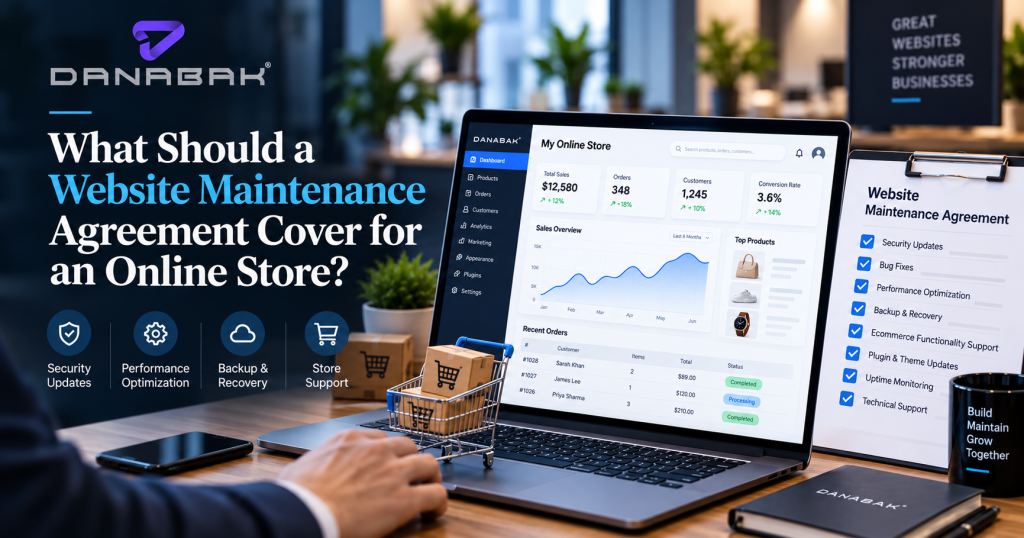
A website maintenance agreement for an online store should define much more than occasional software updates. Ecommerce websites process orders, customer accounts, payment information, product inventory, promotional pricing, shipping rules, integrations, and automated emails, which means even a small technical failure can affect revenue directly. A useful maintenance agreement should therefore explain what is being maintained, how frequently important work will be performed, which problems are covered, how urgent issues will be handled, and which responsibilities remain with the store owner or other service providers.
The purpose of the agreement is to remove uncertainty before a problem occurs. If a checkout failure appears during a weekend sale, the business should already know whether emergency support is included, how quickly someone will investigate, and whether third-party plugin conflicts fall within the agreed scope. A vague statement such as “monthly website maintenance” does not provide enough information for an ecommerce operation because different businesses may interpret that phrase very differently.
Define Exactly Which Website Is Covered
The agreement should identify the domain, ecommerce platform, hosting environment, and any staging environment included in the service. If the business operates multiple regional stores, subdomains, development sites, or separate storefronts, the agreement should clarify whether all of them are covered or whether maintenance applies only to the primary website.
It should also document important technologies such as WordPress, WooCommerce, Shopify integrations, custom applications, payment gateways, caching systems, CDN services, or other components that affect maintenance responsibilities. This gives both parties a shared understanding of the environment before updates begin and helps prevent disagreements when a problem originates from a system that was never included in the maintenance service.
Software and Plugin Updates
For a WordPress or WooCommerce store, routine maintenance normally includes reviewing available WordPress core, theme, and plugin updates. The agreement should explain whether updates are installed automatically, reviewed manually, tested first on a staging site, or scheduled during lower-traffic periods. Installing every update immediately without testing can create unnecessary risk, particularly when the store depends on multiple plugins that interact with checkout, subscriptions, shipping, product variations, or payment processing.
The agreement should also clarify what happens when an update introduces a conflict. Installing the update may be included within routine maintenance, while rewriting a custom plugin or repairing unsupported third-party software may require additional development work. Defining this boundary prevents a basic maintenance package from being treated as unlimited software development.
Backups and Restoration
Backups should be one of the clearest sections because a backup that cannot be restored provides very little protection. The agreement should specify what is backed up, how frequently backups are created, where they are stored, how long they are retained, and who is responsible for testing whether restoration actually works.
For an online store, backup frequency should reflect how frequently the data changes. A brochure website may change only a few times each month, while an ecommerce site may receive orders, customer registrations, inventory updates, and product changes every hour. Restoring an old backup could cause the business to lose recent orders or customer data, so the agreement should explain the backup approach rather than simply stating that “backups are included.”
Security Monitoring
The agreement should explain which security tasks are included in ongoing maintenance. Depending on the website and service level, this may cover malware scanning, monitoring suspicious file changes, reviewing security alerts, checking administrator accounts, updating vulnerable software, and responding to known security issues.
Security responsibilities should also be separated clearly. A maintenance provider can keep website software updated, but the store owner may still be responsible for employee passwords, third-party accounts, payment-provider access, and internal device security. If the website uses a security service or firewall supplied by another company, the maintenance agreement should explain whether that service is simply monitored or actively managed.
Uptime and Website Monitoring
An online store that becomes unavailable cannot accept orders, so uptime monitoring is usually more important for ecommerce than for a simple informational site. The agreement should state whether the website is monitored automatically, how often monitoring occurs, and what happens when downtime is detected.
It should also distinguish between monitoring and guaranteeing uptime. A maintenance provider may detect an outage quickly but may not control a hosting-company network failure, payment-provider outage, DNS issue, or third-party API failure. The agreement should make these limits clear while defining what actions the maintenance provider will take when an issue is identified.
Checkout and Payment Testing
An ecommerce maintenance agreement should address checkout testing because a website can appear completely normal while customers are unable to complete purchases. Updates to WooCommerce, payment gateways, themes, shipping plugins, tax systems, or caching configurations can affect the checkout process without breaking the rest of the site.
The maintenance scope should explain when checkout tests are performed, such as after major ecommerce updates or as part of a scheduled recurring review. Tests may include adding products to the cart, applying coupons, calculating shipping, selecting payment methods, completing a transaction in the appropriate testing environment, confirming order creation, and checking customer and administrator email notifications. If live payment testing requires a real transaction, the agreement should explain how test orders and refunds are handled.
Product and Inventory Responsibilities
Website maintenance should not automatically be interpreted as product management. The agreement should clarify whether adding products, changing prices, uploading images, updating inventory, modifying descriptions, or creating collections is included in the service.
If the maintenance provider is responsible only for technical stability, the business should remain responsible for catalog accuracy. If product updates are included, the agreement should specify reasonable limits, such as a number of product changes per month or an allocated number of support hours. This prevents normal maintenance tasks from becoming an unlimited catalog-management workload.
Performance Monitoring
Site performance can affect both user experience and conversion rates, so the agreement should clarify whether performance monitoring is included. This may involve reviewing page-load problems, caching, database size, image optimisation, server resources, or major performance regressions after updates.
It should also distinguish regular monitoring from a full performance optimisation project. Maintaining an already well-configured ecommerce site is different from rebuilding a slow theme, replacing a page builder, restructuring a database, or rewriting custom code. When those larger projects are required, they should normally be scoped separately.
SSL and Domain Monitoring
An online store depends on HTTPS for secure customer connections, so maintenance should address SSL certificate monitoring where the provider is responsible for it. Automatic renewals usually reduce risk, but failures can still occur because of DNS changes, hosting problems, or configuration errors.
Domain renewal responsibility should also be made explicit. A maintenance company may manage the site without owning or controlling the domain-registration account. If the domain expires because the client did not renew it, the website and business email can both be affected. The agreement should clearly state whether the provider monitors renewal dates, manages them directly, or leaves that responsibility entirely with the business owner.
Forms and Transactional Email
Ecommerce websites depend heavily on email notifications. Customers expect order confirmations, password resets, account notifications, refund notices, and shipping updates, while store administrators may depend on new-order alerts and contact-form enquiries.
The maintenance agreement should state whether email-delivery testing is included and whether the provider manages SMTP or transactional email configuration. Problems caused by third-party mail services may require coordination rather than direct repair, so the provider’s responsibility should be clearly defined. A site can technically remain online while important business emails silently fail, which makes email testing an important part of ecommerce maintenance.
Third-Party Integrations
Online stores often depend on services outside the website itself, including payment gateways, accounting systems, inventory software, shipping providers, CRM platforms, marketing tools, review platforms, and analytics services. The agreement should list critical integrations and define how far maintenance responsibility extends when one of them stops working.
For example, the maintenance provider may investigate whether the website is sending information correctly to a payment gateway, but the provider cannot necessarily repair an outage inside the payment company’s own infrastructure. Similarly, reconnecting an API after credentials expire may be routine support, while rebuilding an integration after the third party changes its API could require a separate development project.
Support Response Times
The agreement should define how support requests are prioritised because not every website issue has the same business impact. A spelling correction does not require the same response time as a checkout failure affecting every customer.
A practical support structure can separate critical, high-priority, and normal requests. Critical issues might include the website being completely unavailable, widespread checkout failure, or an active security incident. Less urgent requests might include minor styling problems or content changes. The agreement should state expected response times rather than promising that every issue will be fully resolved within the same period, because some problems depend on external providers or require detailed investigation.
Emergency Support
Ecommerce websites can experience serious problems outside standard business hours, particularly during sales, product launches, or seasonal shopping periods. The maintenance agreement should explain whether emergency support is available, when it is available, and whether additional charges apply.
This prevents confusion when a business contacts the provider late at night expecting immediate support that was never part of the original package. If the store depends heavily on weekend or holiday revenue, emergency coverage should be discussed before the agreement is signed rather than after the first major incident.
Staging and Testing Procedures
For stores that depend on many plugins or custom functionality, a staging site can reduce the risk associated with important updates. The agreement should explain whether significant changes are tested in staging before they reach the live website and what types of updates qualify for that process.
Testing should focus on the functions that generate business value. A site may pass a basic visual inspection while checkout, coupons, product variations, shipping calculations, customer accounts, or payment notifications fail. A useful maintenance process therefore tests the relevant workflows rather than simply confirming that the homepage still loads.
Reporting and Documentation
Regular reporting helps the store owner understand what maintenance work is actually being performed. The agreement can specify whether the client receives a monthly report covering updates, backups, uptime, security events, major issues, and completed support work.
The report does not need to be excessively technical. Its purpose is accountability and visibility. If an update was postponed because it caused a compatibility problem, the client should know. If malware was detected and removed, that should also be documented. Over time, these records create a useful history of the website’s technical health.
What Is Not Included
A strong maintenance agreement should clearly identify exclusions. This section can prevent more disputes than almost any other part of the contract because website owners may naturally assume that “maintenance” includes anything connected with the site.
Typical exclusions may include complete redesigns, new custom functionality, large catalog imports, third-party subscription fees, paid plugin licences, hosting charges, SEO campaigns, large content projects, photography, custom integrations, and problems caused by services outside the provider’s control. These services can still be offered, but they should not automatically be included in a basic maintenance fee unless the agreement specifically says so.
Ownership and Access
The agreement should state who owns the website files, databases, content, domain name, licences, backups, and third-party accounts. Businesses should also understand what happens to administrative access if the maintenance relationship ends.
Important systems should not become inaccessible simply because one contractor leaves the project. Account ownership, credentials, handover procedures, and termination responsibilities should be defined from the beginning. A professional website design and maintenance relationship should make the business more secure and manageable rather than creating unnecessary dependence on one individual account.
Final Thoughts
A useful website maintenance agreement for an online store should define responsibilities before the website experiences a problem. It should cover software updates, backups, security, uptime monitoring, checkout testing, email functionality, integrations, support procedures, performance monitoring, and the limits of the maintenance service.
The agreement should be specific enough that both parties understand what happens after a plugin update fails, a payment gateway stops responding, a backup needs to be restored, or the website becomes unavailable. It should also clarify which activities are ongoing maintenance and which require additional development or content work.
For ecommerce businesses, maintenance is not simply about keeping WordPress or another platform updated. The real objective is maintaining the systems that allow customers to browse products, place orders, make payments, receive confirmation, and interact with the business reliably. A clear agreement turns those responsibilities into a repeatable process rather than waiting for each technical problem to become an emergency.
FAQs
Should backups be included in a website maintenance agreement?
Yes. The agreement should explain backup frequency, storage, retention, and restoration responsibilities rather than simply saying that backups are included.
Should ecommerce checkout testing be included?
It should be addressed clearly because software updates can affect carts, payments, shipping, coupons, and order notifications even when the rest of the website appears normal.
Does maintenance normally include adding products?
Not automatically. Product management should be listed separately if it is included in the service.
Should emergency support be defined?
Yes. The agreement should state whether after-hours support is available, what qualifies as an emergency, and whether additional charges apply.
Should the agreement cover third-party plugins?
It should explain how third-party software is handled and where routine maintenance ends and custom development begins.