


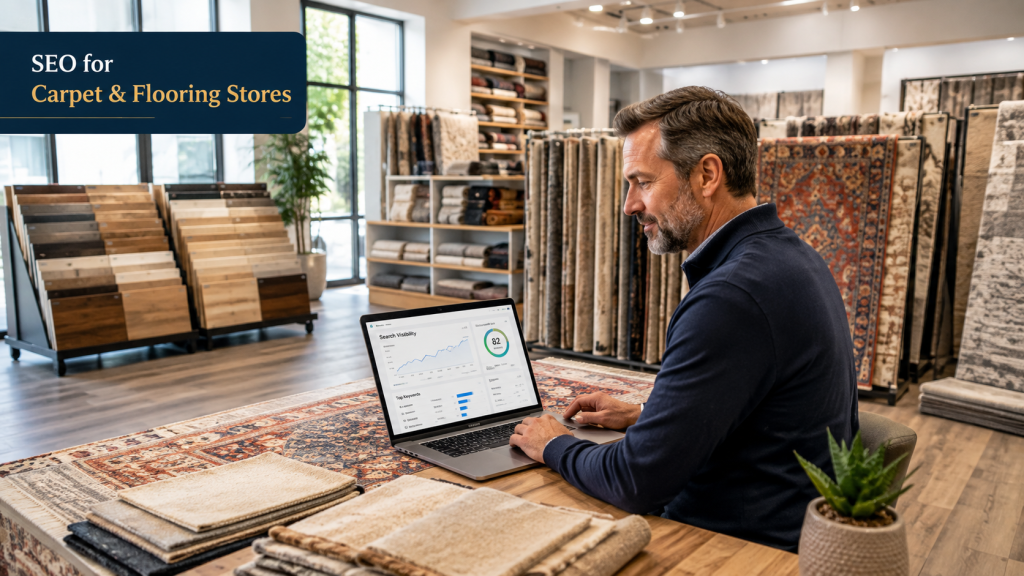
Carpet and flooring is a neighboring category to rugs, and in a lot of ways, a more mature one online. Flooring stores have been fighting for local search visibility against big-box chains for years, and the tactics that hold up in that fight are worth a look, even if you sell rugs, not carpet installation. Both categories deal with the same basic challenge: a shopper who wants to see and feel a product in person before spending real money on it, searching online first to decide where that in-person visit happens.
SEO for carpet and flooring stores has settled into a fairly consistent playbook over the past several years, refined by an industry that’s had to compete hard against national chains with far bigger budgets. Most of that playbook translates directly to rug business marketing, even though the products themselves are different.
Product Pages Built Around How People Actually Search
Flooring stores that do this well don’t build one generic “our products” page. They build separate pages for hardwood, LVP, tile, and carpet, because those are genuinely different searches from genuinely different buyers. A rug retailer can apply the same logic by material, origin, and style, rather than lumping everything into one catalog page. In practice, that might mean a dedicated page for hand-knotted Persian rugs, another for vintage Turkish pieces, and another for modern machine-made rugs in common sizes, each written for the specific person searching that term rather than one page trying to cover all three. This is really the same idea behind rug keyword research built around what a buyer actually types in, not just a broad category name.
Google Business Profile Does More Work Than the Website
For a local flooring showroom, the Google Business Profile is often the first thing a customer sees, before they ever click through to the website. The stores that rank well pick a precise primary category, then stack relevant secondary categories and specific services, rather than leaving the profile half filled out. The same applies to a rug showroom. A profile that clearly lists services like rug cleaning, custom sizing, or appraisal, alongside real photos, is doing more for local visibility than most people expect. This is a big part of what actually drives ranking in Google Maps for local searches.
Location Pages Without the Copy-Paste Problem
One mistake shows up constantly in flooring SEO: a page for every nearby city that’s identical except for the city name swapped in. It rarely works, and it can actively hurt rankings. The stores that do location content well write something genuinely specific to that area, like which neighborhoods they serve or what’s popular locally, rather than a templated paragraph repeated ten times. Rug retailers expanding into multiple cities or a wider service area run the exact same risk, and it’s covered in more depth in our local SEO guide.
Reviews Are a Visible Trust Signal, Not Background Noise
Flooring companies that consistently generate new reviews, not just a high total count, tend to hold stronger Map Pack positions. It’s a simple habit: ask satisfied customers before they leave, and actually respond to what people write. Rug stores benefit from this in exactly the same way, especially since a rug purchase is a bigger, more considered decision than most home services.
Website Structure That Matches the Buying Stage
The stronger flooring sites separate two kinds of content: pages for someone who already knows what they want, and content for someone still researching. A homeowner comparing hardwood versus LVP isn’t ready for a quote yet, and a page trying to sell them one usually loses them. Rug sites benefit from the same split, keeping educational content, like origin guides or care advice, separate from the commercial pages built to convert a ready buyer.
A Few Common Questions
Do rug and carpet stores need a page for every product type? Not every single variation, but broad categories like origin, material, and size deserve their own pages rather than one page trying to rank for everything.
How much do reviews really affect local rankings? More than most owners assume. Review count, recency, and how a business responds all factor into local visibility, not just the star rating.
Is local SEO different for a showroom versus an online-only store? Yes. A showroom has Google Business Profile and Map Pack visibility working in its favor in a way a purely online store doesn’t, which is worth leaning into rather than ignoring.
The Takeaway From SEO for Carpet and Flooring Stores
None of this is unique to flooring. It’s just a category that’s had more time to work out what actually moves local rankings. The core lesson from SEO for carpet and flooring stores is simple: build pages around real search behavior, keep your Google Business Profile genuinely complete, avoid thin duplicated location content, and treat reviews as an ongoing habit rather than an afterthought. Applied to rugs, that same approach holds up just as well.