










Rug Store Near Me: Local SEO That Actually Drives Foot Traffic
By Iman
Last month, a rug store owner called me at 6 PM. Her competitor down the street was crushing her in Google searches, even though she’d been in business 15 years longer. “When people search ‘rug store near me,‘ they’re not finding us,” she said. After digging into her local SEO, I found seven critical gaps that were bleeding customers to competitors. Three months later, she’s getting 40% more showroom visits and her Google Business Profile views doubled.
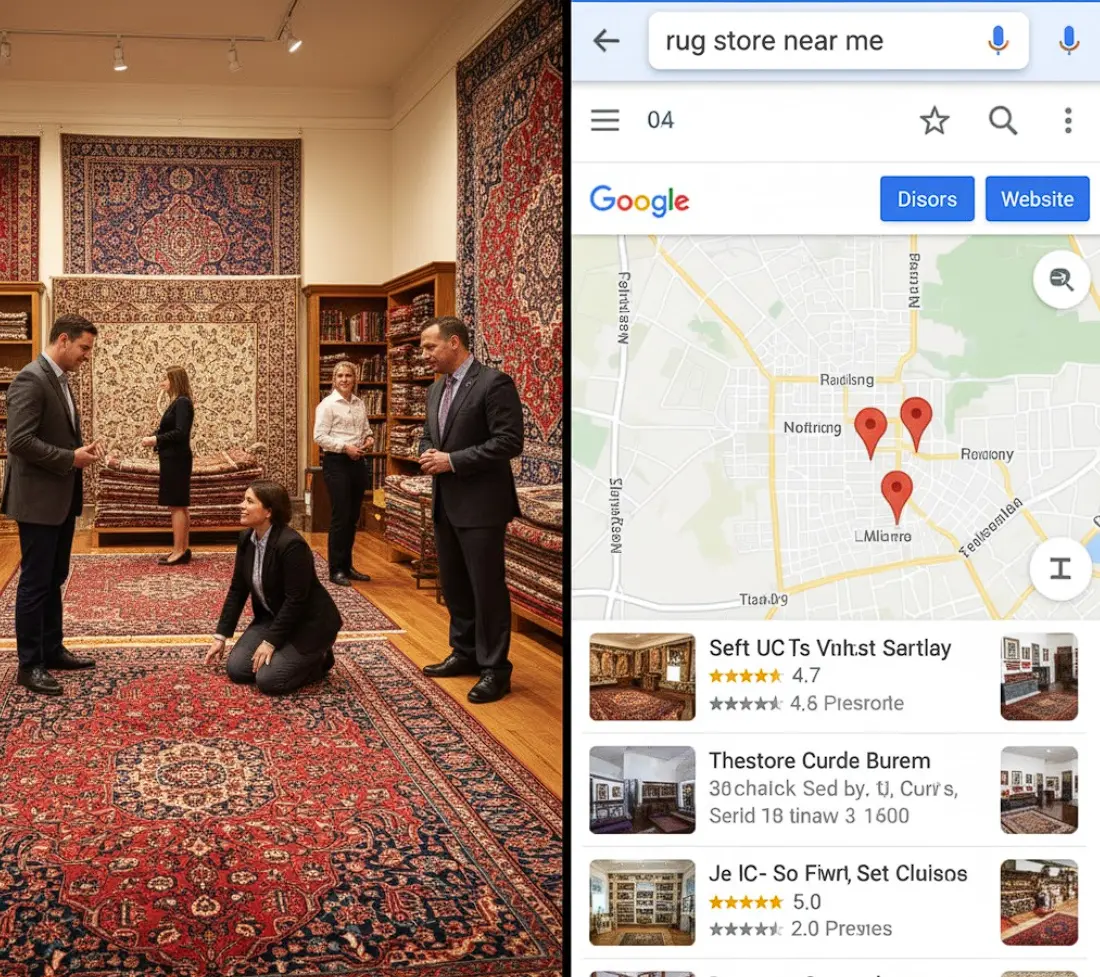
Rug Store Near Me
TL;DR – Quick Answers:
- How long for rug store local SEO results? Expect 2-4 months for Google Business Profile improvements, 4-6 months for organic ranking gains.
- What’s the #1 local SEO mistake rug stores make? Ignoring Google Business Profile optimization while focusing only on website SEO.
- How many reviews does a rug store need? Aim for 50+ reviews with consistent monthly additions – quality and velocity both matter.
- Do location pages actually help rug stores? Only if you serve multiple cities – otherwise focus on neighborhood-specific content instead.
Google Business Profile: Your Digital Storefront
Your Google Business Profile is more important than your website for local searches. **90% of rug shoppers check your GBP before visiting**, yet most rug stores treat it like an afterthought.
Here’s what actually moves the needle: product category photos. Not generic “rugs in a showroom” shots, but **specific category galleries**: Persian rugs, contemporary designs, vintage pieces. I’ve tracked this across dozens of rug retailers, and stores with category-specific photo albums get **67% more direction requests** than those with generic showroom photos.
💡 Key Insight: Upload 8-12 photos monthly in themed albums (Persian, Modern, Vintage, Custom). Google’s algorithm rewards fresh visual content that helps users understand your inventory depth.
Your business description needs to speak local buyer language. Don’t write “We sell quality rugs.” Write “Hand-knotted Persian rugs, modern area rugs, and custom runners. Serving [area] homes and businesses since [year]. Interior design consultation available.”
The posts feature is where rug stores miss huge opportunities. Post your new arrivals weekly with specific details: “Just in: 9×12 Kashan Persian rug, circa 1920s, vegetable dyes. Perfect for traditional dining rooms. $3,200.” These posts show up in local search results and prove you’re actively managing inventory.
The Review Velocity Strategy
Here’s something most rug stores get wrong: they focus on getting reviews, but ignore **review velocity**. Google’s local algorithm cares about consistent review flow, not just total count.
I call this the **3-Touch Review System**: First touch happens during the consultation when you’re helping them envision the rug in their space. Second touch is at purchase when you’re explaining care instructions. Third touch is the follow-up call two weeks later asking how they’re enjoying their new rug.
✅ Review Generation Checklist:
- □ Ask for reviews during the emotional high point (when they see the perfect rug)
- □ Follow up 2 weeks after delivery with care tips and review request
- □ Respond to every review within 48 hours with specific details
- □ Use review insights to improve your consultation process
The businesses that dominate local rug searches don’t have perfect 5.0 ratings. They have **authentic review profiles around 4.7-4.9** with detailed responses that demonstrate expertise. When someone leaves a review mentioning their “beautiful Persian rug,” respond with specifics: “So glad you’re loving that Isfahan design! The hand-spun wool and natural dyes in that piece will only get more beautiful with age.”
Need help implementing a systematic review strategy?
Content That Captures Local Buyers
Most rug stores create generic “how to choose a rug” content. That’s not local SEO – that’s competing with Wikipedia. **Local content addresses local buyer behavior and regional preferences**.
Create neighborhood-specific buying guides: “Best Rug Styles for Tudor Homes” or “Persian Rugs vs Modern Designs: What Works in Contemporary Condos.” This content captures people researching local interior design trends, not just generic rug information.
⚠️ Common Mistake: Creating location pages for cities you don’t serve. Google penalizes this. Instead, focus on neighborhood content within your actual service area.
Room inspiration content performs incredibly well for rug stores. Document real installations with before/after photos. “Transforming a Bland Living Room with a Statement Persian Rug” gets shared locally and builds backlinks from interior designers and homeowners.
The key is solving **local interior design challenges**. If you’re near new construction developments, create content about “Choosing Rugs for Open Floor Plans.” Near historic districts? Write about “Authentic Persian Rugs for Period Homes.”
Citation Consistency That Builds Trust
Citations are your business information (name, address, phone) listed across the web. **Inconsistent citations are ranking poison** for rug stores because Google can’t confidently verify your location.
I audit rug store citations monthly and find the same problems: different phone formats ((555) 123-4567 vs 555-123-4567), abbreviated vs full street names (St vs Street), and outdated information on directories they forgot about.
Priority directories for rug retailers include Yelp, Yellow Pages, Angie’s List, and industry-specific sites like Houzz and Better Homes & Gardens’ directory. But here’s what most miss: **local chamber of commerce and business association listings** often carry more local ranking weight than big national directories.
📋 Citation Audit Process:
- Google your business name + city: Note every listing and its information
- Check major directories: Yelp, Yellow Pages, BBB, Facebook, Apple Maps
- Find industry directories: Houzz, interior design associations, local trade groups
- Document discrepancies: Create a spreadsheet noting incorrect information
- Update systematically: Fix 2-3 citations per week to avoid triggering spam filters
The rug stores that rank consistently have **NAP information that matches exactly** across 15-20 key directories. It’s tedious work, but Google rewards this consistency with better local pack rankings.
Schema Markup for Rug Retailers
Schema markup helps Google understand your rug inventory and business type. Most rug stores ignore this completely, leaving ranking opportunities on the table.
LocalBusiness schema is your foundation, but rug stores should also implement Product schema for featured pieces and Review schema to highlight customer feedback in search results.
**Store hours schema is critical** for rug retailers since many operate by appointment or have unique weekend hours. When Google knows your exact hours, it prevents the frustration of customers arriving when you’re closed.
💪 Pro Tip: Add FAQ schema answering common rug questions like “Do you offer rug cleaning?” or “Can I return a custom rug?” This helps you appear in voice search results and featured snippets.
Product schema for your premium pieces can trigger rich snippets showing prices, availability, and reviews directly in search results. A well-marked-up Persian rug listing might show “$2,400 – In Stock – 4.8★ Reviews” right in Google search results.
5 Local SEO Mistakes Killing Rug Store Rankings
After working with rug retailers for years, I see the same mistakes repeatedly. **These aren’t just minor issues – they’re ranking killers** that hand customers to competitors.
Mistake #1: Keyword stuffing location terms. Writing “Persian rugs [city], area rugs [city], rug store [city]” everywhere looks spammy. Google’s smart enough to understand context – write naturally about serving your area.
Mistake #2: Neglecting mobile optimization. 70% of “rug store near me” searches happen on mobile, often while people are driving around shopping. If your site doesn’t load in 3 seconds or isn’t mobile-friendly, you’ve lost them.
Mistake #3: Inconsistent store hours. Google Business Profile says you close at 6 PM, your website says 7 PM, your door sign says 5 PM. This confusion destroys trust and rankings.
Mistake #4: Ignoring Google Posts. This free feature lets you highlight new inventory, special events, and expertise. Stores that post weekly see **25% more profile actions** than those that don’t.
Mistake #5: Generic business categories. Don’t just select “Furniture Store.” Add specific categories: “Rug Store,” “Interior Design Service,” “Antique Store” if you sell vintage pieces. More relevant categories = better local visibility.
⚠️ Critical Warning: Never buy fake reviews or citations. Google’s getting sophisticated at detecting artificial signals, and the penalty can remove you from local search entirely.
The rug stores that succeed with local SEO focus on **consistent, authentic optimization** over quick fixes. It takes 4-6 months to see significant results, but the traffic quality is superior to paid ads because these customers are actively seeking your expertise.
Check out our Digital Marketing for Rug Stores page
Frequently Asked Questions
How can I rank my rug store for “rug store near me”?
Focus on Google Business Profile optimization first – it’s your biggest ranking factor for local searches. But here’s what most rug stores miss: it’s not just about completing your profile.
The key is demonstrating **inventory depth and expertise** through your GBP content. Upload category-specific photo albums (Persian rugs, contemporary, vintage), post weekly about new arrivals with specific details, and respond to reviews with rug knowledge that proves you’re an expert, not just a retailer.
Your website needs location-relevant content, but don’t create fake location pages. Instead, write about local interior design trends, neighborhood home styles, and regional preferences. A post about “Best Rug Styles for Victorian Homes” targets local buyers better than generic “how to choose a rug” content.
Most importantly, get your citation consistency perfect across directories. Inconsistent business information (different phone formats, abbreviated addresses) confuses Google and kills your local rankings. It’s tedious work, but the rug stores dominating local search have identical NAP information across 15-20 key directories.
Does Google Business Profile really help rug stores get more customers?
Absolutely, but most rug stores use it wrong. They treat GBP like a business card instead of a sales tool.
Here’s the reality: 90% of people check your Google Business Profile before visiting your showroom. They’re looking at your photos, reading reviews, checking hours, and getting directions. If your profile looks neglected or generic, they’ll visit your competitor instead.
The rug stores seeing real results from GBP focus on visual storytelling. They upload new inventory photos weekly, create albums for different rug categories, and use the posts feature to highlight specific pieces with prices and stories. One client started posting “Rug of the Week” features and saw a 40% increase in showroom visits within two months.
Reviews are equally critical, but it’s not just about quantity – it’s about **review velocity and response quality**. Google favors businesses with consistent new reviews and detailed responses. When someone mentions loving their “beautiful Persian rug,” respond with specifics about the weaving technique or region. This expertise demonstration helps both rankings and conversion.
How long does local SEO take for a rug shop?
The honest answer is 2-4 months for Google Business Profile improvements, 4-6 months for meaningful organic ranking gains. But let me break down what you’ll see when.
**Months 1-2:** Your GBP optimization starts showing results quickly. More photos, regular posts, and review responses typically increase profile views and actions within 30-45 days. You’ll also see Google crawling your website more frequently as you add location-relevant content.
**Months 3-4:** Local pack rankings start improving, especially for neighborhood-specific searches. You might not be #1 for “rug store near me” yet, but you’ll start appearing for longer phrases like “Persian rug store” or “custom area rugs.” Citation cleanup during this period builds trust signals that compound over time.
**Months 5-6:** This is where you see substantial movement on competitive local terms. Your consistent review generation, content creation, and technical optimization create momentum that’s hard for competitors to match. The rug stores that quit before month 6 miss the compound effect of good local SEO.
My advice? Commit to 12 months minimum. Local SEO for rug stores isn’t a sprint – it’s relationship building with both Google and your community. The businesses that succeed focus on authentic, helpful optimization rather than trying to game the system.
What local SEO mistakes hurt rug stores the most?
The biggest mistake is treating local SEO like website SEO. Rug stores spend months optimizing their website while completely ignoring their Google Business Profile, which is far more important for local searches.
**Citation inconsistency** is the silent killer I see most often. Your phone number is formatted differently across directories, your address uses “St” in some places and “Street” in others, or you have old information on directories you forgot about. Google can’t confidently verify your location, so your rankings suffer across the board.
Another major mistake is **generic content strategy**. Creating blog posts about “how to choose a rug” puts you in competition with Wikipedia and major home décor sites. Instead, focus on local interior design trends, neighborhood home styles, and regional preferences. “Best Rug Styles for Mid-Century Modern Homes” targets local buyers much better.
Finally, most rug stores completely ignore **review response strategy**. They either don’t respond at all, or they write generic “Thank you for your review!” responses. The stores that dominate local search respond with specific rug knowledge that demonstrates expertise: “So glad you love that Kashan design! The vegetable dyes and hand-spun wool in that piece will only get more beautiful with age.” This builds both Google trust and customer confidence.
How many reviews does a rug store need to rank locally?
It’s not just about total count – **review velocity matters more than most rug stores realize**. Google’s local algorithm rewards consistent monthly review flow over businesses with lots of old reviews but no recent activity.
Aim for 50+ total reviews as your baseline, but focus on getting 3-5 new reviews monthly rather than trying to collect 20 reviews in one month. Consistent flow signals to Google that you’re actively serving customers and maintaining quality service.
The **quality and response rate** of your reviews matters enormously. A rug store with 60 reviews and detailed responses to each one will typically outrank a competitor with 100 reviews but no responses. Google sees engagement as a trust signal, and potential customers read your responses to gauge your expertise.
Here’s what I’ve learned tracking review patterns: rug stores with reviews around 4.7-4.9 stars often outrank those with perfect 5.0 ratings. Why? A few thoughtful 4-star reviews with detailed feedback look more authentic than suspiciously perfect ratings. Mix in some reviews mentioning specific rug types, your consultation process, and delivery experience.
My recommendation: implement a systematic review request process. Ask during the emotional high point when customers find their perfect rug, follow up two weeks after delivery, and always respond with specific expertise that demonstrates your knowledge of rugs, not just generic appreciation.
Your Local SEO Action Plan
Look, I’ve covered a lot of ground here. If you’re feeling overwhelmed, focus on these three priorities first:
- Optimize your Google Business Profile this week – Add 10 category-specific photos, update your description with local keywords, and start posting weekly about new inventory
- Fix your citation consistency over the next 30 days – Audit your top 15 directory listings and make your NAP information identical everywhere
- Create one piece of neighborhood-specific content monthly – Write about local interior design trends, home styles, and how your rugs fit into the community aesthetic
Everything else is optimization. Start with these fundamentals, track your Google Business Profile insights monthly, and commit to at least six months of consistent effort. The rug stores that succeed with local SEO aren’t necessarily the biggest or oldest – they’re the ones that consistently show Google and customers they’re the local rug experts.
Remember: your competitors are probably ignoring most of this. That’s your opportunity.
