


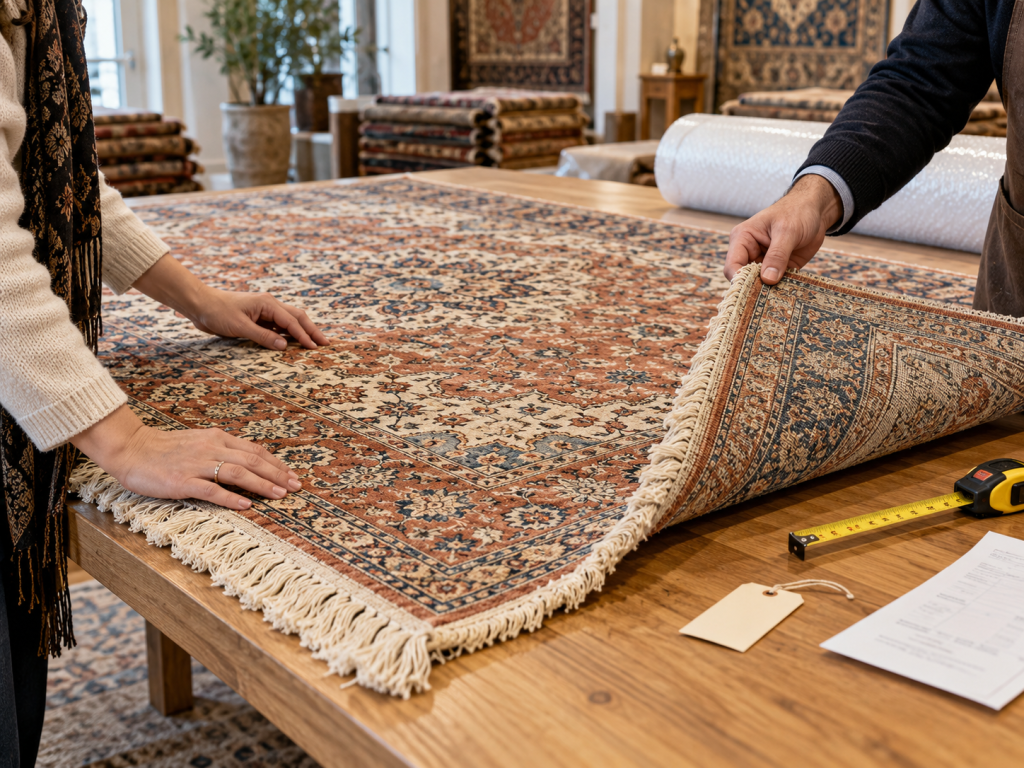
Rug size is one of the most natural ways customers shop for rugs online. A homeowner may already know that an 8×10 rug fits the living room, a designer may specifically need a 9×12 rug for a project, and another buyer may be searching for a 10×14 rug because smaller sizes would look out of proportion in a large space.
That creates a valuable SEO opportunity for rug stores.
Instead of relying only on one broad “All Rugs” category and asking every shopper to use filters, a retailer can create dedicated size collection pages such as 5×7 rugs, 6×9 rugs, 8×10 rugs, 9×12 rugs, 10×14 rugs, runners, and oversized rugs. When these pages match real search demand and contain enough inventory, they can become useful commercial landing pages rather than simple filtered views.
The problem begins when stores create dozens or hundreds of size pages without giving each page enough purpose.
A collection containing twelve rugs, an H1 that says “8×10 Rugs,” and two generic sentences about decorating may technically exist, but that does not automatically make it a strong search result. If the same copy is reused for 5×7, 6×9, 8×10, and 9×12 collections with only the dimensions changed, the website starts producing pages that look different in the URL but offer nearly identical value.
This is where rug size collection pages can become thin.
The solution is not adding 1,500 words of filler to every category. It is building each important size page around the questions, inventory, shopping decisions, and room-planning needs that are genuinely specific to that size.
A strong rug size page should still feel like a shopping page first.
It should help customers understand the size, see available inventory quickly, compare suitable rugs, and move toward a purchase. SEO content should support that experience rather than pushing the products below a giant article.
Why Rug Size Pages Deserve Their Own SEO Strategy
A rug size is not just another product attribute.
For many shoppers, size is one of the strongest constraints in the purchase.
Someone may be flexible about whether a rug is Persian, contemporary, geometric, neutral, blue, or red. They may not be flexible about whether the rug needs to fit under a dining table or extend beneath the front legs of a sectional.
That creates strong commercial intent.
Someone searching for “9×12 rugs” is usually much closer to product discovery than someone searching for a broad informational query such as “how are rugs made.” The user already understands a major part of what they need and is looking for products that meet that requirement.
That is why size pages can sit naturally between broad category pages and individual product pages.
The structure might look like this:
Rugs → 9×12 Rugs → Individual Rug
or:
Persian Rugs → 9×12 Persian Rugs → Individual Rug
This gives the customer a useful level of refinement while giving search engines a clear commercial landing page to understand.
The strategy becomes even stronger when it is based on a proper keyword strategy rather than creating a page for every dimension found in the inventory database.
Do Not Create a Size Page Just Because the Filter Exists
This is one of the most important rules.
An ecommerce system may allow shoppers to filter rugs by 3×5, 4×6, 5×7, 5×8, 6×9, 7×9, 8×10, 9×12, 10×14, 12×15, 12×18, and dozens of less common measurements.
That does not mean every possible filter should automatically become an indexable SEO collection.
A filter is primarily a shopping function.
A collection page should exist because the category has enough search demand, inventory, commercial value, and long-term usefulness to deserve a stable URL.
For example, if the business consistently stocks a substantial number of 8×10 rugs and customers regularly search for that size, an /8x10-rugs/ collection can make excellent sense.
Now imagine the store has only two rugs measuring 7×11 and that inventory may disappear next week. Creating a permanent 7×11 SEO landing page simply because the filter exists is much harder to justify.
The question should therefore be:
Is this size a meaningful shopping category that our store can support consistently?
If yes, build it properly.
If not, let customers use the filter without turning it into another thin indexed page.
Thin Content Is Not Simply a Low Word Count
This is another area where ecommerce SEO is often misunderstood.
A page does not become useful because it contains 1,000 words, and it does not automatically become thin because it contains 150.
The real issue is whether the page gives customers and search engines enough unique value to understand why it deserves to exist.
Ahrefs’ analysis of ecommerce category pages makes a similar point. Category content should help customers make purchasing decisions, while excessive blocks of generic SEO copy can interfere with the commercial purpose of the page.
For a rug size collection, useful information could explain how that specific size generally fits into rooms, what furniture arrangements commonly work with it, how exact dimensions can vary among handmade rugs, and what shoppers should confirm before ordering.
That is very different from publishing 800 words about the history of rugs on every size page.
One helps someone choose.
The other simply adds words.
Build Around Search Intent, Not Word Count
Consider what someone searching “8×10 rugs” actually wants.
They probably want to see 8×10 rugs.
That inventory should remain one of the most prominent parts of the page.
The introduction does not need to begin with a long explanation of how rugs have been used for centuries. It should orient the shopper quickly and then allow them to browse.
A useful opening might explain that 8×10 is a versatile size often considered for living rooms, bedrooms, and medium dining spaces, while reminding buyers that handmade rug dimensions can vary slightly and should always be checked individually.
Then show the products.
Additional information can appear farther down the page for shoppers who need more guidance.
This gives the page enough context for search without turning a product listing into a blog post.
What Should Appear Near the Top of a Rug Size Page?
The top section should be concise because visitors arriving with commercial intent usually want to begin shopping.
A strong page might include:
• A clear H1 such as 8×10 Rugs
• A short useful introduction
• Product count when appropriate
• Current inventory
• Relevant filters
• Sorting options
• Breadcrumbs
• Clear product photography
• Availability information
The introductory copy can answer the most immediate question: what kind of shopping need does this size usually solve?
For example:
Shop our current selection of 8×10 rugs, including handmade, Persian, traditional, contemporary and vintage styles. An 8×10 rug is a versatile option for many living rooms, bedrooms and dining areas. Because handmade rugs can vary slightly from standard dimensions, check each product listing for exact measurements before ordering.
That is enough to establish context.
The customer can then shop.
More detailed guidance can appear after the products or within an expandable but accessible buying-guide section.
Every Major Rug Size Should Have Its Own Reason to Exist
The easiest way to avoid repetitive collection copy is to stop treating every rug size as interchangeable.
A 5×7 rug and a 10×14 rug solve very different room-planning problems.
That means their collection pages should not be written from the same template with only the numbers changed.
A 5×7 page might discuss smaller seating arrangements, compact bedrooms, entry spaces, home offices, and situations where the rug is meant to define a specific zone rather than anchor a whole room.
An 8×10 page can discuss medium living rooms, bedrooms, dining setups, and common furniture placement decisions.
A 9×12 page can speak more directly to larger seating groups, king bedrooms, dining areas with larger tables, and buyers looking for more floor coverage.
A 10×14 page may focus on large living rooms, open-plan interiors, substantial dining spaces, luxury bedrooms, and the importance of measuring furniture placement before selecting an oversized rug.
That difference makes the pages genuinely more useful.
It also creates natural differences in language and topical relevance without artificially forcing keyword variations.
Do Not Promise That a Size Fits Every Room
Size guidance should be practical, but rug stores should avoid presenting room-fit recommendations as absolute rules.
A 9×12 rug does not automatically fit every living room.
The result depends on room dimensions, furniture dimensions, layout, exposed flooring, door clearance, personal style, and how much of the furniture the customer wants positioned on the rug.
This is especially important for ecommerce because the visitor may not have a salesperson beside them.
The collection page can provide general orientation while encouraging customers to measure their actual space.
For example:
A 9×12 rug can work well in larger living rooms where the goal is to anchor a full seating arrangement, but room and furniture dimensions should determine the final choice. Measure the intended rug area before ordering rather than relying on room labels alone.
That is useful without pretending there is one universal design formula.
Exact Rug Dimensions Matter More Than the Collection Label
This is especially important for handmade rug stores.
A rug categorized as 8×10 may not measure exactly 8 feet by 10 feet.
One handmade piece may measure 7’10” x 10’2″. Another may be 8’1″ x 9’11”.
That does not necessarily mean either rug is categorized incorrectly. Size categories often help shoppers browse approximate dimensions while the individual product page provides the exact measurement.
A strong size collection should explain this clearly.
That reduces confusion and gives the category unique relevance to rug shopping.
It can also improve customer experience because a shopper who understands that dimensions vary is more likely to examine the product specifications carefully before purchasing.
Individual product descriptions should then provide the precise dimensions for each rug rather than relying only on the category label.
Inventory Depth Determines Whether a Page Feels Thin
Even excellent copy cannot completely compensate for a collection with almost no products.
If a page called “12×18 Rugs” consistently contains one product, it may not provide a strong category experience.
This is where SEO planning and inventory planning need to work together.
Before creating a permanent size collection, review how much qualifying inventory the business typically carries over time.
Do not evaluate only today’s stock.
A category may have twenty rugs today because a shipment just arrived and two rugs next month after a strong sales period. For one-of-a-kind inventory, some fluctuation is normal.
The better question is whether the business can maintain enough depth for the page to remain a useful destination most of the time.
If a size has consistently weak inventory, it may be better handled through filtering until merchandising becomes strong enough to justify a dedicated page.
A Collection Does Not Need Hundreds of Rugs
Inventory depth is important, but there is no universal minimum product number that every size page needs.
Ten exceptional handmade rugs may create a valuable collection.
A retailer selling mass-market inventory might need a much broader assortment.
The right threshold depends on the type of business, price point, uniqueness of inventory, and customer expectations.
A specialist antique rug dealer should not imitate a national machine-made rug retailer simply because the larger store has 400 products per category.
The page should reflect the business.
This is one reason ecommerce SEO should be connected to the broader rug marketing strategy rather than following generic category templates.
What to Do When Inventory Temporarily Drops
Suppose the store has built a strong 10×14 Rugs collection that normally contains twenty products, but several sell and only three remain.
Should the category immediately disappear?
Usually, that would be an overly aggressive response if the page has established organic value and the business expects inventory to return.
Instead, preserve the useful collection while being honest about availability.
The page might continue showing current 10×14 inventory and offer nearby alternatives such as large rugs, 9×12 rugs, or oversized rugs where appropriate.
If customers can request sourcing assistance, that can also provide a useful next step.
The important distinction is between a temporary inventory shortage and a category the business can no longer support.
If the store has permanently stopped carrying a size, the SEO decision changes.
What If a Size Page Has Zero Products?
An empty size page deserves more careful treatment.
A searcher who lands on an “8×10 Rugs” page and sees nothing except “No products found” has not received much value.
If the business normally carries 8×10 rugs and expects inventory shortly, the page can remain useful by explaining the temporary situation and directing shoppers toward related sizes or a notification option.
For example:
Our 8×10 inventory changes frequently, and no rugs in this size are currently available online. Browse nearby sizes or contact our showroom if you are looking for a particular style, color, or material.
That is more helpful than a blank grid.
However, if a category has been empty for a long period and there is no realistic expectation of inventory returning, keeping the page indefinitely simply because it once ranked may not be the best strategy.
The decision should consider historical traffic, backlinks, customer demand, future inventory, and whether another page can satisfy the intent.
Use Helpful Supporting Content Below the Product Grid
The lower portion of the collection page is a good place to answer questions that matter but should not interrupt shopping.
For an 8×10 collection, supporting content might discuss how the size is typically used in living rooms, bedrooms, and dining spaces. It can explain approximate versus exact handmade dimensions, measuring before purchase, furniture placement considerations, and what nearby rug sizes shoppers might compare.
The content should still remain focused.
A category page does not need to become a 3,000-word article explaining every aspect of interior design.
Ahrefs recommends keeping category content useful and commercially relevant rather than adding large amounts of filler text simply for SEO.
The goal is enough information to answer the next questions a shopper is likely to have.
Room Guidance Can Make Each Size Page Unique
Room-planning guidance is one of the easiest ways to add useful differentiation.
A customer looking at 6×9 rugs may be deciding whether the size is large enough for a small living area.
Someone looking at 9×12 rugs may be deciding whether the rug can sit beneath an entire seating group.
A 10×14 shopper may be concerned about whether the rug leaves enough exposed flooring around the perimeter of a large room.
These are different decisions.
The collection content should reflect them.
Instead of writing:
Our 9×12 rugs come in many colors and styles and can improve any room.
write something more useful:
A 9×12 rug offers enough surface area to anchor many larger seating arrangements while still allowing surrounding flooring to remain visible. Before ordering, measure both the room and the furniture footprint because sofas, chairs and side tables can significantly change how large the rug feels once it is installed.
The second paragraph helps someone make a decision.
That is the type of category content worth publishing.
Explain Furniture Placement Without Turning It Into a Rulebook
Furniture placement is closely connected with rug size, so it belongs naturally on these pages.
But the advice should remain flexible.
For a living room, the page can explain that some customers prefer all major furniture legs on the rug while others use the rug beneath only the front legs of sofas and chairs.
For a dining room, the page can encourage measuring the table and considering the space required for chairs when they are pulled away from the table.
For bedrooms, the guidance can discuss whether the rug will extend around the bed or sit partially underneath it.
This creates genuinely size-related content rather than generic SEO copy.
It also gives the business opportunities for supporting informational articles that can link back into commercial size collections.
Create Size Comparison Paths
Shoppers often hesitate between neighboring sizes.
Someone looking at an 8×10 rug may actually need a 9×12.
A customer browsing 5×7 rugs may discover that a 6×9 creates better proportions.
Rather than forcing that shopper to return to the main navigation, connect adjacent size categories naturally.
For example, an 8×10 page might mention:
Need more floor coverage? Compare our 9×12 collection before choosing.
The page should not contain dozens of keyword-heavy links to every other size. Select the comparisons that make sense for the user.
A thoughtful internal linking structure can help both shoppers and search engines understand how these collection pages relate to one another.
Do Not Create Every Possible Size Combination
Rugs do not always fit perfect standard dimensions.
If the website receives a rug measuring 8’2″ x 10’3″, that does not mean the business needs a separate “8’2 x 10’3 Rugs” category.
Collection architecture should reflect how customers shop, not every measurement stored in the product database.
The site might classify that piece under 8×10 rugs while clearly displaying the exact dimensions on the product page.
This keeps navigation manageable.
Without this discipline, a one-of-a-kind rug retailer could end up with hundreds of highly specific size categories containing only one or two products each.
That would make the website harder to navigate and create a large number of weak search pages.
Standardize the Size Taxonomy
Before building SEO pages, define how the store groups rug dimensions.
For example, the website may decide to maintain primary categories such as:
• 3×5 Rugs
• 4×6 Rugs
• 5×7 Rugs
• 6×9 Rugs
• 8×10 Rugs
• 9×12 Rugs
• 10×14 Rugs
• 12×15 Rugs
• Runners
• Round Rugs
• Oversized Rugs
The exact taxonomy should depend on the store’s inventory and customer demand.
The important point is consistency.
If one team member categorizes 7’10” x 10’1″ as 8×10 while another excludes anything that is not exactly 8×10, inventory becomes unpredictable.
Create merchandising rules for approximate dimensions and apply them consistently.
Then explain on the collection page that exact measurements are listed on individual products.
Keep the URL Stable
Important rug size collections should have permanent, readable URLs.
For example:
/8x10-rugs/
is much easier to manage as a long-term SEO destination than a temporary filtered address such as:
/all-rugs/?width=8&length=10&filter=true
A stable collection gives the business control over its title, description, H1, copy, internal links, breadcrumbs, analytics, and future optimization.
It also avoids making an important commercial category dependent on a filter parameter structure that could change when the ecommerce platform is redesigned.
Google’s ecommerce guidance emphasizes clear site structure and crawlable links so search engines can understand relationships among category, subcategory, and product pages.
For priority rug sizes, treating them as proper categories rather than accidental filter URLs usually creates a stronger foundation.
Avoid Duplicate Size URLs
Collection architecture can become messy when several URLs represent the same size.
For example:
/8x10-rugs/
/rugs/8x10/
/area-rugs/8-x-10/
/all-rugs/?size=8x10
If all of these pages display the same inventory and target the same search intent, the store has created unnecessary duplication.
Choose one preferred SEO destination.
Other filtering systems can continue working for customers, but the site’s canonical, internal-linking, navigation, and sitemap strategy should make the preferred page clear.
One strong 8×10 page is generally more useful than four versions competing for the same search.
Do Not Copy and Paste Descriptions Between Sizes
This is one of the fastest ways to make a size collection cluster feel thin.
A store creates the 5×7 page:
Shop our beautiful collection of 5×7 rugs available in many colors, styles and materials. Find the perfect rug for your home.
Then the 6×9 page becomes:
Shop our beautiful collection of 6×9 rugs available in many colors, styles and materials. Find the perfect rug for your home.
The 8×10 and 9×12 pages follow the same pattern.
Technically, the dimensions changed.
Practically, almost nothing did.
Instead, write each important page around the decisions associated with that size.
The product inventory itself also helps differentiate the page, but useful category copy strengthens the distinction.
Do Not Over-Optimize the H1
The H1 does not need to contain five keyword variations.
For an 8×10 collection, a simple heading such as:
8×10 Rugs
is often enough.
You do not need:
Shop 8×10 Area Rugs, 8 x 10 Rugs, Eight by Ten Rugs for Sale
That looks unnatural and does not improve the shopping experience.
Related language can appear naturally throughout the page where useful.
The objective is clarity.
When a shopper lands on the page, they should immediately understand what collection they are viewing.
Write the SEO Title for Search, Not Just the Category Name
The page H1 can remain simple while the title tag provides additional context.
For example:
8×10 Rugs | Handmade, Persian & Modern Styles
or:
9×12 Rugs | Shop Handmade & Designer Area Rugs
The exact wording should reflect the actual inventory.
Do not mention Persian rugs if the collection rarely contains Persian inventory. Do not advertise handmade rugs if the page is mostly machine-made products.
Metadata should accurately represent the collection.
The goal is attracting the right click rather than simply fitting more keywords into the title.
Write Meta Descriptions That Help Buyers Choose
A good meta description can communicate inventory and intent.
For example:
Shop 8×10 rugs in handmade, traditional, contemporary and vintage styles. Compare current inventory, exact dimensions, materials and designs online.
This is much more useful than:
Looking for 8×10 rugs? We sell the best 8×10 rugs at great prices. Shop our amazing 8×10 rug collection today.
The first description explains what the user can actually do.
The second is mostly promotional repetition.
Search snippets are part of the customer experience.
Treat them that way.
Use Product Grids as Core Content
For a commercial size category, the products are not secondary content.
They are the main reason the page exists.
That means the product grid should be easy to understand and use.
Each listing should provide enough information for customers to decide whether they want to investigate the product further.
Depending on the store, that may include the rug image, product name, dimensions, price, availability, material, or a brief identifying detail.
Do not bury the product grid beneath a long SEO introduction.
Category-page SEO should support commerce.
It should not obstruct it.
Product Titles Should Help Size-Page Shoppers
A customer on an 8×10 collection already knows the approximate size they want.
The individual product listings should help them understand the differences between the rugs.
Weak titles such as:
Rug 1847
provide almost no useful information.
A more descriptive title such as:
Vintage Persian Heriz Rug, Red Wool, 8’1″ x 10’2″
helps the shopper compare inventory without opening every listing.
This is another place where good product architecture and collection-page SEO reinforce one another.
The size page attracts the search.
The product title helps convert the browsing session.
Use Filters Without Letting Them Create Thin Pages
A dedicated 8×10 page can still provide additional filters.
Customers might want to refine the inventory by:
• Color
• Style
• Material
• Origin
• Construction
• Shape
• Price
• Availability
Those filters improve shopping.
They do not all need to become additional indexed pages.
If a visitor filters 8×10 rugs by blue, wool, traditional, and under $2,000, the resulting combination may be useful to that visitor while having little reason to become a permanent Google landing page.
This is why size-page SEO should be coordinated with faceted-navigation rules.
The permanent collection handles the important search intent.
Dynamic filtering handles individual shopping preferences.
Long-Tail Size Collections Can Work When Demand Supports Them
Not every combination is bad.
Sometimes a more specific category deserves its own page.
Examples might include:
8×10 Persian Rugs
9×12 Wool Rugs
Large Round Rugs
10×14 Handmade Rugs
These can represent meaningful commercial searches when the store has enough inventory.
Ahrefs recommends using search demand and actual product depth when deciding whether more specific ecommerce categories deserve their own pages rather than creating every possible subcategory automatically.
The same principle works well for rugs.
Create the page because customers need it and the store can support it.
Do not create it because two filters can technically be combined.
Be Careful With 8×10 Rugs, 8 x 10 Rugs and 8 by 10 Rugs
These usually represent the same search intent.
They generally do not need separate collection pages.
Choose one primary format for the URL and page.
Related wording can appear naturally where helpful.
For example, the H1 might use “8×10 Rugs” while a sentence says “An 8 by 10 rug can work well in many medium-sized living rooms.”
There is no reason to build three near-identical categories simply to target spelling or formatting variations.
One authoritative collection is cleaner.
Add Useful FAQs, Not Generic Ones
FAQs can strengthen a size page when they answer genuine purchase questions.
For an 8×10 page, useful questions might include:
Is an 8×10 rug exactly 8 feet by 10 feet?
Machine-made rugs may follow standardized sizing closely, while handmade rugs can vary slightly. Always check the exact dimensions shown on the individual product page before purchasing.
Is an 8×10 rug large enough for a living room?
It can work in many living rooms, but the result depends on the room and furniture arrangement. Measure the intended rug area and furniture footprint before deciding.
Should an 8×10 rug go under a bed?
It can work with several bedroom layouts, depending on bed size and the amount of rug you want visible around it. Measure the placement rather than choosing only by the room label.
Should I choose an 8×10 or 9×12 rug?
The better choice depends on how much floor coverage you want and how the furniture will sit on the rug. Mark both dimensions on the floor before purchasing if you are unsure.
These questions belong naturally on a size category.
An FAQ such as “What is a rug?” does not.
Avoid Identical FAQs Across Every Size Page
Repeating the same ten questions across 5×7, 6×9, 8×10, 9×12, and 10×14 pages weakens differentiation.
Some overlap is unavoidable.
Customers may ask whether each size works in a living room or under a bed.
But the answers should reflect the actual dimensions.
A 5×7 page may emphasize compact arrangements.
A 10×14 page may discuss large rooms and substantial furniture groupings.
That contextual difference makes the information more useful.
Link Informational Content Back to Size Pages
Supporting blogs can strengthen collection pages when the topics genuinely relate.
For example, an article about choosing a living room rug size can naturally link to 8×10 and 9×12 collections.
A dining-room sizing guide may link to several relevant sizes.
A bedroom rug guide can do the same.
This creates a useful relationship between informational and commercial content.
The article answers the research question.
The collection lets the customer shop after making the decision.
That is a much stronger internal structure than publishing isolated blogs that never connect with revenue-generating pages.
Link Size Pages to Useful Buying Guidance
Internal linking should also work in the opposite direction.
The 9×12 collection could link to a relevant measuring or rug-size guide when a customer needs more help deciding.
This allows the shopper to move between education and products without leaving the website.
Do not overload the category with links.
A few strategically placed links are enough.
The objective is to support the decision process.
Avoid Competing Pages for the Same Size Keyword
Before launching a new size collection, search the existing website.
There may already be a blog ranking for “8×10 rugs.”
There may be a filtered URL receiving impressions.
There may be an old collection.
There may even be several versions from a previous redesign.
Creating another page without reviewing these URLs can create unnecessary competition.
Use Search Console to identify which page Google currently associates with the query.
Then decide whether that URL should be improved, consolidated, redirected, or replaced.
New pages should solve a structural problem, not simply add another URL.
Use Search Console After Launch
Once a rug size page is live, Search Console can reveal whether Google understands its purpose.
Monitor the page’s queries.
An 8×10 collection might begin generating impressions for terms such as:
• 8×10 rugs
• 8×10 area rugs
• 8 by 10 rugs
• handmade 8×10 rugs
• 8×10 Persian rugs
This information can guide future improvements.
If the page begins receiving impressions for a narrower commercial query and the inventory supports it, that may reveal an opportunity for a subcollection.
If irrelevant queries dominate, the page may need clearer content or better internal context.
If impressions grow but clicks remain weak, title and meta optimization may deserve attention.
Search Console should therefore become part of the category-development process rather than something reviewed only after traffic declines.
Use Collection Data to Guide Inventory Decisions
SEO data can also help merchandising.
Suppose the 9×12 page consistently receives strong impressions and customer engagement but inventory is usually limited.
That suggests an opportunity beyond SEO.
The business may need more 9×12 inventory.
Perhaps 10×14 rugs receive surprisingly strong organic demand.
Perhaps 5×7 pages attract traffic but convert poorly because the current styles do not match what customers expect.
Category performance can therefore inform buying and sourcing decisions.
The website is not simply a marketing channel.
It can reveal what customers are actively looking for.
Do Not Add Blog-Length Content Just to Make the Page “Thick”
One of the most common reactions to thin content is overcorrection.
An SEO consultant identifies a thin category, and suddenly the page receives 2,000 words at the bottom.
The page may no longer be technically short, but it can still be strategically weak.
If most of those words do not help someone understand, compare, measure, or choose rugs in that size, the additional length provides little customer value.
The better approach is focused depth.
Explain the size.
Show the products.
Help customers measure.
Discuss the most relevant room-placement considerations.
Address exact dimensions for handmade rugs.
Compare nearby sizes.
Answer a handful of real questions.
Then stop.
The collection page should remain a collection page.
The Best Rug Size Page Balances Three Needs
A high-quality size collection needs to work for three audiences at once.
The first is the shopper.
They need inventory, clear dimensions, strong images, useful filters, and enough guidance to choose confidently.
The second is the search engine.
It needs a stable URL, clear page purpose, crawlable products, sensible internal links, and enough contextual information to understand what makes the page different from other collections.
The third is the business.
The page needs to contribute to product discovery, sales, inventory visibility, analytics, and the broader marketing structure.
A page that satisfies only one of these groups will usually underperform somewhere else.
A giant SEO article with products hidden underneath may satisfy an SEO checklist but frustrate shoppers.
A beautiful product grid with no context may convert loyal customers but struggle to establish relevance for competitive non-branded searches.
A page built entirely around filters may help browsing but create a technical mess.
Balance matters.
A Strong Rug Size Collection Template
For most important sizes, a reusable framework can make production more efficient without turning the pages into duplicates.
The structure could be:
H1: 8×10 Rugs
Short Introduction: Approximately 60 to 100 useful words explaining the inventory and general purpose of the size.
Product Grid: Current 8×10 inventory prominently displayed.
Filters: Style, color, material, origin, price, and other useful attributes.
Size Guidance: A concise section explaining how shoppers commonly use this size.
Measuring Guidance: What to measure before purchasing.
Exact Dimension Note: Particularly important for handmade inventory.
Related Sizes: Helpful comparisons with nearby dimensions.
FAQs: Four to six questions specific to the size and purchasing decision.
The structure can remain consistent across the website.
The actual content should not.
That distinction allows the site to scale while preserving page quality.
Example of Weak vs Strong Collection Content
Consider this weak copy:
Shop our 9×12 rugs. We offer beautiful 9×12 rugs in many colors, styles and materials. Browse the best rugs for your home and find the perfect rug today.
It is not incorrect.
It simply does very little.
Now consider:
Our 9×12 rug collection includes handmade, traditional, vintage and contemporary pieces suited to shoppers who need more floor coverage than an 8×10 typically provides. This size is often considered for larger seating arrangements, dining spaces and bedrooms, but furniture placement and room dimensions should guide the final choice. Handmade rugs may vary slightly from standard 9×12 dimensions, so check each listing for exact measurements before ordering.
The second version still is not long.
But it communicates inventory, comparison, room context, and an important detail about handmade rugs.
That is the difference between writing for word count and writing for usefulness.
Common Mistakes That Create Thin Rug Size Pages
The most common problem is scaling the taxonomy faster than the store can support it.
A business creates dozens of size URLs simply because the ecommerce platform contains those values.
Other recurring problems include:
• Publishing categories with one or two products
• Copying the same introduction across every size
• Changing only the dimensions in templated copy
• Creating separate pages for identical search intent
• Allowing filtered URLs to compete with permanent collections
• Writing huge generic articles beneath product grids
• Providing no measuring guidance
• Hiding exact product dimensions
• Leaving empty collections indexed indefinitely
• Creating pages for extremely specific measurements
• Forgetting to connect size pages through internal links
• Building categories without checking search demand
The technical setup matters, but the underlying question remains simple:
Does this page help someone shopping for this particular rug size?
If the answer is weak, the page probably needs more than SEO copy.
How Many Rug Size Pages Should a Store Build?
There is no ideal number.
A store carrying several thousand rugs may support many size collections.
A boutique gallery with highly unusual antique inventory may need far fewer.
Start with sizes that satisfy three conditions:
Demand: Customers actively search for the size.
Inventory: The store regularly has enough products.
Business value: The collection supports meaningful commercial activity.
Build those pages properly.
Then expand only when additional sizes meet the same standard.
Ten strong size collections can be more valuable than fifty thin ones.
Should Every Size Page Be Indexed?
No.
Important permanent collections should normally be indexable when they provide genuine value and fit the site’s search strategy.
Temporary filter states, extremely specific measurements, weak inventory groups, and duplicate variations do not automatically deserve indexation.
Google’s faceted-navigation guidance warns that filter systems can produce very large URL spaces and unnecessary crawling when every possible combination is exposed.
For rug stores, the objective should be controlled growth.
Let shoppers filter deeply.
Let search engines focus on the strongest permanent collections.
Final Thoughts
Rug size collection pages can become some of the most commercially useful pages on an ecommerce rug website because size often sits close to purchase intent.
But the SEO opportunity does not come from generating a URL for every measurement.
It comes from identifying the sizes customers genuinely search for and building strong, durable collections around those needs.
A useful size page should immediately show relevant rugs. It should give enough context to explain how the size is commonly used without pretending that one measurement works for every room. It should make exact product dimensions easy to find, especially for handmade inventory. It should help shoppers compare nearby sizes and understand what to measure before buying.
Most importantly, every size page should offer something specific to that size.
Do not create 5×7, 6×9, 8×10, 9×12, and 10×14 pages by copying one template and replacing the numbers.
The collection structure can be standardized.
The value cannot.
A strong 5×7 page should help someone considering a smaller rug.
A strong 8×10 page should answer the decisions that come with a medium-size rug.
A strong 10×14 page should help a customer understand a much larger purchase and the space required for it.
When search demand, inventory, content, product presentation, and internal linking work together, size pages stop looking like thin ecommerce filters.
They become genuine shopping destinations.
And that is ultimately the goal: not to create more pages, but to create better ways for customers to find the rugs they are already looking for.
FAQs
Are rug size collection pages good for SEO?
Yes, when the sizes have meaningful search demand, enough inventory, a stable URL, useful content, and a clear place within the website’s category structure.
How much content should an 8×10 rug collection page have?
There is no fixed word count. Include enough unique information to help shoppers understand the collection and make a purchase decision without burying the product grid beneath unnecessary SEO copy.
Should every rug size have its own page?
No. Focus on sizes customers actively search for and that the store can support with sufficient inventory over time.
Should rug size pages include products before the SEO content?
For commercial category pages, customers should be able to reach products quickly. A concise introduction can appear above the grid, while more detailed buying guidance can appear farther down the page.
Can handmade rugs be placed in standard size collections?
Yes, when the store uses consistent approximate-size rules. Exact dimensions should always be displayed on the individual product page because handmade rugs can vary from standard measurements.
Should 8×10 and 8 by 10 rugs have separate pages?
Usually not. They generally represent the same search intent and can be targeted through one strong collection page.
What happens if a rug size collection becomes empty?
If the shortage is temporary and the category normally has inventory, the page can remain useful with an availability message and relevant alternatives. Long-term empty collections should be reviewed individually.
Are filter-generated size URLs enough for SEO?
Important commercial sizes are usually better supported by stable, intentional collection pages that the business can optimize and link to consistently rather than relying only on temporary filter URLs.
Should size pages link to other size collections?
Yes, when the comparison helps shoppers. Nearby sizes such as 8×10 and 9×12 are natural candidates for contextual internal links.
Can rug size pages create keyword cannibalization?
Yes, particularly when several URLs target the same size or when filter pages, old collections, and new landing pages all compete for the same intent.
Should size collection pages contain FAQs?
They can, when the questions address genuine purchasing concerns such as room suitability, measuring, exact dimensions, furniture placement, and comparison with nearby sizes.
How do I keep multiple rug size pages from becoming duplicate content?
Give each major size page its own purchasing context, room guidance, measurement advice, inventory, FAQs, and related-size recommendations rather than copying one template and changing only the dimensions.
Should price and color filters on a size page also be indexed?
Not automatically. Filters can remain useful for shoppers without becoming independent search pages. Only create additional indexable collections when search demand and inventory justify them.
What is the biggest mistake with rug size collection SEO?
The biggest mistake is creating many size pages before determining whether customers search for those sizes and whether the business can maintain enough inventory to make each page useful.
:::