


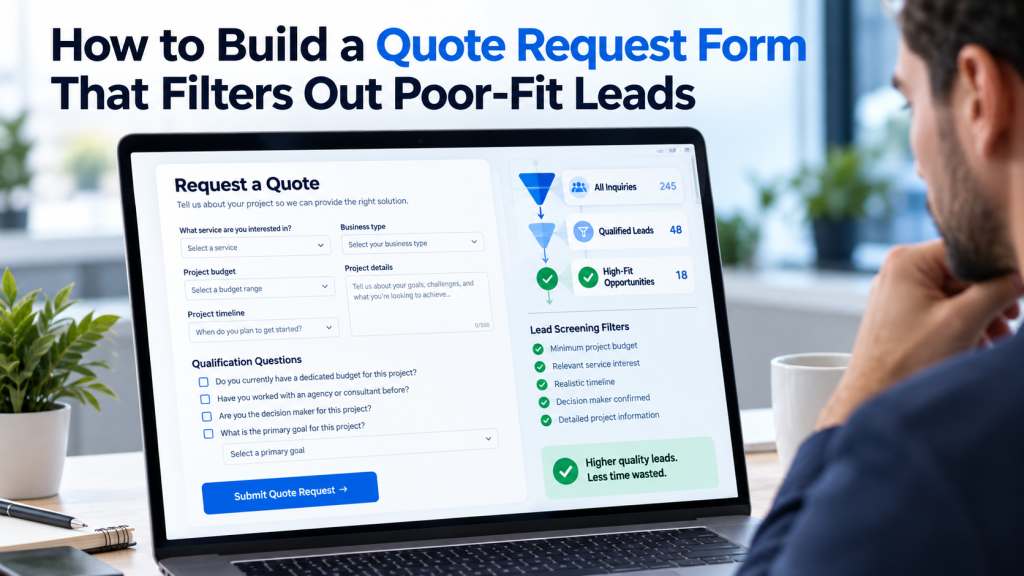
A quote request form should do more than collect a name, email address, and short message. For a service business, agency, contractor, consultant, or development company, the form can become the first stage of the sales qualification process. A well-designed form gives a serious prospect enough space to explain what they need while quietly filtering enquiries that fall outside the company’s services, minimum budget, location, timeline, or working model. This saves the sales team from spending time on conversations that were never likely to become suitable projects.
The challenge is balance. If the form asks too little, the business receives vague enquiries such as “How much for a website?” with no information about scope, functionality, timeline, or budget. If the form asks twenty-five difficult questions before a prospect can submit it, qualified leads may abandon the process because it feels like homework. The strongest quote request forms collect the information required to make the next sales conversation useful without asking the prospect to write the project specification themselves.
Start With the Information You Actually Need
Before designing the form, identify what makes a project a good fit for the business. This should be based on real qualification criteria rather than collecting information simply because another company’s website asks for it. A digital agency, for example, may need to know whether the prospect wants website design, SEO, paid advertising, app development, or several services together. A custom software company may care more about functionality, existing systems, number of users, integrations, and project stage.
The form should gather enough information to answer a few practical questions before anyone schedules a call. Can the company deliver the requested service? Is the project within the typical budget range? Is the desired timeline realistic? Does the prospect have an existing website or system? Is the person enquiring seriously considering the project, or are they only collecting generic prices from dozens of providers?
A clear website design enquiry form, for example, may need very different qualification fields from a form built for ongoing SEO services. The form should reflect what the business actually sells.
Ask the Prospect to Choose the Service First
A service-selection field is one of the easiest ways to improve lead quality because it forces the visitor to define the general problem before submitting an enquiry. Depending on the company, choices might include website design, ecommerce development, SEO, Google Ads, social media, app development, content, or a combined digital marketing project.
This information can also control what the visitor sees next. Someone requesting SEO does not need questions about mobile app functionality, while someone requesting a custom application may need to explain integrations, user roles, and platform requirements. Conditional form logic allows the business to keep the overall experience shorter while still collecting deeper information for complex services.
For businesses offering several digital services, this is usually more effective than showing every possible question to every prospect.
Use Budget Ranges Instead of Asking for an Exact Number
Budget is one of the most useful qualifying fields, but the wording matters. Asking “What is your budget?” with an empty text box can make visitors uncomfortable because they may not know what the project should cost. A range-based question provides context and helps the agency understand what level of solution may be realistic.
For example, the form might offer several investment ranges that reflect the company’s actual projects. Those ranges should be based on the business’s pricing rather than copied from another agency. If the company rarely accepts projects below a certain value, the form should not suggest that much smaller projects are a normal option simply to increase submission volume.
The objective is not necessarily to reject every lead below the ideal range. Budget information helps the team determine whether the requested scope and available investment are reasonably aligned. A prospect with a smaller initial budget may still be suitable for a phased project, while another prospect may be asking for extensive custom development with expectations that are impossible within their stated budget.
Ask What They Actually Want to Accomplish
Many quote forms ask what the prospect wants built but never ask why they want it.
That distinction matters because two businesses requesting a new ecommerce website may have completely different problems. One may already have strong traffic but struggle with checkout conversion. Another may have an outdated website with no organic visibility. A third may need a new platform because the existing inventory system cannot support growth.
A useful question might ask the visitor to describe the main business problem or desired outcome. The response gives the sales team much more context than a generic service selection and can reveal whether the prospect has thought seriously about the project.
This field should remain open enough for a natural answer but should not require an essay. A few sentences are usually enough to understand whether the request aligns with the company’s expertise.
Ask About the Existing Website or System
If the project involves replacing, improving, or marketing something that already exists, ask for the current website or application URL. This is one of the highest-value fields because the team can review the existing situation before responding.
An agency preparing for a redesign conversation can quickly assess the current platform, design, content depth, page structure, technical condition, and apparent business model. An SEO team can review the existing organic footprint. An application developer can better understand whether the request involves extending an existing system or starting from the beginning.
The question also filters some very low-intent submissions because serious prospects are usually willing to share the business they want improved. If the company is not yet launched, include an option that makes that clear rather than making the URL field mandatory.
Ask About Required Features, but Keep the Language Simple
Technical requirements help determine project complexity, but prospects should not need development knowledge to complete the form. Instead of asking them to specify frameworks, APIs, or architecture, ask about functionality in ordinary business language.
For a website project, useful options might include ecommerce, appointment booking, customer accounts, multilingual content, product filtering, payment processing, third-party integrations, membership functionality, or custom forms. An open field can then allow the visitor to mention anything not covered by those options.
This information can also reveal whether the prospect needs a standard site or something closer to app development. A project described initially as “a website” may actually require user dashboards, custom workflows, data synchronization, and application-level functionality. Discovering that during the quote request is much better than discovering it halfway through a proposal.
Use Timeline Questions to Find Unrealistic Expectations Early
Timeline can be a powerful qualification field when used carefully. Instead of asking for an exact launch date, offer realistic choices such as “within one month,” “one to three months,” “three to six months,” “flexible,” or another structure appropriate for the service.
The prospect’s answer gives the team an opportunity to identify projects with serious timing conflicts before investing time in a detailed proposal. A large custom ecommerce site requested within seven days may not be practical. A small landing page with a three-month deadline may be easy to schedule.
The form should not automatically imply that the earliest option is guaranteed. It simply gives the team context for the initial conversation.
Ask How the Decision Will Be Made
This is particularly useful for higher-value agency and development projects. The person submitting the form may be the business owner, marketing manager, project coordinator, or someone collecting information on behalf of several decision-makers.
A simple question about the person’s role or decision process can help the sales team prepare appropriately. If several stakeholders need approval, the proposal may need to address different concerns such as marketing performance, technical requirements, budget, and operational impact.
This is not about refusing to speak with anyone who is not the final decision-maker. It is about understanding the buying process before the proposal stage.
Include a Short Project Description
Even with structured fields, a quote request should provide space for the prospect to explain the project in their own words. This is often where the most useful context appears. The visitor may describe a failed previous project, a platform limitation, an upcoming launch, internal resource problems, or a specific competitor experience they want to improve.
The prompt should be specific enough to encourage useful answers. Instead of “Message,” use wording such as: “Tell us what you are trying to build or improve and what is currently getting in the way.”
That produces much better information without making the form feel overly formal.
Do Not Turn the Form Into a Full Discovery Workshop
A quote form should qualify the lead, not replace discovery.
Questions about detailed user journeys, complete content requirements, every integration endpoint, internal workflows, database structure, brand positioning, and long-term technical roadmap may eventually be important, but asking for all of them before the first conversation creates unnecessary friction.
The initial form should collect enough information to determine whether the opportunity deserves a deeper discussion. Detailed discovery can then happen during a call, workshop, or paid strategy phase.
This distinction is especially important for complex projects because a qualified buyer may not yet know all the answers. A good agency helps uncover those answers rather than expecting the client to arrive with a finished specification.
Use Conditional Logic to Keep the Form Relevant
Conditional logic is one of the best ways to increase qualification without increasing visible form length. The visitor only sees questions related to the options they select.
Someone choosing ecommerce might be asked which payment system or product platform they use. Someone choosing SEO may be asked whether they have Google Analytics and Search Console access. Someone selecting application development might see questions about users, integrations, and operating platforms.
This creates a form that feels personalized rather than long.
Conditional logic can also handle poor-fit enquiries gracefully. If the company serves only certain markets or has a genuine minimum project requirement, the form can explain that limitation before asking the visitor to complete ten more fields.
Do Not Hide Essential Qualification Behind a Phone Call
Some businesses use extremely short forms because they believe every enquiry should be converted into a sales call. That can create a high volume of conversations but poor sales efficiency.
If a business knows that certain information determines whether a project is viable, collect that information before the call. Sales teams should spend their time discussing potentially suitable work rather than discovering basic incompatibilities fifteen minutes into every conversation.
A better digital strategy focuses on lead quality as well as lead volume. Ten well-qualified enquiries can be more valuable than fifty submissions from visitors whose needs, budget, location, or timeline do not match the business.
Make the Form Easy to Complete on Mobile
A qualification form can be well designed strategically and still perform poorly if it is difficult to use on a phone. Fields should be easy to tap, labels should remain visible, dropdowns should work naturally, and long open-text questions should be limited to areas where they genuinely add value.
Avoid requiring information that visitors are unlikely to have available on mobile. If the form demands technical documentation, a detailed project brief, six file uploads, and several long answers before submission, many prospects will postpone it and may never return.
The mobile version should preserve qualification while removing unnecessary friction.
Set Expectations After Submission
The confirmation message should tell the prospect what happens next. If submissions are reviewed before a call is scheduled, say so. If the company responds within a normal business timeframe, communicate that clearly. If qualified prospects receive a discovery invitation, explain that process without promising that every enquiry will receive a full proposal.
This final step helps position the form as part of a professional sales process rather than a generic contact form.
It also discourages prospects from submitting the same request multiple times because they know what to expect after clicking submit.
Final Thoughts
A quote request form should help both the prospect and the business decide whether a conversation makes sense. The best forms do not try to collect every possible project detail, but they do gather the information that determines fit: service needed, business objective, current situation, approximate budget, important functionality, timeline, and enough context to understand the request.
Poor-fit leads should be filtered through relevant questions rather than a deliberately difficult form. Qualified prospects should still find the experience straightforward and professional.
When the form is designed around the company’s real sales process, the result is fewer vague enquiries, better discovery calls, more relevant proposals, and less time spent evaluating projects that were never suitable in the first place.
FAQs
What should a quote request form include?
It should collect contact information, requested service, business goals, relevant project details, approximate budget, timeline, and enough context to determine whether the lead is suitable.
Should a quote form ask for budget?
For many service businesses, yes. Budget ranges can help identify whether the requested project and available investment are reasonably aligned.
How many questions should a quote form have?
There is no ideal number. Ask only the questions required to determine fit and prepare for the next conversation, using conditional logic to avoid showing irrelevant fields.
Should the form ask for an existing website?
Yes, when the project involves improving, redesigning, marketing, or integrating with an existing website or system.
Can a longer form improve lead quality?
It can, but only when the additional questions provide useful qualification information. Unnecessary questions can reduce submissions from qualified prospects as well as poor-fit leads.
Should every quote request receive a proposal?
No. The form should help determine whether discovery or a proposal is appropriate before the business invests significant time preparing one.