


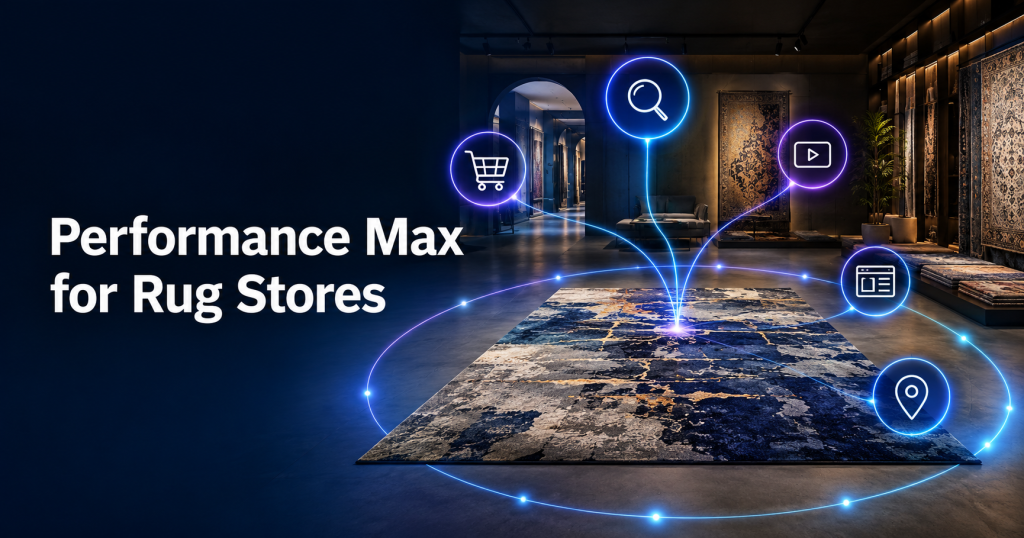
Performance Max can work well for a rug business, but only under specific conditions: reliable conversion tracking, a reasonably complete product feed or clear conversion goals, and enough ongoing conversion volume for Google’s automated bidding to actually learn from. It is not automatically better than a more targeted campaign, and for a small showroom with few online conversions or highly one-of-a-kind inventory, it may not be the right starting point at all.
What Performance Max Actually Is
According to Google’s own Performance Max overview, it’s a goal-based campaign type that gives access to all Google Ads inventory, Search, Display, YouTube, Discover, Gmail, and Maps, from a single campaign. It’s designed to complement keyword-based Search campaigns, not necessarily replace them, using Smart Bidding and the creative assets, product feed, and audience signals an advertiser provides.
For a rug business already running Google Ads through Search or Shopping, Performance Max is best understood as an additional layer that reaches across more surfaces at once, not a fundamentally different way of finding customers. It doesn’t replace the underlying work of good product data and honest creative, it just extends where that work can show up.
How It Works for a Rug Business
Performance Max campaigns are organized into asset groups, essentially themed sets of images, headlines, descriptions, and logos, which can be structured around collections, such as handmade Persian rugs, modern designs, or a seasonal line. If a product feed is connected through Merchant Center, a meaningful share of the campaign’s activity typically routes through Shopping-style placements built from that feed, similar to how Shopping ads work, with Display and YouTube reach layered on top.
Search themes are an optional input, and Google’s own search themes documentation describes them as directional guidance for relevant searches, up to a set number per asset group, functioning more as guidance than the precise keyword control available in a Standard Shopping or Search campaign.
Prerequisites Before Turning It On
Verified conversion tracking matters more here than in almost any other campaign type, since Performance Max bidding is built entirely around the conversion signals it receives. Reviewing conversion tracking setup before launch, not after, avoids weeks of the algorithm optimizing toward incomplete or inaccurate data.
A product feed, for any rug business selling online, gives the campaign real inventory to work with rather than relying on creative assets alone.
Creative assets, real product photography, honest headlines, and accurate descriptions, still matter, since Performance Max assembles ads from what’s provided rather than generating convincing content from nothing.
Audience signals, such as customer lists or website visitor data, help guide early targeting but function as a starting point for Google’s systems rather than a hard restriction on who sees the ads.
Reporting and Brand Controls
Google has expanded Performance Max reporting over time, including channel-level placement data and search term insights, which help identify where budget is actually going. Brand controls, including brand exclusions and business name and logo guidelines, are also available and worth setting deliberately rather than leaving to default. Negative keyword controls have been extending to Performance Max as well, though the exact options available can vary by account, so it’s worth checking current settings directly in Google Ads rather than assuming a specific feature is universally available.
Budget and Conversion Volume
Performance Max relies on machine learning that needs real data to optimize against. Google’s own guidance is that campaigns need time to ramp up, and a campaign with very few conversions per month gives the system little to learn from, regardless of budget size. This is a genuine consideration for a rug business selling a small number of high-ticket pieces rather than a high volume of lower-priced products, since the algorithm is essentially trying to find patterns in outcomes, and a handful of scattered conversions a month simply doesn’t give it much to work with compared to a business converting dozens of times weekly.
When It May Work Well
A rug business with an established online catalog, consistent conversion tracking, and steady month-over-month sales volume is a reasonable candidate, particularly one already seeing results from Shopping or Search and looking to extend reach across YouTube and Display without managing separate campaigns for each.
When a Rug Business May Not Be Ready
Very low conversion volume, common for luxury or one-of-a-kind rugs sold in small numbers, gives the automated bidding little to work with, and results can be inconsistent as a result.
A local showroom with limited online conversion tracking may not have the data foundation Performance Max depends on, and fixing that foundation should come before launching the campaign, not alongside it.
A business that needs precise control over exactly which searches trigger ads may find the reduced visibility and control genuinely frustrating compared to a Standard Shopping or Search campaign, even with the newer reporting and exclusion tools.
A Simple Decision Framework
Before launching, it’s worth checking a few things honestly: is conversion tracking verified and complete, is there a product feed or a clear enough asset foundation, has the business seen consistent conversions over recent months, and does an existing Standard Shopping or Search campaign already perform reasonably well. If most of these are true, Performance Max is worth testing, ideally alongside existing campaigns rather than as a full replacement at first, which also makes it easier to judge marketing ROI by comparing results side by side rather than guessing at what changed.
Performance Max Readiness Checklist
- Conversion tracking verified and firing accurately
- Product feed connected, if selling online
- Real product photography and accurate creative assets ready
- At least some consistent recent conversion history
- Brand exclusions and business name guidelines reviewed
- Clear goal set for the campaign, not just “more traffic”
- A plan for comparing results against existing campaigns
A Few Common Questions
Does Performance Max replace Google Ads Search campaigns? Not necessarily. Google positions it as a complement to keyword-based Search campaigns, and many advertisers run both.
Is Performance Max better than Standard Shopping for a rug store? Neither is automatically better. Performance Max offers broader reach with less manual control, while Standard Shopping offers more direct control over bidding and placements.
How much conversion data does Performance Max need to work well? Google doesn’t publish an exact threshold, but consistent, ongoing conversions give the automated bidding meaningfully more to learn from than a handful of sporadic ones.
Can a luxury rug business with few monthly sales still use Performance Max? It’s possible, but the low conversion volume typical of high-ticket, infrequent purchases makes it harder for automated bidding to optimize, which is worth weighing honestly before committing budget.
Where This Leaves You
Performance Max isn’t a shortcut and it isn’t automatically the wrong choice either. It’s one more tool worth evaluating against the same honest questions any ad platforms decision deserves: does the data foundation exist, does the conversion volume support it, and is there a real plan for measuring whether it’s actually working. This assessment, from a rug marketing company that evaluates this question for real rug businesses regularly, comes down to readiness more than hype either way.