


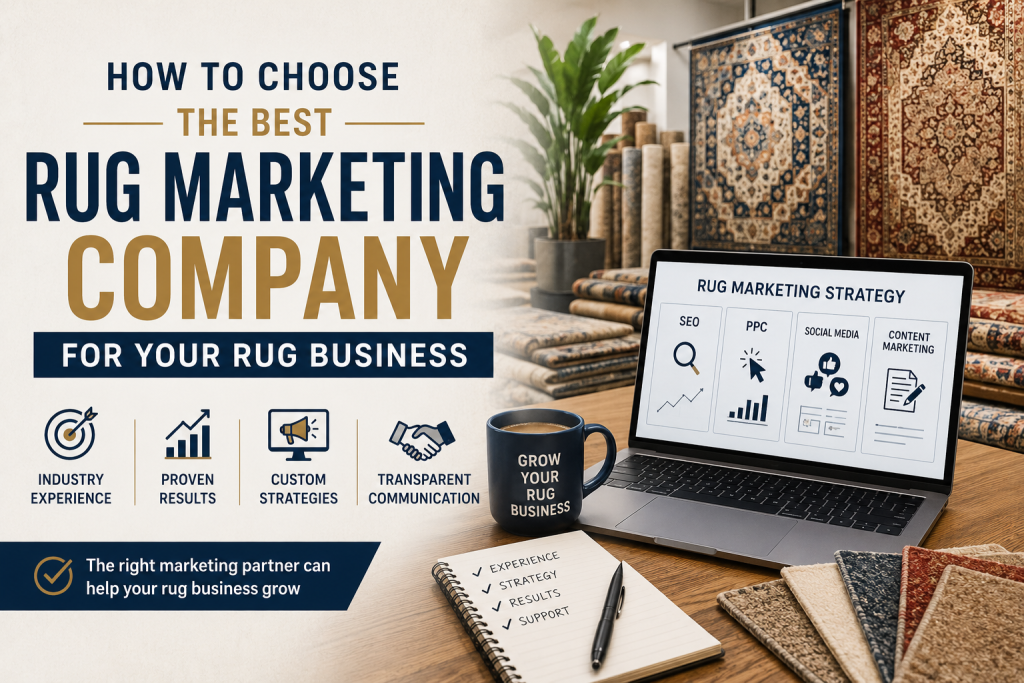
Choosing the right rug marketing company is one of the most consequential decisions a rug business owner will make this year. Rugs are not sold the way most retail products are sold. A buyer researching a hand knotted Persian piece, an antique Oriental rug, or a custom sized area rug is thinking about design, craftsmanship, origin, authenticity, and trust, often for weeks before they ever walk into a showroom or place an order online. A rug marketing company that understands this buying psychology will build a very different strategy than a generic agency that treats a rug store like any other local retailer.
The stakes are real. A marketing partner that does not understand this industry can spend months and a meaningful budget producing traffic and content that never quite connects with the buyers who actually purchase rugs, while a rug business a few miles away, working with a partner who understands the category, quietly builds a stronger online presence with the same resources. Getting this decision right early saves both time and money later.
This guide walks through what a rug marketing company actually does, why specialization matters so much in this industry, what services the best ones offer, and exactly what to ask before you hire one. Whether you run a rug showroom, a carpet retail store, an antique rug gallery, an online rug business, or a rug cleaning and restoration company, the goal here is the same: help you make an informed, confident decision.
What Is a Rug Marketing Company?
A rug marketing company is a specialized digital marketing partner that helps rug stores, carpet retailers, rug showrooms, Persian rug dealers, antique rug sellers, and rug service businesses like cleaners and restorers attract better customers online. Instead of applying a generic playbook built for restaurants or law firms, a rug marketing company builds SEO, advertising, website, and content strategies around how rug buyers actually search, compare, and decide.
In practical terms, that means understanding the difference between a shopper searching “area rug under $300” and one searching “hand knotted Persian rug Tabriz,” building content and campaigns that speak to both without wasting budget on the wrong audience, and presenting inventory in a way that reflects the actual value of a handmade, one of a kind product. It also means understanding local search behavior for a physical showroom, the role interior designers and trade buyers play in the industry, and the service side of the business, including rug cleaning, repair, and restoration.
Why Rug Businesses Need Specialized Marketing
Generic marketing does not always translate well to the rug industry, and the reasons come down to buyer psychology as much as anything technical.
Rug buyers are unusually visual. A photo that fails to show texture, knot density, or true color can lose a sale before a shopper ever reads a description. Generic ecommerce marketing templates rarely account for this the way rug-specific content and imagery strategy does. A stock product photo approach built for a business selling furniture hardware or home decor accessories simply was not designed to capture what makes one rug meaningfully different from another, and buyers who care about that difference notice when it is missing.
Many rug purchases are high value and highly considered. A customer spending several thousand dollars on a hand knotted piece behaves more like someone buying a major appliance or a piece of furniture than someone buying a commodity product, which changes what content, trust signals, and calls to action actually work. A rushed, transactional checkout flow built for impulse purchases works against a buyer who wants to feel confident before committing that kind of money.
Local showroom searches matter enormously for physical retailers. Someone searching “rug store near me” or “Persian rug showroom” wants to know they can see, touch, and compare rugs in person, and local SEO built specifically around that intent performs very differently than a broad, national SEO strategy. A national campaign that ignores local search behavior entirely misses the exact moment a nearby buyer is ready to visit.
Interior designers and trade buyers are a meaningful part of this industry’s revenue, and marketing that ignores that relationship misses a recurring source of higher value orders that a general retail marketing plan usually is not built to capture. A designer specifying rugs across multiple client projects represents a fundamentally different, more valuable relationship than a single retail transaction, and a strategy that treats every visitor the same way has no way to recognize or nurture that difference.
Service side searches behave differently too. Someone searching for rug cleaning or rug repair is often dealing with a specific, sometimes urgent problem, and that content and ad strategy needs to answer a different kind of question than a retail sales page does. A generic agency accustomed to product sales pages often defaults to the same structure for a service page, missing the more direct, problem focused language a service searcher actually responds to.
Rug Marketing Company vs General Marketing Agency
A general marketing agency can usually run a competent ad campaign and set up reasonable technical SEO. What it often lacks is a working understanding of the rug buyer journey, the language buyers actually use, and what builds trust for a high value, considered purchase in this specific category.
A rug marketing company starts from a different place. It already understands what separates a hand knotted rug from a hand tufted one, why that distinction matters to a buyer’s confidence in a purchase, and how to build content, product pages, and campaigns that reflect real product knowledge rather than generic retail language. It also tends to already know what a showroom’s local competitive landscape looks like, how designer and trade relationships factor into revenue, and how to segment keyword strategy by origin, material, and price point rather than treating every rug the same way a general agency might treat every product in a catalog.
The difference is not necessarily about technical skill. A capable general agency can execute SEO and ads competently. The difference is about the starting point, and how much time and budget gets spent bringing an agency up to speed on an industry it does not already understand.
Consider a simple example. A general agency taking on a rug store as a client will likely start with the same discovery process it uses for any local retail business: competitor research, generic keyword tools, and a standard content calendar. A rug marketing company starts from a different baseline, already knowing that “rug” searches split heavily by origin, material, and construction method, that local intent and trade intent behave completely differently, and that a showroom’s photography needs are unlike almost any other retail category. The first few months with a general agency are often spent building that foundational understanding, time a specialized partner does not need to spend.
What Services Should the Best Rug Marketing Company Offer?
A full service rug marketing company should be able to support every stage of how a rug business attracts, converts, and retains customers, not just one narrow channel.
Rug SEO
Rug SEO focuses on ranking for the terms rug buyers actually search: rug store, carpet showroom, Persian rugs, antique rugs, rug cleaning, rug repair, custom rugs, and location specific terms tied to a business’s actual market. This includes building out dedicated pages by rug type, origin, and material rather than relying on one generic catalog page trying to rank for everything at once. For example, a business selling both budget machine made rugs and hand knotted antiques loses potential customers on both ends if everything sits on one undifferentiated category page, since neither type of buyer is searching, or comparing, the same way. Proper SEO services built for this industry separate those audiences from the start rather than trying to rank one page for two very different buyer intents. Google’s own guidance on how search engines evaluate and rank content, laid out in its SEO Starter Guide, still applies here, but the keyword strategy and content structure need to be built specifically around rug buyer search behavior to actually work.
Local SEO
For any rug business with a physical showroom, local SEO is often the single highest impact channel available. A complete, accurate Google Business Profile, a steady stream of genuine customer reviews, city and neighborhood specific landing pages where relevant, and clear service area targeting all combine to determine whether a business shows up when someone nearby searches for a rug store or rug showroom. This matters just as much for a rug cleaning or restoration business, since those searches are almost always local and often urgent. A showroom that has never claimed or optimized its Google Business Profile is often invisible in the exact map pack results where local buyers are actively looking, regardless of how strong its website or inventory might be.
Google Ads for Rug Stores
Paid search can generate faster leads than organic SEO, which builds over months, but only when campaigns are properly targeted. That means separating high intent commercial searches, someone actively looking to buy a specific type of rug, from broad, expensive, low intent terms that mostly attract browsers who were never going to convert. For example, a campaign bidding on the broad term “rugs” alongside a more specific term like “9×12 hand knotted wool rug” will almost always waste budget on the first term while underinvesting in the second, even though the second is far more likely to produce an actual sale. Well managed Google Ads campaigns for this industry are built around that kind of segmentation from the start, with proper conversion tracking in place, so a rug business actually knows which campaigns and keywords are producing real leads rather than just clicks.
Website Design for Rug Businesses
A rug business website needs to do more than look attractive. It needs strong, accurate product visuals, clear service pages for anything beyond retail sales like cleaning or custom sizing, showroom details for anyone considering an in person visit, full mobile optimization since a large share of research happens on a phone, clear calls to action, and content that builds trust in a purchase that often happens without the buyer ever touching the product in person. A site that loads slowly, buries showroom hours and address behind multiple clicks, or lacks a clear way to ask a question before buying will lose considered buyers even when the underlying inventory and pricing are competitive. A rug business considering a redesign or a first real website should look closely at website design built specifically around these priorities rather than a generic template.
Branding and Visual Identity
Rugs are a category where perceived value matters enormously, and a rug business’s branding should reflect that. Inconsistent logos, low quality photography, or a dated visual identity can quietly undercut a business selling genuinely high value, handmade products, even when the inventory itself is excellent. Premium branding is not about looking expensive for its own sake, it is about making sure the presentation matches the actual value of what is being sold.
Content Marketing
Blogs, buying guides, care and cleaning advice, and educational articles about origin, construction, and material all help build the kind of trust that leads to a purchase decision, while also building the organic search visibility that reduces long term reliance on paid advertising. A buyer researching the difference between wool and viscose, or trying to understand what makes a rug “hand knotted,” is exactly the kind of visitor content marketing is built to capture and convert over time.
Social Media Marketing
Rugs are inherently visual products, which makes social media a natural fit when it is used well. Showing full collections, styling ideas in real rooms, behind the scenes showroom moments, and before and after restoration work all give a rug business a way to stay visible and build familiarity with an audience that may not be ready to buy yet but will remember the business when they are.
Email Marketing
Past buyers, interior designers, and showroom visitors who did not purchase immediately are all worth staying in touch with. Email marketing built around new inventory arrivals, seasonal promotions, and useful content keeps a rug business top of mind for exactly the kind of repeat and referral business that matters most in a category where a single strong relationship can produce multiple future sales.
How to Evaluate a Rug Marketing Company Before Hiring
A structured evaluation process catches most of the mistakes that come from choosing based on a good sales pitch alone. Treat this less like a single decision and more like a short due diligence process, the same way you would evaluate any partner who is about to represent your business publicly.
Check their industry experience directly. Ask specifically whether they have worked with rug, carpet, or similar home furnishings businesses before, and what that work actually involved, rather than accepting a general claim of “retail experience” at face value.
Review their portfolio critically. Look for real examples of rug or carpet related work, not just a general client list, and ask what results those projects actually produced. A portfolio full of logos with no explanation of outcomes tells you very little.
Ask about their SEO strategy in detail. A vague answer about “improving rankings” is a weaker signal than a clear explanation of keyword segmentation, content planning, and technical SEO priorities specific to how rug categories and origins get searched.
Ask about Google Ads tracking specifically. A rug marketing company should be able to explain exactly how leads and conversions are tracked, not just how much budget gets spent, and should be able to show you what that tracking actually looks like in practice.
Review their website design quality directly. Look at actual sites they have built, not just mockups, and check how those sites perform on mobile devices, since a large share of rug research happens there.
Ask how they create content. Understanding whether content is written by someone who understands the rug industry, or generated from a generic template with rug keywords swapped in, tells you a lot about what to expect from every future piece of content.
Ask how they measure results. A credible partner will talk about leads, qualified traffic, and conversion data, not just raw visitor counts or social media followers, which are easy numbers to inflate without producing any real business impact.
Check whether they understand local SEO specifically. For any business with a showroom, this is not optional, and a partner who cannot speak to it clearly is missing a core piece of the strategy.
Ask about conversion strategy, not just traffic generation. Getting more visitors to a website matters far less if the site and follow up process are not built to actually turn those visitors into leads.
Make sure they understand rug buyers specifically. This comes through in how they talk about the industry, the questions they ask about your business, and whether their proposed strategy reflects real knowledge of how rug purchases actually happen, rather than assumptions borrowed from a different retail category.
Questions to Ask Before Hiring a Rug Marketing Company
A short, direct list of questions during an initial conversation reveals more than almost any pitch deck. Pay attention not just to the answers themselves but to how directly and specifically they are given, since vague or deflecting answers here tend to predict vague or deflecting reporting later.
- Have you worked with rug or carpet businesses before, and can you describe that work specifically.
- Can you show examples of past work, including real websites, campaigns, or content you have produced for similar businesses.
- How do you approach SEO for rug stores specifically, as opposed to a generic local business.
- How do you choose keywords, and how do you decide which ones are actually worth targeting.
- How do you improve local search visibility for a business with a physical showroom.
- How do you track leads from Google Ads, and what does reporting actually look like month to month.
- Can you improve my existing website, or would this require starting over completely.
- Do you create rug specific content, or would content be written by someone unfamiliar with the industry.
- How do you handle internal linking and site structure as new content gets added over time.
- How do you measure success, and what specific numbers will I see in a typical report.
- How long does SEO usually take to show meaningful results for a business like mine.
- What do you need from my business to get started, in terms of information, access, and time commitment.
None of these questions are meant to catch an agency off guard. A genuinely qualified rug marketing company should welcome all twelve, since they are the same questions a thoughtful partner would want a prospective client asking before committing to a working relationship.
Red Flags to Avoid When Choosing a Rug Marketing Company
Certain warning signs consistently predict a disappointing outcome, and they are worth taking seriously even when the rest of a pitch sounds appealing. None of these signs alone is necessarily disqualifying, but seeing more than one or two together is a strong reason to keep looking.
Any guarantee of instant or guaranteed rankings is a red flag. No legitimate SEO provider can guarantee specific rankings, since search engines do not work that way, and Google’s own advertiser guidance makes clear that even paid placement depends on competitive bidding and relevance, not a fixed guarantee.
- A lack of rug industry understanding, even after it is pointed out directly, suggests the strategy will lean heavily on generic templates rather than anything built for your actual customers.
- Generic, obviously templated content that could apply to any retail business is a sign the same approach is being reused across unrelated industries.
- Poor or inconsistent reporting makes it impossible to know whether a strategy is actually working, and it is one of the most common reasons rug businesses end up switching providers.
- No real conversion tracking means spend is happening without any reliable way to connect it to actual leads or sales.
- Weak or generic website examples in a portfolio are a fairly direct predictor of what your own site will end up looking like.
- The same strategy applied to every client, regardless of industry or business size, suggests a template based approach rather than genuine strategy work.
- No clear local SEO plan for a business with a physical location is a significant gap, not a minor omission.
- No clear keyword strategy, or an inability to explain why specific keywords were chosen, usually means the targeting was not done carefully in the first place.
- No real understanding of high value buyers, including designers, trade buyers, and serious collectors, means a meaningful part of the potential market is likely being ignored.
Trust your own read of the conversation as much as any single item on this list. A partner who gets defensive when asked direct questions, or who rushes toward a contract before answering them clearly, is telling you something important about what the working relationship will actually feel like.
How a Rug Marketer Helps Rug Stores Get More Leads
A skilled rug marketer does more than run campaigns. A good rug marketer improves visibility across search and local listings, attracts better qualified buyers instead of just more traffic, builds the kind of trust signals that matter for a high value purchase, improves the actual website experience so visitors can find and evaluate inventory easily, supports Google Ads campaigns with real conversion tracking, creates content that answers the questions rug buyers actually have, and ultimately increases the number of qualified inquiries a business receives, not just the number of visitors to its website.
The difference between more traffic and more qualified leads matters enormously in this industry. A rug marketer who understands the category focuses on the second outcome, since a flood of unqualified visitors browsing budget rugs does very little for a business trying to sell hand knotted, higher value inventory. In practice, this often means a rug marketer will recommend narrowing keyword targeting rather than broadening it, even when a broader approach would technically produce a higher total traffic number, because the narrower approach produces more of the inquiries that actually turn into sales.
This is also where the value of a rug marketer compounds over time. Every piece of content, every optimized page, and every refined ad campaign builds on what came before it, creating a stronger overall foundation rather than a series of disconnected, one off efforts that stop producing value the moment attention moves elsewhere.
What Makes Danabak a Strong Rug Marketing Company?
Danabak works specifically within the rug and carpet industry, which shapes how strategy gets built from the first conversation rather than being adapted after the fact. That includes SEO built around how rug buyers actually search, Google Ads campaigns targeted at genuinely qualified buyers rather than broad, low intent traffic, website design built around showroom trust and conversion, content created with real knowledge of rug terminology and buyer questions, and branding that reflects the actual value of handmade and imported rug inventory.
This industry focus also means fewer assumptions need correcting along the way. A rug business working with Danabak does not need to explain why a hand knotted piece and a machine made rug should never compete for the same keyword, or why a showroom’s local presence matters as much as its national visibility. That context already exists going into the first strategy conversation, which tends to shorten the ramp up period considerably compared to working with a generalist partner learning the category for the first time.
The goal with rug business marketing at Danabak is not to promise guaranteed results, since no honest agency can promise that, but to bring real industry context to every part of the strategy, from the first keyword research pass to how a showroom’s local presence gets built out over time. For a rug business trying to evaluate any potential partner, including Danabak, the same questions and evaluation criteria covered earlier in this guide apply, and a strong rug marketing company should be comfortable answering all of them clearly, without hedging or redirecting to a generic sales pitch.
Best Marketing Strategy for a Rug Business
The strongest results usually come from combining several channels rather than relying on any single one. Each piece plays a different role, and leaning too heavily on one while neglecting the others tends to produce a lopsided result even when the strategy that is in place is executed well.
SEO provides long term organic visibility that compounds over time and reduces dependence on paid advertising as it matures. It is also the channel most likely to keep producing qualified traffic months and years after the initial work is done, unlike paid channels that stop the moment spending stops.
Google Ads generates faster lead flow while SEO is still building, particularly useful for a newer business or one entering a competitive local market. It also gives a business real, immediate data about which keywords and offers actually convert, data that can inform the content and SEO strategy running alongside it.
Website design determines whether the traffic from both channels actually converts into inquiries, since even strong visibility does little for a site that fails to build trust or make contact easy. This is often the piece that gets underinvested in relative to how much it actually affects results.
Content marketing builds topical authority and answers buyer questions before they ever reach out directly, which shortens the sales conversation once they do. A buyer who has already read a clear explanation of hand knotted versus hand tufted construction arrives at a showroom or a call ready to talk specifics, not basics.
Social media supports visual branding and keeps a business visible to an audience that is not ready to buy yet but will remember it later. Its value shows up gradually, in familiarity and trust, more than in direct, immediately trackable leads.
Email marketing keeps past buyers, designers, and showroom visitors engaged over time, supporting the repeat and referral business that matters so much in this category. It is also one of the least expensive channels available relative to the revenue it can produce from an existing audience.
Local SEO ensures showroom visibility for the local, often high intent searches that drive walk in traffic and in person sales. For any business with a physical location, this channel alone can account for a large share of new customer discovery.
No single channel replaces the others. A rug business investing only in ads with no SEO foundation, or only in content with no way to convert that traffic, will consistently underperform one running a coordinated strategy across all of these areas. The businesses that get the most out of their marketing budget tend to be the ones treating these channels as one connected system, not a menu of separate options to pick from in isolation.
Frequently Asked Questions
What is a rug marketing company?
A rug marketing company is a digital marketing partner that specializes in helping rug stores, carpet retailers, rug showrooms, and rug service businesses attract and convert customers online, using strategies built specifically around how rug buyers search and make decisions.
Why should I hire a rug marketing company instead of a general agency?
A rug marketing company already understands rug terminology, buyer psychology, local showroom search behavior, and the role of designers and trade buyers, which means less time and budget spent bringing a partner up to speed on an industry it does not already know. That head start often shows up directly in how quickly a strategy starts producing real results.
How can SEO help a rug store?
SEO helps a rug store rank for the specific terms buyers search, from broad category terms to origin and material specific searches, while also supporting local visibility for anyone with a physical showroom. Over time, it becomes one of the most cost effective channels available, since the traffic it produces does not disappear the moment ad spend stops.
Are Google Ads useful for rug businesses?
Yes, particularly for generating faster leads while organic SEO is still building, as long as campaigns are properly targeted at genuinely qualified buyers and tracked accurately.
How long does rug SEO take?
Meaningful movement typically starts within the first few months, with larger gains building over six months to a year, though this varies by market competitiveness and starting point.
What should a rug business website include?
A strong rug business website should include high quality product imagery, clear service and showroom information, mobile optimization, straightforward calls to action, and content that builds trust in a considered, often high value purchase.
Can marketing help rug cleaning and restoration companies?
Yes. Rug cleaning and restoration businesses benefit heavily from local SEO and Google Ads specifically, since those searches tend to be local and often reflect an immediate need.
How do I know if a rug marketer is good?
A good rug marketer can speak specifically about rug industry terminology and buyer behavior, shows real past work rather than vague claims, and reports on qualified leads rather than just traffic or impressions.
What is the difference between rug SEO and regular SEO?
Rug SEO applies general SEO principles but builds keyword strategy, content, and site structure around rug specific search behavior, including origin, material, and construction terms that a generic SEO approach would likely miss entirely.
How can Danabak help my rug business?
Danabak brings rug industry specific experience to SEO, Google Ads, website design, content, and branding, building strategy around how rug buyers actually search and decide rather than applying a generic retail marketing template.
Take a Closer Look at Your Rug Business’s Online Presence
Choosing the right rug marketing company starts with an honest look at where your business stands today. If your website is not converting visitors into inquiries, if your showroom is not showing up in local search, or if you are simply not sure whether your current marketing is actually working, that is worth addressing directly rather than guessing.
Use the questions and red flags covered throughout this guide with any agency you are considering, including Danabak. A partner confident in its own work will welcome that scrutiny rather than avoid it, and the answers you get along the way will tell you as much as any portfolio or pitch deck.
Danabak works specifically with rug and carpet businesses, and a good next step is a straightforward conversation about where your marketing stands now and where the real opportunities are. You can contact Danabak to talk through your specific situation, with no pressure and no assumption that any one agency, Danabak included, is automatically the right fit until that conversation actually happens.