


If you’ve owned a rug business for more than a few years, there’s a decent chance you’ve already been burned once. Maybe it was a website redesign that looked nice and converted nothing. Maybe it was a Google Ads account that burned through a few thousand dollars a month with no idea which keywords actually led to a sale. Rug retailers talk to each other more than most industries realize, and the story comes up often enough that it’s worth addressing directly: how do you actually pick a marketing partner without gambling another six months and another few thousand dollars finding out the hard way?
The honest answer is that most of the advice out there about choosing a marketing agency wasn’t written with rug businesses in mind. It’s generic checklist content built for SaaS companies and local plumbers. Rugs are a different animal — high consideration, high price point, and a buyer who researches for weeks before ever picking up the phone. That changes what actually matters when you’re vetting a partner for digital marketing for your rug business.
Start With Whether They Actually Understand Rugs
This sounds obvious, but it’s the filter most rug business owners skip. Ask a prospective agency what makes a hand-knotted rug different from a hand-tufted one, or why an 8×10 Oushak and an 8×10 machine-made rug shouldn’t be competing for the same ad budget. If they can’t answer in plain terms, they’re going to build your keyword strategy, your ad copy, and your product pages around guesses.
This isn’t a minor detail. It’s the difference between an agency that treats your inventory like generic home goods and one that understands why a buyer searching “antique Persian rug” behaves completely differently from someone searching “area rug under $200.” A lot of the common marketing mistakes rug businesses end up paying for trace back to exactly this — an agency applying a general retail playbook to a category that doesn’t fit one.
Ask to See Actual Work, Not Just a Client List
Almost every agency will hand you a logo wall or a list of “industries served.” That tells you very little. What you want instead is specific: a rug or home furnishings client, what their site looked like before, what changed, and what happened to their traffic and inquiries afterward. If an agency can walk you through a real project in detail — not just a testimonial quote — that’s a much stronger signal than any pitch deck.
It’s worth looking at a portfolio with this in mind rather than taking “we’ve worked with retailers before” at face value. A few pointed questions here will tell you more in ten minutes than an hour of sales talk will.
Understand How They’d Actually Approach Your SEO and Ads
Here’s where a lot of rug store owners get talked past rather than talked to. Ask specifically how they’d structure your keyword targeting — not “we do SEO,” but whether they plan to segment by origin, material, size, and condition, since that’s how rug buyers actually search. If you’re also considering paid search, ask how they’d separate high-intent commercial keywords from broad, expensive terms that mostly attract browsers. A well-run Google Ads account for a rug business looks very different from one built for a generic ecommerce store, and it’s worth asking a candidate to walk through their thinking rather than their service list.
The same goes for local visibility, if you have a showroom. Ask directly how they’d approach ranking your business for neighborhood-level searches and improving your presence in the Map Pack. There’s a real difference between an agency that treats Google Business Profile as an afterthought and one that treats it as core infrastructure.
Watch How They Talk About Timelines and Guarantees
Any agency that promises page-one rankings by a specific date, or guarantees a set number of leads before they’ve even seen your website, is telling you something important about how they operate — and it’s not a compliment. Nobody controls Google’s algorithm, and a rug business competing for terms like “Persian rugs near me” or “antique rug showroom” is up against real competition, not a vacuum.
What a credible agency will tell you instead is a realistic range. For most rug retailers, meaningful SEO movement starts showing in the first few months, with the bigger gains building over six months to a year. Paid search can produce inquiries faster, but it takes time to tune out the low-intent clicks and get cost per lead down to something sustainable. If a conversation with an agency skips past this and goes straight to guarantees, that’s usually the moment to end the conversation, not sign the contract.
Ask What Reporting Actually Looks Like
“Transparent reporting” is one of those phrases every agency puts on their homepage, and it means almost nothing until you ask what the report actually contains. Does it show cost per lead, not just impressions and clicks? Does someone walk you through it monthly, or does it show up as an automated PDF nobody explains? Can you see which specific rug categories or campaigns are producing inquiries versus which ones are just spending budget?
If an agency can’t clearly describe what you’ll see and how often, assume the reporting will be vague when it matters most — usually right when you start asking why results have slowed down.
Weigh Specialization Against Flexibility
There’s a real tradeoff worth thinking through honestly. A generalist agency might be cheaper and more flexible, but you’ll likely spend the first several months teaching them your industry — time you’re paying for either way. A specialist agency starts faster because they already understand rug buyer behavior, seasonal patterns, and how designers and trade buyers fit into the picture, but that focus can come with a narrower service list or a higher starting price.
Neither approach is automatically wrong. What matters is being honest with yourself about which tradeoff you’re willing to make, and asking any agency you’re considering to be equally honest about where their limits are.
A Short List Before You Sign Anything
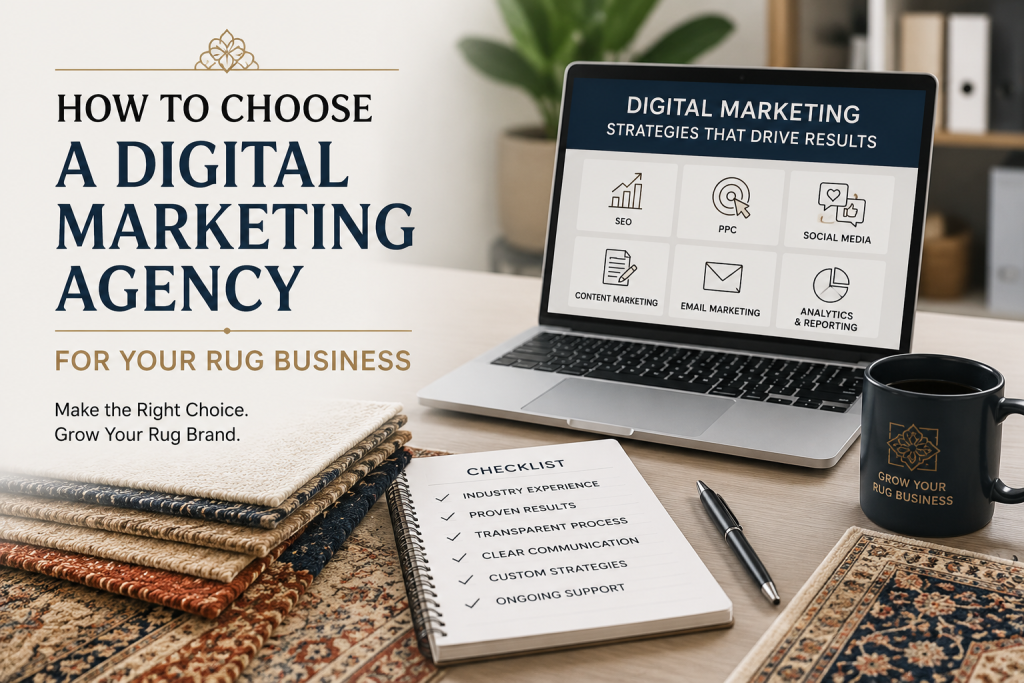
A few questions worth asking directly, and paying close attention to how they’re answered:
- Can you show me a rug or home furnishings client’s actual results, not just a testimonial?
- How would you structure keyword targeting for rugs specifically — by origin, material, size, condition?
- What does a monthly report actually include, and who walks me through it?
- What’s a realistic timeline for SEO results in a market as competitive as mine?
- If I have a showroom, how would you approach local search and Google Business Profile?
- What happens if results plateau — what’s the plan, and how is it communicated?
None of these questions are unusual or aggressive. A good agency will welcome them, because they’re the same questions a good agency wants a prospective client to ask. The ones that get defensive, vague, or start talking over you are usually telling you exactly what the next twelve months would look like.
Choosing the right partner isn’t about finding the agency with the best pitch. It’s about finding the one that asks as many questions about your rugs as you’re asking about their process — and whose answers hold up once you start pressing on the details.