


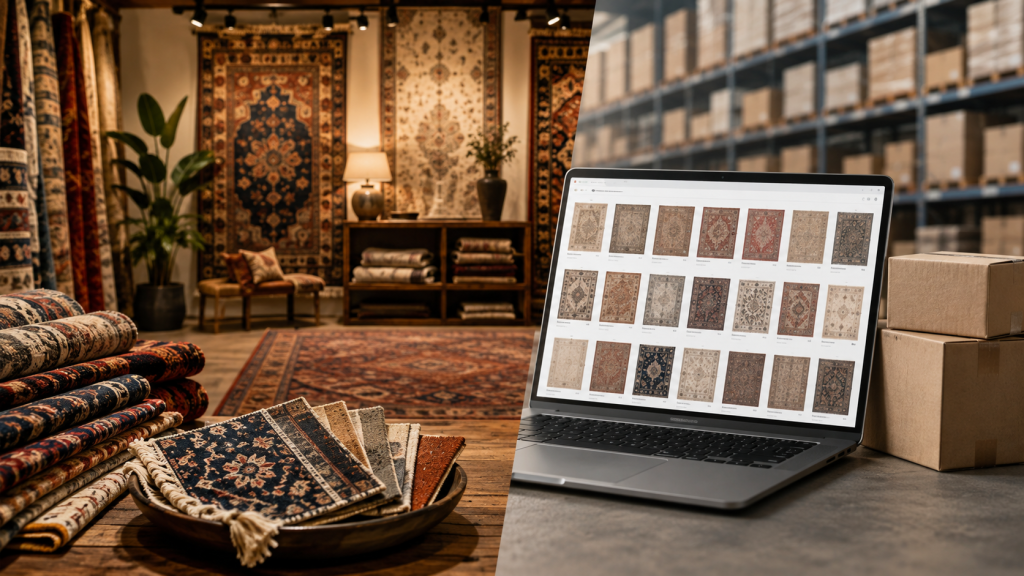
Independent rug stores often feel like they are competing against giants. Wayfair, Amazon, Home Depot, Walmart, Target, and other big-box retailers have huge product catalogs, large ad budgets, fast shipping systems, and strong brand recognition.
At first, that can feel impossible to beat. But independent rug stores do not need to beat big-box retailers at their own game. They need to win where big retailers are weaker: expertise, trust, local service, product knowledge, one-of-a-kind inventory, personal guidance, and customer relationships.
A customer who wants the cheapest rug may choose a big-box store. But a customer who wants the right rug, the right size, the right material, the right story, or expert help still has strong reasons to choose an independent rug dealer.
The online strategy is not to look like Wayfair. The strategy is to look more useful, more trusted, more specialized, and more human than a national marketplace.
Quick Answer
Independent rug stores can compete with Wayfair and big-box retailers online by focusing on niche expertise, local SEO, detailed product content, better photography, educational blogs, review building, designer relationships, email follow-up, and high-intent paid ads. Big retailers can win on scale, but independent rug stores can win on trust, service, quality, and specialized rug knowledge.
Wayfair’s supplier information highlights its large customer reach and home goods platform model, which shows why independent stores should not try to compete only on catalog size or ad budget. Instead, they should build a stronger specialty experience around rugs, service, and buyer education.
Why Big-Box Retailers Are Hard to Compete With
Big-box retailers have several advantages. They have large teams, huge product feeds, national shipping systems, strong domain authority, paid ad budgets, and thousands of product pages. They can rank for broad keywords and advertise across many channels.
They also benefit from convenience. Many shoppers already trust these websites for general home products. If a buyer wants a quick rug purchase without expert guidance, a large retailer may feel easy.
But this strength also creates a weakness. Big retailers often treat rugs as one category inside a much larger home goods catalog. They may not provide deep rug education, local showroom guidance, detailed origin knowledge, restoration advice, or personal design help.
That gap creates opportunity for independent rug stores.
What Independent Rug Stores Can Do Better
Independent rug stores can offer something big retailers usually cannot: real rug expertise.
A local rug dealer can explain why a hand-knotted wool rug feels different from a machine-made rug. A showroom can help a customer understand size, pile, color, pattern, durability, and placement. A specialist can discuss origin, weaving, materials, condition, cleaning, repair, and long-term value.
These details matter for buyers who care about quality. They also help Google understand that the business has useful, people-first content. Google recommends creating helpful, reliable content that benefits people first, not content made mainly to manipulate rankings.
This is where Danabak’s rug marketing strategy can help independent rug stores turn expertise into online visibility.
Do Not Compete on Price Alone
Trying to beat big-box retailers only on price is usually a losing strategy. Large retailers can discount, bundle, and advertise at a scale most independent stores cannot match.
Instead, independent rug stores should compete on value.
That value can include:
- Better rug education
- Higher quality product details
- One-of-a-kind pieces
- Local showroom support
- Personal recommendations
- Rug cleaning and care guidance
- Designer-friendly service
- Custom sizing options
- Antique and handmade expertise
- Honest condition notes
- After-sale support
Price still matters, but it should not be the only message. A rug store that only says “affordable rugs” may sound like every other retailer. A store that explains quality, fit, material, and service gives buyers more reasons to trust it.
Build Local SEO Strength
Big-box retailers may dominate broad national searches, but independent rug stores can win local searches.
A local customer may search for rug store near me, Persian rugs in Charlotte, handmade rugs near me, rug cleaning near me, antique rug dealer, or Oriental rug store in their city. These searches often have strong buying intent.
Google Business Profile is important for local visibility because verified storefront businesses can show helpful details like business hours, website, phone number, and location to customers on Google.
Independent rug stores should optimize:
- Google Business Profile
- Local landing pages
- Service area pages
- Review strategy
- Local photos
- Business categories
- Store hours
- Driving directions
- Local citations
- Local schema markup
Local SEO is one of the biggest advantages independent rug stores have. A big-box retailer may sell rugs online, but it cannot always provide the same local trust, showroom visit, or expert consultation.
Create Better Product Pages
A rug product page should do more than show a photo and price. Rug buyers need details. They want to know what the rug is, where it comes from, how it feels, whether it fits their room, and why it is worth buying.
Strong product pages should include:
- Clear rug name
- Exact size
- Material
- Origin
- Construction type
- Style
- Age if relevant
- Color description
- Condition notes
- Care guidance
- Shipping details
- Return information
- Multiple photos
- Room styling context
- Related rugs
Many big-box product pages are built from templates. Independent rug stores can create richer, more helpful pages. That extra detail can improve both buyer confidence and organic search performance.
Danabak’s website design service can help rug stores organize product pages, collections, service pages, and inquiry paths in a more buyer-friendly way.
Use Content to Answer Real Buyer Questions
Content is one of the strongest ways independent rug stores can compete online. Big retailers often have large catalogs, but independent rug stores can publish better educational content.
Useful topics include:
- How to choose the right rug size
- Wool vs synthetic rugs
- Handmade vs machine-made rugs
- How to clean a wool rug
- Best rugs for living rooms
- Persian rug buying guide
- Why hand-knotted rugs cost more
- How to place a rug under a dining table
- Vintage rug care tips
- Rug pad buying guide
This type of content attracts buyers before they are ready to purchase. It also builds trust. When a visitor learns something useful from a rug store, that business becomes more memorable.
A strong SEO plan connects these blogs to category pages, product pages, and local service pages.
Show Real Expertise
Independent rug stores should not hide their knowledge. They should show it everywhere online.
This can include:
- Staff expertise
- Owner story
- Rug sourcing process
- Weaving knowledge
- Cleaning knowledge
- Restoration experience
- Trade relationships
- Designer projects
- Customer stories
- Before and after examples
- Educational videos
A buyer choosing between a generic rug listing and a knowledgeable rug specialist may prefer the specialist if the website proves expertise clearly.
Independent stores should also avoid thin descriptions. A product page that says “beautiful area rug, high quality, great design” does not say much. A stronger description explains material, pattern, origin, condition, room use, and buyer benefit.
Win With Better Photography
Rugs are visual products. Strong photography can help independent stores compete with larger websites.
Product photos should show:
- Full rug view
- Close-up pattern
- Texture and pile
- Fringe or border
- Backing
- Corner detail
- Room view
- Scale reference
- Any condition issues
- Color accuracy
Independent rug stores should also use lifestyle photos. A rug shown in a real room helps buyers imagine it in their own home. Big retailers often use polished mockups, but independent stores can show authentic showroom photos, real installations, and design projects.
Better images can improve conversion, trust, and social media performance.
Build Trust With Reviews
Reviews are a major advantage for independent rug stores. A big-box retailer may have many product reviews, but a local store can build trust through customer service reviews, showroom experience, installation support, cleaning results, and long-term relationships.
Rug stores should ask happy customers to review the business after:
- Rug purchases
- Cleaning services
- Repair projects
- Designer consultations
- Delivery experiences
- Custom rug orders
- Showroom visits
Reviews should be visible on Google, the website, and key local platforms. A strong review profile can help convince buyers who are unsure whether to choose a local store or a national retailer.
Use Paid Ads Carefully
Independent rug stores can use paid ads, but they should not try to outspend large retailers on broad terms. Competing for generic keywords like rugs or area rugs can become expensive.
A smarter strategy is to focus on high-intent and local searches.
Better paid ad targets may include:
- Handmade rugs near me
- Persian rug store in city
- Oriental rug cleaning
- Antique rug repair
- Custom rugs city
- Wool rugs showroom
- Rug store appointment
- Luxury rugs city
Paid ads should send visitors to focused landing pages, not a generic homepage. A person searching for antique rug repair should land on a repair page. A person searching for handmade rugs should land on a handmade rug page.
A focused Google Ads setup can help independent rug stores avoid wasted spend and reach buyers with clearer intent.
Create Email Follow-Up Systems
Many rug buyers do not purchase on the first visit. They may compare sizes, ask family, consult a designer, or wait for the right piece. This makes email follow-up important.
Independent rug stores should use email to stay connected with leads and past customers.
Useful email campaigns include:
- Welcome emails
- Product inquiry follow-ups
- New arrival updates
- Rug care tips
- Showroom event invites
- Designer trade updates
- Review requests
- Post-purchase care emails
- Seasonal design inspiration
Email gives independent stores a relationship advantage. Big retailers send mass promotions, but a rug store can send more personal and helpful messages.
Danabak’s email marketing service can help create campaigns that nurture buyers instead of only pushing discounts.
Work With Interior Designers
Interior designers can help independent rug stores compete in a way big-box retailers often cannot. Designers need reliable partners, quality inventory, accurate details, trade support, and fast communication.
A rug store can create a designer program with:
- Trade pricing
- Private appointments
- New arrival previews
- Sourcing support
- Custom rug options
- Project boards
- Delivery support
- Sample support
- Direct contact person
The website should include a clear trade or designer page. This helps designers understand why they should work with the store instead of sourcing from a general retailer.
Improve Website Conversion
Traffic alone does not help if the website does not convert. Independent rug stores should make the next step easy.
Important conversion elements include:
- Clear phone number
- Contact form
- Appointment button
- Product inquiry button
- Live chat
- Store hours
- Directions
- Shipping information
- Return policy
- Financing information if available
- Trust badges
- Customer reviews
- Designer program CTA
Every important page should answer the buyer’s question: what should I do next?
For local stores, that may be “Visit the showroom.” For online sellers, it may be “Ask about this rug.” For luxury dealers, it may be “Request a consultation.”
Comparison: Big-Box Retailer vs Independent Rug Store
| Area | Big-Box Retailer | Independent Rug Store |
|---|---|---|
| Product range | Very large catalog | More curated inventory |
| Pricing | Often competitive | Can focus on value and quality |
| Expertise | General home goods knowledge | Specialized rug knowledge |
| Local service | Limited or store-dependent | Strong showroom and local support |
| Product story | Often basic | Can explain origin, weave, and material |
| Customer relationship | Mostly transactional | More personal and consultative |
| SEO opportunity | Broad national terms | Local and niche rug terms |
| Trust building | Brand recognition | Reviews, expertise, and service |
| Best advantage | Scale and convenience | Knowledge, service, and specialization |
This is the main point: independent rug stores should not copy big retailers. They should build a better specialty experience.
What Independent Rug Stores Should Prioritize First
A rug store does not need to fix everything at once. The best starting point is a focused online growth foundation.
Start with:
- Google Business Profile
- Local SEO pages
- Strong product pages
- Clear category structure
- Better rug photography
- Review building
- Educational blog content
- Lead capture forms
- Email follow-up
- Focused paid ads
These steps help independent rug stores compete where they have the best chance to win.
Common Mistakes to Avoid
Independent rug stores should avoid trying to become a smaller version of a big-box retailer. That usually leads to weak positioning.
Common mistakes include:
- Competing only on price
- Using thin product descriptions
- Ignoring local SEO
- Not asking for reviews
- Sending all ad traffic to the homepage
- Posting products without education
- Using poor rug photos
- Not following up with leads
- Ignoring designer relationships
- Not tracking calls and forms
Most of these mistakes are fixable. The key is building a strategy around the store’s strengths.
Final Thoughts
Independent rug stores can compete with Wayfair and big-box retailers online, but they need the right strategy. They do not need a larger catalog or a bigger ad budget. They need better positioning, deeper expertise, stronger local visibility, helpful content, better product pages, and more personal follow-up.
Big retailers win on scale. Independent rug stores can win on trust.
The stores that grow online will be the ones that explain rugs clearly, show inventory beautifully, build local authority, serve customers personally, and use digital marketing in a connected way.
For rug dealers, showrooms, importers, and specialty rug retailers, competing online is not about copying big-box retailers. It is about proving why a specialized rug business is the better choice for buyers who care about quality, service, and expert guidance.
FAQs
Can independent rug stores compete with Wayfair online?
Yes, independent rug stores can compete online by focusing on local SEO, expert content, detailed product pages, better photography, reviews, personal service, and niche rug knowledge.
Should a rug store compete on price?
Usually no. Independent rug stores should compete on value, quality, service, expertise, and trust instead of trying to beat big-box retailers only on price.
What SEO keywords should rug stores target?
Rug stores should target local and high-intent keywords such as rug store near me, handmade rugs in city, Persian rug store, antique rug repair, Oriental rug cleaning, and custom rugs.
Why is local SEO important for rug stores?
Local SEO helps rug stores appear when nearby customers search for showrooms, rug services, or specialty rugs. These searches often have strong buying intent.
How can rug stores improve product pages?
Rug stores can improve product pages by adding clear size, material, origin, construction, condition, care instructions, shipping details, multiple photos, and strong calls to action.
Do rug stores need blogs?
Yes, blogs help rug stores answer buyer questions, build expertise, support SEO, and connect educational content to product and service pages.
Are paid ads useful for independent rug stores?
Paid ads can be useful when targeting local, high-intent searches and sending traffic to focused landing pages with clear conversion actions.
What is the biggest advantage independent rug stores have?
The biggest advantage is specialized knowledge. Independent rug stores can offer expert guidance, local trust, personal service, and deeper product education than many large retailers.