


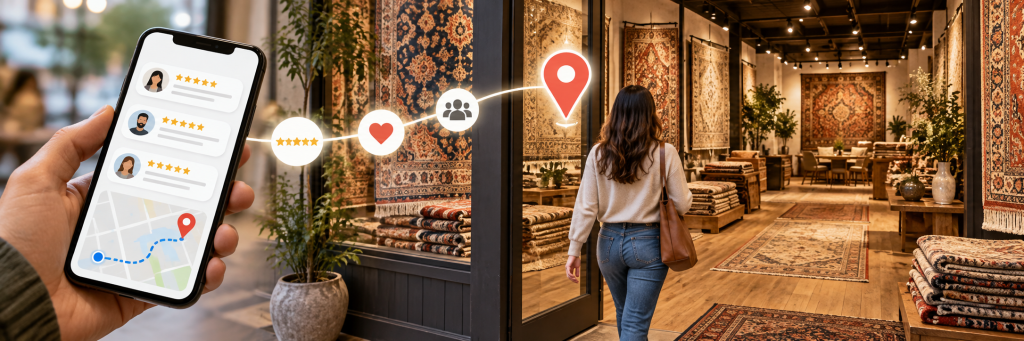
For an independent rug store, customer reviews can influence a buying decision long before anyone walks into the showroom.
A potential customer may discover three local rug stores in Google Maps. All three may offer handmade rugs, Persian rugs, wool rugs, and professional service. The customer may not know any of the businesses personally, so they begin comparing ratings, recent reviews, photographs, location, and what previous customers say about the experience.
That is where a strong review strategy becomes important.
Reviews are not simply reputation badges. They can help customers understand what it feels like to shop with a rug business. A detailed review may tell a prospective buyer that the staff was patient, the selection was large, the salesperson helped with sizing, delivery was smooth, or the customer never felt pressured.
For a rug store, these details can be more persuasive than another promotional statement on the website.
A strong rug marketing strategy should therefore connect reviews with local SEO, showroom conversion, customer service, and long-term reputation building.
Why Reviews Matter More for Rug Stores Than Many Retail Businesses
A rug is not always a simple purchase.
Customers may spend significant time choosing the right size, material, color, construction, and style. Handmade, antique, Persian, Oriental, vintage, or custom rugs can also involve higher prices and more complicated buying decisions.
That creates uncertainty.
A new customer may wonder whether the showroom has enough inventory, whether the rugs are accurately represented online, whether the staff understands handmade rugs, or whether they will receive useful advice instead of a high-pressure sales pitch.
Reviews help answer those questions through previous customer experiences.
A strong review profile can reassure someone who has never visited the store before.
For independent rug businesses, this is especially important when competing with large retailers. A national retailer may have greater brand recognition, but a local showroom can demonstrate something more personal through detailed customer experiences.
Reviews Support Local Search Visibility
Reviews are closely connected with local discovery because they are highly visible inside Google Business Profile and Google Maps.
When a customer searches for a rug store nearby, ratings and reviews may be among the first things they notice.
The business does not need to obsess over having a perfect score. Customers often understand that no established company will satisfy every person in exactly the same way.
What matters is whether the overall review profile looks active, authentic, relevant, and professionally managed.
Reviews should therefore be considered part of a broader SEO strategy rather than something managed only by customer service.
Local visibility may bring the business into the search results, but reviews can influence whether the customer actually chooses it.
What Makes a Rug Store Review Useful?
A useful review contains context.
Compare these two examples.
“Great store.”
This is positive, but it tells future customers very little.
A more useful review might explain that the customer was looking for a large wool rug, brought room measurements to the showroom, received help comparing several sizes, and had the final rug delivered professionally.
The second review gives future buyers much more information.
It demonstrates product selection, expertise, customer service, and delivery.
A rug store should never tell customers exactly what to write, but it can make the review request at the right moment and remind customers that sharing their experience helps other local buyers.
Focus on the Customer Experience First
No review strategy can compensate for a poor customer experience.
The strongest review marketing begins inside the business.
The showroom should provide accurate information, helpful guidance, professional communication, clear pricing, careful handling, and reliable follow-up.
If delivery is promised for a particular day, communication should remain clear.
If a customer needs sizing help, staff should be prepared to provide useful guidance.
If a rug has condition issues, those should be communicated honestly.
When the buying experience feels professional, requesting a review becomes much easier.
Marketing can encourage satisfied customers to share their experiences, but customer service creates the story they have to tell.
Ask for Reviews at the Right Time
Timing matters.
Asking for a review too early can feel unnatural. Waiting too long can result in the customer forgetting important details about the experience.
A good time is usually after the customer has completed a successful interaction with the business.
For a rug retailer, this may happen after the rug has been purchased and delivered.
For a cleaning or restoration service, it may happen after the finished rug has been returned.
For a showroom consultation, it may happen after the customer has completed the purchase and expressed satisfaction.
The request should feel like a natural final step in the customer journey.
Make the Review Request Easy
Customers may be happy to leave feedback but never do so if the process feels complicated.
A good review request should take the customer directly to the relevant review page.
The message can be short and polite.
For example, the business can thank the customer for choosing the showroom and explain that their feedback can help other people who are searching for rugs locally.
Avoid sending customers through multiple website pages before they can leave the review.
Convenience increases participation.
Use Email Follow-Up for Review Requests
Email can be one of the easiest ways to create a consistent review process.
After a completed purchase or delivery, the business can send a simple thank-you message followed by a review invitation.
A professional email marketing system can automate this step while still allowing the message to feel personal.
The email should identify the business clearly, thank the customer, and provide a direct path to leave feedback.
Do not overwhelm customers with repeated requests.
If someone ignores the first message, one gentle reminder may be reasonable. Constant reminders can damage the relationship the business is trying to strengthen.
Train Showroom Staff to Recognize the Right Moment
A review strategy should not exist only inside marketing software.
Showroom staff often know exactly when a customer is happy.
A customer may say that they loved the selection, appreciated the help, or are excited about how the rug looks in their home.
That is a natural moment to mention reviews.
The staff member does not need to pressure the customer. They can simply explain that online feedback is appreciated and helps other buyers discover the showroom.
This feels much more genuine than asking every customer for a review automatically, regardless of their experience.
Reviews Should Reflect Different Parts of the Business
A rug business may offer several different experiences.
Some customers buy handmade rugs.
Others purchase modern area rugs.
Some may use cleaning, repair, restoration, appraisal, or delivery services.
Interior designers may work with the showroom through trade relationships.
A healthy review profile naturally begins to reflect these different customer experiences.
That can help the business appear relevant to more potential buyers.
Someone looking for a Persian rug may notice reviews mentioning handmade inventory. Someone seeking rug cleaning may find comments about careful service.
This is much more useful than having dozens of reviews that all say essentially the same thing.
Do Not Create Fake Reviews
Fake reviews can damage customer trust and create platform problems.
A review strategy should focus on collecting genuine feedback from real customers.
Businesses should also avoid asking employees, friends, or unrelated people to post reviews pretending to be customers.
The purpose of reviews is to create trustworthy third-party information.
Once that trust is compromised, the business can lose more than the review itself.
Long-term reputation is more valuable than quickly increasing the review count.
Do Not Incentivize Only Positive Reviews
A business should not create a system where customers are rewarded specifically for leaving positive feedback.
That can make the review profile less trustworthy.
The better approach is to invite genuine customers to share their actual experience.
A business can improve the probability of positive feedback by providing better service, not by trying to control the wording of customer reviews.
This creates a more sustainable reputation.
Respond to Positive Reviews
A positive review deserves acknowledgment.
The response does not need to be long.
Thank the customer, mention that the team appreciates the feedback, and keep the tone professional.
Avoid copying the exact same response under every review.
If every response says “Thank you for your review. We appreciate your business,” the profile may start to feel automated.
A little variation makes the interaction more natural.
How to Respond to Negative Reviews
Negative reviews will eventually happen for many established businesses.
The objective should not be to win an argument publicly.
Potential customers are watching how the business responds.
A good response should remain calm, professional, and focused on resolving the situation where possible.
Avoid insulting the customer, sharing private information, or writing a long defensive explanation.
If the issue needs detailed discussion, invite the customer to contact the business directly.
A professional response can sometimes reduce the damage of the original review because readers see that the company takes complaints seriously.
Learn From Repeated Review Themes
Reviews are also a source of business intelligence.
If customers repeatedly praise the showroom’s rug selection, that may be something worth emphasizing more strongly in marketing.
If they often mention helpful sizing advice, that could become part of the showroom positioning.
If several reviews mention difficult parking, slow communication, or unclear delivery information, those comments may reveal operational problems.
Reviews should not only be collected.
They should be read.
Patterns can help the business improve both marketing and customer service.
Display Reviews on the Website
Google reviews are valuable, but customers should not need to leave the website to find social proof.
Relevant testimonials can be displayed naturally on important pages.
A showroom page may include reviews describing the in-store experience.
A handmade rug page may include a customer comment about rug quality or professional advice.
A designer page may include feedback from trade clients.
Professional website design can place these trust signals near important conversion points without making the page feel overloaded.
The objective is to answer the visitor’s uncertainty at the moment it matters.
Connect Reviews With Showroom Appointments
Imagine someone is deciding whether to schedule a showroom visit.
They want a handmade rug but have never purchased one before.
The appointment page explains that the customer can bring room measurements and compare several rugs in person.
Directly nearby, they see a genuine testimonial from another customer who describes receiving patient guidance and finding the correct rug size.
That review supports the decision the visitor is currently making.
This is much more strategic than placing twenty unrelated testimonials at the bottom of the homepage.
Reviews work best when context and customer intent match.
Use Reviews on Product and Category Pages Carefully
Reviews can also support product discovery, particularly if the website includes larger rug collections.
However, business reviews and individual product reviews should not be confused.
A store-level testimonial may demonstrate service quality, while a product review describes a particular rug or product experience.
Keep the context clear.
For one-of-a-kind rugs, traditional product reviews may not always make sense because the exact item may only be sold once.
In that situation, showroom and service testimonials may be more useful.
Designer Reviews Can Be Especially Valuable
Interior designers can become important repeat customers for rug stores.
Feedback from a designer may communicate a different type of value than a normal retail review.
A designer may discuss sourcing support, communication, trade service, product photography, availability information, or how the showroom helped with a client project.
These reviews can help attract other designers.
If the business has a trade program, designer feedback can be used naturally within that section of the site.
Again, the review should be genuine and accurately attributed.
Reviews Can Support Paid Advertising
Reviews are not limited to organic search.
Strong reputation can improve the overall effectiveness of paid campaigns because visitors often research a business after seeing an advertisement.
A customer may click an ad, browse the website, then search the business name and read reviews before making contact.
This means a focused Google Ads campaign works better when the rest of the digital reputation is strong.
Advertising creates visibility.
Reviews provide reassurance.
The website creates conversion.
These elements work together.
Review Strategy for Rug Cleaning and Restoration
Service-based rug businesses should also collect reviews.
For cleaning and restoration customers, trust may be particularly important because the customer is handing over a rug they already own.
That rug may have financial, decorative, or sentimental importance.
Useful customer feedback may naturally mention communication, pickup, cleaning quality, restoration work, delivery, and how the rug looked afterward.
Real before-and-after photographs can support that reputation when customer permission is available.
The business should never overstate what restoration can accomplish.
Clear expectations create better customer experiences and therefore better reviews.
Review Strategy for Antique Rug Dealers
Antique rug buyers may care about expertise and trust even more than general retail customers.
They may want confidence in how the business describes age, construction, origin, condition, and restoration.
Reviews from customers who appreciated knowledgeable guidance can therefore be valuable.
Antique rug dealers should also make sure their own website provides enough educational information to support those reviews.
The review demonstrates experience.
The website demonstrates knowledge.
Together, they create stronger credibility.
Review Strategy for Luxury Rug Showrooms
Luxury customers may expect a more personalized buying experience.
Their reviews may naturally focus on private appointments, designer support, home consultations, delivery, curation, and customer service.
Luxury businesses do not necessarily need thousands of reviews.
A smaller collection of detailed, genuine reviews can be more meaningful than a large number of generic comments.
The goal is not volume for its own sake.
The goal is credible evidence that the business provides the type of experience it promises.
Encourage Recent Reviews
A business may have an excellent rating based on old feedback, but customers often want to know whether the experience is still good today.
A steady flow of reviews keeps the profile current.
This does not mean asking customers constantly or aggressively.
It means making review requests part of normal operations so that feedback continues naturally over time.
A business with recent reviews often feels more active than one whose last customer comment was several years ago.
Avoid Sudden Unnatural Review Growth
Consistency is better than large artificial spikes.
If a business has barely received reviews for years and suddenly gains dozens in a very short period, that pattern may look unusual to customers.
Build the review process into ongoing customer communication.
Each successful month should naturally create opportunities for new feedback.
The result is a review profile that develops alongside the business.
Build a Review Funnel
A review strategy can be integrated into the customer journey.
A customer discovers the store through search, visits the showroom, selects a rug, completes the purchase, receives delivery, and then receives a thank-you message.
After the customer confirms satisfaction, the business can invite them to share their experience.
The review then helps another customer discover the business.
That creates a cycle.
Search leads to a customer.
The customer creates a review.
The review helps create the next customer.
That is why reviews can become an important long-term marketing asset.
Measure the Impact of Reviews
Businesses should monitor whether their review strategy is improving more than the review count.
Look at branded searches, Google Business Profile interactions, website traffic, phone calls, direction requests, showroom appointments, and sales.
Ask new customers how they found the business and whether reviews influenced their choice.
Over time, these conversations can reveal how reputation affects the sales process.
A customer may say they chose the store because it had strong reviews about knowledgeable staff.
Another may mention that showroom photos and reviews convinced them to drive farther than they originally planned.
That is valuable marketing information.
What a Strong Review Profile Looks Like
There is no universal number of reviews that guarantees success.
A strong review profile is one that accurately reflects an active business.
It contains genuine experiences, recent feedback, professional responses, and enough detail to help potential customers make a decision.
It should also match the business itself.
If the reviews describe excellent service but the website contains outdated information and poor photography, there is a disconnect.
If the website promises specialist expertise but customers repeatedly complain about inaccurate information, the problem is operational rather than promotional.
Strong digital reputation requires consistency.
Common Review Strategy Mistakes
A common mistake is waiting for reviews to happen automatically.
Many happy customers simply forget to leave feedback unless the business makes the process easy.
Another mistake is asking at the wrong moment, such as before the customer has received their rug.
Some businesses focus only on the star rating while ignoring what customers actually say.
Others fail to respond to reviews or become defensive when criticism appears.
The strongest approach is simple. Provide a good experience, request genuine feedback at the right time, make the process easy, respond professionally, and use the information to improve.
How Reviews Fit Into the Wider Rug Marketing Strategy
Reviews should not operate separately from SEO, website design, email, paid advertising, and customer service.
Local SEO helps the customer discover the business.
Reviews build confidence.
The website explains products and expertise.
The showroom provides the real experience.
Email manages follow-up.
Paid advertising can increase qualified visibility.
Each channel supports the next.
That creates a stronger system than relying on reviews or rankings alone.
Final Thoughts
A rug store review strategy should not begin with the question, “How can we get more five-star reviews?”
It should begin with a better question.
“How can we create an experience customers genuinely want to recommend?”
Once that experience exists, marketing can make it easier for customers to share it.
For rug stores, reviews can help transform an unfamiliar local business into a trusted showroom before the customer ever walks through the door.
They can explain the quality of the service, demonstrate expertise, reduce fear of a high-pressure experience, and show buyers that real customers have already trusted the business.
The strongest review strategy is consistent, ethical, and integrated into the entire customer journey.
A customer discovers the showroom.
They read genuine reviews.
They decide to visit.
They receive helpful service.
They purchase the right rug.
They share their own experience.
Then another customer discovers that review.
That cycle is one of the reasons customer reputation can become such a powerful marketing asset for independent rug businesses.
FAQs
Why are Google reviews important for rug stores?
Google reviews can help potential customers evaluate the reputation, customer service, rug selection, and showroom experience of a local rug business before visiting.
When should a rug store ask for a review?
A good time is after a successful customer experience, such as after purchase, delivery, consultation, cleaning, or restoration has been completed.
Should rug stores ask customers for five-star reviews?
Businesses should ask for genuine feedback rather than directing customers to leave only positive reviews.
How should rug stores respond to negative reviews?
Responses should remain professional, calm, and focused on resolving the issue. Detailed disputes should usually be moved to a private conversation.
Can reviews help local SEO?
Reviews can support a broader local visibility strategy and are particularly important because customers see them prominently when evaluating businesses in Google Maps and local search.
Should reviews be displayed on a rug store website?
Yes. Relevant testimonials can strengthen important showroom, service, trade, and conversion pages when they are displayed accurately.
Are designer reviews useful for rug stores?
Yes. Reviews from interior designers can demonstrate sourcing support, communication, trade service, and the showroom’s ability to support professional projects.
How many reviews does a rug store need?
There is no universal ideal number. The focus should be on receiving genuine, useful, and reasonably recent feedback consistently over time.
Can email automation help collect reviews?
Yes. Email can provide a timely thank-you message and a convenient way for satisfied customers to leave feedback after completing their purchase or service.
What should rug stores measure besides review count?
Rug stores should also monitor calls, directions, appointments, website traffic, branded searches, showroom visits, lead quality, and sales to understand how reputation contributes to business growth.