


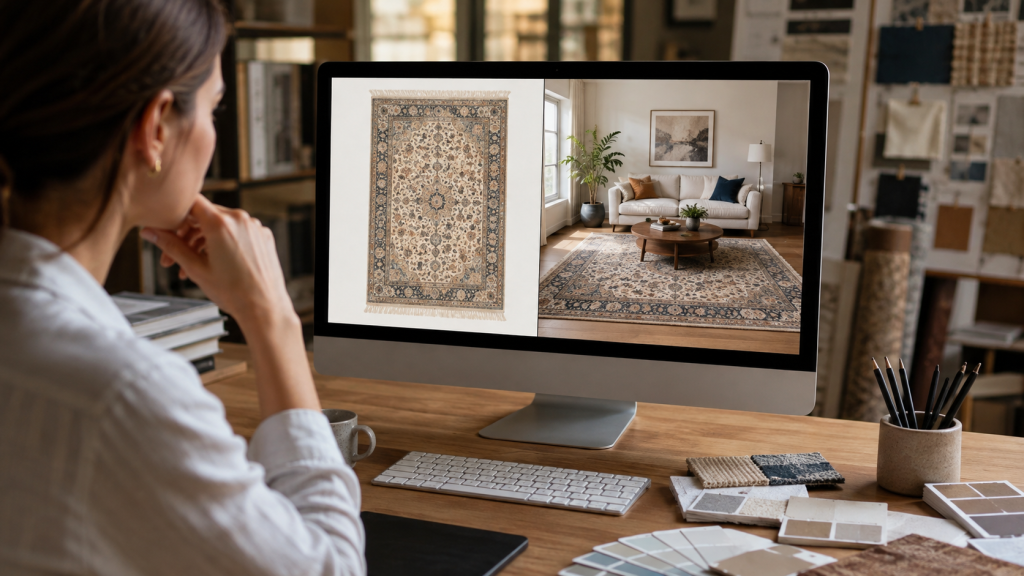
Yes, AI can generate room scenes from a rug photo that look genuinely realistic, but “accurate” is doing a lot of work in that question, and the honest answer needs a real caveat attached to it. These tools are very good at producing a believable, well-composed interior scene. They are not guaranteed to reproduce a rug’s exact pattern, color, and proportions with the same precision as an actual photograph, which is exactly why the review step before anything gets published matters as much as the generation itself.
What Room Scene Generation Actually Does
The basic idea is straightforward. A dealer uploads a photo of an actual rug, and the AI produces a new image showing that rug placed inside a styled interior, a living room, a bedroom, a hallway, without anyone setting up a physical photoshoot. The output is meant to help a shopper picture the rug somewhere real, rather than staring at a flat product photo on a plain background and trying to imagine it in their own home.
This solves a genuine problem. Professional lifestyle photography is expensive and slow, and most rug businesses, especially smaller ones, simply don’t have a library of styled room photos featuring every piece in their inventory. Generating a plausible room scene from an existing photo closes that gap in seconds instead of requiring a studio day and a stylist. A dealer with a hundred rugs in inventory and no budget for a hundred separate styled photoshoots has, until recently, had no realistic way to show each piece in context at all, which made this specific gap one of the more expensive, time-consuming parts of running a rug business online.
Where This Tends to Work Well
For general marketing purposes, AI-generated room scenes are often genuinely good enough to do their job. A few things tend to hold up reliably:
Overall composition and lighting
The generated scenes usually look like real, professionally styled rooms, with believable lighting and furniture arrangement that a viewer wouldn’t immediately flag as artificial.
Style variety
Because the AI can generate multiple interior styles from one source photo, a single rug image can be shown in several different room aesthetics quickly, which is genuinely useful for reaching different customer tastes without reshooting anything.
General proportion at a glance
For a quick visual impression, most generated scenes place a rug at roughly the right relative size in a room, enough to give someone a general sense of scale even if it isn’t measured to the inch.
Engagement value
Even an imperfect room scene tends to hold attention better than a flat product photo, which matters for marketing content that’s meant to stop someone scrolling, not serve as a technical reference document.
Where Accuracy Genuinely Gets Difficult
This is the part worth being direct about, because it’s where the caveat actually lives. AI image generation of this kind doesn’t work by literally cutting out the rug from the source photo and pasting it unchanged into a new scene. Depending on how the tool is built, it’s often closer to reconstructing a version of the rug based on what it learned from the source image, which means small details can shift in the process.
Pattern fidelity, especially on detailed or geometric designs
A rug with a complex medallion, a repeating geometric border, or fine symmetrical detail is exactly the kind of image content that generative AI tools tend to struggle with. Edges can soften, repeating elements can lose perfect symmetry, and intricate knotwork or fringe detail is often the first thing to blur or simplify in a generated scene. This is worth taking seriously for the same reason source image quality matters everywhere else in a rug listing, an idea covered in more depth in our image SEO guide, where specific, accurate visual detail is what actually helps a listing perform, not just a decent-looking photo in general.
Exact color matching
Color can drift between the source photo and the generated output, sometimes subtly, sometimes more noticeably, depending on lighting assumptions the AI makes about the new scene. A rug that reads as a warm terracotta in the original photo might come out slightly more orange or more muted once it’s placed into a differently lit generated room.
Precise scale relative to real furniture
While general proportion tends to look reasonable, exact scale, the kind a buyer would rely on to judge whether an 8×10 rug will actually fit under a specific sofa and coffee table, isn’t something these tools are built to guarantee. The room itself is generated too, which means the furniture in it isn’t a real, measured reference point.
Fine material texture
The difference between a flat-weave and a plush pile, or the subtle sheen of silk versus matte wool, sometimes flattens out in a generated scene in a way that a real photograph, even a mediocre one, tends to preserve better. A viewer scrolling quickly might not notice, but a buyer who has handled rugs before, or who’s comparing a few options closely, often will.
None of this means the technology doesn’t work. It means “accurate” needs a specific, honest definition: these scenes are visually convincing representations, not measured, color-calibrated reproductions.
Why the Review Step Matters More Than the AI Itself
This is really the core of the answer. A platform that generates content and publishes it automatically is making an implicit claim that the output is always correct, which no AI image tool can honestly promise for something as detail-sensitive as a rug. A workflow where a person reviews and approves the AI visualization tool output before it goes live is what actually closes the accuracy gap, not the generation step alone. We covered the broader shape of how the platform works in more detail elsewhere, but the short version relevant here is that nothing publishes without a person checking it first.
That review step is where a dealer catches the things that matter: does the pattern still look recognizably like the actual rug, is the color close enough not to mislead a buyer, does the scene look plausible rather than obviously synthetic. A generated scene that’s slightly off in a way nobody notices is a much smaller problem than one that gets published uncorrected and later disappoints a customer who ordered based on it.
There’s also a trust argument here that goes beyond any single image. A rug business that consistently reviews and corrects AI output before it reaches customers is building a reputation for accuracy, which matters enormously in a category where buyers are often spending real money on a piece they’ll never physically touch before it arrives. A single misleading image can cost more in a returned order and a frustrated customer than the time saved generating it in the first place. Treating the review step as a genuine quality check, rather than a formality on the way to publishing, is what actually protects that reputation over time.
When a Generated Scene Is the Right Tool, and When a Real Photo Still Wins
The honest use case matters as much as the honest limitation. For general marketing, social media content, and giving a browsing shopper a sense of style and scale, a well-reviewed AI room scene does the job well and saves real time and money compared to a full photoshoot for every piece.
For a high-value or one-of-a-kind rug, particularly an antique or hand-knotted piece where a buyer is making a significant purchase decision partly based on exact color and condition, an actual photograph still carries more weight, and probably always will. In that situation, a generated room scene works better as a supplement, giving the buyer a sense of how the piece could look styled, alongside the real, unaltered photo rather than instead of it. Being transparent about which is which, rather than presenting a generated scene as if it were a straight photograph, is part of what keeps this useful rather than misleading.
This is also a reasonable place to think about the tool as one part of a wider strategy rather than a complete answer on its own. Presentation quality is only one piece of what actually moves a rug business forward online, alongside search visibility, designer relationships, and the rest of what makes up connected growth platforms built specifically for this industry. A great room scene on a page nobody finds isn’t worth much, and a well-found page with a misleading image isn’t either.
A Simple Way to Check a Generated Scene Before Publishing It
A few minutes of comparison catches most of the issues that actually matter:
- Put the source photo and the generated scene side by side. Check whether the pattern and color still clearly match at a glance, not just in general impression.
- Look specifically at the edges and border detail. This is where distortion shows up first, particularly on rugs with fine geometric or floral motifs.
- Ask whether the color would set the right expectation. If the generated version reads meaningfully warmer, cooler, or more saturated than the real rug, that’s worth flagging before it goes anywhere near a product page.
- Get a second set of eyes if the piece is high value. Someone who didn’t generate the image is more likely to notice something that’s become too familiar to the person who did.
None of these steps take long individually, but together they turn a fast, imperfect AI draft into something a business can actually stand behind, which is really the whole point of keeping a human in the loop rather than treating the generation step as the finished product.
A Few Common Questions
Does AI-generated room imagery replace the need for real product photography?
No, it works best as a supplement, especially for showing style and context, while the actual product photo remains the accurate reference for what the rug really looks like.
Can a buyer tell the difference between a generated scene and a real photograph?
Often not at a glance, which is exactly why review matters. A convincing image and an accurate one aren’t automatically the same thing.
Is this kind of tool worth using for high-value antique rugs specifically?
It can be, for supplementary lifestyle imagery, but the primary product listing for a valuable piece should still lean on an unaltered, accurate photograph rather than a generated scene alone.
Does better source photo quality improve the accuracy of the generated result?
Generally yes. A clear, well-lit, high-resolution source photo gives the AI more accurate detail to work from, which tends to produce a closer, more reliable result than a blurry or poorly lit original.
Should a business disclose that a room scene was AI-generated?
It’s worth considering, particularly for a high-value piece. Being upfront that an image is a styled visualization rather than a straight photograph tends to build more trust than letting a customer assume otherwise and discover the difference later.
The Takeaway
AI can generate room scenes from a rug photo that look impressively realistic, and for most marketing purposes, that’s genuinely useful. But realistic and precisely accurate aren’t the same thing, particularly around pattern detail, color, and scale. The honest way to use this kind of tool is to treat the generation as a fast first draft and the review step as the part that actually determines whether what gets published is trustworthy, which matters just as much for rug business marketing as it does for any other kind of content a business puts its name on.