


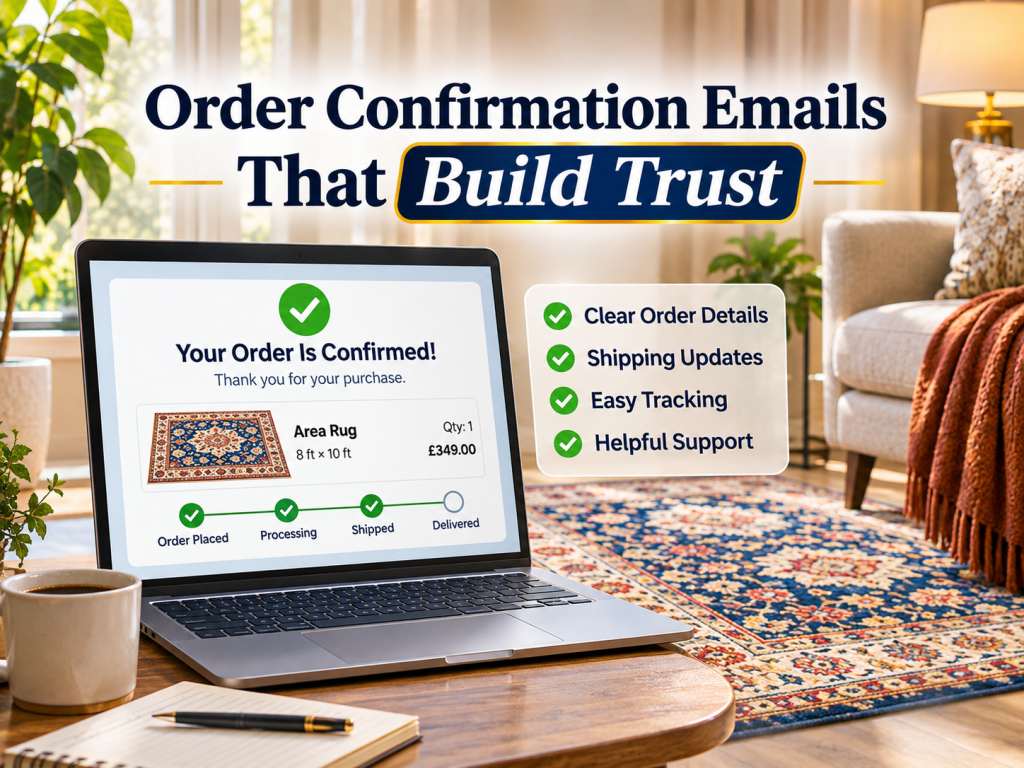
An order confirmation email arrives at one of the most sensitive moments in an ecommerce transaction. The customer has just submitted payment and is waiting for evidence that the store received the order correctly. For a rug purchase, that moment can carry more anxiety than it does for a low-cost everyday item because the order may involve hundreds or thousands of dollars, a one-of-a-kind product, oversized shipping, an unfamiliar retailer, or a purchase the customer spent days comparing before finally committing.
We therefore treat the confirmation email as part of the buying experience rather than an automated receipt that nobody needs to think about. Shopify describes an order confirmation as the digital equivalent of a receipt and recommends including the order number, customer information, item summary, cost breakdown, payment information, shipping information, and a clear support contact. Those fundamentals become even more important for rug ecommerce because the confirmation should reassure the buyer that the correct physical rug, size, delivery information, and payment details were captured.
Confirm the Order Immediately
The first trust signal is speed. When a customer completes checkout and receives no confirmation for twenty minutes, uncertainty begins quickly. They may wonder whether the payment processed, whether the page failed, or whether they accidentally need to place the order again.
We automate the message so it is triggered immediately after the ecommerce system reaches the appropriate order state. If the business does not consider payment finalized at that moment, the wording should say so clearly rather than implying that a pending transaction has already been fully accepted.
The website’s confirmation page and email should also agree. A customer who sees “Order successful” on screen but receives an email saying “We are reviewing your request” needs enough context to understand the difference.
Use a Subject Line That Removes Doubt
The subject line does not need to be clever. Its most important job is helping the buyer recognize the email quickly and understand that it relates to a completed order.
A straightforward subject such as “Order #18432 confirmed” or “Thanks for your order, here are the details” usually provides more reassurance than a promotional subject that hides the transaction behind brand language.
Shopify similarly recommends prioritizing clarity in confirmation subject lines before trying to make them entertaining. For a high-value rug transaction, we generally prefer trust and recognizability over novelty.
Put the Order Number Near the Top
The order number becomes the reference point for customer service, returns, shipping questions, and later order tracking.
We make it visible near the beginning of the message instead of hiding it at the bottom of a long template. If a customer calls the showroom or replies to the email, they should be able to find the number immediately.
The same number should match the account, warehouse, order-management system, and support tools wherever possible so the customer does not need to understand several internal identifiers.
Show the Exact Rug That Was Purchased
A rug confirmation should contain more than a generic product name when the order involves visually distinctive or one-of-a-kind inventory. We include a recognizable thumbnail, product name, size, quantity where relevant, and any variation or option the customer selected.
This allows the customer to confirm immediately that they bought the correct piece.
For unique rugs, we are especially careful with size. If the product category calls the piece “8×10″ but the actual listed measurement is 8’2″ x 10’1”, we prefer the confirmation to preserve the accurate product information rather than replacing it with a generic category size.
The confirmation becomes part of the record of what the customer believed they purchased.
Make One-of-a-Kind Status Reassuring
A customer who has just purchased a unique rug may worry that someone else can still buy it from another page, showroom, or marketplace.
When inventory systems allow it, the confirmation can reassure the customer that the order has been received and the item is being removed or reserved from active inventory according to the store’s normal process.
We avoid promising that the rug is irrevocably theirs before payment or fraud review is complete if the business’s workflow does not support that promise.
The message should match the actual inventory status rather than use generic ecommerce language that was written for endlessly replenishable products.
Confirm the Price Clearly
The customer should be able to see the product subtotal, discounts, shipping, taxes, fees where applicable, and final amount without reconstructing the order from several numbers.
Shopify recommends an itemized cost breakdown for the same reason. Clear pricing protects trust and can reduce support messages from customers trying to understand a charge on their card.
If shipping is calculated separately later for certain freight orders, we explain that clearly rather than presenting an incomplete total as though it represents the final amount.
Identify the Payment Method Without Exposing Sensitive Information
We tell the customer how the order was paid, using only the safe information provided by the payment system. That might mean identifying the payment method and the last four digits of a card where supported, or indicating that financing, store credit, or another approved method was used.
We never include full payment credentials in the email.
The purpose is simply to give the customer enough information to recognize the transaction and notice quickly if the wrong method appears.
Show the Shipping Address
A customer should be able to catch an address mistake before the rug reaches the carrier.
We display the shipping address and make it clear how to contact the business if a correction is needed. If changes are only possible before fulfillment begins, the email can mention that without using aggressive urgency.
For high-value or oversized rugs, correcting an address before shipment can save significant cost and operational complexity.
Explain What Happens Next
A confirmation email should reduce uncertainty about the period between payment and delivery.
We explain whether the order enters warehouse processing, inspection, packaging, freight scheduling, carrier pickup, or another step. If tracking will arrive in a separate email, we say so. Shopify recommends sending separate shipping confirmation once the order leaves the warehouse and including tracking information at that stage.
For handmade or one-of-a-kind rugs, the store may also perform a final inspection before dispatch. If that is part of the normal process, telling the customer can increase confidence rather than make the order feel delayed.
Set a Realistic Delivery Expectation
A vague message saying “Your order is on the way soon” does not give the customer enough information to plan.
When possible, we provide an estimated shipping or delivery window and explain when more precise tracking becomes available. If oversized rugs use freight delivery or require scheduling, the confirmation should prepare the buyer for that process.
The estimate should come from real fulfillment data rather than optimistic marketing language. Missing an promised delivery date creates more distrust than giving a realistic range from the beginning.
Explain Oversized Delivery When Relevant
Large rugs may not arrive like a small parcel. Depending on the carrier and business model, delivery may require a freight appointment, curbside service, signature, or another process.
We make those conditions visible before purchase and reinforce the important details in the confirmation email.
The confirmation should not be the first time a customer discovers a major delivery condition, but repeating it after the purchase helps the customer prepare.
Give the Customer a Clear Support Route
The confirmation email should answer the question, “Who do I contact if something looks wrong?”
Shopify recommends including clear business contact information in the order confirmation. We provide an email address, contact link, phone number, or another support path appropriate to the business.
For high-value orders, easy contact is a trust feature rather than a sign that the site failed to automate enough.
A customer who can reach the seller feels more comfortable when an issue arises.
Let Buyers Review the Return Policy Without Scaring Them
We do not need to paste the entire return policy into the confirmation email, but we make it easy to find.
For a rug purchase, the customer may want to confirm the return window, packaging requirements, or whether return shipping is their responsibility. A concise link to the appropriate policy can answer those questions without turning the confirmation into a legal document.
If the purchased item is final sale, custom, or subject to special return conditions, we want that reflected accurately rather than linking only to a generic policy that creates conflicting expectations.
Keep Transactional Information Above Promotional Content
The customer opened the email to confirm the purchase. We respect that priority.
Order number, item details, cost, shipping, address, and support appear before loyalty invitations, social links, related products, referral offers, or educational content.
Shopify notes that order confirmations can include post-purchase engagement and cross-selling, but the core confirmation information remains the primary purpose of the message. We use that hierarchy carefully because an email that looks like an advertisement before it looks like a receipt can weaken trust.
Use Cross-Sells Only When They Make Sense
A customer who purchased a rug may genuinely need a rug pad, care product, or another related item. That makes a relevant cross-sell more useful than a carousel of random rugs.
We also consider whether encouraging another rug purchase immediately after a high-value transaction makes sense. For many shoppers, it does not.
The best post-purchase recommendation reduces friction around the item they already bought rather than trying to restart the entire sales process before the first order has even shipped.
Link to Useful Care or Setup Information
Confirmation emails can help prepare the customer to receive the rug.
If the store has useful content on unpacking, flattening a rolled rug, using a rug pad, furniture placement, or care, a relevant link can reduce future support questions.
We avoid overwhelming the message with a library of articles. One or two resources connected directly to the purchased product are usually more useful.
This is a good example of how email marketing can support the customer experience rather than existing only for promotions.
Keep the Design Mobile-Friendly
Customers frequently check order confirmations on phones, often immediately after placing the purchase.
We make sure product information, totals, order numbers, and buttons remain readable on narrow screens. Shopify specifically recommends mobile optimization for confirmation emails.
A wide desktop invoice table that requires horizontal scrolling can make an otherwise professional confirmation feel unreliable.
We prefer a simple hierarchy that works even when images are blocked.
Make Sure the Email Still Works Without Images
A product thumbnail is useful, but critical information should not exist only inside an image.
Order number, price, product name, address, delivery information, and support details remain readable as text.
This also helps when email clients block remote images or customers use accessibility tools.
The message should remain understandable before any visual assets load.
Use a Recognizable From Name and Domain
A customer who has just spent thousands of dollars with a business should not receive the confirmation from an unfamiliar sender name or a generic domain they have never seen.
We use a recognizable brand identity and properly authenticated transactional email infrastructure.
This supports both trust and deliverability.
Our guide to email deliverability reinforces why authentication and sender consistency matter for business-critical email, particularly when the message includes order information customers expect immediately.
Do Not Put Marketing Consent Inside the Purchase by Assumption
An order confirmation is transactional communication. Marketing subscription is a separate relationship and can be subject to different legal requirements depending on jurisdiction.
We do not assume that purchasing a rug automatically means the customer wants every promotional campaign the store sends.
Where the business invites customers to subscribe, the consent flow should follow the appropriate rules and the customer’s actual choice.
That separation also protects engagement because the marketing list remains more focused on people who want ongoing messages.
Test the Email With Real Orders
Template preview tools are helpful, but we test actual transactions before assuming the email works.
We verify discounts, taxes, free shipping, paid shipping, multiple products, one-of-a-kind products, guest checkout, account checkout, different payment methods, different address lengths, mobile display, and special order states.
A confirmation that works perfectly for one standard order may break when a coupon or freight option changes the data structure.
We also confirm that the email arrives promptly and that the reply or support path works.
Coordinate the Confirmation Page and Email
Baymard’s checkout research treats the post-purchase confirmation page and confirmation email as connected parts of the checkout experience. We follow the same approach because both surfaces should reassure the customer and communicate the next step consistently.
The webpage can offer immediate confirmation and account-related options, while the email creates a record the customer can return to later.
If they display different totals, delivery promises, or order statuses, the result is confusion at precisely the point where trust should be strongest.
Use the Confirmation to Reduce Future Support Volume
A well-designed order confirmation does more than make customers feel good. It answers predictable questions before they become support tickets.
Where is my order number? What did I buy? What was I charged? Where is it shipping? When will it ship? How will I get tracking? What happens if the address is wrong? How do I contact the store?
If the email answers those questions clearly, the customer needs less reassurance from support.
This is especially valuable for small rug businesses where every unnecessary order-status email consumes time that could be spent on sales and fulfillment.
Measure Trust Outcomes, Not Promotional Clicks Alone
We do not judge confirmation emails only by their open rate or cross-sell revenue.
The message is successful when customers receive it reliably, find the information they need, make fewer avoidable support requests, and proceed through fulfillment with accurate expectations.
We may still measure clicks to order tracking, care guides, account creation, related products, or support.
The important point is that the confirmation email’s primary job is post-purchase confidence, not squeezing another conversion from a customer who completed one seconds ago.
Final Thoughts
An order confirmation email is one of the highest-trust messages a rug retailer sends because the customer is looking for evidence that a valuable purchase was recorded correctly. Shopify’s current best-practice guidance emphasizes immediate automated delivery, order identification, item details, cost breakdown, payment, shipping information, support, and mobile usability. Those fundamentals align closely with what high-value rug buyers need after checkout.
We build the email around reassurance first. The buyer sees the exact rug, size, order number, amount charged, delivery address, shipping expectations, and a clear route to support. Only after those questions are answered do we consider related products, loyalty, referrals, or educational content.
For rug ecommerce, trust is not finished when the payment clears. The period between checkout and delivery is part of the customer experience, and a strong confirmation email is the first opportunity to show that the store will handle that period professionally.
FAQs
What should an order confirmation email include?
We include the order number, customer information, purchased products, size or options, price breakdown, payment information, shipping address, expected fulfillment information, and a clear support contact.
How quickly should an order confirmation email be sent?
It should normally be automated and sent immediately after the ecommerce system reaches the appropriate confirmed order state so the customer does not need to wonder whether the order was received.
Should we include related products in the confirmation email?
We can, but transactional information should come first. For rugs, relevant additions such as a rug pad or care resource usually make more sense than a large generic product carousel.
Should the confirmation email include tracking?
If tracking already exists, it can be included. More commonly, we send a separate shipping confirmation when the order actually ships and the tracking information becomes available.
Can an order confirmation email replace the confirmation page?
We prefer both. The confirmation page provides immediate reassurance after checkout, while the email creates a persistent record the customer can access later.