


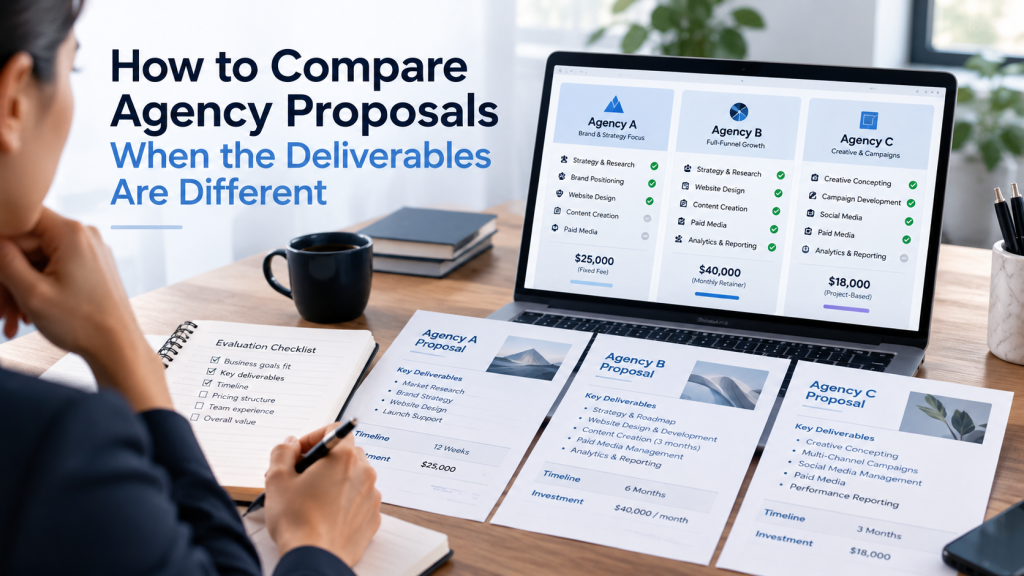
Comparing agency proposals becomes difficult when every company describes the work differently. One proposal may list forty individual tasks, another may present five strategic workstreams, and a third may focus primarily on expected business outcomes. Their prices can vary widely even when all three agencies appear to be offering website design, SEO, advertising, content, or another similar service. Looking only at the number of deliverables or the total price can therefore lead to the wrong decision.
A useful comparison begins by translating each proposal into the same set of questions. What business problem is the agency trying to solve? What work is actually included? Who will perform it? How much ongoing effort does it require? What does the client need to provide? How will progress be measured? What happens when the initial scope is completed? Once proposals are evaluated through the same framework, differences in terminology become much easier to understand.
Compare the Objective Before Comparing the Task List
Two agencies can propose very different deliverables because they are solving different versions of the problem.
Suppose a retailer says it wants more organic traffic. One agency may propose publishing eight articles per month. Another may begin with technical SEO, category optimization, internal linking, and content consolidation before recommending two articles per month. If the proposals are compared only by article quantity, the first agency appears to offer four times as much work.
That conclusion may be wrong.
The second agency may believe the site’s existing architecture is preventing strong content from performing. Its smaller publishing schedule may therefore be part of a broader plan designed to address the actual bottleneck.
Before comparing deliverables, identify the strategic reasoning behind them. An agency should be able to explain why each major activity is included and how it connects to the client’s objective.
Separate Outputs From Outcomes
A proposal may promise:
• 10 blog posts
• 50 backlinks
• 20 social posts
• 5 landing pages
These are outputs.
The business probably cares about something different, such as qualified leads, ecommerce revenue, organic visibility, appointment bookings, brand awareness, or a stronger conversion rate.
Outputs are necessary because they describe what the agency will do, but quantity alone does not determine value. Fifty weak links are not necessarily better than a smaller number of relevant links. Ten articles targeting overlapping keywords can be less useful than three carefully selected pieces supporting important commercial pages.
When evaluating a digital agency, look for the connection between the listed work and the result the business is trying to create.
Normalize the Scope Into Common Categories
When proposals use different terminology, reorganize them into a shared framework.
For a digital marketing engagement, you might compare:
| Area | Agency A | Agency B | Agency C |
|---|---|---|---|
| Strategy | Included | Included | Initial phase only |
| Technical SEO | Monthly | Quarterly | Separate fee |
| Content | 4 articles | 2 articles | Strategy only |
| On-page SEO | 10 pages | Priority pages | Not specified |
| Link building | Included | Digital PR | Separate |
| Reporting | Monthly | Dashboard + monthly | Quarterly |
| Meetings | Monthly | Biweekly | As needed |
| Development | Limited | Not included | 5 hours/month |
This does not make the proposals identical. It makes the differences visible.
You can now identify whether one agency is genuinely more expensive or simply includes services another provider has excluded.
Examine What “Included” Actually Means
A proposal can say “SEO included” without explaining whether that means keyword research, technical audits, on-page optimization, content, internal links, schema, reporting, or only basic metadata.
The same problem appears with “website design.” One agency may include strategy, wireframes, custom design, development, testing, content migration, redirects, analytics, and launch support. Another may include a prebuilt theme with five page templates.
Both may accurately call the service website design.
The proposal should therefore define deliverables at a level that makes the workload understandable. If a major service appears only as one broad line item, ask what activities sit underneath it before comparing the price with another provider.
Look at Depth, Not Just Volume
High deliverable counts can make a proposal look substantial. They can also hide a shallow process.
Imagine one SEO proposal promises optimization of 100 pages per month, while another proposes 20. The first appears stronger until you discover that its “optimization” consists of changing title tags and meta descriptions automatically, while the second includes search intent analysis, content updates, internal linking, schema review, cannibalization checks, and performance monitoring.
The same principle applies to SEO, paid media, content, design, and development. Ask what level of work sits behind each deliverable rather than treating every completed item as equivalent.
Compare Strategy and Execution Separately
Some agencies are strong strategists but outsource or minimize execution. Others are excellent production teams but expect the client to supply most of the strategic direction.
Neither model is automatically wrong.
The important question is what the business needs.
A company with an experienced internal marketing director may primarily need reliable execution. A company without internal digital expertise may need an agency that can identify priorities, develop the roadmap, coordinate specialists, and explain why decisions are being made.
Read the proposal carefully to determine whether strategic planning is included continuously or only at the beginning. A twelve-month engagement can change substantially as performance data becomes available, so a fixed task list without an optimization process may become less useful over time.
Understand Who Will Actually Do the Work
Agency presentations are often led by senior specialists, founders, or sales directors. The proposal should make it reasonably clear whether those people remain involved after the contract is signed.
Ask about the delivery team, particularly for specialized work.
Who handles technical SEO?
Who writes the content?
Who develops the website?
Who manages paid campaigns?
Who becomes the day-to-day contact?
You do not necessarily need every employee’s biography, but you should understand whether the promised expertise exists within the team responsible for execution.
This becomes particularly important when comparing a specialized agency with a generalist provider whose proposal includes a large number of unrelated services.
Compare the Work the Client Must Provide
A lower-priced proposal may require far more work from the client’s internal team.
One agency may include copywriting, page uploads, image optimization, analytics configuration, development support, and reporting. Another may provide recommendations but expect the client to implement them.
Both approaches can work.
Their costs are not directly comparable.
If internal employees must spend fifteen hours per month implementing the cheaper agency’s recommendations, include that cost when evaluating the proposal. If the company does not have the necessary technical resources, recommendations that are never implemented have very little value.
This is especially relevant for website projects because design, development, content, migration, tracking, and launch responsibilities can be distributed very differently between agencies.
Check What Is Explicitly Excluded
The exclusion section often explains pricing differences more clearly than the deliverables.
A proposal may exclude:
• Development hours
• Premium plugins
• Hosting
• Paid media spend
• Photography
• Content writing
• Landing page development
• Translation
• Tracking implementation
• Merchant Center management
• CRM work
If those services will be required later, estimate the likely additional cost before choosing the proposal.
A lower initial fee can become the most expensive option when essential components are charged separately after the project begins.
Understand Revision and Change Limits
Website, design, content, and development engagements often include revision limits. An agency may include two design rounds, while another allows iterative refinement within a defined project phase.
Neither approach is inherently better, but the client should understand the consequence.
Unlimited revisions can sound attractive but may indicate an undefined process. Extremely restrictive revision limits can create additional charges quickly.
A strong proposal explains how feedback is collected, what counts as a revision, and what happens when the client requests work outside the agreed scope.
Compare Reporting Based on Decisions, Not Document Length
A twenty-page monthly report is not automatically better than a five-page one.
Good reporting should show what changed, why it matters, what the agency learned, and what it plans to do next.
For SEO, relevant reporting might include organic clicks, impressions, conversions, rankings, high-opportunity queries, important landing pages, technical progress, and content performance. For paid media, the metrics and decision framework will be different.
If an agency promises reporting, understand whether the report is simply exported from tools or whether someone interprets the results and adjusts the strategy.
The value comes from the decisions generated by the data.
Evaluate Communication and Meeting Structure
An agency can deliver strong technical work and still create a frustrating client relationship if communication expectations are unclear.
Review how frequently meetings occur, who attends, which channels are used for day-to-day communication, and how quickly routine questions are normally addressed. Also determine whether meetings are strategic discussions or simply status updates that repeat information already available in project-management software.
More meetings are not automatically better. The goal is enough communication to make decisions efficiently without consuming unnecessary time for either team.
Compare Ownership of Accounts and Assets
The proposal should make clear who owns the website, advertising accounts, analytics properties, creative files, source code, content, domains, tracking configurations, and other digital assets.
Where practical, business-critical accounts should remain under the client’s ownership while the agency receives the access required to perform its work.
This becomes particularly important when the relationship ends. A client should not discover that the website, advertising history, or analytics data cannot be transferred because those assets were created entirely under accounts controlled by the agency.
A professional digital strategy should increase the business’s capabilities rather than creating unnecessary dependence.
Review Contract Length and Exit Terms
A six-month proposal and a month-to-month proposal are not equivalent even if their monthly costs are similar.
Longer contracts can make sense when the work requires sustained execution, especially with SEO, content, or complex development. However, the client should understand renewal terms, notice periods, early termination rules, and what happens to unfinished work.
Also check whether deliverables are tied to the monthly billing cycle or the entire contract. If a twelve-month agreement includes a major technical project only in the first month, the ongoing monthly value should still be understandable after that phase is complete.
Consider What Happens After the Initial Work
A proposal should explain what the relationship looks like after the initial setup or build.
For a website project, who maintains the site after launch?
For an SEO project, how does strategy change after priority pages have been optimized?
For paid advertising, who creates new landing pages or creative assets when performance data reveals a need?
For custom development, who handles bugs, updates, and new features?
This is particularly important for a company evaluating a long-term agency rather than a one-time vendor.
Use a Weighted Comparison Instead of Choosing the Longest Proposal
A practical comparison can assign importance to the areas that matter most to the business.
For example:
| Factor | Weight |
|---|---|
| Strategic fit | 25% |
| Relevant expertise | 20% |
| Scope quality | 20% |
| Communication | 10% |
| Measurement | 10% |
| Implementation support | 10% |
| Price | 5% |
The percentages will differ by business, but the principle is useful. Price becomes one factor rather than the only factor.
An agency does not become the best choice simply because it delivers the largest number of individual line items.
Be Careful With Guaranteed Outcomes
Marketing and SEO proposals sometimes attempt to stand out by guaranteeing rankings, traffic levels, lead volume, or another outcome that the agency does not fully control.
A stronger proposal explains targets, assumptions, measurement methods, and the work intended to improve performance without pretending that external platforms can be controlled completely.
Website and development proposals can make firmer commitments about deliverables the agency directly controls, but even those should distinguish between building a feature and guaranteeing how customers will behave after launch.
Final Thoughts
Agency proposals should be compared based on strategic value, depth of work, implementation responsibilities, team capability, measurement, and total cost rather than simply counting deliverables.
Begin by identifying the business objective and then translate each proposal into common categories. Determine what each agency actually means by SEO, content, design, development, reporting, or strategy. Review what is excluded, who performs the work, how communication operates, what the client must implement internally, and who owns the resulting assets.
A proposal with fewer line items can be stronger if those activities address the real business problem. A longer proposal can still be valuable when its additional deliverables genuinely contribute to the objective.
The goal is not to choose the agency that appears busiest on paper. It is to choose the team whose scope, process, expertise, and working model give the business the clearest path from its current position to the result it is trying to achieve.
FAQs
Should I choose the agency offering the most deliverables?
Not automatically. Evaluate the depth, relevance, and strategic purpose of the deliverables rather than the quantity alone.
How can I compare proposals with different scopes?
Reorganize each proposal into common categories such as strategy, content, SEO, development, reporting, communication, and implementation support.
Should price be the main comparison factor?
Price matters, but it should be considered alongside scope, expertise, strategic fit, internal resource requirements, and expected long-term value.
What should I check in the exclusions?
Look for services that may still be required, including development, content, hosting, paid software, tracking, photography, and advertising spend.
Does a longer proposal mean a better agency?
No. Proposal length reflects presentation style as much as service quality. Focus on whether the proposed work addresses the actual business problem.
Who should own marketing and website accounts?
Where practical, core business assets should remain under the client’s ownership while the agency receives appropriate access to perform the work.