
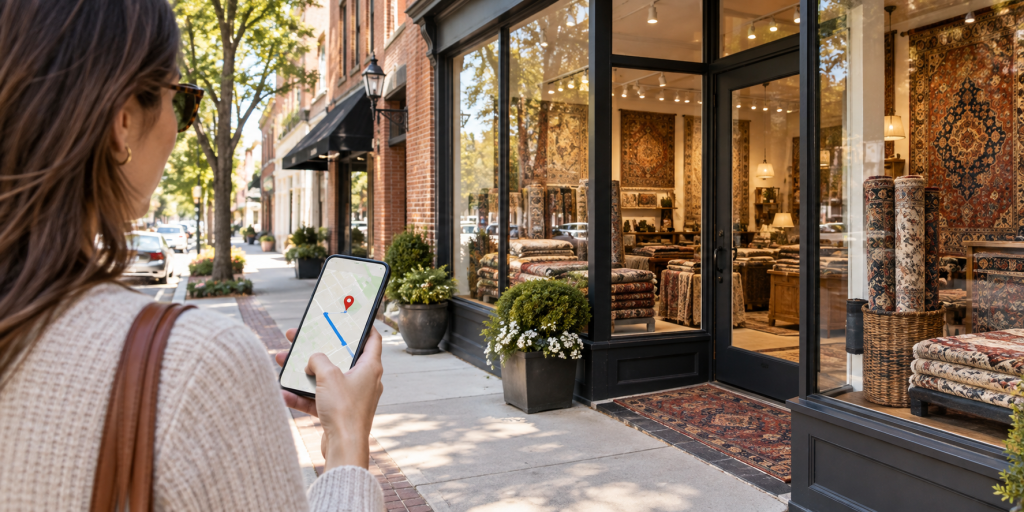
A customer who searches for “rug store near me” is very different from someone casually reading about interior design.
The first person may already be thinking about visiting a showroom, comparing rugs, checking prices, or contacting a dealer. They may be only a few miles away from the business and ready to take action.
That makes local SEO one of the most valuable digital marketing opportunities for independent rug stores.
Large online retailers can compete aggressively for national searches such as area rugs, living room rugs, or wool rugs. They have massive websites, advertising budgets, and product catalogs. However, an independent rug store has an advantage those companies cannot always reproduce: a real showroom, local knowledge, personal service, and the ability to help customers see rugs in person.
Local SEO helps turn that advantage into online visibility.
When someone searches Google for a rug store, handmade rugs, Persian rugs, Oriental rugs, rug cleaning, antique rugs, or other local services, Google may display nearby businesses in Maps and local search results. A well-optimized rug store has a better opportunity to appear where those buyers are already looking.
A strong rug marketing strategy should therefore treat local search as more than a ranking exercise. The goal is to create a clear path from search to phone call, website visit, directions request, showroom appointment, and eventually a sale.
Why Local SEO Matters So Much for Rug Stores
Rugs are products that many customers still prefer to evaluate in person.
A customer may start online, but they often want to see the true color, touch the material, examine the construction, compare different sizes, and understand how a rug might work in their room.
That gives physical rug stores a major local advantage.
Someone searching for a local rug business may already be close to making a decision. They are not simply researching what a rug is. They may be deciding which showroom to visit this weekend.
Local SEO helps your business appear during that moment.
The stronger your local presence becomes, the easier it is for nearby customers to discover your showroom without already knowing your business name.
What Is Local SEO for a Rug Store?
Local SEO is the process of improving a business’s visibility when people search for products or services within a specific geographic area.
For a rug store, this means appearing for searches connected to rugs and location.
A customer might search for a rug showroom in their city, Persian rugs nearby, handmade rugs near them, antique rug dealers, rug cleaning, rug repair, or luxury rug stores.
Google uses several signals to decide which local businesses to display. These signals include relevance to the search, location, business information, website content, reviews, links, and other indicators of local authority.
The objective is therefore not to manipulate one ranking factor. It is to make the entire online presence clearly communicate what the business offers, where it operates, and why it is relevant to local customers.
Google Business Profile Is the Foundation
For many local rug stores, Google Business Profile is one of the most important digital assets.
A potential customer may see the business in Google Maps before visiting the website. They may check the rating, opening hours, photographs, phone number, location, directions, and website link directly from the profile.
That means the profile needs to create confidence immediately.
A rug showroom should keep its business name, address, phone number, website, hours, categories, and service information accurate. Photographs should represent the real showroom and inventory rather than relying only on logos or generic images.
A customer comparing three nearby rug stores may choose one based entirely on which profile looks more active, credible, and useful.
Local SEO begins with making that profile as complete and trustworthy as possible.
Use the Correct Business Information Everywhere
Business information should remain consistent across the web.
If the website displays one phone number while an older directory listing shows another, that creates confusion. If Google lists the showroom at an old address, the problem becomes even more serious.
Your main business information should match across the website, Google profile, social accounts, directories, and relevant industry listings.
This includes the official business name, physical address when applicable, phone number, website, and opening hours.
Consistency helps customers and reduces unnecessary uncertainty around the business.
Create a Strong Location Page
A rug store should not rely only on its homepage for local relevance.
A dedicated location or showroom page gives Google and customers clearer information about the business.
The page should describe the actual showroom, the types of rugs available, the neighborhoods or nearby areas genuinely served, store hours, contact details, appointment options, parking information, delivery services, and directions.
Real photographs are extremely valuable here.
Customers should be able to see the storefront and showroom before visiting.
A strong location page can also explain the shopping experience. For example, customers may be able to compare several rugs, receive sizing guidance, bring photos of their room, or schedule private appointments.
This makes the page more useful than a simple map and address.
Target Local Search Intent
One of the biggest local SEO mistakes is focusing only on a single keyword.
People search for rug businesses in many different ways.
Someone who knows exactly what they want may search for a Persian rug store. Another buyer may search for a rug showroom. A homeowner may look for handmade rugs, while an antique collector may search for an antique rug dealer.
Your website should reflect the real services and inventory available.
The homepage can explain the broader business, while product, service, and location pages can address more specific customer needs.
A professional SEO strategy should map these search intents to the right pages instead of trying to force every keyword onto one page.
Do Not Create Fake Location Pages
A common SEO tactic is creating many city pages even when the business does not actually operate in those locations.
For example, a company might produce nearly identical pages for Dallas, Plano, Frisco, Arlington, and dozens of nearby cities while changing only the city name.
That approach provides little value to customers.
If a rug showroom genuinely serves several nearby communities, it can discuss those service areas naturally. But the business should not pretend to have physical locations where none exist.
Strong local SEO is built on useful local relevance, not artificial geographic expansion.
Build Product Pages That Support Local Search
A local rug store still needs strong product and collection pages.
Customers who discover the business through Google Maps may visit the website before deciding whether to make the trip.
They want to know whether the showroom actually carries rugs they are interested in.
A rug store may have dedicated pages for Persian rugs, handmade rugs, wool rugs, antique rugs, vintage rugs, modern rugs, runners, oversized rugs, or custom rugs.
Each page should explain what the customer can expect rather than showing only a gallery of images.
The content can discuss materials, construction, available sizes, typical styles, showroom availability, and how customers can receive help choosing.
The goal is to connect product interest with a local shopping opportunity.
Show Real Rug Inventory
One of the strongest ways to encourage local visits is showing real inventory.
Customers may not expect every piece to be available online, especially when the showroom sells one-of-a-kind rugs. However, they still want evidence that visiting the store will be worthwhile.
The website can display representative inventory while explaining that availability changes regularly.
A customer browsing handmade rugs should be able to see enough examples to understand the quality, style, and price positioning of the store.
If the website appears empty or outdated, customers may assume the showroom has limited inventory.
Use Local Content Instead of Generic Content
Local content can help a rug business become more relevant to the market it actually serves.
Instead of publishing only broad topics such as “How to Choose a Rug,” consider content that connects rug expertise with local customer needs.
For example, a store in a city with many older homes may publish guidance on rug sizing for historic properties. A store serving large suburban homes may discuss oversized rugs for open-plan living rooms. A business in a design-focused market may publish guides for interior designers.
The content should always be useful first. Adding a city name to a generic article does not automatically make it valuable.
Local knowledge is what creates differentiation.
Reviews Can Influence Local Discovery and Trust
Reviews play an important role in how customers evaluate local rug businesses.
A potential buyer may compare several stores and look for signs that previous customers had good experiences.
Detailed reviews can provide information that a business cannot communicate as convincingly by itself.
Customers may mention rug selection, staff knowledge, sizing help, delivery, pricing, designer service, cleaning, or the overall showroom experience.
These details make the reviews useful to future buyers.
Rug stores should develop a consistent process for requesting genuine reviews after positive customer experiences.
The goal is not simply accumulating a large number of reviews. The quality and relevance of the customer experience matter too.
Respond to Reviews Professionally
Review management should not end when the customer posts the review.
Responding shows that the business pays attention to customer feedback.
A short, professional response can thank the customer and acknowledge the experience without repeating unnecessary details.
If a customer leaves criticism, the response should remain professional and helpful.
Potential buyers may judge the business partly by how it handles difficult situations.
Use Better Showroom Photography
Google Maps and local search are highly visual.
A rug store should show customers what they will experience before they arrive.
Useful images include the storefront, entrance, showroom floor, hanging rugs, rug stacks, styled room displays, close-up rug details, large-format rugs, and different parts of the store.
Images should be clear, current, and realistic.
Avoid using exactly the same generic image repeatedly.
Customers want evidence of a real business with real products.
This is especially important for high-value rug stores because buyers may hesitate to visit an unfamiliar showroom.
Optimize the Website for Mobile Visitors
Local searches frequently happen while customers are using smartphones.
A potential visitor may be sitting in a car, walking nearby, or researching several local businesses before deciding where to go.
The website must therefore work well on mobile devices.
The phone number should be easy to tap. Directions should be accessible. Opening hours should be clear. The appointment form should be simple. Product photos should load quickly.
A difficult mobile experience can reduce both local rankings and customer conversions.
Make Directions Easy to Find
A rug store should never make customers search for directions.
The website should clearly display the full location and provide an easy route to the map.
If parking is confusing, explain where customers should park.
If the showroom is located inside a shopping center, warehouse district, design center, or commercial building, provide instructions that make arrival easier.
Small details like these can have a major impact on whether an online visitor actually becomes a showroom visitor.
Connect Local SEO With Showroom Appointments
Local SEO is most valuable when it produces real customer activity.
A person finds the business on Google, checks the profile, browses the website, sees the showroom, reads reviews, explores available rugs, and then schedules a visit.
That journey should be intentional.
The website can provide a clear appointment option on the location page, product pages, and contact page.
A good website design should make that path simple without overwhelming the visitor with too many calls to action.
Build Local Backlinks
Local backlinks can strengthen a rug store’s connection to its community.
Opportunities may come from local interior designers, chambers of commerce, home design publications, community organizations, business associations, furniture companies, real estate professionals, and local media.
The best links usually come from real relationships.
For example, if a rug showroom collaborates with an interior designer on a project, the designer may naturally mention the showroom on a project page.
A local design publication may cover a new showroom opening.
A community organization may list business members.
These links are useful because they reflect genuine local connections.
Industry Links Can Help Too
Local visibility does not mean ignoring industry authority.
A rug business can also benefit from relevant rug and interior design publications, directories, supplier relationships, and professional associations.
A mention from an industry website can reinforce the business’s expertise while local links reinforce geographic relevance.
Combining both creates a stronger overall digital presence.
Build Relationships With Interior Designers
Interior designers can influence both referrals and local awareness.
A designer may send several clients to the same showroom over time.
The rug store should make it easy for local designers to understand the available inventory, trade benefits, appointment options, delivery services, custom rugs, and sourcing support.
A designer program can also lead to legitimate local links, social mentions, project features, and word-of-mouth discovery.
These relationships support marketing beyond traditional SEO.
Create Local Partnership Content
Partnerships can also create useful content.
A rug store might collaborate with a local designer on an educational article about rug placement. A furniture showroom could feature a rug collection inside a styled room. A home builder might discuss how rugs help define open living spaces.
These collaborations create additional discovery opportunities while showing customers how the products work in real local homes.
Use Schema Markup Properly
Structured data can help search engines understand business information.
A local rug store may use appropriate business schema to clarify details such as business name, website, address, telephone number, opening hours, and other relevant information.
Schema should match visible website content.
It should not be used to create information that customers cannot actually see.
Technical improvements like this are most effective when combined with a strong overall local presence rather than treated as shortcuts.
Local SEO and Google Ads Can Work Together
Organic local visibility takes time to build.
Paid search can support the same geographic strategy while SEO develops.
A rug store can target searches from nearby buyers who are actively looking for rug stores, handmade rugs, Persian rugs, antique rugs, or specific services.
A focused Google Ads campaign should use geographic targeting and relevant landing pages.
Someone searching for Persian rugs should land on a page that clearly discusses Persian rugs and the local showroom.
Someone searching for a rug showroom should see the store location, hours, photos, and appointment option immediately.
Paid advertising and local SEO should reinforce each other.
Track Calls From Local Search
Phone calls are often an important conversion for local rug businesses.
A customer may not complete a form. They may simply call and ask whether a certain rug size is available.
Those calls should be tracked as part of local marketing performance.
The business should know which campaigns, pages, and search channels generate meaningful phone inquiries.
Otherwise, local SEO may appear less valuable than it actually is.
Track Direction Requests
Direction requests are another strong local signal.
A customer who requests directions may be much closer to making a purchase than someone who simply views a blog article.
Google Business Profile performance and website analytics can help the business understand how customers interact with location information.
These actions should be reviewed alongside appointments and sales.
Track Showroom Revenue
Ultimately, rankings are not the final goal.
Revenue is.
A rug business should try to understand where showroom customers originally discovered the company.
The sales team can ask customers how they found the store and record that information in a CRM.
Over time, the business may discover that Google Maps produces more high-value showroom customers than social media, or that organic searches bring more designer appointments than paid ads.
That information can guide future marketing investment.
Local SEO for Multiple Rug Showrooms
Businesses with multiple legitimate showrooms need a more structured approach.
Each physical location should have accurate business information and its own useful page.
The content should reflect what is genuinely different about that showroom.
This can include inventory focus, local photographs, parking, staff, nearby service areas, delivery options, contact details, and customer reviews.
Do not duplicate the same page across every city.
Each physical location deserves its own useful local experience.
Local SEO for Rug Cleaning and Repair
Not every rug business relies only on retail sales.
Cleaning, repair, restoration, and appraisal services can also generate strong local search demand.
These services should have dedicated website pages when they are genuinely offered.
A customer searching for rug repair has different intent from someone shopping for a new area rug.
The page should therefore explain the service, process, geographic coverage, and how the customer can request help.
Combining every service onto a single homepage can make ranking and conversion more difficult.
Local SEO for Antique Rug Dealers
Antique and specialty rug dealers can use local SEO differently from general rug stores.
Their customers may care more about expertise, provenance, condition, handmade construction, and consultation.
The local page should therefore emphasize specialist knowledge as well as location.
Show real antique inventory, educational content, professional background, and relevant customer reviews.
A customer seeking an antique rug specialist is often choosing expertise, not simply the closest store.
Local SEO for Luxury Rug Showrooms
Luxury rug buyers may expect a more premium customer journey.
Local visibility still matters, but presentation becomes especially important.
The website should communicate professional service, high-quality inventory, private appointments, designer relationships, custom sourcing, delivery, and expertise.
Photography should match the positioning.
A luxury showroom with weak mobile design, blurry photographs, or unclear opening information can lose credibility before the customer ever visits.
Do Not Forget Email Follow-Up
Local SEO brings the customer into the funnel, but not every visitor will purchase immediately.
Someone may book a showroom appointment and then wait several weeks before deciding.
Email can help maintain that relationship.
A simple email marketing system can send appointment confirmation, reminders, product information, new arrivals, and post-visit follow-up.
The objective is not to overwhelm the customer.
The objective is to stay helpful while they make their decision.
What Local SEO Success Should Look Like
Successful local SEO should create more than higher rankings.
A rug store should see stronger visibility among nearby customers and more meaningful interactions with the business.
That can include increased phone calls, directions requests, product inquiries, appointment bookings, showroom visitors, designer inquiries, and sales.
The most important metrics will vary by business model.
A showroom should focus heavily on visits and appointments.
A rug cleaning company may prioritize calls and service requests.
A luxury dealer may care more about qualified consultations than total traffic.
The strategy should be measured according to what actually produces revenue.
Common Local SEO Mistakes Rug Stores Make
One common mistake is focusing only on the Google Business Profile while ignoring the website. The two should support each other.
Another problem is publishing identical city pages that provide no useful local information.
Some rug stores also fail to update opening hours, inventory images, or contact information, which can frustrate customers.
Weak mobile performance is another frequent issue. A customer searching locally should be able to call, find directions, and browse inventory easily.
Finally, businesses sometimes focus too heavily on rankings. Ranking first is useful, but if the website does not build trust or encourage a visit, the ranking alone does not create a sale.
A Practical Local SEO Strategy for Rug Stores
The first priority should be accuracy. Make sure business information is consistent across Google, the website, directories, and social profiles.
Next, improve the Google Business Profile with current hours, categories, real showroom photographs, services, and customer reviews.
Then strengthen the website. Create a useful local page, improve product and service pages, add relevant local content, make contact information easy to find, and ensure the mobile experience works properly.
After that, focus on authority. Build local partnerships, develop relationships with designers, seek relevant industry mentions, and create content that genuinely serves the local customer.
Finally, measure actual customer behavior. Track calls, forms, appointments, directions, showroom visits, and sales.
That creates a complete local growth system rather than a collection of isolated SEO tasks.
Final Thoughts
Local SEO gives independent rug stores an opportunity to compete where national retailers are often weakest.
A large online marketplace can offer thousands of rugs, but it cannot always provide a nearby showroom where customers can compare colors, touch materials, speak with a rug specialist, discuss room measurements, and receive personal guidance.
Google Search and Maps can connect local buyers with that experience.
The objective is not simply to appear for “rug store near me.”
The objective is to make the entire customer journey work.
A buyer discovers the business in Google Maps. They see professional photographs and strong reviews. They visit the website and find relevant inventory. They understand the store’s expertise. They check the address and opening hours. They schedule a showroom appointment or request directions.
Then they walk through the door.
That is what successful local SEO should accomplish for a rug business.
When Google Business Profile, local pages, product content, reviews, photography, technical SEO, paid advertising, designer partnerships, and showroom conversion work together, the store becomes easier to find and easier to trust.
For independent rug businesses, that combination can become one of the most reliable ways to turn online search demand into real local customers.
FAQs
What is local SEO for rug stores?
Local SEO for rug stores is the process of improving visibility in Google Search and Maps for customers searching for rug businesses, products, and services within a specific geographic area.
Why is Google Business Profile important for rug stores?
Google Business Profile helps nearby customers discover the showroom, see reviews, check hours, view photographs, call the business, visit the website, and request directions.
How can a rug store rank for “rug store near me”?
The business should maintain accurate local information, optimize Google Business Profile, build a strong website, earn genuine reviews, create useful local content, and strengthen relevant local authority.
Should rug stores create city pages?
City pages can be useful when the business genuinely serves those areas and can provide unique, helpful local information. Avoid creating large numbers of nearly identical pages.
Do customer reviews help local rug marketing?
Yes. Reviews can increase customer confidence and provide useful information about showroom experience, product quality, service, and staff expertise.
Should rug stores show inventory online?
Yes. Showing representative inventory can help customers understand what the showroom offers and increase confidence that visiting the store will be worthwhile.
Can Google Ads support local SEO?
Yes. Google Ads can capture immediate high-intent local searches while organic local visibility develops. Paid and organic strategies can work together.
What local SEO metrics should rug stores track?
Important metrics include local organic traffic, phone calls, direction requests, contact forms, showroom appointments, completed visits, designer inquiries, and revenue generated from local customers.
Does a rug store need a separate showroom page?
Yes. A dedicated showroom or location page can provide address information, store hours, photographs, inventory details, parking information, directions, appointment options, and local FAQs.
How long does local SEO take?
Results depend on competition, website quality, existing authority, reviews, location, and market conditions. Local SEO should be treated as an ongoing growth strategy rather than a one-time task.