


Most rug businesses understand what a marketing agency does. An agency may help with SEO, ads, social media, website design, content, or email campaigns. For many rug stores, that support can be useful. But the rug industry is changing, and many dealers now need more than a single marketing service.
A rug business does not only need traffic. It needs visibility, trust, qualified leads, better product presentation, stronger industry positioning, and long-term customer relationships. That is where the idea of a growth ecosystem becomes important.
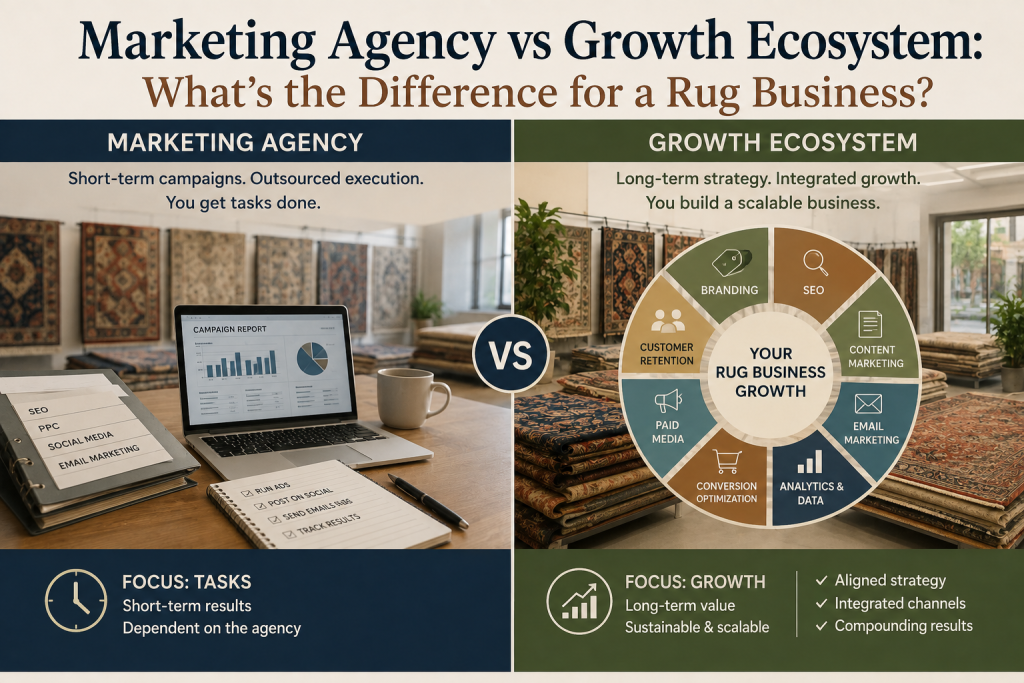
A traditional agency usually works as a service provider. A growth ecosystem works as a connected system. It brings together media, search visibility, directory placement, lead generation, automation, content, and buyer education so rug businesses can grow from more than one direction.
For rug dealers, showrooms, importers, wholesalers, and online retailers, this difference matters. The business that wins online is often not the one using one isolated tactic. It is the one building a connected presence across search, content, industry platforms, customer follow-up, and sales channels.
What Is a Marketing Agency?
A marketing agency is a company that provides marketing services to help a business get more attention, traffic, leads, or sales. For a rug business, that may include SEO, Google Ads, website design, Meta Ads, email marketing, social media, content writing, or local SEO.
A rug dealer may hire an agency to rank better on Google, improve a website, run ads, write blogs, or get more showroom inquiries. This can be helpful, especially when the business does not have an internal marketing team.
A good agency can improve visibility and save time. It can help a rug store build better pages, target better keywords, fix technical SEO problems, create ads, and improve lead tracking.
But a typical agency often works inside one service lane. One team may handle SEO. Another may handle paid ads. Another may work on social media. Even when the agency offers many services, the work may still depend only on the client’s website and ad budget.
For rug businesses, that can create a limit. If the market is competitive and buyers need trust before contacting a dealer, normal marketing services may not be enough by themselves.
What Is a Growth Ecosystem?
A growth ecosystem is a connected group of platforms, tools, content channels, and services that work together to support business growth. Instead of depending only on one website or one campaign, the ecosystem creates multiple ways for a rug business to be discovered, trusted, and contacted.
For the rug industry, this may include an industry publication, a business directory, educational content, lead generation systems, AI tools, marketing services, email follow-up, and marketplace visibility.
A growth ecosystem is not only about getting clicks. It is about creating an environment where rug businesses can build authority, attract qualified buyers, connect with trade partners, and stay visible across different stages of the buyer journey.
This is why Danabak’s rug marketing approach is different from a one-time campaign. A rug business needs visibility from search, trust from content, discovery from industry platforms, and follow-up systems that turn interest into real conversations.
Why Rug Businesses Need More Than Basic Marketing
Rug buying is not the same as buying a low-cost everyday product. Many customers take time before making a decision. They compare colors, sizes, materials, room layout, price, origin, construction, and seller trust.
A homeowner may browse online first, then visit a showroom later. An interior designer may need trade-friendly sourcing. A collector may want origin and condition details. A wholesale buyer may need reliable supplier information. A local customer may search Google Maps before choosing a showroom.
This means the rug business has to appear in more than one place and answer more than one kind of question.
A basic marketing campaign may bring traffic, but a growth ecosystem can support the full journey. It can help people discover the brand, understand the products, trust the business, compare options, and take the next step.
Marketing Agency vs Growth Ecosystem
The difference becomes clearer when both models are compared side by side.
| Area | Typical Marketing Agency | Growth Ecosystem |
|---|---|---|
| Main role | Provides marketing services | Builds a connected growth system |
| Focus | Campaigns, rankings, ads, content | Visibility, trust, leads, authority, and retention |
| Channel use | Usually client website and ad platforms | Website, industry media, directory, tools, content, and lead systems |
| Rug industry context | May need learning time | Built around rug-specific needs |
| Lead generation | Often depends on forms and ads | Uses multiple discovery and trust points |
| Buyer education | Usually blog or service content | Content, guides, industry resources, and platform visibility |
| Authority building | SEO and backlinks | Search presence, industry presence, directory presence, and content authority |
| Long-term value | Depends on ongoing service | Builds a reusable business asset |
| Best for | Businesses needing one service | Businesses wanting scalable growth |
A marketing agency can be useful when a rug business needs a specific service. A growth ecosystem is stronger when the business wants a more complete structure for long-term growth.
The Problem With Single-Service Marketing
Many rug businesses try one service at a time. They may run ads for a few months, then stop. They may publish blogs without improving the website. They may invest in SEO but ignore email follow-up. They may build a beautiful website but fail to capture leads.
This creates gaps.
- Traffic without trust does not convert well.
- Ads without landing pages waste money.
- Blogs without internal linking do not support service pages.
- Leads without follow-up go cold.
- Directory visibility without a strong profile may not bring results.
- A website without authority can struggle to rank.
A single-service agency may fix one part of the problem, but the other gaps remain. Rug businesses need connected marketing because customers do not move in a straight line.
How a 5-Platform Growth Model Helps
A 5-platform growth model gives rug businesses a wider foundation. Instead of relying on one marketing channel, it connects several platforms that support different parts of the customer journey.
The first platform may focus on industry media and educational content. This helps build authority and supports search visibility.
The second platform may focus on directory listings. This helps rug businesses appear where buyers, designers, and trade contacts are searching for trusted providers.
The third platform may focus on marketplace or product discovery. This can help rugs, collections, or business profiles reach more qualified audiences.
The fourth platform may focus on AI, automation, or sales support. This can help organize leads, improve follow-up, and make business operations more efficient.
The fifth platform may focus on marketing execution. This includes SEO, website improvement, paid ads, content strategy, and customer acquisition.
Together, these platforms create a stronger system than a single campaign. A rug business can be discovered through content, trusted through industry presence, contacted through lead systems, and supported through marketing execution.
Why Industry Authority Matters
Authority is very important in the rug business. Customers often want to know whether a dealer understands handmade rugs, antique rugs, Persian rugs, Oriental rugs, cleaning, restoration, sizing, and design use.
A regular website can say that a business is experienced, but an ecosystem can show it through content, directory presence, educational resources, and industry participation.
For example, a rug dealer listed in a relevant industry directory may look more credible than a business that only has a basic website. A dealer featured in educational content or connected to industry resources may appear more trustworthy to buyers and designers.
This is where a directory listing can support credibility, discovery, and referral opportunities.
Why SEO Still Matters Inside an Ecosystem
A growth ecosystem does not replace SEO. It makes SEO stronger.
Search engines need clear content, strong website structure, useful pages, topical authority, internal links, and trusted signals. A rug business still needs optimized service pages, category pages, location pages, blogs, and technical SEO.
The difference is that SEO inside an ecosystem is not isolated. Content can support directory profiles. Directory pages can support discovery. Educational articles can answer buyer questions. Marketing pages can turn visitors into leads.
For rug businesses, SEO should connect with the wider growth system instead of standing alone.
Why Lead Follow-Up Is Part of Growth
Many rug businesses lose leads after the first contact. A visitor may fill out a form and never receive a strong follow-up. A designer may ask about inventory and never get added to a trade list. A past customer may buy one rug and never hear from the business again.
A growth ecosystem should include lead nurturing. This means the business has a system for staying in touch with homeowners, designers, collectors, showroom visitors, and past buyers.
Email, CRM, automation, and retargeting can help keep leads warm. This is especially useful because rug purchases often take time.
A business that follows up well can turn more inquiries into sales without always needing more traffic.
When a Marketing Agency Is Enough
A traditional agency may be enough if the rug business has a simple need. For example, a dealer may only need a website redesign, a Google Ads campaign, or a few SEO fixes.
An agency can also be a good fit when the business already has strong brand authority, strong operations, and a clear sales process. In that case, a single service may be enough to improve performance.
A marketing agency is also useful for short-term campaigns, seasonal promotions, technical support, and content production.
The problem begins when the business expects one service to solve every growth problem.
When a Growth Ecosystem Is Better
A growth ecosystem is better when the rug business wants to build long-term visibility and not depend on one channel.
It is especially useful for:
- Rug dealers who want stronger online authority
- Showrooms that want more qualified visitors
- Importers who want trade visibility
- Wholesalers who want designer or retailer attention
- Rug brands that need content and discovery
- Businesses selling handmade, antique, or luxury rugs
- Companies that want better lead follow-up
- Dealers competing against larger online retailers
A growth ecosystem is also helpful when the rug business serves different audiences. Homeowners, designers, collectors, and trade buyers may all need different messages and discovery paths.
What Rug Businesses Should Look For
Before choosing between an agency and a growth ecosystem, rug businesses should ask what kind of growth they need.
If the business only needs one service, a traditional agency may work. If the business needs stronger search visibility, better trust, industry positioning, lead generation, customer follow-up, and long-term authority, an ecosystem model may be stronger.
Important questions include:
- Does the business need more traffic or better leads?
- Does the website explain products clearly?
- Are designers and trade buyers being reached?
- Does the business appear in industry spaces?
- Are leads followed up automatically?
- Is content supporting service and product pages?
- Is the brand building authority over time?
The right model depends on the gap. But for many rug businesses, the real problem is not just marketing activity. It is disconnected marketing.
Final Thoughts
A marketing agency and a growth ecosystem are not the same thing. A marketing agency usually provides services. A growth ecosystem creates a connected structure for visibility, trust, lead generation, education, and long-term business growth.
For rug businesses, this difference matters because the buying journey is complex. Customers may need education, design inspiration, proof of expertise, local trust, product discovery, and consistent follow-up before they are ready to buy.
A single campaign can help, but a connected ecosystem can do more. It can support the business through content, directory presence, search visibility, automation, and marketing execution.
For rug dealers, showrooms, importers, wholesalers, and luxury rug brands, the future of growth may not come from choosing one service at a time. It may come from building a connected system that helps the right buyers find, trust, and contact the business.
If your rug business is ready to move beyond disconnected marketing, Danabak can help you build a stronger growth foundation through strategy, SEO, content, paid ads, lead nurturing, and a connected ecosystem built around the rug industry.
FAQs
What is a growth ecosystem for a rug business?
A growth ecosystem for a rug business is a connected system of platforms, content, marketing services, directory visibility, lead generation, and follow-up tools that work together to support long-term growth.
How is a growth ecosystem different from a marketing agency?
A marketing agency usually provides services such as SEO, ads, or website design. A growth ecosystem connects multiple platforms and channels so the business can build visibility, authority, trust, and leads from more than one source.
Does a rug business still need SEO in a growth ecosystem?
Yes, SEO is still important. A growth ecosystem makes SEO stronger by connecting optimized content, industry pages, directory visibility, and lead generation into one larger strategy.
Is a marketing agency enough for a rug store?
A marketing agency may be enough if the rug store only needs one service. But if the business needs stronger authority, more qualified leads, better follow-up, and wider industry presence, a growth ecosystem may be better.
Why do rug businesses need connected marketing?
Rug buyers often take time to decide. Connected marketing helps a business appear in search, educate buyers, build trust, capture leads, and follow up until the customer is ready.
What types of rug businesses benefit from a growth ecosystem?
Rug dealers, showrooms, importers, wholesalers, luxury rug sellers, handmade rug specialists, and online rug retailers can all benefit from a connected growth ecosystem.