


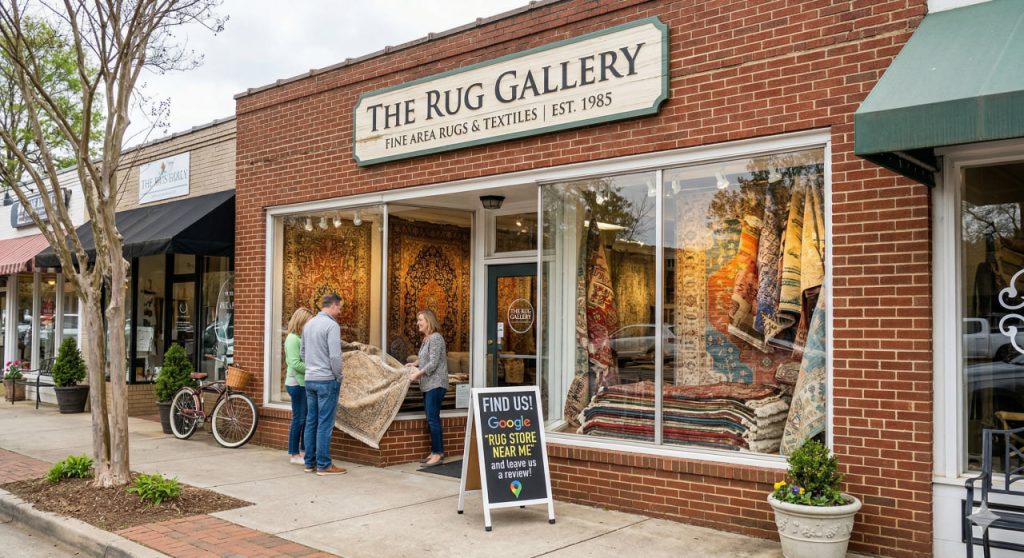
Here’s the thing most rug store owners I meet are leaving thousands on the table because they don’t understand how local search actually works. They’re focused on ranking for “Persian rugs” nationally when their neighbor down the street is capturing all the “rug store near me” traffic that drives real foot traffic.
I worked with a rug gallery in Charlotte last year who was pulling in maybe two walk-ins per week despite being in a high-traffic area. Three months after implementing proper local SEO, they’re averaging 15-20 qualified visitors daily. The difference? They understood that rug buying is intensely local.
Let me be direct: if you’re not showing up in the top three Google Business Profile results when someone searches “rug store near me” in your city, you’re invisible. And that’s a problem because that’s exactly how 78% of your potential customers start their rug shopping journey.
Why Proximity Search Dominates Rug Retail
Look, buying a rug isn’t like ordering a phone case online. People need to see the colors in their lighting. They want to feel the texture. They’re bringing paint samples and fabric swatches to compare.
That physical need creates a massive opportunity for local rug stores. But here’s what most retailers miss: Google’s proximity algorithm now prioritizes businesses based on three factors proximity, prominence, and relevance. Distance matters more than ever.
I’ve seen rug stores lose customers to competitors who are literally three blocks further away, simply because the competitor understood local search signals better. The customer searched “area rugs near me,” and Google showed them the store that optimized for that exact behavior.
Here’s the brutal truth: Rug customers who find you through “near me” searches convert 65% higher than those coming from generic searches. They’re ready to buy, they just need to find the right store.
Google Business Profile: Your Digital Storefront
Your Google Business Profile is more important than your website for local rug sales. I’m not exaggerating it’s often the first and only impression potential customers get.
Most rug store owners set up their profile once and forget about it. That’s a mistake that costs them daily. Here’s what actually moves the needle:
Category Selection That Matters:
- Primary: “Rug Store” (not “Home Decor Store”)
- Secondary: “Carpet Store,” “Interior Design Service,” “Home Goods Store”
- Avoid generic categories like “Retail Store” specificity wins
Your hours need to be obsessively accurate. I’ve watched customers drive to rug stores that showed open but were actually closed for inventory. Those people don’t come back.
Product photos are where most rug retailers completely fail. They post three blurry photos of their storefront and wonder why foot traffic is low. Customers need to see your actual inventory room settings with rugs in place, close-ups of textures, size comparisons with furniture.
For local visibility, you need comprehensive local optimization beyond just your Google profile.
Local Keyword Strategy for Rug Stores (Local Rug Store SEO)
Generic rug keywords are expensive and competitive. Local rug keywords? That’s where the profit lives.
Here’s the keyword hierarchy that actually drives rug store traffic:
| Search Intent | Keywords to Target | Content Needed |
|---|---|---|
| Immediate Purchase | “rug store near me,” “area rugs [city]” | Google Business Profile optimization |
| Product Research | “Persian rugs [city],” “wool rugs [neighborhood]” | Product category pages |
| Design Inspiration | “rug stores [city],” “custom rugs [area]” | Local design content |
Most rug store owners make the mistake of targeting “rugs” when they should be targeting “rug stores.” People searching “rugs” might be browsing Pinterest. People searching “rug stores” are looking for a place to shop.
Neighborhood-specific keywords are pure gold. “Rug store South End Charlotte” or “Persian rugs Dilworth” these hyper-local terms have lower competition but sky-high conversion rates.
I remember one client who was convinced they needed to rank for “Oriental rugs.” We shifted focus to “Oriental rug stores [their city]” and their organic traffic tripled in two months. The intent match was perfect.
Review Generation That Actually Works
Rug store reviews are different from restaurant reviews. Your customers aren’t impulse buyers they researched, visited, thought about it, then came back. That purchase cycle creates review opportunities most stores miss.
The magic moment for review requests isn’t at checkout. It’s 2-3 weeks after delivery, when the rug is in place and they’re loving how it transformed their room.
Review request sequence that works:
- Day of purchase: Thank them, confirm delivery timeline
- Day of delivery: “How was the delivery experience?”
- Two weeks post-delivery: “How does your new rug look in the space?” (with review request)
- One month later: “Would you recommend us to friends?” (referral + review)
Photos in reviews are everything for rug stores. Customers want to see how rugs look in real homes, not just on your showroom floor. Incentivize photo reviews with a small discount on their next purchase.
Responding to reviews shows you care about customer experience. But here’s what most rug retailers get wrong they respond to positive reviews with generic “thank you” messages. Instead, mention something specific about their purchase: “So glad the 9×12 Persian worked perfectly in your living room!”
Building strong local authority often requires specialized rug store SEO strategies that go beyond basic review management.
Local Content That Converts Browsers to Buyers
Content marketing for rug stores isn’t about SEO blog posts nobody reads. It’s about answering the specific questions your local customers ask every day.
The questions I hear most from rug store customers:
- “What size rug do I need for my living room?”
- “Will this rug work with my hardwood floors?”
- “How do I clean red wine out of wool?”
- “What’s the difference between hand-knotted and machine-made?”
Create local content that addresses these concerns with your city/neighborhood in mind. “Choosing Rug Sizes for Charlotte’s Historic Home Layouts” or “Best Rug Materials for Atlanta’s Humidity.”
Room inspiration content performs exceptionally well for local rug stores. Partner with local interior designers or photograph actual customer installations (with permission). People want to see how rugs look in spaces similar to theirs.
The musty smell of old wool rugs being cleaned improperly is something every rug store owner knows. Content about proper cleaning methods written from experience, not generic advice builds trust with local customers who’ve had bad experiences elsewhere.
Seasonal content works beautifully for rug retailers. “Preparing Your Persian Rugs for Charlotte’s Summer Humidity” or “Winter Rug Care in Denver’s Dry Climate” this hyper-local angle can’t be replicated by national competitors.
Technical Local SEO for Rug Retailers
Schema markup for rug stores is more important than most retailers realize. Local Business schema helps Google understand your hours, location, and services. But Product schema on individual rugs can help you show up in Google Shopping results locally.
Your NAP (Name, Address, Phone) consistency across the web needs to be obsessive. I’ve seen rug stores lose local rankings because they used “St.” on their website but “Street” on Yelp.
Site speed matters more for local search than national SEO. Mobile users looking for “rug store near me” are often deciding between multiple options quickly. If your site takes 4 seconds to load while your competitor’s takes 2, guess who gets the visit?
Local structured data should include:
- Store hours (including special holiday hours)
- Phone number that connects directly to your store
- Physical address (not a PO Box)
- Service areas if you deliver locally
- Payment methods accepted
Most rug stores need proper e-commerce site structure to support their local SEO efforts effectively.
Measuring Local SEO Success
Tracking local SEO for rug stores requires different metrics than national campaigns. Here’s what actually predicts revenue:
Google Business Profile Insights:
- “Customers who viewed your profile” (awareness)
- “Customers who visited your location” (foot traffic)
- “Customers who called” (high-intent leads)
- Photo views (product interest)
Google Search Console shows you which “near me” and local keywords are driving traffic. Filter by mobile traffic that’s your local audience.
Local rank tracking tools like Bright Local or White spark help you monitor positions for location-specific searches. But don’t obsess over rankings if calls and foot traffic are increasing.
The clicking sound of customers walking on hardwood floors as they move rugs around your showroom? That’s the real success metric. Everything else is just data that should lead to more of that sound.
Revenue attribution for local SEO:
Ask every customer how they found you. “Google search,” “Google Maps,” or “drove by” tells you whether your local SEO is working. Most rug purchases happen after multiple touchpoints, so track the customer journey.
Call tracking numbers on your Google Business Profile help you measure which local searches drive phone calls. For rug stores, phone calls often convert higher than form fills because customers have complex questions about sizing and materials.
Integration with local social media marketing amplifies your SEO efforts and provides additional tracking opportunities.
Real Results We’ve Delivered
I worked with a family-owned Persian rug gallery that had been operating for 20 years but was struggling with declining foot traffic. Despite their reputation and quality inventory, they were practically invisible online.
The Challenge: They were getting maybe 2-3 walk-ins per day, mostly from referrals. Their Google Business Profile had 12 reviews and showed up on page 2 for “rug store near me” searches.
Our Approach:
- Optimized Google Business Profile with professional photos of actual inventory
- Implemented strategic review generation system
- Created neighborhood-specific landing pages
- Developed local content targeting design questions
- Fixed technical SEO issues preventing local discovery
The Results in 90 Days:
- Daily foot traffic increased from 2-3 to 15-20 visitors
- Google Business Profile now shows in top 3 for local searches
- Review count grew from 12 to 67 (with photos)
- Weekend sales increased 340%
- “Near me” search traffic grew 580%
The owner told me the difference was immediately noticeable. “We went from wondering if we’d have to close to having our busiest year in a decade,” she said.
Key Success Factor: We focused on local intent rather than generic rug keywords. Instead of competing nationally for “Persian rugs,” we dominated locally for “Persian rug stores [their city]” and related searches.
Frequently Asked Questions
How can a local rug store improve its SEO?
Focus on Google Business Profile optimization first most rug customers start with “rug store near me” searches. Upload high-quality photos of your actual inventory, maintain accurate hours, and actively collect reviews. Then target neighborhood-specific keywords like “rug stores [your area]” rather than generic terms.
Why is my rug store not showing up for “rug store near me” searches?
Three common issues: incomplete Google Business Profile, inconsistent business information across the web, or wrong category selection. Make sure you’re listed as “Rug Store” not generic “Retail Store.” Also check that your NAP (name, address, phone) is identical everywhere online.
How important is Google Business Profile for rug retailers?
Critical. It’s often the first impression customers get and directly impacts local rankings. Rug buyers need to see your inventory, read reviews, and get directions. An optimized profile with photos, current hours, and active review management can increase foot traffic by 200-400%.
What keywords should a local rug shop target?
Target buyer-intent keywords like “rug store [city],” “area rugs [neighborhood],” and “[rug type] store near me.” Avoid generic “rugs” keywords people searching “rugs” might just be browsing. People searching “rug stores” are ready to shop.
How can a rug store get more local customers online?
Create content answering local customer questions (“What rug size for Charlotte’s historic homes?”), partner with local interior designers, and showcase customer installations from your area. Local customers want to see how rugs look in spaces similar to theirs, not generic showroom photos.
Key Takeaways
Look, local SEO for rug stores isn’t complicated, but it does require consistency. The rug retail industry is perfect for local dominance because your customers need to see and feel products before buying.
Start with these priorities:
- Claim and optimize your Google Business Profile completely
- Target neighborhood-specific keywords, not generic rug terms
- Generate reviews systematically, especially with photos
- Create local content that answers customer questions
- Track foot traffic and phone calls, not just rankings
Remember, you’re not competing with Wayfair or Overstock. You’re competing with the rug store three miles away for customers who want to touch before they buy.
At Danabak, we’ve helped dozens of rug retailers dominate their local markets through strategic SEO. The results speak for themselves increased foot traffic, higher-quality leads, and sustainable growth.
Ready to stop losing customers to competitors who simply show up higher in local search? Get in Touch Now! Call us at (980) 333-3770 and let’s discuss how to make your rug store the obvious choice for local customers.
[dcp_cta_banner style=”inline”]
[dcp_author_box id=”1″]
[dcp_related_posts]
[dcp_feedback]